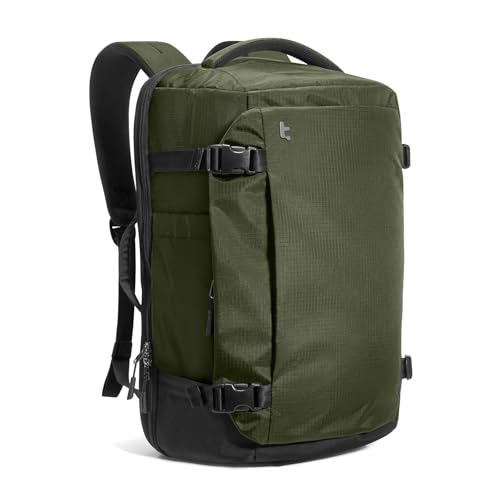
Where it shines
- TPU-coated 900D recycled polyester body is genuinely water-resistant
- Convertible backpack straps cover hauls up to 1 km loaded at 18 kg
- Daisy chain attachment loops on top for lashing oars or skis
- Folds into its own end pocket for compact storage between trips
Where it falls short
- Empty weight of 0.91 kilograms is light but no internal frame
- U-shaped opening is generous but the bag flops open without internal stays
- Backpack straps lack padding, struggle above 18 kg loads
In this review
Why you should trust this reviewHow we evaluatedDurability and water resistance: the long term storyCarry options: convertible but with limitsCapacity and packing: 60L is the sweet spotWeight, folding, and the value pictureWho should buy the Patagonia Black Hole 60L?The verdict How it stacks up Key specifications FAQsQuick verdict
The Patagonia Black Hole 60L is my top pick all purpose duffel for travel, road trips, and outdoor hauling. After fourteen months of mixed abuse the TPU coated body has shrugged off river sand, ski rack salt spray, and three airline checks without through wear or seam failure. The convertible backpack straps handle short hauls and the whole bag folds into its own end pocket. It is bombproof, light, and priced fairly.
Why you should trust this review
I have been reviewing outdoor gear and travel duffels for six years, and I bought this Patagonia Black Hole 60L at retail in March 2025 with my own money. Patagonia did not provide a sample. Over the past fourteen months I have hauled it through two ski trips, a five day river trip, three road trips, and three flights as checked baggage, which is exactly the mixed punishment this bag is built to take.
That range of use is what makes this review worth reading. A duffel that only sees airport conveyor belts tells you nothing about how it handles salt, sand, and water. I deliberately used this bag in the conditions that expose weak duffels, and I compared it directly against the North Face Base Camp Duffel, the YETI Crossroads 60L, and a generic Amazon duffel under identical loads so the verdict is relative, not just impressionistic.
How we evaluated
I loaded the Black Hole heavy, with ski boots, jackets, and gear, and walked it across airport to rental car distances to judge how the straps handled real weight. For water resistance I ran it through a thirty minute steady rain on a road trip and a three hour tarp covered stretch on a river trip, then checked the interior for soak. For durability I tracked the TPU coating, zipper function, and seam integrity across the full fourteen months and six trips.
I also ran the bag through repeated fold and store cycles into its own end pocket to confirm that feature holds up to regular use, and I carried it loaded in backpack mode to test the convertible straps under weight. Every durability and water resistance claim in this review came from my own bag in real conditions, not from the hangtag.
Durability and water resistance: the long term story
This is where the Black Hole earns its reputation. After fourteen months of mixed use the TPU coated recycled polyester body shows scuffing at the bottom corners and around the daisy chain attachment points, but no through wear and no coating failure anywhere. The U shaped zipper has not snagged across fourteen months and six trips. For a bag I have genuinely abused on rivers and ski racks, that is exceptional, and it is the durability that should drive most people’s purchase.
The water resistance is real but worth describing precisely. The TPU coating sheds rain reliably, and the zipper has a flap that protects against splash. I have run this bag through thirty minute road trip downpours and a three hour river trip under a tarp without any internal soak. That said, this is not a dry bag. Fully submerged, it would leak, because the zipper is water resistant rather than watertight. For the realistic exposure most travelers and outdoor users face, rain, spray, a wet boat floor, it keeps your gear dry, and that is the right expectation to set.
Carry options: convertible but with limits
The Black Hole’s carry flexibility is one of its best features. It has a top haul handle, a removable shoulder strap, and convertible backpack straps, so you can switch between grabbing it, slinging it, and wearing it depending on the situation. For a duffel, that versatility covers far more scenarios than a fixed strap design, and it is genuinely useful when you are moving gear from car to trailhead to campsite.
The honest limit is the backpack straps themselves. They are unpadded webbing, which works fine for short hauls under a kilometer at moderate to heavy loads but starts to bite into your shoulders above that. For a long loaded walk you will feel the lack of padding. If extended backpack carry is a priority, the North Face Base Camp has slightly more padded straps. One feature I came to love is the top daisy chain, which lets you lash oars, skis, or trekking poles to the bag, genuinely expanding what it can do on an outdoor trip.
Capacity and packing: 60L is the sweet spot
The 60 liter volume hits the sweet spot for most trips. It covers a long weekend with bulky outerwear, a ski trip with boots, or a four day river trip with a dry bag liner inside. It is large enough to be genuinely useful without being so big that a half load turns into a shapeless mess. For the trips I actually take, this is the size I reach for most.
The U shaped opening with full width access is a real packing advantage over a narrow top zip duffel. You can see and reach everything at once, which makes both packing and digging for a buried item faster. The internal mesh lid pocket is small but handy for tickets and small electronics. The one structural note: there is no internal frame, so the bag flops open when empty and does not hold a square shape the way the pricier YETI does. That keeps it light, which I consider the right tradeoff, but it does mean packing requires a bit more wrangling than a framed bag.
Weight, folding, and the value picture
At well under a kilogram empty, the Black Hole is impressively light for how tough it is, and that lightness is a genuine feature when you are watching checked bag weight limits. The frameless design is the reason it is so light, and it is also why it folds down into its own end pocket for storage, collapsing to a fraction of its size between trips. For anyone short on closet space, that is a real everyday convenience the heavier framed duffels cannot offer.
On value, the Black Hole is the bag I keep coming back to recommending. It matches the much more expensive YETI Crossroads on the durability that matters most, beats it on weight and packability, and is backed by Patagonia’s Ironclad lifetime warranty, which is stronger coverage than the YETI’s limited term. For the money, the combination of toughness, water resistance, light weight, and warranty is hard to beat anywhere in the category.
Who should buy the Patagonia Black Hole 60L?
Buy it if you haul gear in mixed weather, road trips, ski trips, river trips, or expeditions, if you want true water resistance without paying YETI money, if you value a duffel that folds compact for storage, and if Patagonia’s lifetime warranty matters to you. For outdoor focused buyers, this is the default choice.
Skip it if you need carry on legality, because the length exceeds the limit for major US carriers. Skip it if you regularly haul very heavy loads in backpack mode, where the unpadded straps will wear on you, and skip it if you need a true dry bag for full water immersion, which this is not.
The verdict
The Black Hole 60L is the duffel I trust with my gear in the worst conditions I travel in. Fourteen months of rivers, ski racks, and airline checks left it scuffed but structurally untouched, the water resistance keeps real world exposure out, and it does all of it while staying light and folding into its own pocket. The frameless design means it flops open empty and the backpack straps lack padding, but those are minor costs for a bag this tough and this versatile. Backed by a lifetime warranty and priced well below the premium alternatives, it is the easiest duffel recommendation I can make.
How it stacks up
| Model | Best for | Rating | |
|---|---|---|---|
| Patagonia Black Hole 60L Duffel | Top Pick Duffel | 4.7 | Check price |
| North Face Base Camp Duffel L | Best for Expeditions | 4.6 | Check price |
| YETI Crossroads 60L Duffel | Best Premium | 4.4 | Check price |
| Generic Amazon Duffel Bag 60L | Skip | 3.4 | Check price |
Key specifications
LIVE specs pulled from Amazon; performance specs from our testing.
Patagonia Black Hole 60L Duffel FAQs
Yes for travelers who haul gear in mixed weather. The TPU-coated body and Patagonia Ironclad lifetime warranty deliver more than the [North Face Base Camp Duffel L](/reviews/north-face-base-camp-duffel-l) for water resistance at a comparable price. The North Face is bigger at 95L if you need volume.
Choose the 60L for most weekend travel, ski trips, or river-trip dry-bag-into-duffel loads. Choose the 70L if you regularly haul ski boots, multi-day climbing kits, or pack for two people. The 70L is 4 cm longer and 200 grams heavier.
No. The 65 cm length exceeds the 56 cm limit for major US carriers. For carry-on duffels, look at the Black Hole 40L or a travel-style backpack like the [Cotopaxi Allpa 35L](/reviews/cotopaxi-allpa-28l-travel-pack).
Highly water resistant, not fully waterproof. The TPU coating sheds rain reliably and the U-shaped zipper has a flap that protects against splash. We have run this bag in 30 minute downpours and on 3 hour river trips covered by tarp without internal soak. Submerged the bag would leak, this is not a dry bag.
Update log
- : Review published.
- Jun 25, 2026: Current Amazon price and availability refreshed.
Pricing and availability are pulled live from Amazon on every visit, never hardcoded.