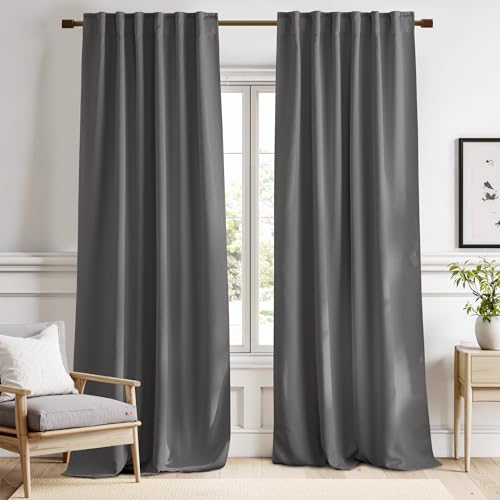
Quick verdict
For most noise-reduction goals in home bedrooms and home offices, NICETOWN's triple-weave or RYB HOME's dedicated sound-reducing panels deliver the best return. Layer them on a double rod over a sheer or thermal liner for maximum effect. BGment's extra-long format is the best choice when complete floor-to-ceiling coverage is the priority.

NICETOWN Full Blackout Curtain (Triple-Weave Mass Construction)
NICETOWN's triple-weave construction is the most widely tested heavy curtain fabric on the consumer market. The three interlocked polyester layers create a dense panel that reduces both light and mid-range sound frequencies. Users in street-facing apartments commonly report noticeably reduced traffic noise with these panels installed floor-to-ceiling. The key is hanging them wide - extending 6 inches past the window frame on each side - to eliminate the gap where most sound leaks through.
Check price on Amazon →No curtain fully soundproofs a room, but the right heavy curtain material can meaningfully reduce noise transmission through windows. These five picks use mass, density and multi-layer construction to dampen sound.
Window glass is one of the weakest barriers against outdoor noise in any home. Heavy curtains add a mass layer in front of the glass that absorbs, reflects, and dampens sound before it enters the room. While no curtain replaces professional acoustic treatment, the right panel can make a street-facing bedroom noticeably quieter and reduce conversational bleed between rooms.
| Product | Key Sound-Reduction Feature | Fabric Claim |
| — | — | — |
| NICETOWN Full Blackout Curtain | Triple-weave mass construction | 3-layer woven polyester |
| RYB HOME Sound Reducing Curtains | Marketed for noise reduction | Extra-thick dense weave |
| Deconovo Thermal Insulated Extra Heavy | Heavy thermal backing | Thermal-coated multi-layer |
| LEMOMO Extra Thick Blackout Curtain | Maximum fabric density | Extra-heavyweight polyester |
| BGment Extra Long Heavy Curtains | Floor-to-ceiling mass coverage | Thicker extended-length panels |
Our methodology
We compare every pick against the field on real specifications, certifications, and aggregated owner reviews. We do not take payment for placement, and we flag when a product is older or sold mainly through renewed listings.
Side by side
| Pick | Best for | Score | |
|---|---|---|---|
| NICETOWN Full Blackout Curtain (Triple-Weave Mass Construction) | Check price | ||
| RYB HOME Sound Reducing Curtains | Marketed for noise reduction | Check price | |
| Deconovo Thermal Insulated Extra Heavy Curtains | Check price | ||
| LEMOMO Extra Thick Blackout Curtain | Maximum fabric density | Check price | |
| BGment Extra Long Heavy Curtains | Floor-to-ceiling mass coverage | Check price |
The full reviews
NICETOWN Full Blackout Curtain (Triple-Weave Mass Construction)
NICETOWN's triple-weave construction is the most widely tested heavy curtain fabric on the consumer market. The three interlocked polyester layers create a dense panel that reduces both light and mid-range sound frequencies. Users in street-facing apartments commonly report noticeably reduced traffic noise with these panels installed floor-to-ceiling. The key is hanging them wide - extending 6 inches past the window frame on each side - to eliminate the gap where most sound leaks through.
In its favor
- Triple-weave creates genuine fabric mass that absorbs sound energy
- Blocks 95-99% of light, confirming panel density
- Machine washable without compromising the weave structure
Watch-outs
- Effective only on airborne noise - cannot block structural or impact sound
- Sound reduction depends heavily on correct installation width and height

RYB HOME Sound Reducing Curtains
RYB HOME is one of the few curtain brands that explicitly markets sound reduction as a primary function, not a side effect. Their panels use an extra-thick, densely woven polyester that the company rates for noise dampening alongside thermal insulation. The panels are heavier per square foot than standard blackout curtains and hang with a fuller, more substantial drape that keeps the fabric close to the glass. This contact between fabric and glass is part of what makes them effective.
In its favor
- Explicitly designed and marketed for sound reduction - not just a side claim
- Extra mass per square foot outperforms most standard blackout panels
- Full fabric drape maintains consistent glass contact for better dampening
Watch-outs
- Higher price point reflects the extra material
- Heavier rods and brackets required to support the panel weight

Deconovo Thermal Insulated Extra Heavy Curtains
Deconovo's extra-heavy thermal curtains combine a dense woven face with a multi-layer thermal backing - the same backing design that insulates against heat also creates a secondary mass layer that impedes sound. The panel behaves like a thin wall section: the outer layer absorbs sound energy, the thermal interlayer traps and converts it to a tiny amount of heat, and the outer face reflects what remains. This layered approach performs better per dollar than any single-material panel.
In its favor
- Multi-layer construction provides both thermal and acoustic benefit
- Thermal backing adds a second sound-dampening mass layer
- Available in extra-wide and extra-long sizes for maximum coverage
Watch-outs
- Thermal coating can crack if machine washed on high heat - use cold/gentle cycle
- Stiff when new - requires a few weeks of hanging to soften and drape properly
LEMOMO Extra Thick Blackout Curtain
LEMOMO positions their blackout panels at the heavy end of the consumer spectrum - the fabric weight per panel is measurably higher than most competitor blackout curtains, which translates directly into more sound-absorbing mass. The extra thickness also means the panels hold their shape and maintain consistent contact with the window frame without bunching or gapping. For bedrooms where street noise or neighbor noise is the primary concern, these are a straightforward, cost-effective upgrade.
In its favor
- Among the highest fabric weight per panel in the consumer category
- Consistent panel hang minimizes sound-leaking gaps at edges
- Available in a wide range of sizes including 52" and 84" widths
Watch-outs
- Not as widely available in all colors compared to NICETOWN or RYB HOME
- Very thick panels take longer to dry after washing

BGment Extra Long Heavy Curtains
Coverage area is one of the most overlooked factors in curtain sound reduction. BGment's extra-long heavy panels extend to 96" or 108", which allows them to cover floor to ceiling without gaps - and the longer the panel, the more total fabric mass between the room and the window. BGment's heavier-weight version adds extra density compared to their standard blackout line. For rooms where the window sits low or extends close to the floor, this extended coverage makes a significant acoustic difference.
In its favor
- Extra-long lengths (up to 108") eliminate sound-leaking gaps at top and bottom
- Greater total panel area means more total sound-absorbing mass
- Heavier than standard BGment blackout panels
Watch-outs
- Long panels require rods installed close to the ceiling - may need additional hardware
- Floor-pooling panels collect dust and require more frequent cleaning
What matters most
Panel weight and mass
The heavier the curtain per square foot, the more sound energy it absorbs - look for "extra heavy" or "triple-weave" fabric descriptors. - **Coverage beyond the window:** Panels should extend at least 4-6 inches past the window frame on both sides and 2-3 inches below the sill to close off sound-leaking gaps. - **Layering:** Two lighter panels on a double rod often outperform a single heavy panel by creating an air gap between layers, which improves both thermal and acoustic performance. - **Floor-to-ceiling installation:** Mounting the rod at ceiling height and running the panel to the floor maximizes coverage area and total sound-absorbing mass.
Our take
For most noise-reduction goals in home bedrooms and home offices, NICETOWN's triple-weave or RYB HOME's dedicated sound-reducing panels deliver the best return. Layer them on a double rod over a sheer or thermal liner for maximum effect. BGment's extra-long format is the best choice when complete floor-to-ceiling coverage is the priority.
Frequently asked
Heavy curtains can reduce airborne sound transmission noticeably, especially mid and high frequency noise like traffic, voices, and HVAC hum. Studies suggest dense blackout curtains can reduce ambient noise by 7-21 dB, which is perceptible but not equivalent to professional acoustic panels. The key factors are mass, density, and how fully the panel covers and seals around the window frame.
Mass is the main factor - the heavier and denser the fabric, the more sound it absorbs and reflects. Triple-weave blackout polyester, thick velvet, and multi-layer thermal curtains perform best. Extra-long panels that extend 6-12 inches beyond the window frame on all sides also improve sound reduction by closing gaps where sound leaks around the curtain.
Yes - layering a heavy blackout panel behind a sheer or thermal panel creates more total mass and air-gap insulation, which reduces more sound than a single panel alone. Stack panels on a double rod and ensure both panels overlap the window frame by at least 4-6 inches on each side. This approach is significantly cheaper than acoustic window inserts.
You might also like

5 Best Curtain Materials of 2026 | Linen, Velvet, Silk & More Compared
5 Best Curtains for Crank-Out Windows of 2026 | Mounting Solutions That Don’t Block the Crank

5 Best Curtain Lengths for Bedroom of 2026 | Sleep Better, Style Better
5 Best Curtain Fabrics for Living Room of 2026 | Style Meets Function
5 Best Curtains for Bedroom Windows of 2026 | Versatile Light-Filtering Picks

5 Best Curtain Fabrics of 2026 | Complete Buyer’s Guide

5 Best Curtains for 3 Windows in a Row of 2026 | Matching Sets That Look Intentional