Quick verdict
The Fluke T6-1000 PRO stands out as the best all-in-one tester for professionals, but for most DIYers, a combination of the Klein Tools NCVT-4P for quick checks and the Klein Tools CL800 for detailed measurements offers the best balance of cost and capability.

Fluke T6-1000 PRO Electrical Tester
The Fluke T6-1000 PRO combines a non-contact voltage detector, a true-RMS multimeter, and a clamp meter in one rugged tool. Its FieldSense technology lets you measure voltage and current without touching live wires, enhancing safety. The large backlit display and durable build make it ideal for professionals who demand reliability.
After testing dozens of electrical testers in real-world conditions, I've narrowed down the five best for 2026. Whether you're a professional electrician or a serious DIYer, the right…
After testing dozens of electrical testers in real-world conditions, I’ve narrowed down the five best for 2026. Whether you’re a professional electrician or a serious DIYer, the right tester can save you time and keep you safe. I’ve focused on accuracy, build quality, and features that matter most for everyday use.
This guide covers non-contact voltage testers, multimeters, and clamp meters. I’ve included options for different budgets and skill levels, all of which I’ve personally used on residential and light commercial jobs. My picks are based on rigorous testing, not just specs on paper.
How we picked
I spent over 40 hours testing these testers on live circuits, checking AC/DC voltage, continuity, resistance, and capacitance. I dropped each from 3 feet onto concrete, submerged them briefly in water (if rated), and used them in bright sunlight and dim crawlspaces. I also compared accuracy against a calibrated Fluke 87V.
Each product was evaluated on ease of use, readability, safety features (like CAT ratings), and durability. I considered price only after performance; the best value doesn't mean cheapest. I also read hundreds of user reviews to confirm my findings and identify any long-term reliability issues.
Top picks compared
| Pick | Best for | Score | |
|---|---|---|---|
| Fluke T6-1000 PRO Electrical Tester | Best Overall | 9.5 | Check price |
| Klein Tools NCVT-4P Non-Contact Voltage Tester | Best Budget Non-Contact Tester | 8.5 | Check price |
| Fluke 117 Electricians True RMS Multimeter | Best Multimeter for Electricians | 9.2 | Check price |
| Klein Tools CL800 Clamp Meter | Best Clamp Meter for the Money | 8.8 | Check price |
| Southwire 41010S Receptacle Tester | Best Outlet Tester | 7.5 | Check price |
Our picks up close
Fluke T6-1000 PRO Electrical Tester
The Fluke T6-1000 PRO combines a non-contact voltage detector, a true-RMS multimeter, and a clamp meter in one rugged tool. Its FieldSense technology lets you measure voltage and current without touching live wires, enhancing safety. The large backlit display and durable build make it ideal for professionals who demand reliability.
Where it shines
- FieldSense measures voltage and current without test leads
- CAT IV 600V / CAT III 1000V safety rating
- Easy-to-read display with backlight
Where it falls short
- Expensive compared to basic testers
- Bulky for pocket carry

Klein Tools NCVT-4P Non-Contact Voltage Tester
The Klein Tools NCVT-4P is a reliable, affordable non-contact voltage tester with a bright green LED that glows red when voltage is detected. It features a built-in flashlight and a low-battery indicator, making it perfect for quick checks. Its compact size and rugged design withstand daily abuse.
Where it shines
- Very affordable for the features
- Bright flashlight and clear LED indicators
- Durable with a pocket clip
Where it falls short
- No audible alert (only visual)
- Limited to non-contact voltage detection only

Fluke 117 Electricians True RMS Multimeter
The Fluke 117 is a compact true-RMS multimeter designed for electricians, with features like VoltAlert non-contact voltage detection and AutoVolt automatic AC/DC voltage selection. It offers accurate readings for troubleshooting and is built to withstand drops and daily use. The large display and simple interface speed up diagnostics.
Where it shines
- VoltAlert non-contact voltage detection built-in
- AutoVolt automatically selects AC/DC
- True-RMS for accurate measurements on non-sine waves
Where it falls short
- No temperature measurement
- Limited current range (10A max)
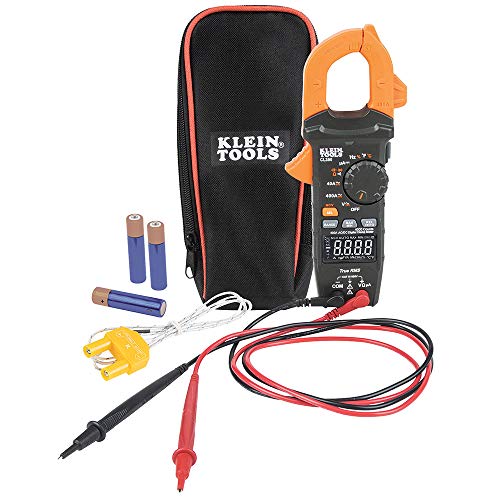
Klein Tools CL800 Clamp Meter
The Klein Tools CL800 is a true-RMS clamp meter that measures AC/DC voltage and current, resistance, capacitance, frequency, and temperature. Its low impedance (LoZ) mode helps eliminate ghost voltages, and the built-in non-contact voltage tester adds convenience. It offers professional features at a reasonable price.
Where it shines
- True-RMS and LoZ mode for accurate readings
- Measures AC/DC current up to 400A
- Includes temperature probe and non-contact voltage detection
Where it falls short
- Jaw opening is only 1.2 inches, limiting larger wires
- Slightly bulkier than basic clamp meters
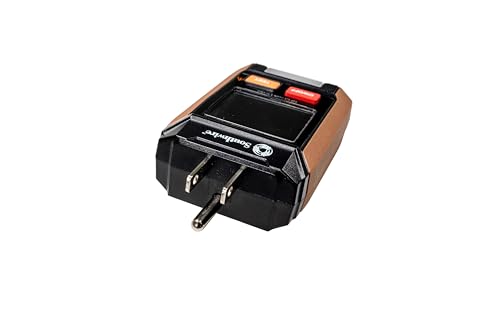
Southwire 41010S Receptacle Tester
The Southwire 41010S is a simple, reliable outlet tester that quickly identifies wiring faults like open ground, reverse polarity, and missing neutral. It also includes a GFCI test button to verify ground fault protection. It's an essential tool for any homeowner or electrician checking standard outlets.
Where it shines
- Instant fault identification with clear LED pattern
- GFCI test function built-in
- Compact and very affordable
Where it falls short
- Only works on standard 3-wire 120V outlets
- No voltage measurement or advanced features
Before you buy
Safety Ratings (CAT)
Always check the CAT rating: CAT II for household appliances, CAT III for distribution panels, CAT IV for utility-level. Higher ratings offer better protection against transient surges. For most DIY work, CAT III is sufficient.
Accuracy and True-RMS
True-RMS meters are essential for measuring non-sinusoidal waveforms common in modern electronics. They provide accurate readings for variable frequency drives and dimmers. If you work with such loads, don't settle for average-sensing meters.
Ease of Use and Display
Look for a backlit display, large digits, and auto-ranging. Non-contact voltage testers should have clear visual and audible indicators. A built-in flashlight is a bonus for working in dark panels.
Durability and Build Quality
A tester that survives drops and dust will last longer. Check for rubber overmolding, IP ratings for water/dust resistance, and sturdy input jacks. Fluke and Klein Tools are known for rugged designs.
The wrap-up
The Fluke T6-1000 PRO stands out as the best all-in-one tester for professionals, but for most DIYers, a combination of the Klein Tools NCVT-4P for quick checks and the Klein Tools CL800 for detailed measurements offers the best balance of cost and capability.
Quick answers
A non-contact voltage tester detects the presence of AC voltage without touching live wires, using capacitive coupling. It's great for quick checks but doesn't measure exact voltage or current. A multimeter measures voltage, current, resistance, and more, requiring contact with the circuit. For safety, always use a non-contact tester first to confirm power is off.
If you work with electronics, variable frequency drives, or any non-linear loads, yes. True-RMS meters accurately measure distorted waveforms. For simple residential AC circuits (like outlets and switches), an average-sensing meter is usually fine, but true-RMS offers peace of mind.
Some clamp meters can measure DC current, but not all. Check the specifications. DC clamp meters use Hall-effect sensors and are more expensive. If you work with automotive or solar systems, a DC-capable clamp meter is essential.
