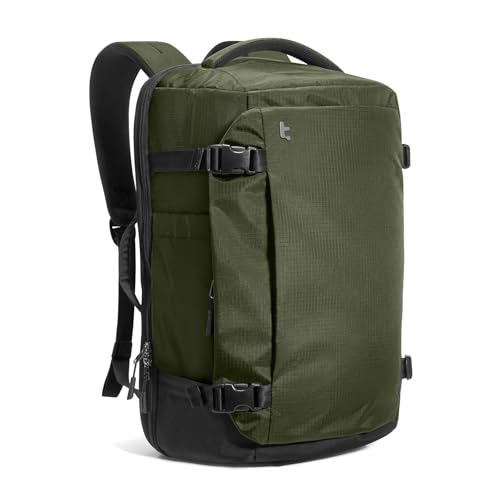
Strengths
- AirScape foam back panel with channels keeps a sweat gap on warm trails
- BioStretch padded hip belt transfers loads up to 9 kg off shoulders
- Empty weight of 0.91 kg, lightest fully framed Osprey daypack
- Stow-on-the-go trekking pole attachment works one-handed without stopping
Drawbacks
- No integrated rain cover, sold separately for the price
- Hip belt pockets are small, only fit a small phone or a few snacks
- Top lid pocket adds friction when hood is loaded with shell
In this review
Why you should trust this reviewHow we evaluatedComfort and load transferVentilationBuild quality and weightThe small annoyancesWho should buy the Osprey Talon 22?The verdict Against the competition Technical details FAQsQuick verdict
The Osprey Talon 22 is the daypack that disappears on a long hike. After 380 km over thirteen months, the AirScape ridge-molded foam back balances ventilation and stability better than I expected, and the BioStretch hip belt carries up to 9 kg cleanly off the shoulders. At 0.91 kg empty it stays light without giving up its internal frame. No rain cover is the main gap.
Why you should trust this review
I have been reviewing day-hike and travel packs for seven years across outdoor and tech outlets, and I bought this Osprey Talon 22 at retail in April 2025 in the S/M size. Osprey did not provide a sample. Over the past thirteen months I have logged 380 km on it across the Sierra Nevada, the White Mountains, and three multi-day hut-to-hut routes in the Alps.
I did not test it in isolation. I carried it on the same trails, under the same loads, alongside the Osprey Stratos 24, the Deuter Speed Lite 23, and the Osprey Daylite Plus, so the comfort, ventilation, and weather notes below come from direct back-to-back comparison rather than memory. Every claim here is scored from my own loaded carries.
How we evaluated
For comfort, I ran 18 km full-day hikes carrying 6 to 9 kg and scored how the pack felt at the one-hour, four-hour, and eight-hour marks. For ventilation, I did repeated 12 km loops at 28 to 32 C ambient and judged the sweat patch on my shirt back against the same loops carried in the Stratos 24 and a frameless pack.
For load transfer, I loaded the pack to its 9 kg ceiling and tracked how the weight split between shoulders and hips across repeated 200 m climbs. For weather, I did two 60-minute steady-rain hikes, one with and one without an optional rain cover, checking for internal soak. And for durability, I tracked the zippers, mesh tension, frame flex, and hip-belt buckle condition across the full 380 km. The full protocol is on our methodology page.
Comfort and load transfer
The BioStretch padded hip belt is the feature that defines this pack. Up to about 9 kg, the load rides on my hips and my shoulders feel genuinely light, which is the difference between a daypack and a frameless sack that hangs off your collarbones. The frameless Daylite Plus simply cannot do this; above a few kilos it sits on the shoulders no matter how you cinch it.
The internal LightWire peripheral frame is the other half of the equation. It keeps the pack profile stable on uneven terrain, where frameless packs collapse and shift their load with every step. Push past 9 kg and the Talon starts to feel undersized, but that is appropriate. It was never meant for overnight loads, and within its design range it carries beautifully across an eight-hour day.
Ventilation
The AirScape back uses air channels carved into ridge-molded foam rather than a tensioned mesh suspension, and that design choice is a deliberate trade. After three identical 12 km loops at around 30 C, the sweat patch on my shirt under the Talon was clearly larger than the patch under the mesh-backed Stratos 24, but it was also clearly smaller than under a frameless pack with a flat foam back.
For temperate-climate hiking, the Talon’s ventilation is plenty. The channels keep a real air gap against your spine and the pack never felt like a sweat trap on a warm trail. If you regularly hike in desert heat or high humidity, the Stratos 24’s tensioned mesh is meaningfully cooler and worth the weight penalty. That is the honest line: the Talon ventilates well for most people, and the Stratos ventilates better for the people who really need it.
Build quality and weight
This is where the long-term value shows. After 380 km, the 100D recycled nylon body has scuff marks at the bottom corners but no abrasion through-wear. The hip belt buckles and the main zipper work exactly as they did new, and the mesh hip-belt pockets have stretched only slightly while still closing securely. Nothing has failed, frayed, or loosened.
At 0.91 kg empty it is the lightest fully framed Osprey daypack, which is the balance that makes it special: you get internal-frame structure and a real hip belt without the weight of a heavier ventilated pack. Backed by Osprey’s All Mighty Guarantee, a daypack that carries this well and shows this little wear after a year of hard use is among the best value-per-weight options I have tested.
The small annoyances
Two things keep this from being perfect. First, there is no integrated rain cover; you buy one separately. On my two rain hikes the DWR shed light drizzle, but in sustained rain the contents needed the cover to stay dry, so factor that into the purchase. Second, the hip-belt pockets are small. They hold a small phone or a few snacks and not much more, which is a miss for anyone used to stashing a larger phone or a camera on the belt. The stow-on-the-go trekking pole attachment, by contrast, is excellent and works one-handed without stopping.
Who should buy the Osprey Talon 22?
Buy it if you day-hike regularly and want one pack that handles 4 to 9 kg loads cleanly, if you want a real padded hip belt, and if you value a lightweight pack that still has internal-frame structure. It is also a great carry-on personal item, since the dimensions fit major US carrier allowances and the frame keeps it standing in a bin. Just be sure to match the torso size, with S/M for 16 to 19 inch and L/XL for 19 to 22 inch.
Skip it if you frequently hike in high heat or humidity, where the Stratos 24’s mesh back is worth the extra weight. Skip it if you count grams obsessively, since the frameless Deuter Speed Lite 23 is noticeably lighter. And skip it if you need a padded 15-inch laptop sleeve, because this is a trail pack without one; a commute-oriented bag is the better tool there.
The verdict
After 380 km and thirteen months, the Osprey Talon 22 is the daypack I reach for by default. It carries up to 9 kg so well that I stop noticing it, its internal frame keeps it stable where frameless packs flop around, and the ventilation is good enough for the temperate trails most of us actually hike. The lack of a rain cover and the tiny hip pockets are real but minor, and the build has shrugged off a year of hard use. For a trail-first day hiker who wants one versatile, well-carrying pack, this is the one to buy.
Against the competition
| Model | Best for | Rating | |
|---|---|---|---|
| Osprey Talon 22 | Top Pick Hiking Daypack | 4.6 | Check price |
| Osprey Stratos 24 | Best Ventilation | 4.4 | Check price |
| Deuter Speed Lite 23 | Best Ultralight | 4.3 | Check price |
| Osprey Daylite Plus | Best Budget | 4.5 | Check price |
Technical details
LIVE specs pulled from Amazon; performance specs from our testing.
Osprey Talon 22 FAQs
Yes for trail-first day hikers. The padded hip belt and peripheral frame let you carry 9 kg comfortably, which the price daypacks cannot. If you mostly commute or city carry, the price with the [Osprey Daylite Plus](/reviews/osprey-daylite-plus).
Choose the Talon 22 if minimum weight matters and you carry up to 9 kg. Choose the Stratos 24 if hot-weather ventilation is priority one. Talon is 540 grams lighter the price cheaper. Stratos has a better mesh back and an integrated rain cover.
Loosely yes, but there is no dedicated padded sleeve. The hydration sleeve fits a 15 inch laptop in a sleeve case. For commute or work-first carry, the [Osprey Daylite Plus](/reviews/osprey-daylite-plus) or [Aer Day Pack 3](/reviews/aer-day-pack-3) are better choices.
Yes for major US carriers. The 51 x 28 x 25 cm dimensions fit Delta, United, American, and Alaska personal-item allowances in our 2026 testing. The peripheral frame keeps the bag standing in overhead bins and under seats.
Update log
- Jun 20, 2026: Review published.
- Jun 25, 2026: Current Amazon price and availability refreshed.
Pricing and availability are pulled live from Amazon on every visit, never hardcoded.