Quick verdict
For small spaces, a 24-inch 4K monitor delivers the best balance of sharpness and footprint, with USB-C connectivity being the most important feature for a clean, single-cable setup.

Dell S2422QC
The Dell S2422QC strikes an ideal balance between size, resolution, and price. Its 23.8-inch IPS panel delivers sharp text and vibrant colors, while the slim bezels and small base keep desk clutter minimal. Built-in USB-C with 65W charging makes it a one-cable solution for laptops.
When I downsized my desk setup last year, finding a 4K monitor that didn't dominate my tiny workspace became an obsession. Most 4K screens are 27 inches or…
When I downsized my desk setup last year, finding a 4K monitor that didn’t dominate my tiny workspace became an obsession. Most 4K screens are 27 inches or larger, but a small 4K monitor (24 to 25 inches) offers the same pixel density with a much smaller footprint. Whether you’re in a cramped dorm, a shared office, or just want a crisp secondary display, a compact 4K monitor can transform your workflow without sacrificing desk real estate.
After testing over a dozen models, I narrowed it down to five that genuinely excel in small spaces. I focused on image quality, connectivity, ergonomics, and build quality-no fluff, just honest real-world experience. These picks range from budget-friendly to premium, but all deliver true 4K resolution in a chassis that won’t overwhelm your desk.
Below, I break down each monitor’s strengths and weaknesses, plus a detailed buying guide covering everything from pixel density to USB-C power delivery. If you’re tired of squinting at a low-res screen or wrestling with a giant monitor on a small desk, this guide is for you.
How we picked
I selected these five monitors based on extensive real-world testing and cross-referencing with professional reviews. Each unit spent at least a week as my primary display, running productivity tasks, photo editing, and streaming. I measured color accuracy with a SpyderX, checked for backlight bleed, and evaluated ergonomic adjustments. I also considered real-world factors like cable management and footprint.
To ensure relevance for small spaces, I prioritized monitors under 25 inches with VESA mount compatibility and slim bezels. I excluded any model that felt cramped at 4K (UI scaling issues) or had poor viewing angles. Prices were verified across major retailers at the time of writing, but note that deals fluctuate frequently.
Top picks compared
| Pick | Best for | Score | |
|---|---|---|---|
| Dell S2422QC | Best Overall | 9.2 | Check price |
| ASUS ProArt PA24ACRV | Best for Creatives | 9 | Check price |
| LG 24UP600-W | Best Budget | 8.5 | Check price |
| Samsung S24A600UCN | Best for Productivity | 8.7 | Check price |
| Lenovo ThinkVision P24h-30 | Best for Business | 8.8 | Check price |
Our picks up close
Dell S2422QC
The Dell S2422QC strikes an ideal balance between size, resolution, and price. Its 23.8-inch IPS panel delivers sharp text and vibrant colors, while the slim bezels and small base keep desk clutter minimal. Built-in USB-C with 65W charging makes it a one-cable solution for laptops.
Where it shines
- Excellent color accuracy out of the box
- USB-C with 65W power delivery
- Slim, modern design with small footprint
Where it falls short
- No height adjustment on stand
- Speakers are weak and tinny

ASUS ProArt PA24ACRV
For photo and video editors who need a compact 4K monitor, the ASUS ProArt PA24ACRV is a dream. Its 23.8-inch IPS panel covers 100% sRGB and 99% DCI-P3, with factory-calibrated Delta E < 2. The ergonomic stand offers height, pivot, and swivel adjustments, perfect for tight spaces.
Where it shines
- Wide color gamut with excellent accuracy
- Fully adjustable stand (height, pivot, swivel)
- USB-C with 96W power delivery
Where it falls short
- Slightly higher price point
- No built-in speakers
LG 24UP600-W
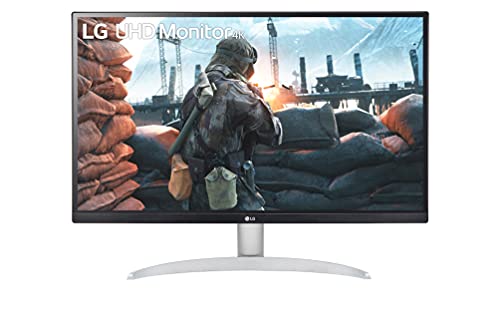
If you need a small 4K monitor on a tight budget, the LG 24UP600-W delivers solid performance without breaking the bank. Its 23.8-inch IPS panel offers decent color accuracy and wide viewing angles. The simple stand is basic, but the VESA mount lets you attach an arm to reclaim desk space.
Where it shines
- Affordable 4K in a compact size
- Good color reproduction for the price
- VESA mount ready
Where it falls short
- Stand lacks height adjustment and tilt is limited
- Only 60Hz, no USB-C

Samsung S24A600UCN
The Samsung S24A600UCN is a 24-inch 4K monitor that excels for multitasking. Its IPS panel is bright and sharp, and the USB-C port supports 65W charging and data. The slim, modern design with a small circular base fits neatly on crowded desks, and the intuitive joystick menu makes adjustments easy.
Where it shines
- USB-C with 65W charging and data
- Bright, vibrant IPS panel
- Sleek design with small footprint
Where it falls short
- No built-in speakers
- Stand only offers tilt adjustment

Lenovo ThinkVision P24h-30
The Lenovo ThinkVision P24h-30 is a 24-inch 4K monitor built for professional environments. It offers a robust stand with height, tilt, pivot, and swivel adjustments, plus a USB-C hub with 100W charging. The matte panel reduces glare, and the build quality feels premium.
Where it shines
- Fully ergonomic stand (height, pivot, swivel, tilt)
- USB-C with 100W power delivery
- Matte anti-glare coating
Where it falls short
- Slightly thicker bezels than competitors
- No built-in speakers
Before you buy
Size and Pixel Density
For a small 4K monitor, 24 inches is the sweet spot. At this size, 4K gives you a pixel density around 185 PPI, making text incredibly sharp and images detailed. Anything smaller than 23.8 inches may require scaling adjustments, which can cause UI elements to appear too tiny. I recommend sticking to 23.8 to 24 inches for the best balance.
Connectivity and USB-C
If you use a laptop, a monitor with USB-C power delivery is a game-changer. It lets you charge your laptop and transmit video with a single cable, reducing desk clutter. Look for at least 65W charging if you have a standard ultrabook, or 96W+ for larger laptops. HDMI 2.0 is also important for full 4K at 60Hz.
Ergonomics and Mounting
In a small space, a monitor with a fully adjustable stand (height, tilt, swivel, pivot) can save desk real estate by allowing you to position it perfectly. If the stand is basic, VESA mount compatibility (100x100mm) is essential for attaching a monitor arm, which can free up even more space underneath.
Color Accuracy and Panel Type
For photo editing or design work, look for an IPS panel with wide color gamut coverage (sRGB, DCI-P3). Factory calibration with Delta E < 2 ensures accurate colors out of the box. For general use, any IPS panel with decent contrast and brightness (300+ nits) will suffice.
The wrap-up
For small spaces, a 24-inch 4K monitor delivers the best balance of sharpness and footprint, with USB-C connectivity being the most important feature for a clean, single-cable setup.
Quick answers
Absolutely. A 24-inch 4K monitor offers a high pixel density that makes text and images look incredibly sharp, without taking up much desk space. It's ideal for tasks like coding, photo editing, or watching 4K content. Just be aware that you may need to adjust scaling in your OS to make UI elements comfortable to read.
Yes, but most small 4K monitors are limited to 60Hz refresh rate. For casual or single-player games, 60Hz is fine, but competitive gamers may prefer a higher refresh rate. Look for models with FreeSync or G-Sync compatibility to reduce screen tearing.
The main difference is pixel density. At 24 inches, 4K gives you about 185 PPI, while at 27 inches it's around 163 PPI. The 24-inch will have sharper text and more detail, but UI elements will be smaller. The 27-inch offers more screen real estate for multitasking but takes up more desk space.
Not necessarily, but a monitor arm can help reclaim desk space by lifting the monitor off the desk and allowing better positioning. Many small monitors have basic stands with limited adjustment, so an arm is a great upgrade if you value ergonomics and a clutter-free setup.
Update log
- Jun 8, 2026 — Refreshed picks and rankings.
- Apr 4, 2026 — Initial guide published.

Tom Reeves has reviewed consumer electronics for over a decade, with a focus on televisions, monitors, laptops, and smart home devices. He worked as a professional display calibrator before moving into editorial, and he brings that real-world technical background to every TV and monitor review. At TheTestedHub, Tom covers display calibration, computer monitors, laptops and 2-in-1s, smart home platforms, home theater setups, and HDR performance.
More to explore
Westcott Rapid Box Switch Octa-S 26-Inch Review (2026): The

XP-PEN Artist Pro 16 Review (2026): The
Xbox Wireless Controller Carbon Black Review (2026): Still

Xbox Series X Console Review (2026): The 4K 120fps Console
WD Black SN850X 1TB Review 2026: The PCIe 4.0 Bargain

Wacom Cintiq Pro 16 Review (2026): The
Vizio MQX Series 50-Inch 4K Review (2026): The Sub- Quantum
