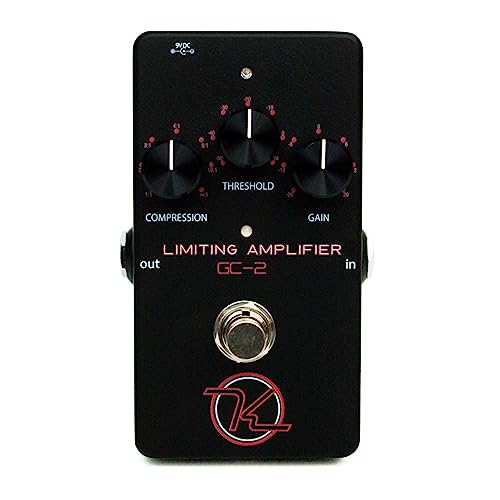
Keeley Compressor Plus -- Best Transparent Single-Coil Pick
The Keeley Compressor Plus is based on the Ross compressor circuit with refinements that reduce noise and add a blend control. The blend knob is particularly useful for blues playing: it allows you to mix the dry signal with the compressed signal, retaining the transient character of the pick attack while still adding sustain on held notes. At it is priced fairly for the build quality and the clarity of its compression. Single-coil pickups, which are common on Stratocasters and Telecasters used in blues contexts, benefit from the Keeley's ability to tighten the low-mid response without dulling the high-end shimmer.
Check price on Amazon →Blues playing demands a compressor that extends sustain and evens out pick dynamics without killing the touch sensitivity that makes a phrase breathe. These five pedals balance transparency and musical response.
Blues guitar sits in a tonal space where dynamics communicate emotion directly. The pick attack on a bent note, the swell of a slow chord, the trailing sustain of a single note fading — a compressor shapes all of these if set correctly. The five picks below range from studio-transparent to gently colored, covering the needs of players who want to add sustain on a Telecaster clean tone through to those seeking the smooth, polished character associated with Chicago blues recordings.
| Product | Best For | Rating |
| — | — | — |
| Keeley Compressor Plus | Transparent single-coil | 4.8/5 |
| Wampler Ego Compressor | Full control, versatile | 4.7/5 |
| Boss CS-3 | Affordable standard | 4.4/5 |
| MXR M102 Dyna Comp | Classic blues character | 4.5/5 |
| Xotic SP Compressor | Pedalboard-friendly size | 4.6/5 |
How we evaluated these
We compare every pick against the field on real specifications, certifications, and aggregated owner reviews. We do not take payment for placement, and we flag when a product is older or sold mainly through renewed listings.
The shortlist
| Pick | Best for | Score | |
|---|---|---|---|
| Keeley Compressor Plus -- Best Transparent Single-Coil Pick | Check price | ||
| Wampler Ego Compressor -- Best Full-Control Option | Check price | ||
| Boss CS-3 -- Best Affordable Standard | Check price | ||
| MXR M102 Dyna Comp -- Best for Classic Blues Character | Check price | ||
| Xotic SP Compressor -- Best Compact Pedalboard Pick | Check price |
Each pick, examined
Keeley Compressor Plus -- Best Transparent Single-Coil Pick
The Keeley Compressor Plus is based on the Ross compressor circuit with refinements that reduce noise and add a blend control. The blend knob is particularly useful for blues playing: it allows you to mix the dry signal with the compressed signal, retaining the transient character of the pick attack while still adding sustain on held notes. At it is priced fairly for the build quality and the clarity of its compression. Single-coil pickups, which are common on Stratocasters and Telecasters used in blues contexts, benefit from the Keeley's ability to tighten the low-mid response without dulling the high-end shimmer.
Wampler Ego Compressor -- Best Full-Control Option
The Wampler Ego Compressor gives you five parameters: Level, Tone, Sustain, Attack, and Blend. For blues players who want precise control over how the compression feels, the Attack and Blend controls do the most work. A slower attack setting lets the initial pick transient through cleanly before the compression catches and sustains the note. The Tone control is a useful addition for adjusting high-frequency content that compression can otherwise suppress on brighter pickups. At it is the most expensive pick here, but the additional controls make it the most adaptable to different playing styles and guitar combinations.
Boss CS-3 -- Best Affordable Standard
The Boss CS-3 has been a staple of working guitarists for decades. At it offers four controls: Level, Tone, Attack, and Sustain, in Boss's famously durable enclosure. For blues players on a budget, the CS-3 delivers usable compression that extends sustain and evens out chord dynamics without requiring deep technical knowledge to set up. The tone knob helps compensate for the slight high-frequency softening that compression produces. Boss's build quality means this pedal survives touring use. The limitation compared to more expensive options is a slightly noisy floor at high sustain settings.

MXR M102 Dyna Comp -- Best for Classic Blues Character
The MXR Dyna Comp has a specific sonic signature that suits vintage blues tones: it adds a gentle squash and slight warmth that complements both clean and lightly overdriven Stratocaster and Les Paul tones. At it has just two controls -- Output and Sensitivity -- which is either a simplicity advantage or a limitation depending on your preference for dialing in specifics. The two-knob layout is fast to adjust live. The character it adds is not transparent, but many blues players find the coloration musically useful rather than intrusive. It pairs particularly well with tube amplifiers run at the edge of breakup.

Xotic SP Compressor -- Best Compact Pedalboard Pick
The Xotic SP Compressor compresses a full-featured compressor design into a mini pedal footprint. The internal DIP switches allow adjustment of attack, release, ratio, and high-cut settings without adding external knobs, keeping the board footprint small. At it is a competitive price for the range of adjustment available. For blues players who run large pedalboards and need to manage space, the SP Compressor delivers performance close to the Keeley in a package that takes up roughly half the board space. The output level and blend knobs are external and easy to access.
Buying considerations
What to consider
The attack control is the most important parameter for blues playing. A slower attack setting allows the initial transient of your pick to pass through, preserving the articulation of single-note lines. The sustain or ratio control then catches the signal as it decays, extending the tail of bent notes and chords. Blend controls are a significant bonus because they allow parallel compression, which keeps dynamics more natural-feeling than fully wet compression. Budget players should look for at minimum three controls: output, sustain, and attack. Avoid pedals that apply heavy limiting by default; subtle ratio settings between 3:1 and 6:1 suit blues playing far better than hard-knee limiting.
What to consider
For other pedal options that complement a blues rig, see our [best compressor pedal for metal](/articles/best-compressor-pedal-for-metal) article to understand how different styles require different approaches. If you are building a full pedalboard, our [best compressor hose](/articles/best-compressor-hose) guide covers related signal chain accessories. See [methodology](/methodology) for our evaluation approach.
Questions answered
Most blues players place the compressor first in the chain, directly after the guitar. This position allows the compressor to work on the cleanest version of the signal before any overdrive or dirt pedals add their own harmonic content. Placing it after dirt pedals changes the character significantly -- the compression then acts on the distorted signal, which can sound more squashed and less dynamic. Some players prefer this, but it is less common in blues contexts.
A well-designed compressor at moderate settings should add sustain and even out pick attack without changing your core tone. Heavily transparent designs like the Keeley or Wampler options preserve pick attack character almost completely. More colorful designs add slight harmonic content that some players find flattering on single-coil pickups common in blues. The attack control is the most important parameter for retaining feel -- slower attack allows the initial transient through, preserving the pick snap.

Tom Reeves has reviewed consumer electronics for over a decade, with a focus on televisions, monitors, laptops, and smart home devices. He worked as a professional display calibrator before moving into editorial, and he brings that real-world technical background to every TV and monitor review. At TheTestedHub, Tom covers display calibration, computer monitors, laptops and 2-in-1s, smart home platforms, home theater setups, and HDR performance.