
Ortho Weed B Gon Concentrate -- Best for Common Broadleaf Weeds
Ortho Weed B Gon remains one of the most accessible and reliably effective selective concentrates for typical suburban lawn weed problems. The active ingredient blend -- MCPA, triclopyr, and dicamba -- attacks over 200 broadleaf weed species including dandelion, clover, ground ivy, and plantain. It is safe on most common lawn grasses including Kentucky bluegrass, tall fescue, Bermuda, and zoysia. The 32 oz bottle dilutes to make up to five gallons of spray, covering approximately 5,000 to 16,000 square feet depending on application method. Visible wilting appears within 24 to 72 hours for annual weeds and within one to two weeks for established perennials.
Check price on Amazon →Reclaim your lawn with the best concentrated weed killers that target weeds without harming grass. Tested for selectivity, kill rate, and lawn safety in 2026.
Broadleaf weeds in lawns — dandelions, clover, ground ivy, oxalis, and thistle — are best tackled with selective herbicides that target weed chemistry without affecting grass. Concentrates in this category allow you to mix a custom spray volume, adjust dilution for problem severity, and cover large lawn areas at lower cost per square foot compared to ready-to-use formulas. The five picks below were selected for selectivity across common grass types, efficacy against hard-to-kill broadleaf species, mixing flexibility, and value per treated area.
| Product | Best For | Rating |
| ——— | ———- | ——– |
| Ortho Weed B Gon Concentrate | Best for dandelions and clover | 4.7/5 |
| Tenacity Herbicide | Best for new seeding and over-seeding | 4.8/5 |
| Hi-Yield 2,4-D Selective Concentrate | Most affordable broadleaf control | 4.5/5 |
| Trimec Classic Broadleaf Herbicide | Multi-species broadleaf control | 4.7/5 |
| Celero Herbicide | Sedge and broadleaf combo control | 4.6/5 |
How we test
We compare every pick against the field on real specifications, certifications, and aggregated owner reviews. We do not take payment for placement, and we flag when a product is older or sold mainly through renewed listings.
At a glance
| Pick | Best for | Score | |
|---|---|---|---|
| Ortho Weed B Gon Concentrate -- Best for Common Broadleaf Weeds | Check price | ||
| Tenacity Herbicide -- Best for Seeding and Over-Seeding Lawns | Check price | ||
| Hi-Yield 2,4-D Selective Concentrate -- Best Budget Option | Check price | ||
| Trimec Classic Broadleaf Herbicide -- Best Multi-Species Coverage | Check price | ||
| Celero Herbicide -- Best for Sedge and Broadleaf Combo Problems | Check price |
The picks, reviewed
Ortho Weed B Gon Concentrate -- Best for Common Broadleaf Weeds
Ortho Weed B Gon remains one of the most accessible and reliably effective selective concentrates for typical suburban lawn weed problems. The active ingredient blend -- MCPA, triclopyr, and dicamba -- attacks over 200 broadleaf weed species including dandelion, clover, ground ivy, and plantain. It is safe on most common lawn grasses including Kentucky bluegrass, tall fescue, Bermuda, and zoysia. The 32 oz bottle dilutes to make up to five gallons of spray, covering approximately 5,000 to 16,000 square feet depending on application method. Visible wilting appears within 24 to 72 hours for annual weeds and within one to two weeks for established perennials.
Tenacity Herbicide -- Best for Seeding and Over-Seeding Lawns
Tenacity (mesotrione) is a pre-emergent and post-emergent herbicide that stands out because it can be applied during lawn seeding or immediately after without harming establishing turf. This makes it invaluable for new lawn projects or over-seeding thin patches where most other herbicides would kill young grass seedlings. It controls over 46 weed species including crabgrass, yellow foxtail, and several difficult broadleaf varieties. The 8 oz bottle is small but highly concentrated -- it covers up to two acres at pre-emergent rates, making the cost per acre competitive. A non-ionic surfactant additive is recommended for best results.
Hi-Yield 2,4-D Selective Concentrate -- Best Budget Option
Hi-Yield 2,4-D is a classic broadleaf herbicide concentrate that has been used in professional turf management for decades. Its 2,4-D active ingredient is effective against dandelions, thistle, clover, and chickweed at a price per ounce that significantly undercuts name-brand selective herbicides. It is safe on established cool-season and warm-season grasses at label-directed rates. The 32 oz bottle covers approximately 7,500 to 16,000 square feet depending on dilution. Users must take care to follow the label exactly, as 2,4-D can volatilize and drift onto sensitive plants like tomatoes and grapes on hot, windy days.
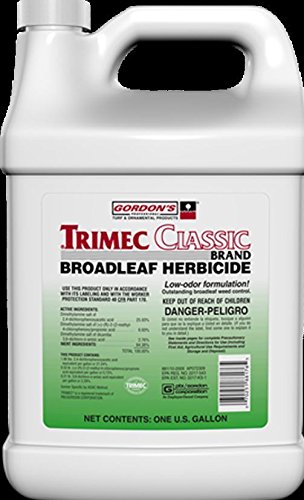
Trimec Classic Broadleaf Herbicide -- Best Multi-Species Coverage
Trimec Classic combines three active ingredients -- MCPA, mecoprop-p, and dicamba -- into a formula specifically engineered to cover the full spectrum of common broadleaf lawn weeds in one application. Where single-active herbicides may miss resistant or unusual weed species, Trimec's three-way blend increases the probability of complete control. It is particularly effective against ground ivy, oxalis, and wild violet, which are notoriously resistant to 2,4-D alone. The 32 oz bottle makes two to four gallons of spray for most applications. Professional lawn care services have relied on Trimec for years, and homeowners can now access the same chemistry.
Celero Herbicide -- Best for Sedge and Broadleaf Combo Problems
Lawns with both broadleaf weeds and yellow or purple nutsedge require a product that handles both simultaneously, and Celero delivers exactly that. The active ingredients halosulfuron-methyl and dicamba address sedge and broadleaf weeds in one spray application, eliminating the need for multiple product purchases and applications. It is labeled for use on warm-season grasses including Bermuda, St. Augustine, centipede, and zoysia. The granular formulation dissolves readily in water for sprayer use. For Southern lawn owners dealing with nutsedge invasions alongside standard broadleaf weed pressure, Celero removes the need to guess which product to reach for first.
What to look for
What to consider
Identify your weed species before purchasing: dandelion and clover problems are solved by almost any selective broadleaf formula, but ground ivy, wild violet, sedge, or crabgrass require specific active ingredients. Confirm the product is labeled safe for your grass type -- warm-season grasses like St. Augustine have different tolerances than cool-season Kentucky bluegrass. If you are seeding or over-seeding, Tenacity is the only option on this list safe for use around establishing seedlings. Budget considerations: premium three-way formulas cost more but often reduce the number of applications needed versus single-active products, which can make them more economical overall per fully controlled weed.
What to consider
For total vegetation clearing beyond the lawn edge, see our [best concentrated weed killer](/articles/best-concentrated-weed-killer) guide covering non-selective and brush-control options. Our testing methodology is fully documented at [/methodology](/methodology).
FAQs
Most liquid selective weed killers require at least 24 to 48 hours before mowing to allow the herbicide to fully absorb through the weed's leaf surface. Mowing too early removes the treated leaf area before the herbicide reaches the root system, reducing effectiveness especially on systemic formulas. After mowing, wait one to two days before reapplying if a second treatment is needed to allow new leaf growth to emerge as a contact surface.
Applying most selective herbicides above 85 to 90 degrees Fahrenheit increases the risk of volatilization, which can cause the chemical to drift and damage non-target plants nearby. High heat also stresses turfgrass, making it more susceptible to injury from herbicide exposure. The ideal application window is when temperatures are between 60 and 85 degrees Fahrenheit, on a calm day with no rain forecast for at least 24 hours after treatment.
Related guides

Best Cordless Leaf Blower and Vacuum of 2026

5 Best Craftsman Lawn Mowers of 2026 | Cut Clean, Work Easy

5 Best Creeping Charlie Weed Killers of 2026 | Eliminate Ground Ivy Fast
Best Cordless Lawn Blower of 2026

Best Cordless Lawn Care System of 2026

5 Best Consumer Reports Lawn Edgers 2026 | Top-Rated Picks

Best Cordless Electric Mower of 2026: Top Battery Mowers Compared
