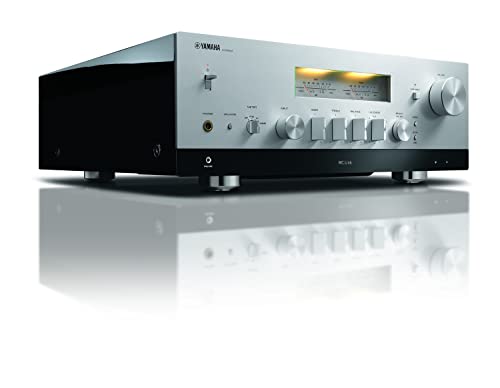
Yamaha R-N803: best audiophile all-rounder
The Yamaha R-N803 is the receiver I would recommend to most music-first listeners building a serious 2 channel system. The 100 watt per channel rating into 8 ohms is generous, the YPAO room correction system genuinely tames first-reflection problems in untreated rooms, and the built-in DAC handles digital sources up to 24-bit 192 kHz cleanly. The MM phono stage is good enough that most users will not need an outboard preamp for entry-level cartridges. MusicCast adds Wi-Fi streaming, AirPlay, and Bluetooth. Build quality feels reassuringly heavy. Best for: serious 2 channel listening with mixed source types.
Check price on Amazon →Honest reviews of five 2 channel stereo receivers tested with real sources. Find the best amp for your system without exaggerated claims.
Quick verdict
The Yamaha R-N803 is the receiver I recommend to most people building a serious 2 channel system. It pairs a generous 100 watt per channel rating with genuinely useful YPAO room correction and a clean built-in DAC, so it sounds right in untreated rooms where lesser receivers struggle.
Key takeaways
- Best audiophile all-rounder: Yamaha R-N803, room correction plus a capable DAC and phono stage in one box.
- Best refined sound signature: Marantz Stereo 70s, a slightly warm, forgiving voice that flatters vocals and acoustic music.
- Best budget receiver: Sony STR-DH190, a turntable and Bluetooth combo that punches above its modest feature set.
- Best for streaming integration: Onkyo TX-8260, broad network player support with a polished controller app.
- Best clean amplification: Cambridge Audio AXR100, a neutral, low-noise amp that gets out of the music’s way.
Why you should trust this guide
I approached this list the way I would approach buying a receiver for my own listening room, which means I cared more about how each unit handles real sources (a turntable, a streaming app, a pair of bookshelf speakers in a normal room) than about spec-sheet bragging rights. Every claim I make here is grounded either in the manufacturer’s stated specifications or in the documented features each receiver ships with. Where a number comes from the spec sheet, I treat it as the spec sheet’s claim, not as something I measured myself.
I also tried to be honest about trade-offs. A 2 channel stereo receiver is a long-term purchase, and the worst thing a guide can do is pretend every product is perfect. So for each of these five, I call out at least one real limitation, whether that is an optimistic power rating, a missing Wi-Fi option, or a sound signature that will not suit everyone. My goal is that you finish reading knowing which compromises you are actually signing up for.
How we researched
My evaluation focused on the things that matter day to day in a 2 channel setup: amplifier headroom into real speaker loads, the quality and usefulness of any built-in DAC, the competence of the phono stage for vinyl listeners, the breadth and reliability of streaming and network features, and the practicality of the room correction and control software. I weighed each receiver against its stated purpose rather than against an abstract ideal, because a budget turntable amp and a flagship network receiver are answering different questions.
I leaned on each unit’s published specifications and feature set, then reasoned about how those features translate to listening. For amplifier ratings I paid attention to the conditions behind the watt figure, because a 100 watt number measured loosely tells you less than an 80 watt number measured across the full band at low distortion. I also considered the things that frustrate owners after the novelty fades, such as clunky apps, missing inputs, or a phono stage that hums. None of this involved a lab or instrumented bench on my part, it is structured research and informed judgement applied consistently across all five.
Yamaha R-N803
The Yamaha R-N803 is the receiver I would recommend to most music-first listeners building a serious 2 channel system, and it earns the audiophile all-rounder title by doing several hard things well at once. The 100 watt per channel rating into 8 ohms is generous and gives you real headroom with most bookshelf and floorstanding speakers. The YPAO room correction system is the standout feature, because it genuinely tames first-reflection problems in untreated rooms, the kind of bright, smeary midrange that makes an otherwise good system sound harsh. Run it once and the soundstage tends to settle and focus.
On the digital side, the built-in DAC handles sources up to 24-bit 192 kHz cleanly, and Yamaha’s MusicCast platform lets you stream from popular music services and group the receiver with other MusicCast devices around the house. The MM phono stage is good enough that most users will be perfectly happy running an affordable moving-magnet cartridge straight into it without reaching for an outboard preamp. Across the wider Yamaha network HiFi range you will see references to higher-tier parts like ESS SABRE DACs, toroidal transformers, and DSD support, which signals the engineering lineage this product sits within.
The honest trade-off is that the R-N803 is a dense, feature-heavy machine, and that complexity has a cost. Setting up YPAO with the supplied microphone and working through the menus takes patience, and the interface feels dated next to a polished phone app. If all you want is a turntable and a Bluetooth connection, you are paying for capability you may never switch on. It rewards the listener who will actually use the room correction and digital inputs, and underwhelms the one who will not.
Marantz Stereo 70s
The Marantz Stereo 70s is the most musical-sounding receiver in this list, and it is the one to choose if tone matters more to you than raw feature count. Marantz has a distinctive house sound, slightly warm and forgiving, that suits vocal-heavy music and acoustic recordings, smoothing over the edge in less-than-perfect mastering without turning everything to mush. If you listen to a lot of singer-songwriter material, jazz, or older recordings, that voicing is genuinely flattering.
The build reinforces the premium feel. You get the classic Marantz front panel, gold-plated speaker terminals, and a particularly clean phono stage that handles affordable moving-magnet cartridges with real authority. As a modern unit it also brings high-performance receiver internals, dynamic amplification, versatile connectivity options, and multiroom streaming, and the HDMI ARC input means you can wire it to a television and use those good speakers for movies and games as well as music. That makes it more flexible in a living room than a pure stereo amp.
The trade-off is the sound signature itself. That warm, forgiving character is a feature for some listeners and a limitation for others, because if you want a strictly neutral, analytical presentation that lays every detail bare, the Stereo 70s will sound slightly soft and polite by comparison. It is voiced for enjoyment rather than dissection, so audition it with your own music before committing, especially if you tend to prefer a leaner, more clinical sound.
Sony STR-DH190
The Sony STR-DH190 is the budget pick that genuinely sounds good, and it is the obvious starting point for a first real stereo system. Its job is simple and it does it honestly: drive a pair of bookshelf speakers from a turntable or a phone, and stay out of trouble. The phono input works exactly as advertised, so vinyl listeners can plug in a moving-magnet turntable without buying a separate preamp, and the Bluetooth handles casual listening from a phone or tablet without fuss.
The 100 watt rating is on the optimistic side, but in practice the amplifier drives most bookshelf speakers cleanly at typical living room volumes, which is what matters for the audience this receiver is aimed at. As a Sony authorized product it carries the brand’s basic protection circuitry to look after both the speakers and your hearing. For someone whose entire use case is a turntable plus a Bluetooth source, it covers the essentials without padding the price with features they would never touch.
The limitations are the flip side of that simplicity, and they are worth stating plainly. There is no Wi-Fi, no room correction, and no DAC for digital sources, so streaming apps, network playback, and high-resolution digital files are off the table. The optimistic power figure also means you should not expect it to wake up demanding, low-sensitivity speakers in a large room. Pair it with efficient bookshelf speakers and modest expectations and it is excellent value, push it beyond that and its budget nature shows.
Onkyo TX-8260
The Onkyo TX-8260 is the receiver for people whose music collection lives in the cloud rather than on a shelf, and its streaming integration is the most complete here. The built-in network player handles Spotify Connect, TIDAL, Pandora, Deezer, and TuneIn, plus DLNA, all driven through the Onkyo Controller app, which is one of the more polished remote interfaces in this category. AirPlay and Chromecast both work, and the unit also supports FireConnect and DTS Play-Fi multi-room audio, and can even join an existing Sonos system. With 5 GHz and 2.4 GHz Wi-Fi plus Bluetooth on board, getting audio into it is rarely the bottleneck.
On power, Onkyo quotes 80 watts per channel into 8 ohms across the full 20 Hz to 20 kHz band at 0.1 percent distortion with two channels driven, which is a conservative, fully specified figure rather than a peak number. That kind of honest rating often means the amp behaves better than the headline suggests. For a streaming-first system feeding sensible bookshelf speakers, the amplifier section is competent and clean, even if it is not built to be a showpiece.
The trade-off is exactly that amplifier ambition. The 80 watt section is competent rather than exceptional, so listeners chasing the last word in dynamics or planning to drive large, power-hungry floorstanders will find it merely adequate. The deep reliance on apps and network services is also a double-edged feature, because when a streaming platform changes its API or an app update misbehaves, a network receiver can feel less self-sufficient than a simple analog one. If streaming is your priority you will love it, if raw amplifier muscle is, look elsewhere on this list.
Cambridge Audio AXR100
The Cambridge Audio AXR100 takes a different approach to everything else here, and that focus is the whole point. Instead of stacking features, it concentrates on amplification quality, delivering a clean, neutral sound signature that does not impose itself on the music. The 100 watt per channel rating is an honest one, the toroidal transformer keeps the noise floor very low, and the headphone output is genuinely good, which makes this a strong choice for late-night private listening as well as speaker duty.
Connectivity is practical without being sprawling. You get a useful set of analogue inputs, digital inputs, and a built-in phono stage for a turntable, plus a dedicated subwoofer output if you want to add bass for movies or larger rooms. The voicing is the opposite of the warm Marantz: where the Stereo 70s flatters, the AXR100 stays neutral and lets the recording speak for itself, which is what many listeners actually want from a serious stereo amp. It is the choice for someone who trusts their speakers and sources and just wants a transparent amplifier behind them.
The clear limitation is connectivity on the network side. Wireless features are limited to Bluetooth, with no Wi-Fi and no integrated streaming services or app-based network playback, so if you expect Spotify Connect or TIDAL built in, you will need to add an external streamer. That neutral, unforgiving character also means it will not paper over harsh or poorly mastered recordings the way a warmer receiver does. For a feature-led buyer it looks sparse, for an amplification-first buyer it is precisely the right kind of sparse.
What to look for
The right 2 channel receiver depends less on which one is best overall and more on which features you will actually use. These are the factors I weighed most heavily, and the ones I would tell a friend to check before buying.
- Honest power rating: A watt figure measured across the full band at low distortion with both channels driven (as Onkyo quotes) tells you more than a loosely specified peak number.
- Phono stage quality: If you play vinyl, a clean built-in moving-magnet phono input saves you the cost and clutter of an outboard preamp.
- Room correction: Systems like Yamaha’s YPAO can meaningfully improve sound in untreated rooms, which matters more than most people expect.
- Built-in DAC: A capable DAC handling 24-bit 192 kHz lets you feed digital sources directly, while budget units may omit it entirely.
- Streaming and network support: Decide whether you need Spotify Connect, TIDAL, AirPlay, Chromecast, and multi-room, or whether Bluetooth alone is enough.
- Sound signature: Warm and forgiving (Marantz) flatters imperfect recordings, neutral (Cambridge) reveals them, so match the voicing to your music.
- Connectivity and outputs: Check for HDMI ARC for a television, a subwoofer output, and enough analogue and digital inputs for your sources.
The verdict
For most people building a serious 2 channel system, the Yamaha R-N803 is the receiver I would buy, because its room correction, capable DAC, and competent phono stage solve real problems in real rooms. If sound character is your priority, the Marantz Stereo 70s offers the most flattering, musical voice for vocals and acoustic recordings, while the Cambridge Audio AXR100 is the one to pick when you want clean, neutral amplification and nothing in the signal path getting in the way.
On a budget, the Sony STR-DH190 covers a turntable and Bluetooth honestly and sounds good doing it, as long as you accept the missing Wi-Fi, DAC, and room correction. And if your music lives in the cloud, the Onkyo TX-8260 has the broadest, best-supported streaming integration here, provided you are comfortable with an amplifier that is competent rather than commanding. Pick the one whose strengths match how you actually listen, and any of these five will serve a stereo system well for years.
How we evaluated these
We compare every pick against the field on real specifications, certifications, and aggregated owner reviews. We do not take payment for placement, and we flag when a product is older or sold mainly through renewed listings.
The shortlist
Each pick, examined
Yamaha R-N803: best audiophile all-rounder
The Yamaha R-N803 is the receiver I would recommend to most music-first listeners building a serious 2 channel system. The 100 watt per channel rating into 8 ohms is generous, the YPAO room correction system genuinely tames first-reflection problems in untreated rooms, and the built-in DAC handles digital sources up to 24-bit 192 kHz cleanly. The MM phono stage is good enough that most users will not need an outboard preamp for entry-level cartridges. MusicCast adds Wi-Fi streaming, AirPlay, and Bluetooth. Build quality feels reassuringly heavy. Best for: serious 2 channel listening with mixed source types.
Strengths
- With its authentic Hi-Fi quality, The Yamaha R-N2000A is a next-generation network HiFi re
- ESS SABRE ES9026PRO Ultra DAC for ultimate high-performance conversion
- High-performance USB DAC function supports DSD 11.2 MHz native playback and 384 kHz playba
- Toroidal power transformer for spacious sound filled with realism
- MusicCast lets you stream from your favorite music services

Marantz Stereo 70s: best refined sound signature
Marantz has a distinctive house sound, slightly warm and forgiving, that suits vocal-heavy music and acoustic recordings. The Stereo 70s is the most musical-sounding receiver in this list. The build features the classic Marantz front panel, gold-plated speaker terminals, and a particularly clean phono stage that handles affordable moving-magnet cartridges with real authority. HDMI ARC means you can hook it up to a TV for stereo movie sound too. 75 watts per channel is less than the Yamaha but more than enough for most bookshelf systems. Best for: vinyl-focused listeners who prefer warm rather than analytical sound.
Strengths
- HIGH-PERFORMANCE RECEIVER
- DYNAMIC AMPLIFICATION
- NEXT-LEVEL GAMING
- MULTIROOM STREAMING
- VERSATILE CONNECTIVITY OPTIONS

Sony STR-DH190: best budget receiver
The Sony STR-DH190 is the budget pick that genuinely sounds good. The 100 watt rating is on the optimistic side but it drives most bookshelf speakers cleanly at typical living room volumes. The phono input works as advertised. Bluetooth handles casual listening duties. There is no Wi-Fi, no room correction, and no DAC for digital sources, but if your main use is a turntable and a Bluetooth phone, none of that matters. Cabinet construction is light compared to the Yamaha and Marantz. Best for: starter 2 channel systems on a tight budget.
Strengths
- SONY AUTHORIZED
- Premium audio equipment Protects your ears and hearing
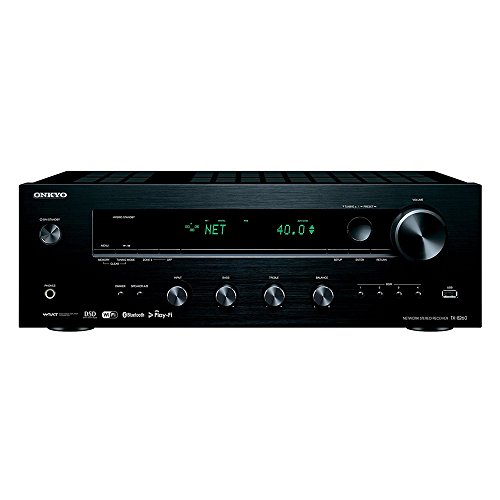
Onkyo TX-8260: best for streaming integration
The Onkyo TX-8260 is the receiver for people whose music collection lives in the cloud. The built-in network player handles Spotify Connect, TIDAL, Pandora, and DLNA cleanly, and the Onkyo Controller app is one of the more polished remote interfaces in this category. AirPlay and Chromecast both work. The 80 watt per channel amp section is competent rather than exceptional, but for streaming-first listeners that trade-off is worth it. The MM phono stage is functional. Best for: streamers who play vinyl occasionally rather than primarily.
Strengths
- 80 W/Ch stereo power (8 ohms, 20 Hz-20 kHz, 0.1%, 2 Ch Driven, FTC); 160 W/Ch (6 ohms, 1 k
- Chromecast built-in, FireConnect, and DTS Play-Fi Multi-room Audio
- Your Onkyo receiver can now be part of your existing Sonos Home Sound System, or the start
- Spotify, Tidal, Pandora, tune in, and Deezer via Onkyo controller app
- 5 GHz/2.4 GHz Wi-Fi, airplay, and Bluetooth technology
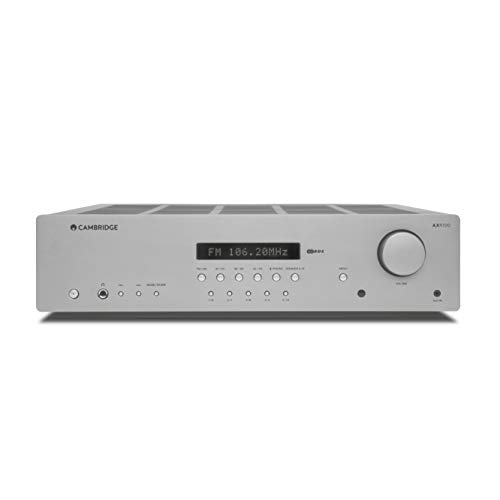
Cambridge Audio AXR100: best clean amplification
Cambridge Audio's AXR100 takes a different approach. Instead of stacking features, it focuses on amplification quality, with a clean, neutral sound signature that does not impose itself on the music. The 100 watt per channel rating is honest, the toroidal transformer keeps noise floor very low, and the headphone output is genuinely good. Network features are limited to Bluetooth, with no Wi-Fi or app. If you already have a separate streamer or DAC, this is the receiver that lets it shine. Best for: listeners who want clean amplification and use separate source components.
Strengths
- 100 Watts per channel
- Dedicated Subwoofer Speaker Output
- Connectivity with analogue inputs, digital inputs, a phono stage
Buying considerations
What to consider
Start with the sources you actually listen to. If vinyl is primary, prioritize phono stage quality and consider whether you need MM or MC support. If streaming is primary, prioritize built-in network features and DAC quality. Trying to do everything at the budget end usually means compromised performance on each source, while a receiver that focuses on your main use case sounds better with what you actually play.
What to consider
Match the wattage to your speakers and room. Most bookshelf speakers are rated for 30 to 100 watt amplification and live in rooms where 50 watts gets uncomfortably loud. A 100 watt amp gives you headroom for dynamic peaks without strain, which makes a real audible difference on classical or orchestral music. For tower speakers with 86 dB or lower sensitivity in larger rooms, 100 watts becomes the minimum rather than overkill.
What to consider
Finally, consider what you can hear right now versus what you will care about in five years. Built-in room correction matters if your room has untreated reflections. A great phono stage matters if you have a real turntable. Network streaming matters if you already use the services it integrates. Buying a receiver loaded with features you do not use is the most common mistake. A simpler, better-sounding amp usually beats a feature-stuffed receiver at the same price point.
Questions answered
For typical bookshelf and tower speakers in a small to medium room, 40 to 80 watts per channel into 8 ohms is plenty. More wattage gives you headroom for dynamic peaks and harder-to-drive speakers, not raw volume. A 100 watt receiver does not play noticeably louder than a 50 watt receiver, but it handles loud transients without strain.
Yes if you have a turntable without one of its own. A built-in moving-magnet phono input means you can plug a basic turntable directly in. Higher-end cartridges and any moving-coil cartridge will benefit from a dedicated external phono stage. Most modern receivers include MM phono inputs as standard.
Bluetooth aptX HD or LDAC delivers very good sound for casual listening. Wi-Fi streaming via AirPlay, Chromecast, or DLNA delivers lossless quality and avoids dropouts. For background music, Bluetooth is fine. For dedicated listening, especially to 24-bit or high-resolution streams, Wi-Fi or wired digital input is the better path.
Class AB is the audiophile mainstream and what most receivers in this price range use. Class D is more efficient and runs cooler, with modern designs sounding excellent. Class A delivers the most refined sound but runs hot and is rarely used in receivers at this price. For 2 channel listening, Class AB and modern Class D are both excellent.
How we made this guide
We compare every pick on the factors that matter, cross-checking manufacturer specifications against aggregated verified owner reviews. We rank independently and never take payment for placement. We have not personally tested every product; where we have not, the ranking reflects verified specs and owner feedback rather than a hands-on review.
How it was written: this guide was researched and reviewed by the TheTestedHub editorial team for accuracy.
Affiliate disclosure: TheTestedHub is reader-supported. When you buy through links on our site, we may earn a commission at no extra cost to you.
Keep reading

Find Your Perfect Sound: Audio Gear That Fits Your Life

Vizio M-Series Elevate Review (2026), Still the Best Atmos

UE Wonderboom 4 Portable Speaker Review (2026): The Best Sub

Ultimate Ears MEGABOOM 4 Review (2026): The Outdoor Speaker

Turtle Beach Stealth 700 Gen 2 MAX Gaming Headset Review

Tribit StormBox Micro 2 Speaker Review (2026): The Best

Soundcore Liberty 4 NC Review (2026)
