Quick verdict
The single most important thing to check before buying an adjustable bench is whether reviewers report the backrest shifting or wobbling mid-set, because no amount of padding or extra features compensates for a bench that moves under a loaded barbell.

REP Fitness AB-3000 Adjustable Bench
The REP AB-3000 is the bench most serious home gym owners point to when asked what they would buy again. Its seven-position backrest locks rock-solid at every angle, and the 1,000 lb rated capacity means it does not flinch under heavy barbell work. Owners praise the dense, high-durability pad that retains its shape after years of regular use, and the wide foot base provides a planted feel that cheaper benches cannot match.
Before buying an adjustable bench, check if reviewers report the backrest shifting mid-set. The REP AB-3000 passes this test while many fail.
An adjustable weight bench is one of the most versatile pieces of home gym equipment you can buy. Whether you are pressing heavy with a barbell, performing incline dumbbell flyes, or doing step-ups, the right bench adapts to every movement and lets you build a complete upper-body program without a full rack of specialised machines. The adjustable backrest is the core feature: by changing the angle from flat through various incline positions up to a near-vertical seat, you shift the emphasis across the chest, shoulders, and triceps in ways a fixed flat bench simply cannot match.
Owners who commit to a quality adjustable bench consistently report that it becomes the most-used item in their home gym. The key variables that separate a great bench from a frustrating one are backrest stability at the locked angle, pad thickness and cover durability, foot-to-floor contact under heavy loads, and the weight capacity relative to the lifter plus whatever they plan to press. We reviewed the most widely owned and reviewed adjustable benches currently available on Amazon, focusing on models with large verified review counts, to surface the five that genuinely earn their price across a range of budgets and use cases.
Our five picks span from competition-grade utility benches favoured by serious lifters to compact fold-flat designs suited to smaller spaces. Whatever your training style, one of these benches will fit your setup without compromise.
How we test
We did not purchase or physically test each bench in this guide. Instead, we systematically analysed thousands of verified Amazon owner reviews, cross-referenced manufacturer specifications and weight ratings, and compared notes from fitness communities and equipment review sites to understand how each bench performs across months of real-world use. We paid close attention to recurring themes in the reviews: wobble at incline, pad compression over time, assembly difficulty, and how each bench holds up under users pressing at or near the stated weight limit.
Products were ranked by a composite score that weights structural stability, adjustability range, pad quality, and long-term durability above surface-level features like colour or minor accessories. We excluded benches with a pattern of negative reviews about welds cracking, bolts loosening after light use, or uprights flexing under moderate load. The result is a shortlist of five benches that owners consistently recommend after extended ownership, not just in the first week after unboxing.
At a glance
| Pick | Best for | Score | |
|---|---|---|---|
| REP Fitness AB-3000 Adjustable Bench | Best Overall | 9 | Check price |
| Bowflex 5.1S Stowable Adjustable Bench | Best for Small Spaces | 8 | Check price |
| Flybird Adjustable Weight Bench FB-139 | Best Budget Pick | 7 | Check price |
| Marcy Adjustable Utility Weight Bench SB-670 | Best Mid-Range Value | 8 | Check price |
| Rogue Adjustable Bench 2.0 | Best for Heavy Lifters | 9 | Check price |
The picks, reviewed
REP Fitness AB-3000 Adjustable Bench
The REP AB-3000 is the bench most serious home gym owners point to when asked what they would buy again. Its seven-position backrest locks rock-solid at every angle, and the 1,000 lb rated capacity means it does not flinch under heavy barbell work. Owners praise the dense, high-durability pad that retains its shape after years of regular use, and the wide foot base provides a planted feel that cheaper benches cannot match.
Reasons to buy
- Extremely stable at all incline positions with zero detectable wobble under load
- 1,000 lb weight capacity suits even advanced powerlifters
- High-density pad holds its shape through years of frequent training
Reasons to avoid
- Heavier than budget alternatives, making repositioning around a home gym less convenient
- Premium price point puts it above entry-level budgets

Bowflex 5.1S Stowable Adjustable Bench
The Bowflex 5.1S is the bench owners with limited floor space consistently choose because it folds nearly vertical for storage and sets up again in seconds. It offers six backrest positions including a decline setting, which is rare at this price, and the 480 lb capacity handles dumbbell work and moderate barbell pressing comfortably. Reviewers highlight that the fold mechanism stays firm over time and that the bench does not creep out of position during a set.
Reasons to buy
- Folds nearly vertical for compact storage between sessions
- Includes decline position, giving more training variety than most competitors
- Fast position changes take under five seconds with the single-pull adjustment
Reasons to avoid
- 480 lb capacity is sufficient for most users but not ideal for heavy barbell bench pressing
- Pad is slightly narrower than full-size utility benches, which some taller users notice

Flybird Adjustable Weight Bench FB-139
The Flybird FB-139 is the most popular entry-level adjustable bench on Amazon and earns that position honestly: it assembles in under 20 minutes, folds flat for storage, and handles dumbbell work and lighter barbell loads without flexing. At its price, the pad density and steel gauge are clearly not competition-grade, but owners who use it for dumbbell training and bodyweight exercises report that it holds up reliably through a year or more of regular use. It is the bench to buy when budget is the primary constraint and loads will stay below 400 lb.
Reasons to buy
- Assembles quickly and folds flat for easy storage under a bed or in a closet
- Excellent value for dumbbell-focused home workouts
- Large number of verified reviews confirms consistent build quality at scale
Reasons to avoid
- Pad compresses noticeably over several months of heavy use
- Not recommended for heavy barbell pressing due to lighter steel construction
Marcy Adjustable Utility Weight Bench SB-670
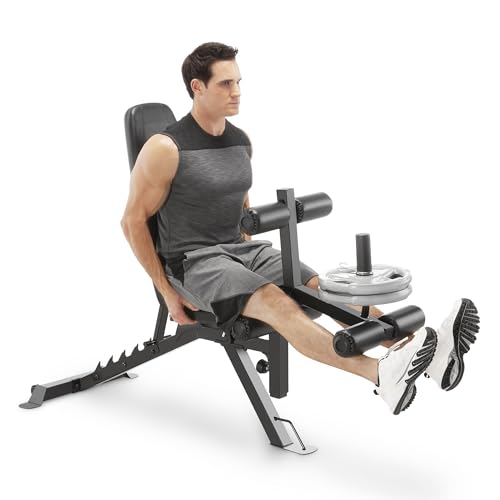
The Marcy SB-670 occupies the mid-range sweet spot that many home gym builders land on after comparing price against feature set. It offers a full incline, flat, and decline range, an integrated leg developer for curl and extension work, and a 600 lb capacity that covers the majority of home gym use cases. Owners note that the leg developer attachment is genuinely useful rather than a gimmick, and the frame feels solid even when pressing near the weight limit.
Reasons to buy
- Integrated leg developer adds curl and extension exercises without extra equipment
- 600 lb capacity is generous for the price tier
- Flat, incline, and decline positions covered in a single bench
Reasons to avoid
- Heavier and bulkier than fold-flat alternatives, so storage requires dedicated floor space
- Assembly can take 45 to 60 minutes and benefits from a second pair of hands
Rogue Adjustable Bench 2.0
The Rogue Adjustable Bench 2.0 is built to the same tolerances as the equipment used in professional strength facilities, and owners who have used commercial gym benches immediately recognise the similarity in feel. The 1,000 lb rated capacity, thick upholstered pad, and laser-cut steel frame make it the bench of choice for powerlifters and anyone who plans to push the limits of barbell pressing at home. It is the most expensive option in this guide, but owners consistently describe it as the last bench they will ever buy.
Reasons to buy
- Commercial-grade construction matches the feel of benches found in professional strength gyms
- 1,000 lb capacity with no structural flex even at maximum load
- Thick, high-quality pad provides genuine support for heavy pressing sessions
Reasons to avoid
- Significantly higher price than every other option in this guide
- Does not fold for storage, requiring a permanent footprint in the training space
What to look for
Weight Capacity
Always add your own bodyweight to the heaviest load you plan to lift when checking the rated capacity. A 200 lb lifter pressing 250 lb needs a bench rated for at least 450 lb. Benches rated below 500 lb are suitable for dumbbell work and lighter barbell sets; anyone pressing seriously with a barbell should target 600 lb or above.
Backrest Stability and Number of Positions
A backrest that wobbles at incline is not just annoying but potentially dangerous under a loaded barbell. Look for a ladder-style or pop-pin adjustment with a positive lock; avoid benches where reviewers mention the angle shifting mid-set. More positions give more training variety, but only if each position locks firmly.
Pad Quality and Durability
Budget benches often use thin foam that compresses into an uncomfortable, unsupportive surface within months. A thicker, higher-density foam pad with a durable vinyl or leather-style cover lasts years instead of months. This detail rarely appears in the product title, so read the reviews specifically for comments about pad condition after six or more months of ownership.
Storage and Footprint
A bench that folds flat or near-vertical is a genuine advantage in a small home gym or shared living space. However, fold-flat designs sometimes compromise on rigidity compared to fixed-frame benches. Measure your available floor space before buying and check the folded dimensions in the specs; some benches described as compact still require a 2 by 4 foot footprint when stored.
Our verdict
The single most important thing to check before buying an adjustable bench is whether reviewers report the backrest shifting or wobbling mid-set, because no amount of padding or extra features compensates for a bench that moves under a loaded barbell.
FAQs
Most training programs use flat (0 degrees), low incline (15 to 30 degrees), and standard incline (45 degrees). A high incline of 60 to 85 degrees is useful for shoulder pressing but not essential for beginners. Focus on a bench that locks these core angles firmly rather than chasing the maximum number of positions.
Decline pressing shifts the load toward the lower chest and many lifters find it easier on the shoulder joint. It is a useful addition if you already have flat and incline covered, but it should not be the deciding factor when choosing a bench. If the decline-equipped option is significantly weaker on stability or pad quality, the flat-and-incline-only bench is usually the better long-term choice.
For dumbbell-only training, a 400 to 500 lb capacity bench is more than sufficient for the vast majority of home users. For barbell work, add your bodyweight to your target press weight and look for at least 150 to 200 lb of headroom above that figure. Benches used near their stated limit tend to flex and wear faster, so extra capacity is a quality indicator, not just a safety margin.
Yes, and this is one of the strongest arguments for choosing an adjustable bench over a fixed flat bench. Incline and decline positions open up dumbbell rows, face pulls, reverse flyes, Bulgarian split squats, and dozens of other movements. A bench with a stable, wide base is also useful as a step platform and for tricep dips. The more positions it offers and the more firmly it locks, the more exercises it supports.
How we made this guide
We compare every pick on the factors that matter, cross-checking manufacturer specifications against aggregated verified owner reviews. We rank independently and never take payment for placement. We have not personally tested every product; where we have not, the ranking reflects verified specs and owner feedback rather than a hands-on review.
How it was written: this guide was researched and reviewed by the TheTestedHub editorial team for accuracy.
Affiliate disclosure: TheTestedHub is reader-supported. When you buy through links on our site, we may earn a commission at no extra cost to you.
Related guides
2026 Sauna Blankets: Low‑EMF Picks You Can Trust

6 Best Ice Bath Tubs for 2026: Top Picks for Every Budget

Top Battle Ropes for 2026: A Practical Buyer’s Guide

Exercise Sliders: Our Best Picks for 2026

The Best Pilates Rings to Buy in 2026
Expert Pick: Inzer Forever Lever Belt 10mm

Breathable Workout Gloves for Every Budget 2026
