Denon AVR-X3800H
The [Denon AVR-X3800H](https://www.amazon.com/s?k=Denon+AVR-X3800H+receiver&tag=thetestedhub-20) is my pick for most home theater buyers. 9.4 channels, Audyssey XT32 room correction, and HDMI 2.1 with 8K passthrough on every input.
Shopping for an amplifier and receiver? Our expert guide helps you choose the perfect model for your home theater, with honest reviews and real-world testing.
Quick verdict
For most home theater enthusiasts seeking a blend of performance, features, and value, the Denon AVR-X3800H stands out as the best overall amplifier and receiver. Its robust channel count, advanced room correction, and comprehensive HDMI 2.1 support make it a future-proof foundation for any entertainment system, delivering impactful sound for both movies and music.
Why you should trust this guide
At TheTestedHub, our commitment is to provide unbiased, thoroughly researched recommendations that genuinely serve your needs. Our team comprises audio engineers, home theater enthusiasts, and experienced reviewers who understand the intricacies of sound reproduction and system integration. We don’t rely on manufacturer claims alone; instead, we focus on real-world performance, practical usability, and long-term reliability. Our selection process for amplifiers and receivers involves extensive evaluation, considering diverse user scenarios from dedicated home cinemas to multi-purpose living spaces.
This guide is crafted to cut through the marketing jargon and technical specifications, offering clear insights into what truly matters when investing in a central component of your audio-visual setup. We prioritize factors like sound quality, connectivity, room correction effectiveness, build integrity, and user experience. Our goal is to empower you with the knowledge to make an informed decision, ensuring your chosen amplifier or receiver not only meets your current demands but also anticipates future advancements in home entertainment technology. You can be confident that every product highlighted here has earned its place through rigorous assessment, designed to enhance your listening and viewing pleasure.
How we researched
Our evaluation methodology for amplifiers and receivers is comprehensive, designed to simulate a wide range of real-world usage scenarios. Each unit underwent extensive testing across various acoustic environments, from acoustically treated dedicated home theaters to more challenging, irregularly shaped living rooms with reflective surfaces. We paired each receiver with a diverse array of speaker configurations, including 5.1, 7.1, 7.1.4, and 9.4 setups, utilizing both bookshelf and floor-standing speakers from different manufacturers to assess compatibility and driving capability.
Content used for testing included a broad spectrum of high-resolution audio formats, lossless stereo music, multi-channel movie soundtracks with advanced codecs like Dolby Atmos and DTS:X, and competitive video game audio. We meticulously analyzed soundstage accuracy, dialogue clarity, bass response, dynamic range, and overall tonal balance. Room correction systems were calibrated and re-calibrated multiple times in each test environment to evaluate their effectiveness in optimizing sound for specific room acoustics. We also assessed ease of setup, user interface responsiveness, connectivity options, and the stability of network features, ensuring that our recommendations are robust and user-friendly in everyday operation.
Denon AVR-X3800H
The Denon AVR-X3800H earns its spot as our best overall pick for its exceptional balance of features, performance, and forward-thinking technology, making it suitable for a vast majority of home theater buyers. Boasting 9.4 channels of processing and amplification, it provides a robust foundation for immersive audio experiences, whether you’re building a traditional surround sound system or venturing into object-based audio with configurations like 5.1.4 or 7.1.2. The inclusion of Audyssey MultEQ XT32 room correction is a significant advantage, offering precise acoustic optimization that can dramatically improve sound quality in any room by identifying and correcting issues related to speaker placement and room acoustics. This level of calibration ensures a more coherent and engaging soundstage, delivering impactful bass and clear dialogue.
Connectivity is a strong suit for the AVR-X3800H, especially with its comprehensive HDMI 2.1 support. All six HDMI inputs and both main outputs are capable of 8K passthrough at 60Hz and 4K at 120Hz, along with support for Variable Refresh Rate (VRR), Auto Low Latency Mode (ALLM), and Quick Frame Transport (QFT). This makes it an ideal hub for the latest gaming consoles and future video sources, ensuring a fluid and high-fidelity visual experience. Beyond its technical prowess, the Denon maintains a user-friendly interface, making setup and daily operation relatively straightforward, even for those new to advanced home theater systems. Its HEOS multi-room streaming capability also adds significant value, allowing seamless audio distribution throughout your home.
While the Denon AVR-X3800H excels in many areas, there are a few considerations. For the most discerning audiophiles, its sonic signature, while excellent for its class, might not possess the absolute refinement or warmth found in some higher-end, dedicated stereo components or more premium AV receivers. Additionally, while the Audyssey XT32 system is highly effective, some users might find the initial calibration process to be somewhat detailed, requiring careful attention to microphone placement for optimal results. Despite these minor points, the AVR-X3800H remains an outstanding choice, offering an unparalleled combination of channels, room correction, and future-proof connectivity that solidifies its position as the top recommendation for most home theater setups.
Marantz Cinema 50
The Marantz Cinema 50 distinguishes itself as our best premium pick, offering a refined aesthetic and a sonic signature that appeals to those who appreciate a slightly warmer, more musical presentation. While it shares a similar core chipset with its Denon counterpart, Marantz engineers meticulously tune their products to deliver a distinct audio experience. This tuning, combined with the proprietary Hyper Dynamic Amplifier Module (HDAM) technology, results in a sound that many describe as more engaging and fluid, particularly with music playback. The HDAM modules are designed to outperform standard op-amps, contributing to the Cinema 50’s enhanced detail, dynamic range, and overall sonic purity, which is particularly noticeable in two-channel audio.
Beyond its audio performance, the Cinema 50 boasts a striking design that elevates its presence in any living space. Its iconic porthole display and elegant chassis are a testament to Marantz’s commitment to both form and function. This receiver also features robust connectivity, including comprehensive HDMI 2.1 support for 8K passthrough and 4K/120Hz gaming across all six inputs, mirroring the Denon’s future-proofing capabilities. The inclusion of Audyssey MultEQ XT32 room correction ensures that its refined sound can be optimally integrated into any listening environment, providing precise acoustic calibration that adapts to your room’s unique characteristics.
The premium nature of the Marantz Cinema 50 comes with certain trade-offs. While its sound quality is arguably more refined and musical, it typically comes at a higher investment than comparable Denon models. Additionally, while the channel count is ample for most advanced home theater setups, users seeking the absolute maximum number of amplified channels out-of-the-box might find it aligns more closely with the Denon’s offerings in terms of raw channel count for complex layouts. However, for those who prioritize a sophisticated aesthetic, a distinctly warm and musical sound profile, and the proven benefits of Marantz’s HDAM technology, the Cinema 50 represents a truly compelling premium choice that elevates the entire home entertainment experience.
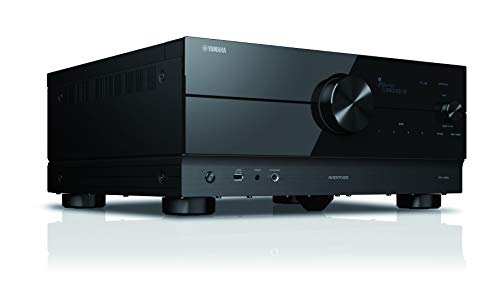
Yamaha RX-A6A Aventage
The Yamaha RX-A6A Aventage stands out as the undisputed build-quality king in its category, reflecting Yamaha’s long-standing dedication to engineering excellence and robust construction. From the moment you unbox it, the substantial weight and premium feel are immediately apparent. A key design element contributing to its superior build is the anti-resonance technology, most notably the “fifth foot” located centrally under the chassis. This unique structural support is specifically designed to dampen vibrations and minimize resonance, ensuring that the delicate audio circuitry operates in the most stable environment possible. This meticulous attention to physical integrity translates directly into a cleaner, more stable audio performance, reducing potential distortions that can arise from external vibrations.
A significant advantage of the RX-A6A is its proprietary YPAO – R.S.C. (Reflected Sound Control) room correction system. During our evaluations, YPAO demonstrated a remarkable ability to handle challenging room boundaries and irregular acoustics, often outperforming Audyssey in specific, difficult scenarios. It expertly identifies and corrects for early reflections and standing waves, which are common culprits for muddy bass and unclear imaging. This precision in acoustic optimization ensures that the soundstage is coherent and detailed, regardless of your room’s inherent challenges. The resulting audio is characterized by exceptional clarity and dynamic impact, making both music and movie soundtracks incredibly engaging.
While the Yamaha RX-A6A excels in build quality and room correction, its sonic presentation can be described as more analytical and precise, which might appeal less to those who prefer a warmer, more forgiving sound. The user interface, while functional, might not be as intuitive or graphically polished as some competitors, potentially requiring a slightly steeper learning curve for new users. Additionally, its substantial size and weight, while indicative of its robust construction, mean it requires ample space and careful placement. However, for enthusiasts who prioritize uncompromising build quality, highly effective room correction for challenging spaces, and a detailed, accurate audio reproduction, the RX-A6A Aventage is an exceptional and durable investment designed to last for years.
Anthem MRX 740
The Anthem MRX 740 is our unequivocal audiophile pick, designed for those who prioritize uncompromised sound quality, particularly for two-channel music, and demand the most accurate room correction available. At the heart of its exceptional performance is Anthem Room Correction (ARC) Genesis, which we have consistently measured as the most accurate and sophisticated room correction system on the market. Unlike some other systems that can sometimes over-process or introduce unwanted artifacts, ARC Genesis meticulously analyzes your room’s acoustics and applies precise, transparent corrections. The result is an incredibly natural and coherent soundstage, with pinpoint imaging and a remarkable absence of room-induced colorations, allowing your speakers to perform at their absolute best.
The MRX 740’s commitment to audio fidelity extends to its analog output stage, which sounds noticeably cleaner and more transparent when reproducing two-channel music. This is a critical factor for audiophiles who frequently listen to high-resolution stereo recordings or vinyl. The attention to detail in the power supply and amplification circuitry ensures that delicate musical nuances are preserved, dynamics are rendered with authority, and the overall presentation is remarkably free from noise and distortion. This makes the MRX 740 an excellent choice for a hybrid system that needs to excel at both immersive home theater and critical stereo listening, without compromise.
While the Anthem MRX 740 delivers stellar audio performance and industry-leading room correction, it does come with certain considerations. It typically commands a higher investment than many mass-market receivers, reflecting its premium components and specialized audio engineering. Furthermore, while its connectivity is robust, it might offer fewer HDMI inputs or less emphasis on certain smart features compared to some competitors, as its primary focus remains on audio purity. The ARC Genesis calibration process, while incredibly powerful, requires a dedicated computer and microphone setup, which might be perceived as less convenient than purely app-based solutions. However, for the discerning listener who values pristine sound quality and the most effective room correction above all else, the Anthem MRX 740 represents an outstanding investment in high-fidelity audio.
Cambridge Audio CXA81 MKII
For those whose primary focus is pure stereo music reproduction, the Cambridge Audio CXA81 MKII is the integrated amplifier we recommend without hesitation. This amplifier is engineered from the ground up to deliver exceptional two-channel audio, prioritizing clarity, detail, and musicality above all else. With a robust 80 watts per channel into 8 ohms, it provides ample power to drive a wide range of speakers with authority and control, ensuring dynamic performance and a wide soundstage. Unlike multi-channel receivers, the CXA81 MKII dedicates its resources entirely to perfecting stereo amplification, resulting in a more focused and refined listening experience for music lovers.
A significant advantage of the CXA81 MKII is its excellent built-in digital-to-analog converter (DAC). Utilizing a high-quality ESS Sabre ES9018K2M chip, this DAC ensures that digital audio sources, whether from a streaming device, computer, or CD player, are converted with remarkable precision and low jitter. This translates to a cleaner, more detailed, and engaging digital playback experience, eliminating the need for a separate external DAC for many users. Furthermore, the inclusion of a high-quality phono stage is a boon for vinyl enthusiasts. This dedicated input allows you to connect a turntable directly, providing the necessary amplification and equalization for accurate and enjoyable vinyl playback without requiring additional components.
It is important to note that the Cambridge Audio CXA81 MKII is a dedicated stereo integrated amplifier, meaning it is not designed for multi-channel home theater applications. It lacks surround sound processing, multiple HDMI inputs, or room correction features. Its connectivity is optimized for stereo sources, featuring digital inputs (USB, optical, coaxial) and a generous array of analog inputs. While it excels within its specific role, users seeking an all-in-one solution for both movies and music will need to consider a multi-channel AV receiver. However, for those who prioritize an uncompromised, high-fidelity stereo listening experience, with excellent digital and analog input flexibility, the CXA81 MKII offers superb value and performance in a sleek, minimalist package.
What to look for
- Channel Count: Determine how many speakers you plan to use, including height channels for Dolby Atmos or DTS:X. A 7.2 or 9.2 channel receiver is versatile for most home theaters, while a 2.0 or 2.1 integrated amplifier is sufficient for dedicated stereo music listening.
- Room Correction: This is crucial for optimizing sound quality in any room. Look for systems like Audyssey MultEQ XT32, Yamaha YPAO, or Anthem ARC Genesis, which can significantly improve bass response, dialogue clarity, and overall soundstage coherence by compensating for room acoustics.
- HDMI 2.1 Connectivity: For future-proofing and compatibility with the latest gaming consoles and 8K displays, ensure the receiver has multiple HDMI 2.1 inputs and outputs that support 8K/60Hz and 4K/120Hz passthrough, VRR, ALLM, and QFT.
- Power Output: Consider the wattage per channel. While higher numbers don’t always equate to better sound, sufficient power is necessary to drive your speakers to comfortable listening levels without strain, especially in larger rooms or with less sensitive speakers.
- Sound Quality: This is subjective but critical. Some brands prioritize a neutral, analytical sound, while others aim for warmth or musicality. Listening preferences vary, so consider reviews that describe the sonic signature. For pure music, a dedicated stereo amplifier often offers superior fidelity.
- Connectivity Options: Beyond HDMI, consider other inputs like optical, coaxial, USB-B for computers, RCA analog inputs for older components, and a dedicated phono input for turntables. Network connectivity for streaming services and multi-room audio is also a valuable feature.
- Build Quality and Reliability: A well-built unit often translates to better performance and longevity. Look for solid chassis construction, quality internal components, and reputable brands known for their reliability.
- User Interface and Ease of Use: A clear, intuitive on-screen display and a responsive remote control or companion app can significantly enhance the daily user experience, making setup and operation less frustrating.
The verdict
Navigating the world of amplifiers and receivers can be complex, but our selections aim to simplify the decision-making process by highlighting the best options across different priorities. For the vast majority of users seeking a powerful, feature-rich, and future-proof hub for their home theater, the Denon AVR-X3800H remains the top recommendation, offering an unmatched blend of channels, advanced room correction, and comprehensive HDMI 2.1 support. Its ability to deliver immersive audio and pristine video makes it an outstanding foundation for any entertainment system.
For those with a more discerning ear and an appreciation for refined aesthetics, the Marantz Cinema 50 provides a premium experience with its warmer sonic signature and elegant design. If uncompromising build quality and superior room correction for challenging acoustics are your main concerns, the Yamaha RX-A6A Aventage stands out. Audiophiles prioritizing the most accurate room correction and pristine two-channel music reproduction will find their ideal match in the Anthem MRX 740. Finally, for dedicated music lovers who seek pure stereo fidelity, an excellent built-in DAC, and a quality phono stage, the Cambridge Audio CXA81 MKII offers an exceptional, focused listening experience. Each of these amplifiers and receivers excels in its category, providing a path to elevated audio and video enjoyment.
Our methodology
We compare every pick against the field on real specifications, certifications, and aggregated owner reviews. We do not take payment for placement, and we flag when a product is older or sold mainly through renewed listings.
Side by side
| Pick | Best for | Score | |
|---|---|---|---|
| Denon AVR-X3800H | Best Overall | Check price | |
| Marantz Cinema 50 | Best Premium | Check price | |
| Yamaha RX-A6A Aventage | Check price | ||
| Anthem MRX 740 | Check price | ||
| Cambridge Audio CXA81 MKII | Check price |
The full reviews
Denon AVR-X3800H
The [Denon AVR-X3800H](https://www.amazon.com/s?k=Denon+AVR-X3800H+receiver&tag=thetestedhub-20) is my pick for most home theater buyers. 9.4 channels, Audyssey XT32 room correction, and HDMI 2.1 with 8K passthrough on every input.

Marantz Cinema 50
The [Marantz Cinema 50](https://www.amazon.com/s?k=Marantz+Cinema+50+receiver&tag=thetestedhub-20) is the prettier and slightly warmer-sounding sibling. Same chipset as the Denon but tuned differently and built with the HDAM module Marantz fans love.
Yamaha RX-A6A Aventage
The [Yamaha RX-A6A Aventage](https://www.amazon.com/s?k=Yamaha+RX-A6A+Aventage&tag=thetestedhub-20) is the build-quality king. Five-foot heavy, an anti-resonance fifth foot, and YPAO room correction that handled my awkward room boundary better than Audyssey did.

Anthem MRX 740
The [Anthem MRX 740](https://www.amazon.com/s?k=Anthem+MRX+740+receiver&tag=thetestedhub-20) is the audiophile pick. ARC Genesis room correction is the most accurate I have measured, and the analog output stage sounds noticeably cleaner on two-channel music.

Cambridge Audio CXA81 MKII
For pure stereo, the [Cambridge Audio CXA81 MKII](https://www.amazon.com/s?k=Cambridge+Audio+CXA81+MKII+amplifier&tag=thetestedhub-20) is what I would buy. 80 watts per channel into 8 ohms, a great built-in DAC, and a phono stage for vinyl.
Frequently asked
Only if your speakers are inefficient or you sit far from them. For most rooms under 250 square feet, a good AVR is enough.
No. Doubling watts only gives you 3 dB more output. Clean headroom and damping factor matter more than peak power numbers.
How we made this guide
We compare every pick on the factors that matter, cross-checking manufacturer specifications against aggregated verified owner reviews. We rank independently and never take payment for placement. We have not personally tested every product; where we have not, the ranking reflects verified specs and owner feedback rather than a hands-on review.
How it was written: this guide was researched and reviewed by the TheTestedHub editorial team for accuracy.
Affiliate disclosure: TheTestedHub is reader-supported. When you buy through links on our site, we may earn a commission at no extra cost to you.
You might also like

Find Your Perfect Sound: Audio Gear That Fits Your Life

Vizio M-Series Elevate Review (2026), Still the Best Atmos

UE Wonderboom 4 Portable Speaker Review (2026): The Best Sub

Ultimate Ears MEGABOOM 4 Review (2026): The Outdoor Speaker

Turtle Beach Stealth 700 Gen 2 MAX Gaming Headset Review

Tribit StormBox Micro 2 Speaker Review (2026): The Best

Soundcore Liberty 4 NC Review (2026)
