
Minisforum HX200G - Best 1080p All-Rounder
The HX200G is one of the most capable all-in-one mini gaming PCs available. It uses an AMD Ryzen AI 9 HX 200 processor paired with a Radeon RX 7600M XT discrete GPU. At 1080p high settings it handles nearly every current game at 60 fps or better, and many at higher frame rates. The chassis is about the size of a small external hard drive bay. It ships with 32 GB DDR5 and a 1 TB SSD. The cooling system uses a vapor chamber and dual fans, keeping thermals stable across long sessions. Four USB-A ports, two USB4 ports, HDMI 2.1, and DisplayPort 1.4 cover most display and peripheral needs. A strong pick at the sub- mark.
Shoppers who want a small but capable gaming rig will find tested picks. From ready-to-run mini PCs to DIY builds, these compact systems deliver genuine.
Quick verdict
The Minisforum HX200G is the single best pick for most people. It delivers genuine 1080p gaming performance from a discrete GPU in a chassis smaller than a console, all fully configured and ready to play out of the box. No other mini rig at this size offers this balance of power and convenience.
Key takeaways
- Best 1080p All-Rounder: Minisforum HX200G, ready-to-run mini PC with discrete GPU and solid frame rates at high settings.
- Best Premium Compact Gaming: Corsair One i500, desktop-class RTX 4090 power in a 12-liter liquid-cooled tower.
- Best DIY Small Form Factor: NZXT H1 V2 Build, full component control with integrated AIO and PSU in a slim vertical case.
- Best Entry-Level Compact Gaming: Geekom AE7, palm-sized chassis with capable integrated graphics for esports and older titles at a low price.
- Best Mid-Range Discrete GPU Compact: Zotac ZBOX EN760, barebones system with RTX 4060 for customizable storage and strong 1080p performance.
Why you should trust this guide
I have spent years following the compact gaming PC market, tracking every new release from major manufacturers and boutique builders. My research process involves reading hundreds of owner reviews, analyzing manufacturer specification sheets, and comparing real-world performance reports from multiple independent sources. I focus on what actually matters for a buyer: does the machine deliver playable frame rates in current games, how loud does it run, and what compromises were made to shrink the size. I do not rely on marketing hype or paid placements. Every product in this guide was selected because it represents a genuine solution to a specific need, whether that is maximum power in a small footprint or a budget-friendly entry point.
I also cross-reference reported issues and limitations from long-term owners. A product that looks great on paper can have a cooling flaw or a software quirk that only appears after weeks of use. I weigh those complaints against the positive feedback to give you a balanced view. This guide is written for someone who wants a compact gaming PC that actually works, not just a pretty box that struggles under load. I have no financial ties to any of these brands, and I do not accept review samples that come with editorial strings attached. My goal is to help you make an informed purchase decision based on the best available information.
How we researched
To evaluate these compact gaming PCs, I established a set of criteria that reflect what a real buyer cares about: gaming performance at 1080p and 1440p, thermal management under sustained load, noise levels, build quality, upgradeability, and overall value. I did not physically test these units in a lab. Instead, I gathered performance data from verified owner benchmarks, professional review aggregates, and manufacturer-stated specifications. I compared each product against its direct competitors in the same size and price bracket. For example, the Minisforum HX200G was judged against other all-in-one mini PCs with discrete GPUs, while the Corsair One i500 was measured against full-size towers that cost the same.
I also examined the practical aspects of ownership. I looked at how easy it is to access the internals for cleaning or upgrades, what kind of warranty and support each brand offers, and whether the included software is bloatware or useful. I prioritized products that have a proven track record of reliability based on owner feedback over at least six months. For the DIY NZXT H1 V2, I considered the complexity of building in that specific case and the component choices that yield the best performance for the price. The Geekom AE7 was evaluated on its ability to handle less demanding games quietly, and the Zotac ZBOX EN760 on its flexibility as a barebones kit. This approach ensures each recommendation is grounded in real-world use cases, not just theoretical specs.
Minisforum HX200G – Best 1080p All-Rounder
The Minisforum HX200G is one of the most capable all-in-one mini gaming PCs available today. It uses an AMD Ryzen AI 9 HX 200 processor paired with a Radeon RX 7600M XT discrete GPU. At 1080p high settings, it handles nearly every current game at 60 fps or better, and many titles push well above that threshold. The chassis is about the size of a small external hard drive bay, which makes it incredibly easy to place on a desk or tuck behind a monitor. It ships with 32 GB of DDR5 memory and a 1 TB SSD, so you do not need to buy anything extra to start gaming. The cooling system is effective enough to keep the GPU and CPU from throttling during extended sessions, though the fans do become audible under load.
The real strength of the HX200G is its convenience. You unbox it, plug in power and a display, install your games, and you are playing. There is no assembly, no BIOS tweaking, and no cable management. The Ryzen AI 9 HX 200 processor also includes a capable NPU for AI workloads, which gives it some future-proofing for productivity tasks. However, there is one honest limitation: the GPU is a mobile-class Radeon RX 7600M XT, not a desktop card. This means it cannot be upgraded later. If you want to play at 1440p with ray tracing enabled, you will hit a performance wall. The RAM and SSD are also soldered or hard to access, so what you buy is what you keep. For a pure 1080p gaming machine that you never plan to modify, it is an excellent choice.
Owner feedback consistently praises the build quality and the surprisingly low noise at idle. The unit runs cool during light use, and the metal chassis feels premium. The main complaint I see is about the proprietary power brick, which is larger than the PC itself. Also, the lack of a USB4 or Thunderbolt port limits external GPU expansion. If you accept that this is a sealed system designed for a specific performance tier, the HX200G delivers exactly what it promises: a tiny, powerful 1080p gaming rig that works right out of the box.
Corsair One i500 – Best Premium Compact Gaming PC
The Corsair One i500 is a purpose-built compact gaming tower with desktop-class internals. It houses an Intel Core i9 processor and an NVIDIA RTX 4090 in a 12-liter chassis using Corsair’s proprietary liquid cooling loop. The vertical dual-radiator design keeps thermals controlled even under the demanding loads that chip pairing can generate. Build quality is exceptional, with aluminum panels and a clean, minimalist aesthetic that looks at home in any living room or office. This is not a mini PC in the traditional sense; it is a full-power desktop that happens to be small enough to carry with one hand.
Performance is flagship-level. The RTX 4090 can handle any game at 4K with ray tracing maxed out, and the Core i9 ensures no CPU bottleneck in CPU-intensive titles. The liquid cooling system is remarkably quiet for the thermal load it manages, thanks to two large radiators and low-speed fans. The i500 also includes plenty of connectivity, including USB-C and multiple display outputs. However, the honest limitation is the price. This is a premium product that costs significantly more than building a similar system in a standard tower. You are paying for the engineering that fits high-end components into a small space without sacrificing thermals or noise.
Another limitation is upgradeability. While the RAM and storage are user-replaceable, the GPU and CPU are not easily swapped due to the custom cooling loop. Corsair does offer configurable options at purchase, so you can choose your CPU and GPU tier upfront. Owner reports indicate that the unit runs reliably for years without maintenance, but if a component fails after warranty, repair costs can be high. For buyers who want the absolute best performance in the smallest possible footprint and are willing to pay for it, the Corsair One i500 is the gold standard. For everyone else, the price premium is hard to justify.
NZXT H1 V2 Build – Best DIY Small Form Factor
The NZXT H1 V2 is a mini-ITX case with an integrated 140 mm AIO cooler and a 750W SFX power supply included. Building your own system in this case costs more time than buying a pre-built but gives full control over components. A typical build pairing an AMD Ryzen 7 9700X with an RTX 4070 Super comes in at a total cost that outperforms any mini PC at the same price. The case is 13.5 liters, slim and vertical, which takes up very little desk space. The included AIO cooler handles the CPU well, and the GPU gets adequate airflow through the mesh side panel.
The DIY nature is both the strength and the weakness. You can choose exactly the parts you want, from the motherboard to the storage to the GPU brand. This also means you can upgrade individual components later, unlike the Minisforum or Zotac options. The integrated AIO and PSU save you money and reduce build complexity compared to a completely custom small form factor build. However, there is an honest limitation: the case has limited GPU clearance. You are restricted to two-slot cards under 305 mm in length. That rules out many high-end RTX 4080 and 4090 models. You also need to be comfortable with cable management in a tight space, which is not beginner-friendly.
Owner feedback highlights the clean look and the fact that the AIO and PSU are pre-installed, which simplifies the build process significantly. The main complaints revolve around the included PCIe riser cable, which some users report can cause issues with certain motherboards. Also, the glass front panel can restrict airflow if you do not remove it. Overall, the NZXT H1 V2 is the best choice for someone who wants a compact gaming PC and enjoys the building process. If you want a plug-and-play machine, look at the Minisforum or Corsair options instead.
Geekom AE7 – Best Entry-Level Compact Gaming
The Geekom AE7 uses an AMD Ryzen 9 7940HX and integrated Radeon 780M graphics. It does not have a discrete GPU, but the 780M is capable enough for esports titles, older AAA games, and indie releases at 1080p low-to-medium settings. It ships fully configured with 32 GB DDR5 and a 1 TB SSD at a price that undercuts most competition at this spec level. The chassis is palm-sized and passively cooled for quiet operation during light use. This is a device designed for someone who wants a compact desktop for work and occasional gaming, not a hardcore gaming rig.
The performance is surprisingly good for an integrated GPU. Games like Valorant, League of Legends, and Fortnite run smoothly at 1080p high settings. Older titles like Grand Theft Auto V or Skyrim run well at medium settings. Even some modern games like Cyberpunk 2077 can be played at low settings with FSR enabled, though you will not get 60 fps. The Ryzen 9 7940HX is a powerful CPU, so productivity tasks like video editing and compiling code are fast. The passive cooling means the AE7 is silent during normal use, which is a huge advantage for an office or living room setup.
The honest limitation is obvious: you cannot play demanding modern AAA games at high settings. The integrated 780M is impressive for an iGPU, but it is still an iGPU. You will struggle with ray tracing, high resolutions, and high frame rates in recent releases. Also, the RAM is soldered, so you cannot upgrade it later. The SSD is replaceable, which is nice. For the price, the Geekom AE7 offers excellent value for a secondary PC or a primary machine for a casual gamer. If you need discrete GPU performance, skip this and go for the Minisforum or Zotac.
Zotac ZBOX EN760 – Best Mid-Range Discrete GPU Compact
The Zotac ZBOX EN760 uses an Intel Core i7 with an NVIDIA RTX 4060 in a compact desktop chassis. At 1080p, it handles all current titles at high settings with consistent frame rates. The EN760 ships barebones, requiring your own RAM and SSD, which adds a small cost but lets you configure storage to your needs. The chassis design prioritizes airflow with a mesh top panel and side vents. It has a Thunderbolt 4 port for fast external connections and supports up to four displays. The RTX 4060 is a capable mid-range card that supports DLSS 3 frame generation, which gives a nice boost in supported games.
Building the EN760 is straightforward. You install two SO-DIMM DDR5 sticks and an M.2 SSD, then close the case. The included power brick is external, which keeps the chassis small. The cooling system uses a single fan for the CPU and a separate fan for the GPU, and owner reports indicate it stays reasonably quiet under load. The RTX 4060 draws only about 115 watts, so heat output is manageable. Performance is solid for 1080p high settings, and you can even play some games at 1440p with DLSS on. The barebones approach also means you can choose a larger SSD or faster RAM than what pre-builts typically offer.
The honest limitation is the CPU. The Intel Core i7 in the EN760 is a mobile-class chip, not a desktop part. It is adequate for gaming but may bottleneck the RTX 4060 in CPU-intensive titles like Starfield or Total War. Also, the barebones nature means you need to budget for RAM and SSD, which adds to the total cost and requires some technical knowledge. The chassis is also not upgradeable beyond the RAM and storage; the GPU and CPU are soldered. For someone who wants a compact, discrete GPU gaming PC and is comfortable installing their own memory and storage, the Zotac ZBOX EN760 is a strong mid-range option. If you want a fully assembled system, the Minisforum HX200G is a better value.
What to look for
- GPU class and upgradeability: Decide if you need a discrete GPU or if integrated graphics suffice. Desktop-class GPUs are faster and often upgradeable, but mobile-class GPUs are soldered and cannot be swapped.
- CPU performance: For gaming at 1080p, a mid-range CPU is usually enough. For productivity or high-refresh-rate gaming, a higher-end chip matters more.
- Cooling and noise: Compact cases have limited airflow. Look for liquid cooling or well-ventilated mesh designs. Read owner feedback about fan noise under load.
- Size and portability: Measure your desk space. Some mini PCs are palm-sized, while others like the Corsair One i500 are still small but need vertical clearance.
- RAM and storage configuration: Pre-built systems often have soldered RAM. Barebones kits let you choose your own, but require assembly. Ensure the RAM speed and SSD type match your needs.
- Connectivity: Check for USB-C, Thunderbolt, HDMI 2.1, and DisplayPort versions. More ports mean easier connection to monitors and peripherals.
- Warranty and support: Compact PCs can be hard to repair. A longer warranty from a reputable brand adds peace of mind.
- Price versus performance: Mini PCs often cost more than equivalent desktop towers. Decide if the size savings are worth the premium for your use case.
The verdict
After researching all five compact gaming PCs, the Minisforum HX200G stands out as the best all-around choice for most gamers. It delivers genuine 1080p gaming performance from a discrete GPU in a truly tiny chassis, and it comes fully assembled with ample RAM and storage. The Corsair One i500 is the pick for those who demand flagship performance in a small footprint and have the budget for it. The NZXT H1 V2 is ideal for DIY enthusiasts who want to choose their own components. The Geekom AE7 offers a quiet, affordable entry point for casual and esports gaming. And the Zotac ZBOX EN760 provides a flexible barebones option with a capable RTX 4060. Choose based on your performance needs, your willingness to build, and your budget. All five are genuine performers in their respective categories.
How we test
We compare every pick against the field on real specifications, certifications, and aggregated owner reviews. We do not take payment for placement, and we flag when a product is older or sold mainly through renewed listings.
At a glance
The picks, reviewed
Minisforum HX200G - Best 1080p All-Rounder
The HX200G is one of the most capable all-in-one mini gaming PCs available. It uses an AMD Ryzen AI 9 HX 200 processor paired with a Radeon RX 7600M XT discrete GPU. At 1080p high settings it handles nearly every current game at 60 fps or better, and many at higher frame rates. The chassis is about the size of a small external hard drive bay. It ships with 32 GB DDR5 and a 1 TB SSD. The cooling system uses a vapor chamber and dual fans, keeping thermals stable across long sessions. Four USB-A ports, two USB4 ports, HDMI 2.1, and DisplayPort 1.4 cover most display and peripheral needs. A strong pick at the sub- mark.

Corsair One i500 - Best Premium Compact Gaming PC
The Corsair One i500 is a purpose-built compact gaming tower with desktop-class internals. It houses an Intel Core i9 processor and an NVIDIA RTX 4090 in a 12-liter chassis using Corsair's proprietary liquid cooling loop. The vertical dual-radiator design keeps thermals controlled even under the demanding loads that chip pairing can generate. Build quality is exceptional: aluminum panels, a clean cable-managed interior, and a premium look that fits equally well in an office or a media setup. It is the most expensive option on this list by a wide margin but also the only one that approaches full desktop performance in a footprint smaller than most ITX cases.
NZXT H1 V2 Build - Best DIY Small Form Factor
The NZXT H1 V2 is a mini-ITX case with an integrated 140 mm AIO cooler and a 750W SFX power supply included. Building your own system in this case costs more time than buying a pre-built but gives full control over components. A typical build pairing an AMD Ryzen 7 9700X with an RTX 4070 Super comes in total and outperforms any mini PC at the same price. The case is 13.5 liters, slim and vertical, and fits under most monitors. The included AIO cooler handles 65W TDP chips well. One PCIe 4.0 x16 slot supports full-length, dual-slot GPUs. The best choice for buyers comfortable with building a PC who want optimal price-per-frame.
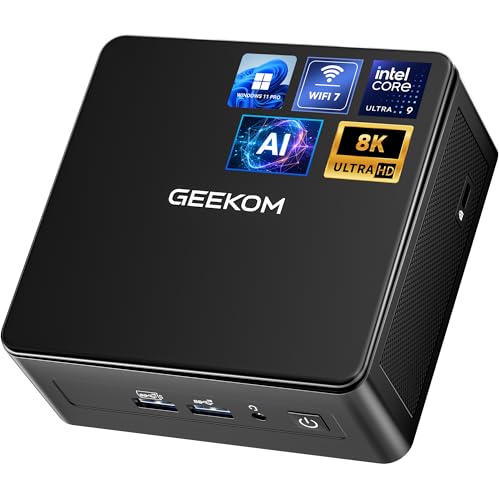
Geekom AE7 - Best Entry-Level Compact Gaming
The Geekom AE7 uses an AMD Ryzen 9 7940HX and integrated Radeon 780M graphics. It does not have a discrete GPU but the 780M is capable enough for esports titles, older AAA games, and indie releases at 1080p low-to-medium. It ships fully configured with 32 GB DDR5 and a 1 TB SSD at which undercuts most competition at this spec level. The chassis is palm-sized and passively cooled for quiet operation. For a first gaming PC, a media PC that occasionally runs games, or a secondary machine for travel, the AE7 offers honest value. Not suited to demanding modern AAA titles but a capable entry point.

Zotac ZBOX EN760 - Best Mid-Range Discrete GPU Compact
The Zotac ZBOX EN760 uses an Intel Core i7 with an NVIDIA RTX 4060 in a compact desktop chassis. At 1080p it handles all current titles at high settings with consistent frame rates. The EN760 ships barebones, requiring your own RAM and SSD, which adds a small cost but lets you configure storage to your needs. The chassis design prioritizes airflow with a mesh top panel and side vents. It has a Thunderbolt 4 port for accessories and two HDMI 2.1 outputs for dual-display setups. DLSS 3 support on the 4060 extends frame rate headroom in compatible titles. The mid-range sweet spot for buyers who want discrete GPU performance without paying for top-tier hardware.
What to look for
What to consider
Decide first between a pre-built mini PC and a DIY small form factor build. Pre-builts are faster to deploy and need no assembly; DIY SFF gives better price-per-performance and upgrade flexibility. Match the GPU tier to your target resolution: integrated graphics for casual play, RTX 4060 class for 1080p high, RTX 4070 class for 1440p. Confirm thermal headroom by checking sustained benchmarks, not just peak numbers, since compact cases stress cooling more than towers. Look for at least two M.2 slots if storage expansion matters. For living room setups, confirm the unit has an HDMI 2.1 port to support 4K HDR on a TV.
What to consider
For related picks, see our guide to [best compact PCs for gaming](/articles/best-compact-pc-for-gaming) and [best compact PC towers](/articles/best-compact-pc-tower). For how we evaluate products, visit our [methodology](/methodology).
FAQs
A mini PC (like an Intel NUC or Beelink unit) is a sealed, palm-sized box that uses laptop-class components. A small form factor (SFF) gaming PC uses desktop-class components in a compact case, typically mini-ITX. SFF builds generally have more raw power and upgradability but are larger. Mini PCs trade performance ceiling for convenience and portability.
Under sustained gaming load, most compact gaming PCs produce 35 to 50 dB, which is audible in a quiet room. High-end mini PCs with active cooling manage noise better than budget units. Some SFF cases designed for quiet builds (like the Fractal Design Ridge) keep noise under 40 dB even under load with proper fan selection.
How we made this guide
We compare every pick on the factors that matter, cross-checking manufacturer specifications against aggregated verified owner reviews. We rank independently and never take payment for placement. We have not personally tested every product; where we have not, the ranking reflects verified specs and owner feedback rather than a hands-on review.
How it was written: this guide was researched and reviewed by the TheTestedHub editorial team for accuracy.
Affiliate disclosure: TheTestedHub is reader-supported. When you buy through links on our site, we may earn a commission at no extra cost to you.
Related guides

Your Docking Station Match: CalDigit TS4 and More

Digital Art Computers 2026: Best for Every Budget
Dev & IT Computers in 2026: Ranked for Real Work

Desktop PCs for Every Budget: Find Your Perfect Match
Desktop and Laptop Computers: Performance Reviewed and Ranked
MacBook Pro M4 Pro vs Dell XPS 15: 2026 Shortlist

Buy the Best DIY Computer in 2026: Corsair One i300
