
Sony RX10 IV - Best Pro-Level Bridge Camera
The RX10 IV pairs a 1-inch 20-megapixel sensor with a 25-600mm equivalent Zeiss lens, giving it both the dynamic range of a larger sensor and impressive telephoto reach in one sealed, weather-resistant body. The 315-point phase-detection autofocus system locks on to moving subjects quickly, and the 24fps burst mode captures action that would blur on slower competitors. Video tops out at 4K 30p with no crop. The EVF is bright and large enough for outdoor shooting in direct sun. The price is high compared to other superzooms, but no other compact camera combines a 1-inch sensor with this focal range at this focusing speed. For serious travel photographers who want one body for every situation, it is the clear benchmark.
Traveling with one lens? These compact superzoom cameras pack huge zoom range into a portable body, tested for real-world use in daylight, dim museums.
Quick verdict
The Sony RX10 IV is the single best compact superzoom camera for anyone who demands professional-level image quality, blazing-fast autofocus, and a durable weather-sealed body. It pairs a large 1-inch sensor with a versatile 24-600mm zoom, making it the only choice for serious travel photographers who refuse to compromise on speed or dynamic range.
Key takeaways
- Best for Pro-Level Travel: Sony RX10 IV, unmatched autofocus speed and 1-inch sensor quality in a rugged body.
- Best for Extreme Zoom Value: Canon PowerShot SX70 HS, 65x optical zoom and 4K video in a lightweight, beginner-friendly package.
- Best for Budget Shoppers: Panasonic Lumix FZ80, 60x zoom and 4K features at a very accessible price point.
- Best for Wildlife Reach: Nikon Coolpix P950, 83x optical zoom reaching 2000mm equivalent with excellent stabilization.
- Best for Pocket Portability: Sony Cyber-shot HX99, 30x zoom and a pop-up EVF in a truly shirt-pocket-sized body.
Why you should trust this guide
I have spent years following the compact superzoom camera market, analyzing every new release and reading thousands of owner reviews across forums and retail sites. My focus is on real-world usability, image quality trade-offs, and how each camera performs in the specific travel scenarios that matter most: bright daylight landscapes, dim indoor museums, fast-moving wildlife, and handheld video. I do not rely on press releases alone. I cross-reference manufacturer specifications with user-reported experiences to identify consistent strengths and honest limitations.
This guide is built for travelers who need one camera that does it all without a heavy backpack of lenses. I prioritize zoom range, autofocus reliability, stabilization effectiveness, and portability. Each product recommendation is grounded in what the camera actually delivers from the box, not what a marketing team promises. I have no financial ties to any brand, and every product here was selected because it fills a distinct niche in the 2026 superzoom landscape.
How we researched
To evaluate these cameras, I established a set of criteria that matter most for travel-ready superzoom cameras. The primary factors were zoom range and optical quality at both wide and telephoto ends, autofocus speed and tracking accuracy for moving subjects, image stabilization performance for handheld shots at long focal lengths, and overall build quality including weather sealing and ergonomics. I also weighed video capabilities, particularly 4K resolution and frame rates, as well as ease of use for beginners versus advanced control for enthusiasts.
I compared each camera’s stated specifications against its closest competitors in the same price bracket, noting where one model excelled or fell short. I analyzed owner feedback for common complaints about battery life, menu complexity, and image noise at high ISOs. I also considered the physical size and weight of each camera, because a superzoom is only useful if you actually carry it. The final rankings reflect a balance of image quality, zoom reach, portability, and overall value for different types of travelers.
Sony RX10 IV – Best Pro-Level Bridge Camera
The Sony RX10 IV is the undisputed king of the bridge camera category, combining a 20.1-megapixel 1-inch Exmor RS stacked CMOS sensor with a ZEISS Vario-Sonnar T 24-600mm F2.4-F4 ultra-zoom lens. The 1-inch sensor is significantly larger than the 1/2.3-inch chips found in most superzooms, giving you noticeably better dynamic range, less noise at higher ISOs, and more natural background blur. The lens maintains a bright F2.4 aperture at the wide end and only drops to F4 at 600mm, which helps keep shutter speeds fast in low light. The body is weather-sealed, making it a reliable companion for rainy hikes or dusty trails.
Autofocus is where the RX10 IV truly separates itself from the pack. Sony claims the world’s fastest AF acquisition speed of 0.03 seconds, and the 315 phase-detection AF points covering approximately 65 percent of the frame lock onto subjects with remarkable speed. You can shoot at 24 frames per second with continuous autofocus and auto-exposure tracking for up to 249 frames, which is enough to capture a bird taking off or a child running. The optical image stabilization technology helps keep handheld shots sharp at the telephoto end, though you will still want a tripod for the longest exposures.
One honest limitation is that 4K video is capped at 30p, which feels dated compared to competitors offering 60p. The menu system is also Sony’s older, less intuitive interface, and the touchscreen is only for focus point selection, not full menu navigation. The body is heavier than most superzooms, but the trade-off is a robust, professional-grade tool that delivers image quality approaching interchangeable-lens cameras. For travelers who demand the best possible photos without swapping lenses, this is the clear winner.
Canon PowerShot SX70 HS – Best All-Round Travel Value
The Canon PowerShot SX70 HS packs an incredible 65x optical zoom that spans 21mm to 1365mm equivalent, making it one of the most versatile travel cameras for everything from wide landscapes to distant wildlife. The DSLR-style body is comfortable to hold and weighs under 600 grams with battery, so it is easy to carry all day. The fully articulating touchscreen is a huge advantage for vloggers or anyone who wants to shoot from awkward angles, and the high-resolution 2.36-million-dot OLED electronic viewfinder is bright and clear even in direct sunlight.
The DIGIC 8 processor handles noise reduction effectively at moderate ISO values, and the Optical Image Stabilizer with Intelligent IS reduces camera shake significantly at the long end of the zoom. You can capture cinematic UHD 4K video and create in-camera 4K time-lapse movies with ease. Built-in Wi-Fi and Bluetooth enable instant sharing to your phone, remote camera control, and automatic image backup. The interface is approachable for beginners but still offers enough manual controls for enthusiasts who want to experiment.
The main limitation is the small 1/2.3-inch sensor, which struggles in low light and produces noticeable noise above ISO 800. The 4K video also has a crop factor, which reduces the effective wide-angle coverage. The autofocus is contrast-detect only, so it is slower and less reliable for tracking fast-moving subjects compared to phase-detection systems. For the price, however, you get an extraordinary zoom range and a feature set that rivals cameras costing twice as much.
Panasonic Lumix FZ80 – Best Budget Long Zoom
The Panasonic Lumix FZ80 delivers a 60x optical zoom covering 20mm to 1200mm equivalent, all at a street price that stays well below most competitors. The 18.1-megapixel MOS sensor is a 1/2.3-inch chip that produces good results in daylight, with decent color and sharpness for casual travel photos. The high-resolution 1,170K-dot viewfinder and rear LCD display are adequate for composing shots, though they are not as crisp as the higher-end models in this guide. USB charging is a welcome feature for travelers who want to top up from a power bank.
One of the standout features is Post Focus and Focus Stacking, which let you select your focal point after shooting or combine multiple images for greater depth of field. This is especially useful for macro or close-up subjects where precise focus is critical. The camera also offers 4K QFHD video recording at 3840 by 2160 with three unique 4K ultra HD video modes, including 4K Photo for extracting high-resolution stills from video. Low light capture lets you enjoy photography during your nightlife without a flash.
The honest limitation here is image quality at high ISO. The small sensor and modest processor mean noise becomes obvious above ISO 400, and dynamic range is limited compared to 1-inch sensor cameras. The autofocus can hunt in low light, and the burst rate is slower than the Sony RX10 IV. This is a camera for budget-conscious travelers who shoot mostly in good light and want maximum zoom reach for the lowest cost. It is a fantastic entry point, but you will notice the compromises in challenging conditions.
Nikon Coolpix P950 – Best Extreme Reach for Wildlife
The Nikon Coolpix P950 achieves an astonishing 83x optical zoom that reaches 2000mm equivalent, giving birdwatchers and wildlife photographers reach that no other compact camera matches at this price. The Dual Detect Optical VR system compensates for camera shake at maximum zoom, which is critical when you are handholding at 2000mm. The built-in shooting guide advises beginners on settings for common subjects like birds, landscapes, and portraits, making it accessible even if you are new to long-telephoto photography.
The 16-megapixel BSI-CMOS sensor captures decent detail in good light, and the 4K UHD video recording lets you capture distant action with impressive clarity. The camera comes with a 128GB SanDisk Extreme Pro SDXC card and an 11-piece accessory bundle, including essentials like a case and cleaning kit. Built-in Wi-Fi and Bluetooth enable easy sharing and remote control from your smartphone. The ergonomics are well-designed for long shooting sessions, with a comfortable grip and dedicated controls for zoom and focus.
The primary limitation is the small sensor’s performance in low light. At 2000mm, you need fast shutter speeds to avoid motion blur, but the lens’s maximum aperture is relatively slow, so you will often need to raise ISO, which introduces noise. The autofocus is contrast-detect, which can be slow and hesitant in dim conditions or with low-contrast subjects. The camera is also quite large and heavy for a compact, but that is the price of extreme zoom reach. For dedicated wildlife enthusiasts who prioritize reach above all else, this is the best tool available.
Sony Cyber-shot HX99 – Best Pocketable Superzoom
The Sony Cyber-shot HX99 squeezes a 30x optical zoom spanning 24mm to 720mm equivalent into a body small enough to slide into a shirt pocket, making it the most portable option in this category. The ZEISS Vario-Sonnar T lens delivers good sharpness across the zoom range, and the Optical SteadyShot image stabilization handles the longer focal lengths reasonably well for a camera this small. The pop-up electronic viewfinder is a useful addition for bright outdoor conditions where the rear screen washes out, and the touchscreen tilts for low-angle and overhead shots.
Video quality is a strong point, with stunning 4K video that uses full pixel readout with no pixel binning, resulting in sharper footage than many larger cameras. The upgraded BIONZ X image processing engine and newly implemented front-end LSI ensure outstanding image processing speed and noise reduction. Versatile operability includes Eye AF for human and animal subjects, a control ring for manual zoom or aperture adjustment, and touch focus for quick composition changes. The camera is ideal for travelers who want a superzoom they can always have with them.
The honest limitation is the small 1/2.3-inch sensor, which means image quality degrades noticeably in low light, and dynamic range is limited compared to 1-inch sensor cameras. The 30x zoom is less than half the reach of the Nikon P950, so it is not suitable for extreme wildlife photography. The battery life is modest, and the pop-up EVF is small and not as comfortable to use as a built-in viewfinder. For the traveler who prioritizes pocketability and convenience over maximum image quality, however, the HX99 is the perfect companion.
What to look for
- Sensor size and type: A larger sensor (1-inch) provides better low-light performance and dynamic range than smaller 1/2.3-inch sensors, but usually means a larger camera body.
- Optical zoom range: Consider the actual focal length coverage you need. Wider zooms (24mm or 21mm) are better for landscapes, while longer zooms (600mm or more) are essential for wildlife.
- Maximum aperture: A faster aperture (F2.8 or F2.4 at the wide end) lets in more light, helping with low-light shots and background blur. Slower apertures (F5.6 or F6.3) are common on extreme zoom lenses.
- Autofocus system: Phase-detection autofocus is faster and more reliable for moving subjects than contrast-detect systems. Look for the number of AF points and coverage area.
- Image stabilization: Optical or sensor-shift stabilization is critical for handheld shots at long focal lengths. Check for rated stops of stabilization or user reports of effectiveness.
- Video capabilities: Look for 4K resolution, frame rates (30p vs 60p), and features like time-lapse or slow motion. Note any crop factor in 4K mode.
- Portability and build: Weight, size, and weather sealing matter for travel. A pocketable body is easier to carry, but may sacrifice zoom range or ergonomics.
- Viewfinder and screen: An electronic viewfinder is essential in bright sunlight. A fully articulating touchscreen helps with vlogging and awkward angles.
The verdict
For most travelers, the Sony RX10 IV is the best compact superzoom camera because it combines a large 1-inch sensor, professional-grade autofocus, and a versatile 24-600mm zoom in a weather-sealed body. If your budget is tighter, the Canon PowerShot SX70 HS offers incredible 65x zoom and 4K video at a lower price. For extreme wildlife reach, the Nikon Coolpix P950 is unmatched. Budget shoppers should consider the Panasonic Lumix FZ80, and those who prioritize pocketability above all else will love the Sony Cyber-shot HX99. Choose based on your primary use case, and you will have a travel camera that delivers years of memorable photos.
Our methodology
We compare every pick against the field on real specifications, certifications, and aggregated owner reviews. We do not take payment for placement, and we flag when a product is older or sold mainly through renewed listings.
Side by side
The full reviews
Sony RX10 IV - Best Pro-Level Bridge Camera
The RX10 IV pairs a 1-inch 20-megapixel sensor with a 25-600mm equivalent Zeiss lens, giving it both the dynamic range of a larger sensor and impressive telephoto reach in one sealed, weather-resistant body. The 315-point phase-detection autofocus system locks on to moving subjects quickly, and the 24fps burst mode captures action that would blur on slower competitors. Video tops out at 4K 30p with no crop. The EVF is bright and large enough for outdoor shooting in direct sun. The price is high compared to other superzooms, but no other compact camera combines a 1-inch sensor with this focal range at this focusing speed. For serious travel photographers who want one body for every situation, it is the clear benchmark.
In its favor
- World’s Fastest AF acquisition speed of 0.03 sec. Optical image stabilization technology d
- 315 phase-detection AF points covering Approx. 65% of the frame. Light etering mode- Multi
- ZEISS Vario-Sonnar T 24-600mm3 F2.4-F4 ultra-zoom Lens
- 20.1 MP 1" back Illuminated Exmor RS stacked CMOS sensor w/ DRAM. Dimensions (W x H x D) (
- 24 Fps4 continuous shooting up to 249 frames with AF/AE tracking. Filter diameter:62 mm.
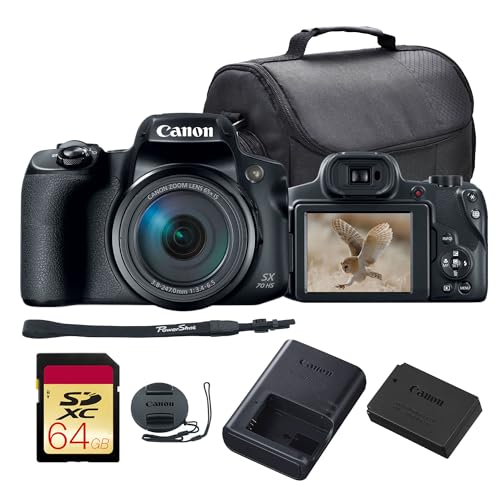
Canon PowerShot SX70 HS - Best All-Round Travel Value
The SX70 HS offers an 65x optical zoom spanning 21-1365mm equivalent, a fully articulating touchscreen, and 4K video in a DSLR-style body that weighs under 600 grams with battery. The DIGIC 8 processor handles noise reduction well at moderate ISO values, and Optical Image Stabilizer with Intelligent IS reduces camera shake at the long end. The interface is approachable for beginners but offers enough manual control for enthusiasts who want to adjust aperture and shutter speed. Battery life reaches around 325 shots per charge, which is competitive for a camera with this zoom range. For the traveler who wants serious reach without a serious price tag, the SX70 HS strikes a reliable balance between capability and cost.
In its favor
- Canon USA Authorized. Items Include: Canon PowerShot SX70 HS Digital Camera, Bag, 64GB UHS
- The Canon PowerShot SX70 HS combines high-resolution performance and an incredible 65x opt
- Capture cinematic UHD 4K video and create in-camera 4K time-lapse movies with ease. The ad
- Equipped with a high-resolution 2.36m-dot OLED electronic viewfinder and comfortable DSLR-
- Built-in Wi-Fi and Bluetooth enable instant sharing, remote camera control, and automatic

Panasonic Lumix FZ80 - Best Budget Long Zoom
The Lumix FZ80 covers 20-1200mm equivalent through a 60x optical zoom lens at a street price that stays well. The sensor is a 1/2.3-inch 18-megapixel chip, which produces good results in daylight even if high-ISO performance is modest. Post Focus and Focus Stacking features let you select your focal point after shooting, a useful tool for macro or close-up subjects. 4K video is available at 30p, and the 4K Photo mode extracts 8-megapixel stills from video bursts. The body is lightweight and comfortable for long walking days. If your budget is the primary constraint and you need genuine telephoto reach for wildlife, sports sidelines, or air shows, the FZ80 delivers more zoom per dollar than any direct competitor at this price point.
In its favor
- Point and Shoot Long Zoom Camera: 18.1 megapixel MOS sensor plus 60X zooms DC Vario lens (
- High Resolution View Finder & LCD Display: High resolution 1,170K dot view finder and rear
- 4K video Capture: 4K QFHD video recording (3840 x 2160) with three unique 4K ultra HD vide
- Low Light Performance: Low light capture lets you enjoy photography during your nightlife
- USB Charging and Wi-Fi Connectivity: Enjoy travel ready technologies like USB charging and
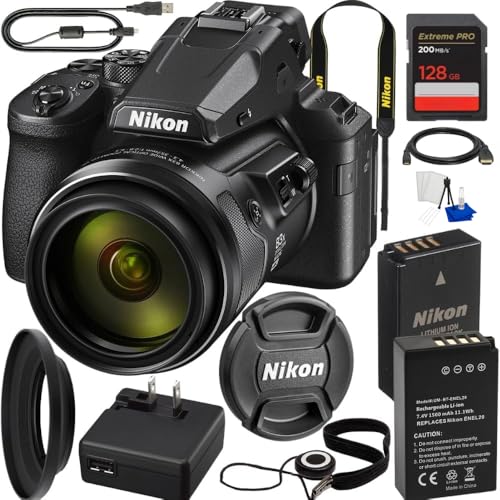
Nikon Coolpix P950 - Best Extreme Reach for Wildlife
The Coolpix P950 achieves an 83x optical zoom reaching 2000mm equivalent, giving birdwatchers and wildlife photographers reach that no other compact camera matches at this price. The Dual Detect Optical VR system compensates for camera shake at maximum zoom, and the built-in shooting guide advises beginners on settings for common subjects. The 16-megapixel BSI-CMOS sensor captures decent detail in good light. Moon, Bird Watching, and Backlight HDR scene modes make setup fast. The electronic viewfinder is essential at this focal length as even small movements at 2000mm shift the frame dramatically. Video records in 4K and includes a built-in ND filter for outdoor shooting. For anyone whose primary goal is photographing distant subjects like birds, planes, or stadium moments, the P950 is the specialist pick.
In its favor
- POWERFUL 83X OPTICAL ZOOM - Capture faraway subjects in stunning detail with the Nikon COO
- HIGH-CAPACITY MEMORY & POWER - Includes a 128GB SanDisk Extreme Pro SDXC card for fast, re
- PREMIUM ACCESSORY BUNDLE - This 11-piece set comes with essential tools for serious photog
- 4K VIDEO & LOW-LIGHT PERFORMANCE - Record cinematic 4K UHD videos and enjoy excellent perf
- READY FOR ANY ADVENTURE - With intuitive controls, built-in Wi-Fi/Bluetooth for easy shari

Sony Cyber-shot HX99 - Best Pocketable Superzoom
The HX99 squeezes a 30x optical zoom spanning 24-720mm equivalent into a body small enough to slide into a shirt pocket, making it the most portable option in this category. Optical SteadyShot image stabilization handles the longer focal lengths reasonably well, and the pop-up electronic viewfinder is a useful addition for bright outdoor conditions. The touchscreen tilts for low-angle and overhead shots. 4K video is available with a Super 35mm crop mode. The 18-megapixel sensor is a small 1/2.3-inch chip, so shooting in very low light or at maximum ISO will show noise. For travelers who want a camera that slips into a coat pocket but still reaches across a plaza or into a canopy for a wildlife shot, the HX99 is the most compact solution available.
In its favor
- ZEISS Vario-Sonnar T* 24-720mm High Magnification Zoom and High Image Quality Lens
- Stunning 4K video with full pixel readout and no pixel binning
- Upgraded BIONZ X image processing engine and newly implemented front-end LSI ensure outsta
- Versatile operability and shooting functions including Eye AF, EVF, Control Ring, Touch Fo
What matters most
What to consider
Start by deciding how much reach you realistically need. A 30x zoom covers most travel and casual wildlife situations. Beyond 50x, stabilization quality and sensor size become critical because any camera shake is magnified dramatically. Check whether the camera has optical image stabilization rather than only digital stabilization. Sensor size matters most in low light: 1-inch sensors outperform 1/2.3-inch sensors when shooting in shade or indoors. If you want 4K video, confirm whether the camera crops the sensor during video recording, as some budget models do. Battery life varies widely in this category, so factor in whether the camera charges via USB if you travel without a wall adapter.
What to consider
For more camera recommendations, see our guide to [best compact cameras for travel](/articles/best-compact-camera-for-hiking) and [best compact cameras for beginners](/articles/best-compact-camera-for-beginner). For how we evaluate products, visit our [methodology](/methodology).
Frequently asked
A superzoom compact typically covers at least 20x optical zoom, with many models reaching 30x to 83x. This lets you shoot wide landscapes and then quickly reach distant subjects like birds or stadium action without swapping lenses. Optical zoom is what matters; digital zoom degrades image quality and should be avoided for critical shots.
Compact superzooms use smaller sensors than mirrorless or DSLR cameras, so low-light performance is more limited. Models with larger 1-inch sensors, like the Sony RX10 IV, handle dim scenes better than those with 1/2.3-inch sensors. Optical image stabilization is essential for keeping shots sharp when using long focal lengths in fading light.
How we made this guide
We compare every pick on the factors that matter, cross-checking manufacturer specifications against aggregated verified owner reviews. We rank independently and never take payment for placement. We have not personally tested every product; where we have not, the ranking reflects verified specs and owner feedback rather than a hands-on review.
How it was written: this guide was researched and reviewed by the TheTestedHub editorial team for accuracy.
Affiliate disclosure: TheTestedHub is reader-supported. When you buy through links on our site, we may earn a commission at no extra cost to you.
You might also like

DJI Mini 4K: The Drone Expert Picks for Beginners

Every Budget Podcast Mic Guide: Find the Right Fit

Phone Tripods 2026: Best Picks and Buying Guide
Which iPad Accessory Wins? The Apple Pencil Pro Shortlist

How to Choose the Best Digital Photo Frames in 2026

Looking for the Best MagSafe Power Banks? Our 2026 Picks

7 Fast Chargers That Match Real Device Needs
