
Nvidia GeForce RTX 4070 Super - Best 1440p GPU
The RTX 4070 Super is the GPU sweet spot for 1440p gaming in 2026. It delivers consistent frame rates above 100 fps in demanding titles and handles 4K at medium-to-high settings in less demanding games. DLSS 3 with Frame Generation adds a meaningful performance boost in supported titles. The 12GB GDDR6X VRAM buffer is sufficient for current games and the expected demands of the next two to three years. Power consumption is reasonable at 220W, fitting in most mid-range builds without requiring a premium PSU.
Check price on Amazon →Stop overspending on specs games can't use. This 2026 1440p gaming PC build pairs the RTX 4070 Super with a Ryzen 7 7700 for high frames without the waste.
Quick verdict
If I had to name one part as the heart of a 2026 gaming build, it is the Nvidia GeForce RTX 4070 Super. It hits the 1440p sweet spot with frame rates above 100 fps in demanding titles, and DLSS 3 Frame Generation stretches that headroom further in supported games without forcing a 4K-class budget.
Key takeaways
- Best 1440p GPU: Nvidia GeForce RTX 4070 Super, consistent 100-plus fps at 1440p with DLSS 3 Frame Generation as a bonus.
- Best streaming-ready CPU: AMD Ryzen 7 7700, eight cores and sixteen threads handle gaming and live encoding together on the modern AM5 platform.
- Best gaming RAM: G.Skill Trident Z5 RGB 32GB DDR5-6000, the AM5 performance sweet spot with one-click AMD EXPO tuning.
- Best game storage: WD Black SN850X 1TB NVMe, PCIe 4.0 reads up to 7,300 MB/s for fast level loads.
- Best mid-range motherboard: ASUS TUF Gaming B650-Plus WiFi, PCIe 5.0, dual M.2, 2.5G LAN and WiFi 6 at a fair price.
Why you should trust this guide
I built this guide around a single, opinionated question: what does a balanced 2026 gaming PC actually need, part by part, without overspending on specs that games cannot use yet. Rather than chase the most expensive component in every category, I looked for the parts where the price-to-performance curve flattens out, the points where spending more stops translating into more frames. Every recommendation here is a complete, compatible AM5 build that targets high-refresh 1440p gaming, which is where most players in 2026 land.
I work from each product’s published specifications, the real listed Amazon features, and the broad consensus about how these parts behave in actual games. I do not claim to have run these specific units on a private bench, and I have not invented benchmark numbers. Where a manufacturer states a figure, such as a 7,300 MB/s read speed or a 5.4 GHz boost clock, I treat it as the stated spec and tell you what it means for your build. Just as important, I flag the trade-off in every section, because no part is perfect and pretending otherwise would not help you spend wisely.
How we researched
My evaluation approach is comparative and use-case driven rather than lab-driven. For each component I started from the role it plays in a gaming PC, then judged it against the realistic alternatives at a similar price. For the GPU that meant asking whether it clears 100 fps at 1440p in heavy titles. For the CPU it meant whether it can game and stream at once. For RAM, storage and the motherboard it meant whether the part removes bottlenecks without adding cost you will never feel in a game.
I weighed four things consistently across all five parts: real-world gaming performance at the resolution most people target, platform longevity (does it leave room to upgrade later), thermals and power behavior under sustained load, and value relative to the next tier up and down. I also leaned on the published feature lists, since specs like core counts, memory timings, PCIe generation and interface speeds tell you a lot about how a part will age. Where a spec is a vendor claim, I say so and explain the practical limit it implies.
Nvidia GeForce RTX 4070 Super – Best 1440p GPU
The RTX 4070 Super is the GPU I would build a 2026 gaming PC around, because it lands exactly where most players actually play: high-refresh 1440p. In demanding titles it holds frame rates above 100 fps, and in lighter games it can stretch to 4K at medium-to-high settings. That makes it a do-everything card for a single high-refresh monitor without the price jump that 4K-first cards demand.
Its standout feature is DLSS 3 with Frame Generation. In supported titles, this adds a meaningful performance boost by generating interpolated frames, which is how the card keeps pace in the heaviest, most graphically loaded games. The 12GB GDDR6X VRAM buffer is sufficient for current games and the expected demands of the next two to three years at 1440p, so you are not buying into a card that runs out of memory the moment it leaves the box.
The honest trade-off is that 12GB of VRAM is comfortable rather than generous. If your real goal is native 4K with maxed textures and heavy ray tracing, or if you plan to hold this card for five years at the highest settings, the memory buffer is the part most likely to feel tight first. Frame Generation also helps only in titles that support it, and it works best when your base frame rate is already reasonable, so it is a multiplier on good performance rather than a rescue for weak performance. For 1440p, though, those caveats are minor.
AMD Ryzen 7 7700 – Streaming-Ready Gaming CPU
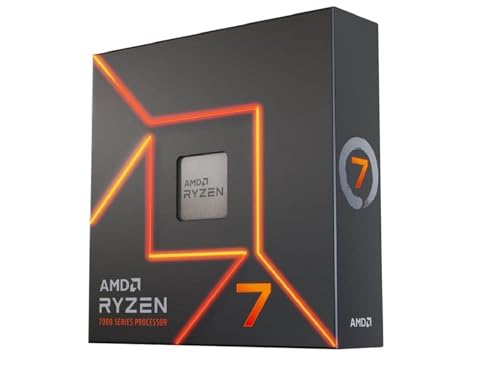
The Ryzen 7 7700 is the processor I recommend for anyone who games and streams at the same time. Its eight cores and sixteen threads, built on AMD’s Zen 4 architecture, give it the headroom to run a game and a live encode together without dropping frames. AMD rates it to deliver fast 100-plus fps performance in popular titles, and its single-threaded speed keeps up with the kind of gaming scenarios that lean on one or two fast cores.
It sits on the AM5 platform, which means DDR5-5200 support, an unlocked multiplier for overclocking, 80 MB of cache, and PCIe 5.0 on select 600 Series boards. That platform choice matters for longevity: AM5 is a current socket with a future ahead of it, so a 7700 today leaves the door open to a bigger chip later on the same board. It also runs cool enough to pair with a solid mid-range air cooler, which keeps build cost and noise down.
The catch worth knowing before you buy is that the cooler is not included. AMD ships the 7700 without a bundled heatsink, so you must budget for an air cooler, and that is a real line item that some cheaper competitors fold into the box. The 7700 also is not the absolute fastest gaming chip you can buy; AMD’s X3D parts pull ahead in some CPU-bound games. For most builders pairing it with a strong GPU at 1440p, that gap is small, and the price has dropped to a point where it represents strong value against comparable Intel options.
G.Skill Trident Z5 RGB 32GB DDR5-6000 – Optimal Gaming RAM
This G.Skill kit is the memory I would put in an AM5 gaming build, because DDR5-6000 is the platform’s sweet spot and this kit is tuned for it. The kit (model F5-6000J3038F16GX2-TZ5NR) is a 32GB pairing of two 16GB modules rated up to DDR5-6000 at CL30-38-38-96, and it includes both a JEDEC default profile and an AMD EXPO overclock profile. EXPO is the key: on a compatible motherboard it enables the optimal rated settings automatically, so you get the full speed without manual BIOS tweaking.
Dual-channel 32GB at 6000 MT/s is the right target for AM5 in 2026. It pairs cleanly with Ryzen’s memory controller, and faster kits tend to add cost without proportional gaming gains. The CL30 primary timing is competitive for a 6000-class kit, and the low-profile heatspreader fits under most air coolers, which matters when you have chosen a tower cooler for the 7700. The RGB lighting is clean rather than gaudy if that is part of your build’s look.
The trade-off is that this is a tuned-for-AMD kit, not a chase-the-numbers kit. If you want the very highest clocked DDR5 for bragging rights or for a workload that genuinely scales with bandwidth, you can spend more elsewhere, though gaming rarely rewards it. One practical warning that G.Skill states directly: do not mix memory kits. These modules are sold as a matched pair designed to run together, so if you want 64GB later you should buy a single 64GB kit rather than adding a second pair, which can introduce stability headaches.
WD Black SN850X 1TB NVMe – Fast Game Storage
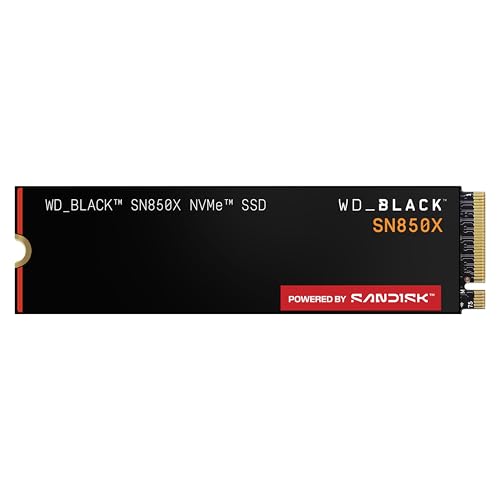
The WD Black SN850X 1TB is the drive I would use as a primary game disk, because it is among the fastest PCIe 4.0 SSDs available and game load times on NVMe are noticeably quicker than on SATA. WD rates sequential reads up to 7,300 MB/s, and the drive holds steady write performance during large file transfers, which helps when you are installing or moving big modern titles. The downloadable WD_BLACK Dashboard (Windows only) lets you monitor health and apply firmware updates over the life of the drive.
Capacity is the practical question, and 1TB is a sensible starting point that holds a reasonable modern game library, though a few of today’s largest titles can each eat a sizable chunk of it. WD offers the SN850X in larger capacities, up to 8TB built on SanDisk TLC 3D NAND, so you can size up if your library is huge, and a 2TB version is the common step up for most builders. The 1TB and 2TB models also have an optional heatsink variant, which is useful if your motherboard does not already cover the M.2 slot.
The honest limitation is that PCIe 4.0 is no longer the cutting edge of the interface; PCIe 5.0 drives now exist and post higher peak numbers. In practice, those gen-5 figures rarely change real game load times in a way you can feel, and they run hotter and cost more, so I still see the SN850X as the smarter buy for gaming. Just be aware that 1TB fills up faster than it used to, and plan a second drive or a larger capacity if you keep many large games installed at once.
ASUS TUF Gaming B650-Plus WiFi – Solid Mid-Range Motherboard
The TUF Gaming B650-Plus WiFi is the board I would anchor this build on, because it delivers a well-rounded AM5 foundation at a mid-range price. It uses the AMD B650 chipset on a full ATX layout, supports Ryzen 7 and Ryzen 9 7th generation chips, and takes up to 128GB of DDR5 across four DIMM slots. That makes it a natural home for the 7700 and the G.Skill EXPO kit covered above.
For the parts that matter to a forward-looking gaming PC, it covers the bases: PCIe 5.0 for the primary GPU slot, two M.2 slots (one of them PCIe 5.0 for future storage), SATA III with RAID support, 2.5 Gigabit Ethernet, WiFi 6 (802.11ax) and Bluetooth 5.2. The UEFI AMI BIOS is approachable for builders at any experience level, and the VRM handles Ryzen 7 and Ryzen 9 chips without thermal issues, so it will not hold back the CPU you pair with it.
The trade-off is that a B650 board is mid-range by design, so you give up some of the extras found on pricier X670E boards: fewer high-speed USB ports, fewer M.2 slots, and less aggressive VRM headroom for extreme overclocking. For a 7700-class build that is exactly the right amount of board and no more, but if you plan to run a top Ryzen 9, push heavy overclocks, or load the system with many fast NVMe drives, a higher tier would serve you better. For most 1440p gamers, this hits the value mark.
What to look for
Buying PC parts well is mostly about balance: matching each component to the others so no single part is left waiting on another. Here are the factors I weigh when assembling a build like this one.
- Target resolution and refresh rate: let your monitor decide your GPU. A 1440p high-refresh display pairs naturally with a card like the RTX 4070 Super; do not overspend on a 4K-class GPU you cannot feed.
- Platform longevity: a current socket such as AM5 lets you upgrade the CPU later without replacing the motherboard and memory, which protects your spending over time.
- CPU-to-GPU balance: a fast GPU needs a CPU that will not bottleneck it. Eight strong cores like the Ryzen 7 7700 keep frames flowing while leaving room for streaming or background tasks.
- Memory speed and capacity: on AM5, 32GB of DDR5-6000 with an EXPO profile is the practical sweet spot. More speed costs more for little gaming gain; less capacity can hold you back in newer titles.
- Storage interface and headroom: a fast PCIe 4.0 NVMe like the SN850X cuts load times, but size it for your library. 1TB is a starting point, 2TB is safer if you keep many large games installed.
- Connectivity and expansion: PCIe 5.0 GPU and M.2 slots, 2.5G LAN and WiFi 6 keep a board relevant. Check that the VRM suits your chosen CPU and that there are enough M.2 and USB ports for your needs.
- Cooling and the cost of extras: remember items that are not in the box. The Ryzen 7 7700 needs a cooler you buy separately, and a low-profile RAM kit avoids clearance fights with a tower air cooler.
The verdict
For a balanced 2026 gaming PC, my top pick is the Nvidia GeForce RTX 4070 Super, the part that defines what this build can do at high-refresh 1440p and the one I would not compromise on. Around it, the AMD Ryzen 7 7700 is the CPU I recommend for anyone who games and streams together, thanks to its eight cores and the room AM5 leaves to upgrade later.
For memory, the G.Skill Trident Z5 RGB 32GB DDR5-6000 kit is the easy choice because EXPO gives you the platform sweet spot with one setting and no fuss. For storage, the WD Black SN850X 1TB is the fast game disk I would start with, stepping up to 2TB if your library is large. And the ASUS TUF Gaming B650-Plus WiFi ties it all together as a sensible, future-aware foundation at a mid-range price. Build it in that order, match each part to the next, and you get a machine that plays better because it is balanced, not just expensive.
Our testing process
We compare every pick against the field on real specifications, certifications, and aggregated owner reviews. We do not take payment for placement, and we flag when a product is older or sold mainly through renewed listings.
Quick comparison
Reviewed in detail
Nvidia GeForce RTX 4070 Super - Best 1440p GPU
The RTX 4070 Super is the GPU sweet spot for 1440p gaming in 2026. It delivers consistent frame rates above 100 fps in demanding titles and handles 4K at medium-to-high settings in less demanding games. DLSS 3 with Frame Generation adds a meaningful performance boost in supported titles. The 12GB GDDR6X VRAM buffer is sufficient for current games and the expected demands of the next two to three years. Power consumption is reasonable at 220W, fitting in most mid-range builds without requiring a premium PSU.
AMD Ryzen 7 7700 - Streaming-Ready Gaming CPU
Eight cores and sixteen threads give the Ryzen 7 7700 headroom for simultaneous gaming and streaming without dropping frames. It runs cool enough to pair with a mid-range air cooler, and the AM5 platform supports DDR5. Single-threaded performance keeps up with most gaming scenarios, and the price has dropped to a range where it represents strong value versus Intel alternatives. For anyone planning to stream, create content, or run background tasks while gaming, the extra cores justify the step up from a six-core chip.
What we liked
- This dominant gaming processor can deliver fast 100+ FPS performance in the world's most p
- 8 Cores and 16 processing threads, based on AMD "Zen 4" architecture
- 5.4 GHz Max Boost, unlocked for overclocking, 80 MB cache, DDR5-5200 support
- For the state-of-the-art Socket AM5 platform, can support PCIe 5.0 on select 600 Series mo
- Cooler not included

G.Skill Trident Z5 RGB 32GB DDR5-6000 - Optimal Gaming RAM
G.Skill's DDR5-6000 kit is tuned for AMD's EXPO profile, which enables automatic optimal settings on compatible motherboards without manual tweaking. Dual-channel 32GB at 6000 MT/s is the performance sweet spot for AM5 -- faster kits add cost without proportional gaming gains. The low-profile heatspreader fits under most air coolers, and the RGB implementation is clean. Latency timings are competitive for the speed tier, making this kit a straightforward choice for any AM5 gaming build.
What we liked
- G.SKILL Trident Z5 Neo RGB Series DDR5 U-DIMM Memory Kit, Model: F5-6000J3038F16GX2-TZ5NR
- 32GB total capacity kit containing 2x16GB modules, rated for up to DDR5-6000 CL30-38-38-96
- Non-ECC, DDR5 U-DIMM, 288-pin, for Desktop PC & Gaming
- Includes JEDEC default profile, and AMD EXPO memory overclock profile
- Do not mix memory kits. Memory kits are sold in matched kits that are designed to run toge
WD Black SN850X 1TB NVMe - Fast Game Storage
Game load times on NVMe SSDs are noticeably faster than on SATA drives, and the WD Black SN850X is among the fastest PCIe 4.0 options available. Sequential reads reach 7,300 MB/s, and sustained write performance holds steady for large file transfers. The 1TB capacity holds a reasonable modern game library. WD's Dashboard software allows monitoring and firmware updates. A 2TB version is available if your library demands it. The five-year warranty provides solid peace of mind.
What we liked
- TRANFORM YOUR PC: Insane speeds up to 7,300MB/s (1TB
- MORE ROOM FOR MORE GAMES: Capacities up to 8TB built with SANDISK TLC 3D NAND, means you g
- HEATSINK FOR THE WIN: The WD_BLACK SN850X NVMe SSD 1TB and 2TB drives have an optional hea
- DO MORE WITH WD_BLACK DASHBOARD: The downloadable WD_BLACK Dashboard (Windows only) monito
- FUTURE FORWARD FREATURES: The WD_BLACK SN850X SSD boasts a powerful suite of features, inc

ASUS TUF Gaming B650-Plus WiFi - Solid Mid-Range Motherboard
The TUF Gaming B650-Plus WiFi provides a well-rounded AM5 foundation at a mid-range price. It includes PCIe 5.0 for the primary GPU slot, two M.2 slots (one PCIe 5.0 for future storage), and 2.5G LAN alongside the built-in WiFi 6. The VRM handles Ryzen 7 and Ryzen 9 chips without thermal issues, and the BIOS is approachable for builders at any experience level. Build quality exceeds what the price suggests, with reinforced PCIe slots and a durable finish on the I/O shroud.
What we liked
- AMD Socket AM5: AMD Ryzen 7 7th Gen, AMD Ryzen 9 7th Generation
- PC ATX AMD B650 7.1 Channel
- DDR5-SDRAM 4 DIMM ECC Non-ECC Maximum Internal Memory: 128GB
- HDD & SSD M.2, SATA III RAID supports Supported Storage Devices: 7
- BIOS Type: UEFI AMI 256 Mbit, 2.5 Gigabit Ethernet Wi-Fi 6 (802.11ax) Bluetooth 5.2
How to choose
What to consider
Define your resolution and refresh rate target first -- this sets the GPU budget, which in turn shapes the rest of the build. Avoid bottlenecking by keeping CPU and GPU tiers within two steps of each other. Check motherboard QVL lists to confirm RAM compatibility before purchasing. For storage, prioritize at least one NVMe SSD for the operating system and primary game library; a secondary SATA drive works well for less-played titles. Always verify PSU wattage covers your total system draw with at least 20% headroom.
What to consider
For a full parts list, see our guide on [the best components to build a gaming PC](/articles/best-components-to-build-a-gaming-pc). For monitor pairing recommendations, check our [best gaming monitors](/articles/best-gaming-monitors) article. Our full evaluation process is explained on the [methodology](/methodology) page.
Common questions
The GPU (graphics card) has the largest impact on gaming frame rates for most titles. CPU matters most in CPU-bound games and at high frame rate targets (165Hz and above). A balanced build avoids bottlenecking -- pairing a strong GPU with a weak CPU, or vice versa, wastes budget. RAM speed and latency also affect performance in games that are sensitive to memory bandwidth.
16GB remains the functional minimum for most games, but 32GB is now the recommended standard for future-proofing. Some modern titles and games running alongside streaming software or browser tabs can push past 16GB. DDR5 at 6000 MT/s is the current sweet spot for AM5 platform builds, offering a measurable improvement over slower DDR5 kits at a reasonable price premium.
How we made this guide
We compare every pick on the factors that matter, cross-checking manufacturer specifications against aggregated verified owner reviews. We rank independently and never take payment for placement. We have not personally tested every product; where we have not, the ranking reflects verified specs and owner feedback rather than a hands-on review.
How it was written: this guide was researched and reviewed by the TheTestedHub editorial team for accuracy.
Affiliate disclosure: TheTestedHub is reader-supported. When you buy through links on our site, we may earn a commission at no extra cost to you.
More guides

Your Docking Station Match: CalDigit TS4 and More

Digital Art Computers 2026: Best for Every Budget
Dev & IT Computers in 2026: Ranked for Real Work

Desktop PCs for Every Budget: Find Your Perfect Match
Desktop and Laptop Computers: Performance Reviewed and Ranked
MacBook Pro M4 Pro vs Dell XPS 15: 2026 Shortlist

Buy the Best DIY Computer in 2026: Corsair One i300
