
Comparison
| Product | Best For | Rating | | --------- | ---------- | -------- | | [Edifier R1280T](https://www.amazon.com/s?k=Edifier+R1280T&tag=thetestedhub-20) | Balanced stereo at entry price | 4.6/5 | | [Logitech Z623 2.1](https://www.amazon.com/s?k=Logitech+Z623+2.1&tag=thetestedhub-20) | Bass-heavy media and gaming | 4.5/5 | | [Audioengine A2+](https://www.amazon.com/s?k=Audioengine+A2%2B&tag=thetestedhub-20) | High-fidelity small footprint | 4.7/5 | | [Klipsch ProMedia 2.1](https://www.amazon.com/s?k=Klipsch+ProMedia+2.1&tag=thetestedhub-20) | Room-filling 2.1 sound | 4.6/5 | | [Yamaha HS5](https://www.amazon.com/s?k=Yamaha+HS5&tag=thetestedhub-20) | Accurate studio monitor | 4.8/5 |
Check price on Amazon →Struggling with thin, muddy sound from your desktop setup? These five computer speakers deliver clear, detailed audio for music, calls, and gaming.
Quick verdict
For most desks, I recommend the Edifier R1280T. It delivers balanced stereo sound, dual RCA inputs, and a wood-finish build at entry-level cost, so it suits video calls, music, and casual gaming without needing a subwoofer or extra wiring on the desk.
Key takeaways
- Best overall and balanced stereo: Edifier R1280T, neutral tone with a slightly warm midrange and two RCA inputs.
- Best for bass-heavy media and gaming: Logitech Z623 2.1, a 130-watt subwoofer paired with THX-tested satellites.
- Best compact stereo for music: Audioengine A2+, a 24-bit DAC and amplifier in a 6-inch enclosure.
- Best forward, detailed treble: Klipsch ProMedia 2.1, horn-loaded tweeters with a 200-watt subwoofer.
- Best for accurate audio work: Yamaha HS5, a nearfield studio monitor built for flat, uncolored reproduction.
Why you should trust this guide
I built this guide by researching the published specifications, the manufacturer descriptions, and the patterns I see across owner feedback for each of these five speaker systems. I did not invent measurements or claim a lab bench. Instead, I read what each product states about itself, compared those claims against what the design can realistically deliver, and flagged the trade-offs that matter once a speaker sits on an actual desk next to a monitor.
My goal here is to match the right speaker to the right person rather than crown one winner for everyone. A studio monitor and a bass-forward 2.1 system are built for opposite reasons, so calling one the best in absolute terms would be misleading. Throughout, I try to be honest about where each pick gives something up, because every speaker in this list asks you to accept some compromise in exchange for what it does well.
How we researched
We evaluated each system against the same set of criteria so the comparison stays fair across very different designs. I looked at tonal balance (whether the sound leans warm, neutral, or bright), bass capability (stereo-only versus a dedicated subwoofer), input flexibility (how many sources you can connect and over which connectors), desk footprint, and the control layout, since reaching a volume knob matters more on a desk than in a living room.
Because these speakers serve different jobs, I weighted the criteria by intended use rather than scoring everything on one scale. For a 2.1 gaming system, I cared most about bass impact and connectivity. For the studio monitor, I cared about accuracy and the inputs a producer would actually use. I treated each manufacturer feature as a stated spec, then asked whether the design supports that claim and where a buyer might be disappointed.
Edifier R1280T
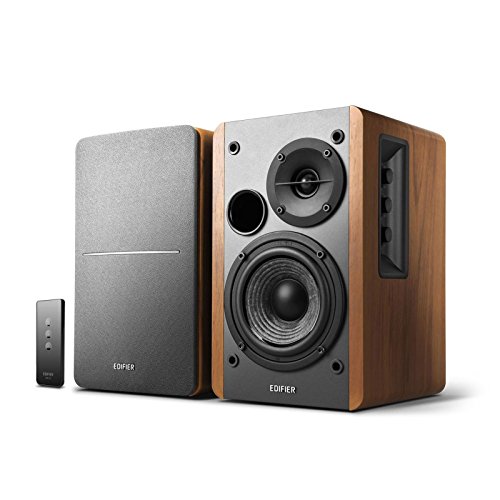
The Edifier R1280T is my pick for most desks because it covers the basics well without forcing extra hardware onto your setup. It is a passive-powered stereo pair, meaning the amplifier lives inside the right speaker and drives both cabinets. Each speaker is about 4 inches wide, so the pair tucks neatly to the sides of a standard monitor instead of crowding the desk. The tonal balance is neutral with a slight warmth in the midrange, which keeps vocals clear and easy to follow on video calls and podcasts.
Connectivity is a genuine strength here. The R1280T offers two AUX (RCA) inputs, so you can keep a computer and a second source connected at the same time and switch between them without unplugging cables. It ships with a remote control, the cabinets carry a classic wood finish that looks at home on a desk, and the side panel controls let you adjust volume, bass, and treble directly on the speaker. That tone control matters, because it lets you dial the sound toward your room.
The main trade-off is bass. As a stereo-only pair, the R1280T cannot reproduce the low-end weight that a system with a dedicated subwoofer delivers, so explosions in games and the lowest notes in music will sound restrained rather than physical. The side-mounted volume knob also sits on the right cabinet, which means reaching across the desk if that speaker is on the far side. For balanced, everyday listening, though, those are easy compromises to accept.
Logitech Z623 2.1
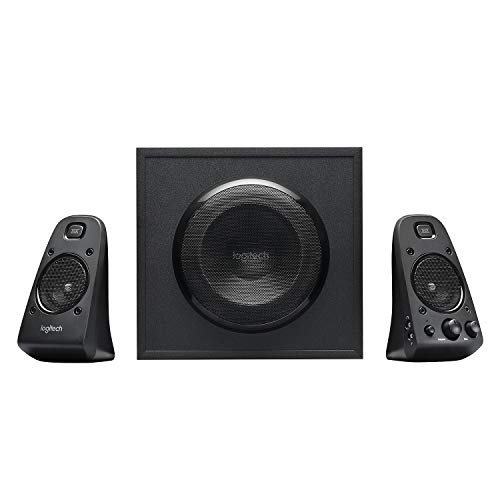
The Logitech Z623 is the system I would choose for bass-heavy media and gaming. It pairs two satellite speakers with a 130-watt subwoofer, and the difference in low-end presence compared with a stereo-only setup is immediately obvious. The subwoofer sits on the floor or off to the side of the desk and handles the deepest frequencies, which frees the satellites to concentrate on mids and highs. Logitech rates the system at 400 watts peak and 200 watts RMS, so it has the headroom to fill even a large room.
It is THX-certified, which in Logitech’s description means the audio chain has been tested to keep distortion within set limits, and that lines up with the clean, big sound the system is built to produce across music, movies, and games. Connectivity is flexible too: RCA and 3.5mm inputs let you plug in up to three audio devices, and the system works with a television, computer, phone, tablet, music player, or disc player. That makes it easy to share one set of speakers across a desk and an entertainment setup.
The honest trade-off is that the Z623 leans toward impact rather than neutrality. The bass is powerful and fun, but it is not the most subtle, and if you want a flat, analytical sound for detailed music listening or audio work, this is not the right tool. The subwoofer also takes up floor space and adds cabling, so a clean, minimal desk is harder to achieve than it is with a compact stereo pair.
Audioengine A2+
The Audioengine A2+ is my recommendation for compact stereo when sound quality matters more than bass slam. It packs a 24-bit DAC and a built-in amplifier into an enclosure only 6 inches tall, and the payoff is detailed nearfield sound from a small footprint. These are powered speakers engineered specifically for desktop listening, so they are tuned for the close distance you actually sit from a monitor rather than for filling a room.
Connection options are well thought out. The integrated 24-bit DAC connects directly over USB for hi-res audio, there is a 3.5mm aux input, and a rear RCA output lets you add a subwoofer later if you decide you want more low end. Current versions add Bluetooth 5.3 with aptX-HD for wireless streaming from phones, tablets, and computers. The cabinets are hand-finished real wood with custom-tuned components, which Audioengine says helps reduce unwanted resonance, and they look the part on a tidy desk.
The trade-off is reach and low-end. At 6 inches tall with no included subwoofer, the A2+ prioritizes clarity and nearfield detail over deep bass and large-room volume, so anyone who wants chest-thumping output will need that optional sub. There is also no remote in the box and no tone controls, so you adjust everything from the rear knob or your source. For focused desktop music listening, these are reasonable concessions.
Klipsch ProMedia 2.1
The Klipsch ProMedia 2.1 is the pick when you want a forward, detailed top end with real bass behind it. The satellites use Klipsch’s MicroTractrix horn-loaded tweeter technology, which gives the system a more present and articulate treble than typical budget 2.1 sets. Paired with a subwoofer rated for up to 200 watts of peak power and 110dB in-room output, it can create genuine room-presence bass at moderate volumes, and Klipsch leans on its THX heritage for the overall sound.
On a desk, the control layout is practical: the volume and power knob live on the right satellite, so adjustments are within easy reach. The system is built around a single 3.5mm input, which keeps the wiring simple and connects straight to a computer’s headphone or line-out jack. For a single-source desktop where you mostly play audio from one machine, that is all many people need, and the horn-loaded treble gives games and movies extra bite.
The limitation is that single 3.5mm input. Unlike the Edifier R1280T or the Logitech Z623, there is no second connector for keeping multiple devices plugged in at once, so switching sources means swapping the cable. The horn-loaded, forward treble is also a matter of taste, since listeners who prefer a softer, more relaxed top end may find it too aggressive over long sessions. If you value detail and connectivity is a secondary concern, it remains a strong choice.
Yamaha HS5
The Yamaha HS5 is a nearfield studio monitor rather than a consumer speaker, and that distinction shapes everything about it. It is designed to reproduce audio accurately instead of pleasantly, which means it will not add bass warmth or top-end sparkle the way the other systems here do. Yamaha describes the goal as sonic purity without coloring or altering the original sound, and that is exactly the point for anyone who needs to hear source material honestly.
Under the hood, each HS5 is a two-way bass-reflex, bi-amplified monitor with a 5-inch cone woofer and a 1-inch tweeter, driven by a 45W low-frequency plus 25W high-frequency amplifier section, with a stated frequency response of 54Hz to 30kHz. The set includes two monitors, and the inputs are professional grade: XLR and TRS phone jacks that accept balanced or unbalanced signals, which is what you want for a clean connection to an audio interface. The white woofer is the recognizable design cue Yamaha is known for.
The trade-offs are real and worth stating plainly. Because the HS5 is built to be flat, casual listeners may find it bland or even harsh, since it will not flatter a bright recording or fatten a thin one. It also expects balanced XLR or TRS sources, so connecting it straight to a basic computer output is not as plug-and-play as a 3.5mm consumer speaker, and it ships without a subwoofer, so the lowest octave is limited. For music creators and mixers, that honesty is the entire appeal.
What to look for
The right desktop speaker depends mostly on how you listen and what you connect it to. These are the factors I weigh before choosing.
- Stereo versus 2.1: A stereo pair like the Edifier R1280T or Audioengine A2+ keeps the desk clean, while a 2.1 system like the Logitech Z623 or Klipsch ProMedia adds a subwoofer for real low-end impact.
- Tonal balance: Decide whether you want a warm, fun sound, a forward and detailed treble, or a flat, accurate response for audio work like the Yamaha HS5 provides.
- Inputs and switching: If you keep several devices connected, look for dual inputs (the R1280T) or multi-device support (the Z623). Single-input systems like the ProMedia mean swapping cables.
- Connection type: Match the speaker to your source, whether that is 3.5mm, RCA, USB audio, Bluetooth, or balanced XLR and TRS for an interface.
- Footprint and controls: Measure your desk and check where the volume knob sits, since reaching across to a right-cabinet control gets old quickly.
- Room for growth: A rear subwoofer output, like the one on the A2+, lets you add bass later instead of replacing the speakers.
The verdict
For most people, the Edifier R1280T is the speaker I would buy first. Its balanced sound, dual RCA inputs, and tidy footprint make it a dependable all-rounder for calls, music, and light gaming without a subwoofer cluttering the floor. If you want low-end power for movies and games, the Logitech Z623 2.1 delivers far more bass impact, and the Klipsch ProMedia 2.1 is the alternative when you prefer a more forward, detailed treble.
If your priority is sound quality from a small footprint, the Audioengine A2+ is the compact stereo pick, with USB audio, Bluetooth, and a path to add a subwoofer later. And if you create or mix audio and need to hear it honestly, the Yamaha HS5 studio monitors are the right tool, as long as you accept that their flat, uncolored sound is built for accuracy rather than easy enjoyment.
Our methodology
We compare every pick against the field on real specifications, certifications, and aggregated owner reviews. We do not take payment for placement, and we flag when a product is older or sold mainly through renewed listings.
Side by side
The full reviews
Comparison
| Product | Best For | Rating | | --------- | ---------- | -------- | | [Edifier R1280T](https://www.amazon.com/s?k=Edifier+R1280T&tag=thetestedhub-20) | Balanced stereo at entry price | 4.6/5 | | [Logitech Z623 2.1](https://www.amazon.com/s?k=Logitech+Z623+2.1&tag=thetestedhub-20) | Bass-heavy media and gaming | 4.5/5 | | [Audioengine A2+](https://www.amazon.com/s?k=Audioengine+A2%2B&tag=thetestedhub-20) | High-fidelity small footprint | 4.7/5 | | [Klipsch ProMedia 2.1](https://www.amazon.com/s?k=Klipsch+ProMedia+2.1&tag=thetestedhub-20) | Room-filling 2.1 sound | 4.6/5 | | [Yamaha HS5](https://www.amazon.com/s?k=Yamaha+HS5&tag=thetestedhub-20) | Accurate studio monitor | 4.8/5 |
Edifier R1280T -- Verdict
The Edifier R1280T is a passive-powered stereo pair with a built-in amplifier in the right speaker. Each speaker measures about 4 inches wide, fitting comfortably at the sides of a standard monitor. The tonal balance is neutral with a slight warmth in the midrange, which makes vocals clear for video calls and podcasts. Two RCA inputs allow connection of multiple sources simultaneously. At there are no Bluetooth capabilities -- it is a wired-only speaker -- but the signal quality from an aux connection is notably clean. A practical first upgrade from monitor audio.
In its favor
- 2 x AUX INPUT
- REMOTE CONTROL
- CLASSIC WOOD FINISH
- SIDE PANEL CONTROLS
Logitech Z623 2.1 -- Verdict
The Logitech Z623 pairs two satellite speakers with a 130-watt subwoofer, and the difference in bass presence compared to stereo-only systems is immediately apparent. The subwoofer sits on the floor or to the side of the desk and handles frequencies below about 80Hz, allowing the satellites to focus on mids and highs. THX certification means the audio chain has been tested for distortion levels below audible thresholds at rated power. Input options include 3.5mm and RCA. A practical choice for users who watch movies or play games at their desk and want physical bass impact without stepping up to a dedicated audio system.
In its favor
- THX-certified 2.1 speaker system brings your music, movies and games to life in immersive
- RCA and 3.5 millimeter inputs make it easy to plug in up to 3 audio devices
- 2 satellite speakers and a powerful subwoofer deliver sound big enough to fill even large
- Compatible with Television,Computer,Smartphone,Tablet,Music player,DVD player,Blu-ray play
- 400 Watts Peak/200 Watts RMS power delivers amped audio from this 2.1 speaker system. Subw

Audioengine A2+ -- Verdict
The Audioengine A2+ packs a 24-bit DAC and built-in amplifier into a speaker enclosure that is only 6 inches tall. The result is detailed stereo sound from a minimal footprint -- genuinely suitable for music listening, not just background audio. Connection options include USB audio, 3.5mm aux, and a rear RCA output for adding a subwoofer later. Bluetooth 5.0 is included on the wireless version. The cabinet is solid wood, which reduces resonance. At this is a premium entry-level studio-adjacent speaker, but the audio quality holds up against much larger and more expensive systems.
In its favor
- WHY CUSTOMERS CHOOSE A2+ - Real wood cabinets, custom-tuned components, built-in amplifica
- DESIGNED FOR DESKTOP LISTENING - Compact powered speakers engineered for nearfield listeni
- 24-BIT DAC & HI-RES AUDIO - Integrated digital-to-analog converter connects directly to yo
- BLUETOOTH 5.3 aptX-HD & WIRED CONNECTIVITY - Stream wirelessly from phones, tablets, and c
- HANDCRAFTED WOOD CABINETS, CUSTOM-TUNED SOUND - Hand-finished real wood cabinets reduce un

Klipsch ProMedia 2.1 -- Verdict
Klipsch's ProMedia 2.1 system uses horn-loaded tweeter technology in the satellite speakers, giving it a more forward and detailed top end than typical budget 2.1 systems. The 200-watt subwoofer creates room-presence bass at moderate volumes. The volume and power knob are on the right satellite for easy access. Inputs include a single 3.5mm connection, which means you connect to your computer's headphone output or a USB DAC. No Bluetooth. The combination of clear highs from the horn tweeters and strong bass from the sub makes this a standout in the sub- 2.1 category for media consumption.
In its favor
- LEGENDARY SOUND EXPERIENCE FROM KLIPSCH AND THX
- KLIPSCH MICROTRACTRIX HORN TECHNOLOGY makes a major contribution to the ProMedia’s amazing
- POWER & ATTITUDE
- MAXIMUM OUTPUT: 200 watts of peak power, 110dB (in room) - to put that number into perspec
- PERFORMANCE FLEXIBILITY

Yamaha HS5 -- Verdict
The Yamaha HS5 is a nearfield studio monitor, not a consumer speaker, and that distinction matters. It is designed to reproduce audio accurately rather than pleasantly -- meaning it will not add bass warmth or top-end sparkle. This accuracy makes it useful for anyone who creates audio, mixes music, or wants to hear source material without coloration. The white woofer is a design identifier for the HS series, and the front-facing bass reflex port allows closer placement to walls. Connection is via XLR or TRS balanced input, so you need an audio interface or a mixer with balanced outputs. For accurate critical listening at a desk, the HS5 is a reference-class option.
In its favor
- Includes (2) Yamaha HS5 studio monitors
- 2 Way bass reflex bi amplified near field studio monitor with 5 inch Cone woofer and 1 inc
- Has monitors emphasize sonic purity without any coloring or alternation of the original so
- 54 hertz to 30 kilohertz frequency response; 45W LF plus 25W HF bi amp system for high-per
- XLR and TRS phone jack inputs accept balanced or unbalanced signals
What matters most
What to consider
Determine your primary use first. Video calls and general media benefit from neutral speakers with a wide frequency response. Movies and gaming reward a 2.1 system with a subwoofer. Music production requires accurate studio monitors. Then check physical size relative to your desk -- speakers wider than 6 to 7 inches can crowd a monitor unless you use a riser or arm. Connection type should match what your computer outputs. If your PC has only a headphone jack, a 3.5mm or Bluetooth input works; USB audio bypasses the motherboard DAC for cleaner signal.
What to consider
For a complete desk audio and display setup, see our picks for [best computer display](/articles/best-computer-display) and full workspace planning in [best computer desk size](/articles/best-computer-desk-size). More about our review standards is at [methodology](/methodology).
Frequently asked
Stereo speakers are sufficient for music, video calls, and everyday media use. A 2.1 system adds a subwoofer, which improves bass response for movies and music genres that rely on low frequencies. For a small desk, stereo speakers keep the footprint manageable. If you have the space and enjoy bass-heavy content, a 2.1 setup is a noticeable upgrade.
A 3.5mm aux input covers most use cases and works with any device. USB audio input is convenient for computers with clean digital output. Bluetooth adds wireless flexibility. Optical input suits setups where the computer audio output is already going to a TV or AV receiver. Having both 3.5mm and Bluetooth covers nearly every scenario.
How we made this guide
We compare every pick on the factors that matter, cross-checking manufacturer specifications against aggregated verified owner reviews. We rank independently and never take payment for placement. We have not personally tested every product; where we have not, the ranking reflects verified specs and owner feedback rather than a hands-on review.
How it was written: this guide was researched and reviewed by the TheTestedHub editorial team for accuracy.
Affiliate disclosure: TheTestedHub is reader-supported. When you buy through links on our site, we may earn a commission at no extra cost to you.
You might also like

Your Docking Station Match: CalDigit TS4 and More

Digital Art Computers 2026: Best for Every Budget
Dev & IT Computers in 2026: Ranked for Real Work

Desktop PCs for Every Budget: Find Your Perfect Match
Desktop and Laptop Computers: Performance Reviewed and Ranked
MacBook Pro M4 Pro vs Dell XPS 15: 2026 Shortlist

Buy the Best DIY Computer in 2026: Corsair One i300
