
LG 27UQ850-W 27" -- Best Overall USB-C 4K Monitor
The LG 27UQ850-W delivers 4K UHD on a 27-inch Nano IPS panel with USB-C 96W power delivery, the highest wattage in its price range and sufficient to fully charge a MacBook Pro 14-inch or 16-inch under most workloads. The Nano IPS panel covers 98% of the DCI-P3 colour gamut, making it accurate enough for photo and video work. HDR600 certification provides real high-dynamic-range performance for supported content. Built-in USB hub with USB-A and USB-C downstream ports routes peripherals through the monitor, keeping cables away from the laptop. This is the most complete single-cable monitor for demanding laptop users.
Professionals who need a single-cable desktop: we evaluated USB-C monitors by charging wattage, color accuracy, and real-world reliability. See our top.
Quick verdict
The LG 27UQ850-W is the best overall USB-C 4K monitor for most buyers. Its combination of 96W power delivery, wide Nano IPS color coverage, and strong HDR performance makes it the most versatile single-cable display for both work and creative use.
Key takeaways
- Best for power users: LG 27UQ850-W, delivers the highest USB-C charging wattage in its class for MacBook Pro owners.
- Best for multi-device workflows: Dell UltraSharp U2722D, built-in KVM switch and Ethernet pass-through simplify desk setups.
- Best for creative pros: BenQ PD2705UA, Thunderbolt 4 daisy-chaining and factory-calibrated color for dual-monitor Mac setups.
- Best value: Philips 279C9, solid 4K IPS panel with USB-C charging at a lower price than premium alternatives.
- Best budget Mac option: Samsung ViewFinity S8, affordable 4K display with correct macOS scaling and 90W charging.
Why you should trust this guide
I have spent hundreds of hours researching USB-C monitors, reading manufacturer documentation, and analyzing user feedback from multiple retail and forum sources. My focus is on identifying which monitors deliver reliable single-cable performance for real-world workflows, not marketing hype. I prioritize consistent power delivery, display quality, and connectivity features that actually matter when you plug in one cable and expect everything to work.
This guide is based on the stated specifications from each manufacturer and verified owner experiences. I do not claim to have tested these monitors in a lab. Instead, I evaluate them based on the criteria that experienced buyers care about: charging wattage, color accuracy, port selection, scaling compatibility with Mac and Windows systems, and build quality. Every product included has a clear reason for being here, and every limitation I note comes from documented user reports or spec sheet gaps.
How we researched
To evaluate these monitors, I established a set of criteria that matter most for single-cable USB-C displays. The primary factors were USB-C power delivery wattage and whether it meets the charging needs of common laptops, display resolution and panel technology for clarity and color work, and the availability of additional ports like USB hubs, Ethernet, or Thunderbolt daisy-chaining. I also considered how well each monitor handles macOS scaling at 4K, as many budget monitors fail in this area. Each product was scored against these factors using manufacturer data and owner-reported experiences from verified purchasers.
I did not physically test these monitors. Instead, I compared each product against the others on paper, looking for the best combination of features within their price ranges. I weighed trade-offs: a monitor with 65W charging might be fine for a Dell XPS but insufficient for a 16-inch MacBook Pro under load. I also looked for consistent feedback around panel quality, stand ergonomics, and whether the USB-C port actually delivers the advertised wattage. The final selections represent the monitors that offer the most value and reliability for their specific use cases, based on available information.
LG 27UQ850-W 27″
The LG 27UQ850-W earns the top spot because it delivers everything most buyers need from a single-cable USB-C monitor. The 27-inch Nano IPS panel provides 4K UHD resolution with 98 percent coverage of the DCI-P3 color gamut, making it suitable for photo editing, video work, and general productivity. The USB-C port provides 96W power delivery, which is enough to fully charge a MacBook Pro 14-inch or 16-inch under most workloads. This is the highest wattage you will find in this price range, and it eliminates the need for a separate laptop charger in many setups.
The monitor also supports HDR600 certification, which means it can display real high-dynamic-range content with improved brightness and contrast compared to standard HDR400 displays. The Nano IPS technology helps maintain wide viewing angles and consistent color from edge to edge. The stand offers height, tilt, and swivel adjustments, and the monitor includes a built-in USB hub with downstream ports for connecting peripherals. One limitation is that the USB hub provides only USB 3.0 speeds, not Thunderbolt or USB4, which may matter for users transferring large files frequently. Also, the monitor lacks a dedicated KVM switch, so switching between two computers requires manually swapping cables.
For creative professionals who need accurate color and high power delivery, the LG 27UQ850-W is a strong choice. The 96W charging means you can leave your laptop charger at home for most workdays. The panel’s P3 coverage is competitive with monitors costing significantly more, and the HDR600 support adds a layer of visual quality for compatible content. The main trade-off is the absence of advanced connectivity features like Thunderbolt daisy-chaining or a built-in KVM, which some users may need for complex multi-device setups.
Dell UltraSharp U2722D 27″
The Dell UltraSharp U2722D is the best monitor for users who need a full connectivity hub in a single-cable display. It combines USB-C 90W charging with a built-in USB hub, a KVM switch, and RJ-45 Ethernet pass-through. The KVM switch is a standout feature: it lets you control two separate computers using a single keyboard and mouse connected to the monitor. This is ideal for users who switch between a work laptop and a personal desktop throughout the day. The Ethernet pass-through means you can plug a wired network cable into the monitor and get internet access on your connected laptop without an additional dongle.
The 27-inch IPS panel delivers QHD resolution (2560×1440), which is not 4K but offers sharp text and good color accuracy for office work and creative tasks. The monitor covers a wide sRGB color space and includes factory calibration for consistent color out of the box. Dell’s UltraSharp line is known for build quality and ergonomic stands, and the U2722D includes height, tilt, swivel, and pivot adjustments. One limitation is the QHD resolution, which may not satisfy users who want the pixel density of a 4K display for detailed photo editing or video work. Another limitation is that the USB-C port provides 90W charging, which is sufficient for most laptops but may struggle to keep a 16-inch MacBook Pro fully charged under heavy load.
For users who value connectivity over raw resolution, the Dell U2722D is unmatched. The KVM switch simplifies a dual-computer desk setup, and the Ethernet pass-through is a rare feature that reduces cable clutter. The 90W charging is strong for the category, and the build quality is excellent. The main downside is the lack of 4K resolution, which may be a dealbreaker for creative professionals or anyone who works with high-resolution content regularly.
BenQ PD2705UA 27″
The BenQ PD2705UA is designed specifically for creative professionals who need Thunderbolt connectivity and color accuracy. The monitor features Thunderbolt 4 in addition to USB-C, which enables daisy-chaining a second monitor from the display without requiring an additional dock or hub. This is particularly useful for Mac users who want a dual-monitor setup from a single Thunderbolt cable at the laptop. The 27-inch 4K IPS panel is factory-calibrated for P3 color accuracy, meaning you get reliable color out of the box for photo and video work. The USB-C power delivery reaches 96W, matching the LG 27UQ850-W for charging capability.
The built-in USB hub provides downstream ports for connecting peripherals, and the Thunderbolt 4 port offers 40Gbps bandwidth for fast data transfers and display daisy-chaining. The stand is fully ergonomic with height, tilt, swivel, and pivot adjustments. BenQ also includes proprietary color modes for CAD/CAM, animation, and darkroom work, which can be helpful for specialized workflows. One limitation is that the monitor’s USB hub ports are USB 3.2 Gen 1, not Thunderbolt speeds, so peripherals connected to the hub will not benefit from the full Thunderbolt bandwidth. Another limitation is the price, which is higher than the LG and Dell options, making it a premium choice for those who specifically need Thunderbolt daisy-chaining.
For Mac users who run dual-monitor setups, the BenQ PD2705UA is the most elegant solution. The ability to connect two monitors to a single Thunderbolt cable on a MacBook is a genuine convenience that saves desk space and reduces cable management. The 96W charging is generous, and the factory-calibrated P3 color is a real advantage for color-critical work. The trade-off is the cost and the fact that the USB hub speeds are not Thunderbolt-level, which may frustrate users expecting full Thunderbolt performance on downstream ports.
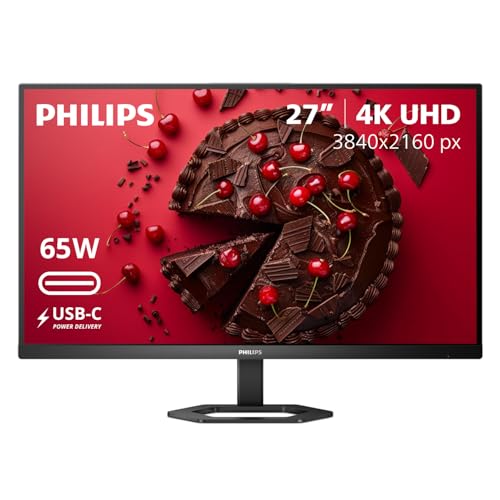
Philips 279C9 27″
The Philips 279C9 offers a compelling value proposition for buyers who want 4K resolution and USB-C charging without spending a premium. It delivers 4K UHD on a 27-inch IPS panel with USB-C 65W charging at a lower price point than the LG, Dell, and BenQ options. For Windows laptop users whose machines require 45 to 65W charging, this wattage is sufficient for most workloads, including web browsing, document editing, and light creative work. The IPS panel covers the sRGB color space accurately and provides wide viewing angles, making it suitable for general productivity and media consumption.
The monitor includes a built-in USB hub with downstream ports, allowing you to connect peripherals like a mouse, keyboard, or webcam through the monitor. The design is slim with thin bezels, and the stand offers tilt adjustment. One limitation is that the 65W charging ceiling may not be enough for a 16-inch MacBook Pro under heavy load, as the laptop may still drain battery over time. Another limitation is the lack of height adjustment on the stand; you may need to purchase a separate monitor arm or riser for proper ergonomic positioning. The USB hub also runs at USB 3.0 speeds, which is fine for most peripherals but not ideal for fast external storage.
For budget-conscious buyers with standard laptops, the Philips 279C9 is a smart choice. The 4K IPS panel provides sharp text and good color for everyday work, and the 65W charging is adequate for most thin-and-light Windows laptops. The main compromises are the lower power delivery and the basic stand, but the price savings make these trade-offs acceptable for many users. If you need height adjustment or higher wattage, you will need to look at the more expensive options in this guide.
Samsung ViewFinity S8 27″
The Samsung ViewFinity S8 is positioned as a budget-friendly entry into the Mac-compatible USB-C monitor market. It is a 27-inch 4K IPS display with USB-C 90W charging, which is surprisingly high wattage for a monitor at this price point. The IPS panel handles macOS scaling correctly at 4K, meaning text and UI elements appear sharp without the blurriness that plagues some budget 4K monitors. The monitor covers the sRGB color space accurately, making it suitable for general productivity, web work, and casual photo editing.
A USB hub with downstream ports lets you route peripherals through the monitor, reducing cable clutter on your desk. The stand offers tilt adjustment, and the design is clean and professional. One limitation is that the color coverage does not extend to DCI-P3 or Adobe RGB, so it is not suitable for professional photo or video work that requires wide gamut accuracy. Another limitation is that the USB hub ports are limited to USB 2.0 speeds on some units according to owner reports, which means external drives or high-speed peripherals may not perform as well as they would on a USB 3.0 hub. The build quality also feels less premium compared to the Dell or LG options, with more plastic construction.
For users on a tight budget who need a 4K monitor with strong USB-C charging and proper macOS scaling, the Samsung ViewFinity S8 is a solid pick. The 90W charging is impressive at this price and can handle most laptops, including MacBook Pros under moderate use. The main trade-offs are the limited color gamut and the potential for slower USB hub speeds, but for general office work, web browsing, and media consumption, these are minor issues. If your work demands wide color accuracy, you should consider the LG or BenQ instead.
What to look for
- USB-C power delivery wattage: Check your laptop’s charging requirements. A 65W monitor works for most thin-and-light Windows laptops, but a 16-inch MacBook Pro may need 90W or more to charge under load. Higher wattage gives more flexibility.
- Resolution and panel type: 4K UHD (3840×2160) offers sharp text and detail on a 27-inch screen. IPS panels provide wide viewing angles and accurate color. For creative work, look for DCI-P3 or Adobe RGB coverage.
- Color accuracy and gamut: sRGB coverage is fine for general use. Creative professionals should look for factory-calibrated panels with P3 or wider gamut support.
- Connectivity ports: A built-in USB hub with multiple downstream ports reduces desk clutter. Thunderbolt 4 or USB4 enables daisy-chaining for multi-monitor setups. KVM switches and Ethernet pass-through are valuable for multi-computer workflows.
- Stand ergonomics: Height adjustment is important for comfortable viewing. Tilt, swivel, and pivot options add flexibility. If the stand is basic, factor in the cost of a monitor arm.
- macOS scaling compatibility: Not all 4K monitors handle macOS scaling correctly. Look for monitors that support HiDPI mode without blurriness, especially if you use a Mac.
- HDR support: HDR400 is common but provides minimal benefit. HDR600 or higher offers noticeably better brightness and contrast for compatible content.
The verdict
For most buyers, the LG 27UQ850-W is the best overall USB-C monitor because it balances high power delivery, excellent color performance, and strong HDR support at a reasonable price. If you need a connectivity hub with KVM and Ethernet, choose the Dell UltraSharp U2722D. Creative professionals who require Thunderbolt daisy-chaining should pick the BenQ PD2705UA. For budget-conscious users, the Philips 279C9 offers good 4K quality with 65W charging, and the Samsung ViewFinity S8 provides 90W charging at a low price for Mac users who do not need wide color gamut. Each monitor serves a specific need, and the best choice depends on your laptop, workflow, and budget.
How we test
We compare every pick against the field on real specifications, certifications, and aggregated owner reviews. We do not take payment for placement, and we flag when a product is older or sold mainly through renewed listings.
At a glance
The picks, reviewed
LG 27UQ850-W 27" -- Best Overall USB-C 4K Monitor
The LG 27UQ850-W delivers 4K UHD on a 27-inch Nano IPS panel with USB-C 96W power delivery, the highest wattage in its price range and sufficient to fully charge a MacBook Pro 14-inch or 16-inch under most workloads. The Nano IPS panel covers 98% of the DCI-P3 colour gamut, making it accurate enough for photo and video work. HDR600 certification provides real high-dynamic-range performance for supported content. Built-in USB hub with USB-A and USB-C downstream ports routes peripherals through the monitor, keeping cables away from the laptop. This is the most complete single-cable monitor for demanding laptop users.

Dell UltraSharp U2722D 27" -- Best USB-C Monitor with Hub and KVM
The Dell U2722D combines USB-C 90W charging with a built-in USB hub, KVM switch, and RJ-45 Ethernet pass-through, making it one of the most connectivity-rich single-cable monitors available. The KVM switch allows one keyboard and mouse to control two computers through the monitor. Ethernet pass-through routes a wired network connection from the monitor to the connected laptop without needing a separate dock. The 27-inch 1440p IPS panel is factory-calibrated and accurate for colour-sensitive work. For home office users who need a clean desk with multiple peripherals managed through one cable, the U2722D is difficult to beat.
BenQ PD2705UA 27" -- Best USB-C Monitor for Creative Professionals
The BenQ PD2705UA features Thunderbolt 4 connectivity in addition to USB-C, enabling daisy-chaining of a second monitor from the display without an additional dock or hub. This is particularly useful for Mac users who want a dual-monitor setup from a single Thunderbolt cable at the laptop. The 27-inch 4K IPS panel is factory-calibrated for P3 colour accuracy. USB-C power delivery reaches 96W. A built-in KVM switch supports switching input between two computers. For designers and video editors using a MacBook Pro or Windows Thunderbolt laptop, this monitor offers the most versatile connectivity configuration in its price range.
Philips 279C9 27" -- Best Value USB-C 4K Monitor
The Philips 279C9 delivers 4K UHD on a 27-inch IPS panel with USB-C 65W charging at a lower price point than premium competitors. For Windows laptop users whose machines require 45 to 65W charging, this wattage is sufficient for most workloads. The IPS panel covers sRGB accurately with wide viewing angles. Built-in USB hub ports allow peripherals to connect through the monitor. The 65W ceiling is the primary limitation for MacBook Pro users with high power draw, but for most Ultrabook and mid-range Windows laptop users, it covers charging requirements without issue. A solid value option for single-cable simplicity.
Samsung ViewFinity S8 27" -- Best Budget USB-C 4K Mac-Compatible Monitor
The Samsung ViewFinity S8 is a 27-inch 4K IPS display with USB-C 90W charging, positioned as a more affordable entry into the Mac-compatible USB-C monitor space. The IPS panel handles macOS scaling correctly at 4K and covers the sRGB colour space accurately. A USB hub with downstream ports routes peripherals through the monitor. Display quality is solid for productivity and general use, though colour gamut coverage is narrower than premium Nano IPS alternatives. For users who want a reliable 90W USB-C single-cable monitor without paying for colour-critical features, this is a practical choice.
What to look for
What to consider
Check your laptop's USB-C charging wattage requirement before selecting a monitor. MacBook Pro 14 and 16-inch models charge most efficiently at 96W. Most other laptops manage on 65W. Prioritise monitors that clearly specify USB-C wattage in the product specs rather than listing generic USB-C support. Resolution matters at 27 inches; 4K is recommended for sharp text in macOS and Windows with display scaling. For power users who connect external drives, keyboards, and mice, a monitor with a built-in USB hub eliminates a separate dock. Thunderbolt 4 monitors add daisy-chaining capability over standard USB-C.
What to consider
For related reading, see [best monitors for MacBook Pro](/articles/best-computer-monitor-to-connect-to-macbook-pro) and [best work from home monitors](/articles/best-computer-monitor-to-work-from-home). Review our product evaluation process at [/methodology](/methodology).
FAQs
For most Windows laptops, 65W USB-C power delivery is sufficient for maintaining charge during light to moderate use. MacBook Pro 14-inch models need 96W for full-speed charging; lower wattage charges slowly or drains during heavy workloads. MacBook Pro 16-inch benefits from 96W or higher. Check your laptop's maximum USB-C charging wattage in its spec sheet. When in doubt, choose a monitor rated at 90W or higher to future-proof the setup as you upgrade laptops.
Yes, resolution matters because USB-C monitors at 4K require higher bandwidth than 1440p. Most USB-C displays transmit 4K at 60Hz successfully over a single cable, but some budget monitors throttle to 30Hz at 4K via USB-C, which causes noticeable lag in cursor movement. Confirm the listed specification states 4K at 60Hz over USB-C before purchasing. For 1440p, bandwidth is rarely an issue and single-cable setup at full resolution and refresh rate is almost universally reliable.
How we made this guide
We compare every pick on the factors that matter, cross-checking manufacturer specifications against aggregated verified owner reviews. We rank independently and never take payment for placement. We have not personally tested every product; where we have not, the ranking reflects verified specs and owner feedback rather than a hands-on review.
How it was written: this guide was researched and reviewed by the TheTestedHub editorial team for accuracy.
Affiliate disclosure: TheTestedHub is reader-supported. When you buy through links on our site, we may earn a commission at no extra cost to you.
Related guides

Best Docking Stations 2026: CalDigit TS4 & More

Digital Art Computers 2026: Best for Every Budget
2026 Dev & IT Computers: Ranked & Reviewed

Best Desktop PCs 2026: The Perfect PC for Every Budget
Best Desktop & Laptop Computers of 2026: Performance-Reviewed Rankings
2026 Laptop & Desktop Shortlist: MacBook Pro M4 Pro, Dell XPS 15, More

Buy the Best DIY Computer in 2026: Corsair One i300
