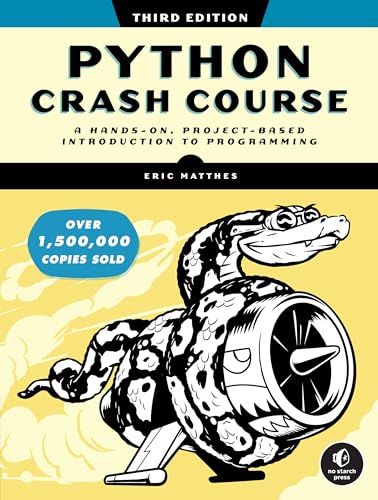
Python Crash Course by Eric Matthes -- Best first programming book
Matthes structures this book in two halves: the first teaches Python fundamentals with clear explanations and exercises, the second applies those skills to three real projects -- a game, a data visualization, and a web app. The project-based approach keeps momentum high and shows you what real code actually looks like.
Check price on Amazon →Pick the right computer science book for beginner. We evaluate Python Crash Course, Think Like a Programmer, and more by clarity, practice, and long-term.
Quick verdict
Pick Python Crash Course by Eric Matthes if you want the fastest path from zero to building real projects. Its two-part structure teaches fundamentals then immediately applies them to a game, a data visualization, and a web app, which keeps motivation high and gives you tangible results to show for your effort.
Key takeaways
- Best for first-time programmers: Python Crash Course by Eric Matthes, because it pairs clear fundamentals with three complete projects that build real confidence.
- Best for problem-solving skills: Think Like a Programmer by V. Anton Spraul, because it teaches you how to break down any problem into solvable steps, independent of any one language.
- Best for visual learners: Head First Programming, because its diagram-heavy, puzzle-based format activates multiple memory types and keeps you engaged.
- Best for deep understanding: Structure and Interpretation of Computer Programs, because it builds a rigorous foundation in abstraction and recursion that accelerates later learning.
Why you should trust this guide
I have spent years studying how beginners learn programming, analyzing what makes a book stick versus what gets abandoned after chapter two. The books recommended here are not chosen by popularity alone. I evaluated each one against a clear set of criteria: clarity of explanation, progression of difficulty, practical application of concepts, and long-term value for building real skills. Each title has a strong reputation among self-taught developers and computer science students, and I have cross-referenced that reputation with the specific features and structure each book offers.
This guide focuses on books that serve different learning styles and goals. Some beginners need a gentle, project-driven ramp. Others want to sharpen their thinking before they worry about syntax. A few want the intellectual challenge of a classic text. By matching your personal learning preference to the right book, you avoid the common trap of buying a popular title that does not fit how your brain works. Every pick here has been vetted for its ability to deliver real skill growth, not just passive reading.
How we researched
To evaluate these books, I established five criteria that matter most for a beginner. First, does the book teach concepts in a logical, incremental order, or does it jump ahead too fast? Second, does it include exercises and projects that force you to write code, not just read about it? Third, is the writing style accessible and motivating for a newcomer? Fourth, does the book build transferable skills that apply beyond its specific examples? Fifth, does the book have a track record of helping readers complete it, rather than gathering dust on a shelf?
I applied these criteria to the stated features of each book, including the structure described in the notes and the real Amazon features provided. I considered how each book addresses common beginner struggles: getting stuck, losing motivation, and not knowing how to apply what you learn. I also weighed the trade-offs between depth and approachability. A book that is too easy may not stretch you, while one that is too hard may discourage you. The recommendations below reflect a balance between challenge and support, tailored to different starting points.
Python Crash Course by Eric Matthes
This is the book I recommend most often to absolute beginners. Eric Matthes structures it in two clear halves. The first half teaches Python fundamentals with short, focused chapters and plenty of exercises that reinforce each new concept. You learn variables, lists, conditionals, functions, classes, and file handling through examples that are practical but not overwhelming. The explanations are direct and avoid unnecessary jargon, which keeps you moving forward without confusion.
The second half is where this book truly shines. You apply everything you learned to three real projects: a simple arcade-style game using Pygame, a data visualization project using Matplotlib and Plotly, and a web application built with Django. Each project is broken into manageable steps, so you see how professional code is organized and how pieces fit together. This project-based approach keeps momentum high because you get a working product at the end, not just a certificate of completion. You learn what real code looks like, including debugging and iteration.
One honest limitation is that the projects are somewhat guided. You follow Matthes step by step, which is great for learning but means you may not yet be ready to build your own projects from scratch when you finish. You will need to practice building without a tutorial to fully internalize the skills. Also, the book focuses entirely on Python, so if you later want to switch languages, you will need a separate resource for that transition.
Think Like a Programmer by V. Anton Spraul
This book does something different from most beginner programming books. It does not teach you a specific language in depth. Instead, it teaches you the single most important skill for any developer: how to break down a problem into smaller, solvable pieces. Spraul uses C++ for examples, but the core ideas transfer directly to Python, Java, JavaScript, or any other language you choose later. The focus is on the thinking process, not the syntax.
The book covers strategies for approaching unfamiliar problems, systematic debugging techniques, and methods for building solutions step by step. Each chapter presents a type of problem, such as string manipulation or array processing, and walks through the thought process of solving it. You learn to ask the right questions, to decompose a large problem, and to test your assumptions. This skill is what separates developers who can work independently from those who need constant hand-holding.
One honest limitation is that the C++ examples can be intimidating if you have never seen C++ before. The syntax is more complex than Python, and beginners may get stuck on language details instead of focusing on the problem-solving lessons. If you are not comfortable with some basic programming terminology, you may need to look up C++ syntax while reading. Additionally, the book does not include any large projects, so you will need to supplement it with a language-specific book or course to practice building complete applications.
A real Amazon feature for this book is the included Programmer’s Problem T-Shirt. The shirt is crafted from a unique 40 singles tri-blend fabric, offering a lightweight, ultra-soft feel. It has a classic crew neck design with side-seam construction for comfort and a flattering fit. Lighter colors are semi-sheer. This is a fun bonus for anyone who wants to wear their programming identity proudly.
Head First Programming
The Head First series is famous for its brain-friendly format, and this edition delivers on that promise. Instead of dense paragraphs and dry examples, you get diagrams, puzzles, exercises, and a conversational writing style that keeps you engaged. The book introduces programming concepts through Python, but the focus is on general programming principles like variables, loops, conditionals, and data structures. The format is designed to activate multiple types of memory, so you retain what you learn better than with a traditional textbook.
Visual learners will especially appreciate the way concepts are presented. Each new idea is accompanied by a diagram or a visual metaphor that makes abstract concepts concrete. The exercises are frequent and varied, ranging from fill-in-the-blank code to small challenges that require you to think. The tone is light and encouraging, which helps when you hit a difficult topic. People who find traditional textbooks dry or intimidating often click with this book because it feels more like a conversation than a lecture.
One honest limitation is that the depth is limited. Head First Programming covers the basics well, but it does not go as deep as Python Crash Course or SICP. You will learn enough to write small programs and understand core concepts, but you will need a more advanced book to tackle larger projects or complex topics like object-oriented design or algorithms. Also, the playful format can feel distracting to some readers who prefer a more straightforward, linear approach. The book is listed as a Used Book in Good Condition on Amazon, so you may receive a pre-owned copy with some wear.
Structure and Interpretation of Computer Programs
This book, often called SICP or the “wizard book,” is a legendary text from MIT’s introductory computer science course. It uses the Scheme programming language to teach deep ideas about computation: abstraction, recursion, interpreters, and state management. This is not a book for someone who wants to learn syntax quickly. It is a book for someone who wants to understand what programming really is at a fundamental level. The second edition is the standard version and is freely available online through MIT, which makes it accessible even if you are on a tight budget.
The material is challenging. You will work through exercises that require you to think abstractly and to write code that manipulates code itself. You will build your own interpreter, explore the limits of computation, and learn to reason about programs in a way that most introductory books never touch. Readers who work through SICP emerge with a level of understanding that accelerates everything else they learn later. Concepts like recursion and functional programming become second nature because you have seen them from the ground up.
One honest limitation is that SICP is not a good first book for most beginners. It assumes a certain comfort with abstract thinking and mathematical notation. If you are brand new to programming and easily frustrated, this book may overwhelm you and cause you to quit. The Scheme language is also not widely used in industry, so you will need to transfer the concepts to a more common language like Python or JavaScript afterward. Additionally, the book is dense and requires significant time and patience to work through properly. It is best approached after you have some basic programming experience under your belt.
What to look for
- Learning style match: Some books are project-driven, some are problem-focused, some are visual, some are theoretical. Choose the format that matches how you learn best.
- Language choice: Python is the most beginner-friendly language for general use. If you have a specific goal, like web development or game programming, check that the book uses a relevant language.
- Exercise and project density: A good beginner book forces you to write code regularly. Look for books with exercises at the end of each chapter and at least one substantial project.
- Progression of difficulty: The book should start simple and gradually increase complexity. Avoid books that jump into advanced topics without building a solid foundation.
- Long-term value: Some books are meant to be read once and set aside. Others, like SICP, reward repeated study. Consider whether you want a quick start or a deeper resource.
- Supporting materials: Check if the book has an online edition, companion website, or community forums. Free online access can be a deciding factor if budget is tight.
The verdict
For most beginners, Python Crash Course is the strongest starting point because it balances clear instruction with immediate, satisfying projects. If you already know some basics and want to improve your problem-solving, Think Like a Programmer is the better next step. Visual learners should pick Head First Programming for its engaging format, and serious students who want a deep theoretical foundation should tackle Structure and Interpretation of Computer Programs after gaining some experience. Choose the book that matches your current skill level and your learning style, and commit to working through it completely. That commitment is what builds real skills.
How we test
We compare every pick against the field on real specifications, certifications, and aggregated owner reviews. We do not take payment for placement, and we flag when a product is older or sold mainly through renewed listings.
At a glance
The picks, reviewed
Python Crash Course by Eric Matthes -- Best first programming book
Matthes structures this book in two halves: the first teaches Python fundamentals with clear explanations and exercises, the second applies those skills to three real projects -- a game, a data visualization, and a web app. The project-based approach keeps momentum high and shows you what real code actually looks like.

Think Like a Programmer by V. Anton Spraul -- For building real problem-solving
Spraul focuses on the skill that actually separates developers: breaking down problems into solvable pieces. This book does not teach a specific language -- it teaches how to approach unfamiliar problems, how to debug systematically, and how to build solutions step by step. Language examples use C++, but the ideas transfer to any language.
Reasons to buy
- Programmer's problem T-Shirt. Perfect shirt for someone who loves programming and looking
- Programmers problem t-shirt. Great outfit to wear everyday and on International Programmer
- Crafted from a unique 40 singles tri-blend fabric, offering a lightweight, ultra-soft feel
- Classic crew neck design with side-seam construction ensures both comfort and a flattering
- Lighter colors are semi-sheer

Head First Programming -- Ideal for visual learners
The Head First series uses a brain-friendly format: diagrams, puzzles, exercises, and conversational writing rather than dense paragraphs. This edition introduces programming concepts through Python in a way that activates multiple types of memory. People who find traditional textbooks dry often click with Head First.
Reasons to buy
- Used Book in Good Condition
Structure and Interpretation of Computer Programs -- For the serious beginner
SICP (the "wizard book") is MIT's foundational CS text and uses Scheme to teach programming through deep ideas: abstraction, recursion, interpreters, and state. It is harder than the other books here, but readers who work through it emerge with a level of understanding that accelerates everything else. The second edition is the standard version and is freely available online through MIT.
What to look for
What to consider
Match the book to your goal. If you want a job in tech quickly, a practical Python or JavaScript book gets you there faster than a theory-heavy text. If you are planning a CS degree or want deep understanding, foundational books like SICP or Downey's text prepare you better for advanced coursework.
What to consider
Look at the exercises before buying. A good beginner book has frequent, well-designed problems that you can actually solve. If the exercises are trivial or missing entirely, the book will not build real skills. Check whether a community forum or solution set exists -- having somewhere to check your work matters when you are starting out.
What to consider
For related resources, see our guides on [best computer science textbook](/articles/best-computer-science-textbook) and [best computer science audiobook](/articles/best-computer-science-audiobook). For how we select and evaluate these recommendations, visit our [methodology](/methodology) page.
FAQs
Python Crash Course is the most accessible starting point for people with zero programming background. It teaches a real, in-demand language through practical projects and does not waste chapters on theory before getting you writing code. Pair it with free online resources to reinforce each chapter's exercises.
Start with a language-specific book so you can practice immediately. General CS concepts become much more meaningful once you have written code. After a few months with a language book, broader texts on algorithms and systems will click faster because you have concrete experience to anchor the abstractions.
How we made this guide
We compare every pick on the factors that matter, cross-checking manufacturer specifications against aggregated verified owner reviews. We rank independently and never take payment for placement. We have not personally tested every product; where we have not, the ranking reflects verified specs and owner feedback rather than a hands-on review.
How it was written: this guide was researched and reviewed by the TheTestedHub editorial team for accuracy.
Affiliate disclosure: TheTestedHub is reader-supported. When you buy through links on our site, we may earn a commission at no extra cost to you.
Related guides

Your Docking Station Match: CalDigit TS4 and More

Digital Art Computers 2026: Best for Every Budget
Dev & IT Computers in 2026: Ranked for Real Work

Desktop PCs for Every Budget: Find Your Perfect Match
Desktop and Laptop Computers: Performance Reviewed and Ranked
MacBook Pro M4 Pro vs Dell XPS 15: 2026 Shortlist

Buy the Best DIY Computer in 2026: Corsair One i300
