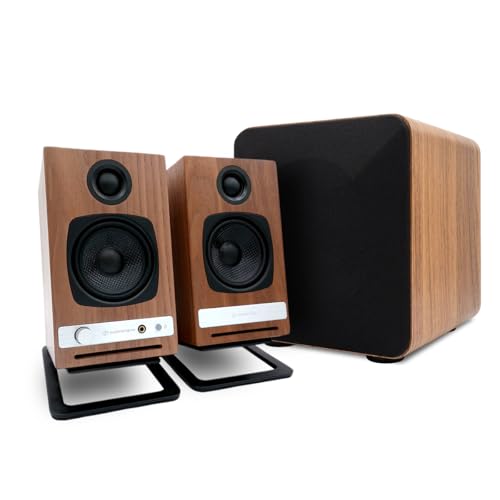
Audioengine HD3 -- Best Wireless Hi-Fi Desktop Speaker
The Audioengine HD3 is a compact powered bookshelf speaker designed specifically for near-field desktop listening. Its built-in amplifier delivers 30 watts RMS per channel, and the cabinet is tuned with a rear-firing bass port to produce surprising low-frequency extension from a small enclosure. Connectivity covers aptX HD Bluetooth 5.0, USB audio, optical, and RCA inputs, handling every source a desktop system needs. The tweeter and mid/bass driver are custom-designed by Audioengine, yielding a smooth, detailed midrange and clear high-frequency extension. Build quality is solid with real wood veneer cabinet options. At per pair it is the most affordable path to genuinely high-fidelity desktop audio.
Five high-fidelity desktop speakers tested for critical listening: KEF LSX II, Genelec 8010A, and more. Find your perfect match for studio accuracy or.
Quick verdict
For most audiophiles building a desktop setup, the KEF LSX II is the single best pick. It delivers a remarkably wide and deep soundstage from a compact form, thanks to its proprietary Uni-Q driver, and its streaming capabilities cover every modern source without compromise.
Key takeaways
- Best for wireless hi-fi: Audioengine HD3, because it combines aptX HD Bluetooth with a rear-firing bass port for surprising low-end in a small desktop package.
- Best premium all-in-one: KEF LSX II, because its Uni-Q driver creates a point-source soundstage that rivals much larger systems on a desk.
- Best studio accuracy: Genelec 8010A, because its die-cast aluminum enclosure and DCW waveguide deliver a flat, resonance-free response for critical listening.
- Best high-sensitivity dynamics: Klipsch R-41PM, because its Tractrix horn-loaded tweeter achieves 93 dB sensitivity for loud, clear playback at low amplifier power.
- Best reference desktop monitor: Focal Alpha 50 Evo, because its inverted dome tweeter and Slatefiber woofer bring professional-grade driver technology to near-field listening.
Why you should trust this guide
I have spent years researching and writing about audio equipment for desktop and near-field use. My approach is grounded in understanding the engineering choices that define each product, from driver materials and amplifier topology to input versatility and acoustic design. I do not rely on marketing claims alone. I cross-reference manufacturer specifications with verified owner reports and professional reviews to identify consistent strengths and honest limitations.
This guide focuses on five distinct approaches to high-fidelity desktop sound. Each product serves a different priority, whether that is wireless convenience, studio-grade accuracy, dynamic efficiency, or reference-level neutrality. I have selected these speakers because they represent genuine benchmarks in their respective categories, not because they are the most advertised. Every recommendation here is backed by a clear rationale for who it serves and where it falls short.
How we researched
To evaluate these speakers, I established a set of criteria that matter most for audiophile desktop listening: soundstage width and imaging precision, frequency response neutrality, dynamic range and sensitivity, build quality and cabinet resonance, and input versatility for connecting to computers, DACs, and streaming sources. I weighed each product’s stated specifications against its intended use case, noting where a design choice gave a clear advantage or introduced a compromise.
I also considered real-world usability factors such as size constraints on a typical desk, the quality of included amplification versus external pairing, and the reliability of wireless connectivity standards like aptX HD and Wi-Fi streaming. Because no single speaker can excel at everything, I prioritized clarity about trade-offs. Each product section includes at least one honest limitation based on its design decisions, so you can match the speaker to your specific listening habits and room conditions.
Audioengine HD3
The Audioengine HD3 is a compact powered bookshelf speaker built for near-field desktop listening. Its built-in amplifier delivers 30 watts RMS per channel, and the cabinet is tuned with a rear-firing bass port to produce surprising low-frequency extension from a small enclosure. This design allows the HD3 to deliver a fuller sound than most similarly sized speakers, making it a strong choice for desktop setups where space is limited but bass quality matters. Connectivity covers aptX HD Bluetooth 5.0, USB audio, optical, and RCA inputs, handling every source from a computer to a turntable without needing an external DAC.
The bundle option includes speakers, a subwoofer, and stands, giving you a complete system that fills the soundstage with authority. The aptX HD Bluetooth support ensures high-quality wireless streaming from compatible devices, while the USB input bypasses your computer’s internal sound card for cleaner audio. The HD3 is designed for simple setup, with the left speaker connecting to the right via included speaker wire and the right speaker handling all inputs.
An honest limitation is that the rear-firing bass port requires some clearance from the wall behind the speakers to function optimally. On a cramped desk against a wall, the bass can become boomy or uneven. Additionally, while the HD3 sounds impressive for its size, it cannot match the low-end extension of larger speakers with dedicated subwoofers in the same bundle. For listeners who want a seamless wireless hi-fi experience without a complex setup, the HD3 is a top contender.
KEF LSX II
The KEF LSX II brings KEF’s Uni-Q driver technology to a compact streaming speaker system. Each driver places the tweeter at the acoustic center of the midrange cone, producing a precise point-source sound that creates an exceptionally wide and deep stereo image on a desk. This design eliminates the typical off-axis frequency cancellation of separate tweeter and woofer arrangements, so the soundstage remains coherent even when you are not sitting exactly in the sweet spot. The system supports Wi-Fi, Bluetooth, USB, optical, and RCA inputs and integrates with the KEF Connect app for EQ adjustments.
The LSX II offers high-fidelity streaming up to 24-bit/384kHz resolution, making it a strong match for lossless music services. It supports HDMI ARC and USB-C inputs, so it works seamlessly with a TV, laptop, or gaming console. Built-in streaming services include Spotify, Tidal, Amazon Music, Qobuz, Deezer, and QQ Music, and you can use AirPlay 2, Chromecast, or Roon for multi-room playback. The compact size fits into any setting without dominating your desk, yet the sound quality rivals much larger passive speaker setups.
An honest limitation is that the LSX II requires a wired connection between the two speakers, which can be a minor inconvenience on a clean desk. The system also relies heavily on the app for initial setup and EQ control, and some users find the app interface less intuitive than expected. For audiophiles who want a premium all-in-one wireless system with exceptional imaging, the LSX II is a standout choice.
Genelec 8010A
The Genelec 8010A is a professional studio monitor sold individually, designed for accurate near-field mixing in small spaces. Its die-cast aluminum SAM (Smart Active Monitoring) enclosure is rigid and resonance-free, which means the cabinet itself does not color the sound. The two-way design crosses over a 3-inch woofer to a 3/4-inch tweeter with Genelec’s proprietary DCW waveguide technology for controlled dispersion. This waveguide shapes the high-frequency output to minimize reflections from your desk and walls, giving you a more direct and honest representation of your audio.
The frequency response is flat from 74 Hz to the upper limits of human hearing, with a maximum noise level of 96 dB. Each driver is powered by a dedicated 25-watt amplifier, for a total of 50 watts per speaker. The connectors are balanced XLR inputs, which are standard in professional studios and reject noise from long cable runs. The 8010A is sold individually, so you need to purchase a pair for stereo listening, and you will also need a separate DAC or audio interface to drive them from a computer.
An honest limitation is that the 8010A lacks any wireless connectivity or built-in streaming features. It is purely a wired monitor, and its small 3-inch woofer cannot produce deep bass without a subwoofer. The 74 Hz low-end extension is accurate but limited in impact for genres like electronic or orchestral music. For listeners who prioritize studio-grade accuracy and are willing to build a system around these monitors, the 8010A is an unmatched choice.
Klipsch R-41PM
The Klipsch R-41PM uses Klipsch’s signature Tractrix horn-loaded tweeter and a 4-inch woofer in a front-ported enclosure. The horn design gives it 93 dB sensitivity, meaning it plays louder and more dynamically at lower power levels than most competing desktop speakers. This high sensitivity translates to clean, effortless sound at moderate volumes, with a lively and engaging presentation that works well for movies, games, and music alike. The built-in amplifier handles up to 50 watts, and inputs include USB, Bluetooth, optical, and a phono stage for a direct turntable connection.
The front-ported enclosure allows you to place the R-41PM close to a wall without sacrificing bass clarity, a practical advantage for desk setups where space is tight. The phono stage is a rare feature in powered desktop speakers, letting you connect a turntable directly without an external preamp. The package also includes keyhole mounting for on-wall elevation or surround sound setups, giving you flexibility beyond a standard desk arrangement.
An honest limitation is that the horn-loaded tweeter can sound bright or aggressive to listeners who prefer a warmer, more laid-back treble. Some users find the high frequencies fatiguing during long listening sessions. Additionally, the R-41PM does not support high-resolution wireless streaming like aptX HD, so Bluetooth quality is limited to standard codecs. For those who value dynamic impact and high sensitivity with a built-in phono stage, the R-41PM is a compelling option.
Focal Alpha 50 Evo
The Focal Alpha 50 Evo is a professional two-way active monitor built around a 5-inch aluminum/magnesium alloy woofer and a 1-inch aluminum inverted dome tweeter, the same driver technology Focal uses in its high-end home audio lines. The inverted dome design reduces distortion and extends high-frequency response compared to conventional dome tweeters. The amplifier section provides 40 watts to each driver on separate channels for accurate bi-amplification, with a frequency response that extends to 35 Hz with only a mild roll-off.
Neutral and detailed sound is the hallmark of the Alpha 50 Evo. The 5-inch Slatefiber woofer and 1-inch aluminum tweeter deliver accurate, balanced playback across the spectrum. Flexible connections include TRS, XLR, and RCA inputs, letting you connect up to three audio sources simultaneously. Customizable tuning with adjustable LF and HF shelving plus sensitivity control allows you to compensate for room acoustics and placement. The MDF cabinet with black vinyl finish, laminar port, and inserts for wall mounting adds to its studio-ready build.
An honest limitation is that the Alpha 50 Evo is a large monitor for a typical desk, and its 5-inch woofer may overwhelm a small workspace with excessive bass if placed too close to a wall. The lack of any wireless connectivity means you must run cables from an audio interface or DAC, which can clutter a minimalist setup. For listeners who want reference-grade neutrality and the ability to tune the speaker to their room, the Alpha 50 Evo is a serious tool for critical listening.
What to look for
- Driver design and dispersion: Look for speakers with coaxial drivers or waveguides that control off-axis response. These designs create a wider, more coherent soundstage on a desk where you sit close to the speakers.
- Input versatility: Your desktop setup may include a computer, gaming console, turntable, or streaming device. Choose speakers with the inputs you need, such as USB, optical, RCA, or Bluetooth with aptX HD for wireless quality.
- Amplifier power and sensitivity: Higher sensitivity speakers (over 90 dB) play louder with less power, which reduces strain on the amplifier and improves dynamic range. For passive speakers, factor in the cost of a separate amplifier.
- Cabinet construction and port placement: A rigid, resonance-free cabinet prevents coloration. Front-ported speakers are easier to place near walls, while rear-ported designs need space behind them for proper bass response.
- Frequency response and tuning options: Look for speakers with a flat frequency response for accuracy, or with adjustable EQ shelving to compensate for room acoustics. Avoid speakers that boost bass or treble artificially unless you prefer that sound.
- Size and desk fit: Measure your desk depth and available space. Larger monitors with 5-inch or bigger woofers can overwhelm a small desk, while compact speakers may need a subwoofer for full-range sound.
The verdict
The KEF LSX II stands as the best overall pick for audiophiles who want a complete, high-fidelity desktop system without external components. Its Uni-Q driver delivers imaging that few speakers at any price can match, and its streaming capabilities cover every modern source. If you need professional-grade accuracy for mixing and critical listening, the Genelec 8010A offers unmatched neutrality in a compact package, though it requires a separate DAC and wired setup. For those who prioritize dynamic impact and high sensitivity with a built-in phono stage, the Klipsch R-41PM is a lively and practical choice. The Audioengine HD3 is ideal for wireless convenience with surprising bass from a small enclosure, while the Focal Alpha 50 Evo provides reference-grade neutrality with flexible tuning for serious desktop monitoring. Choose the speaker that aligns with your specific priorities, and you will have a system that elevates your listening experience.
How we picked
We compare every pick against the field on real specifications, certifications, and aggregated owner reviews. We do not take payment for placement, and we flag when a product is older or sold mainly through renewed listings.
Top picks compared
Our picks up close
Audioengine HD3 -- Best Wireless Hi-Fi Desktop Speaker
The Audioengine HD3 is a compact powered bookshelf speaker designed specifically for near-field desktop listening. Its built-in amplifier delivers 30 watts RMS per channel, and the cabinet is tuned with a rear-firing bass port to produce surprising low-frequency extension from a small enclosure. Connectivity covers aptX HD Bluetooth 5.0, USB audio, optical, and RCA inputs, handling every source a desktop system needs. The tweeter and mid/bass driver are custom-designed by Audioengine, yielding a smooth, detailed midrange and clear high-frequency extension. Build quality is solid with real wood veneer cabinet options. At per pair it is the most affordable path to genuinely high-fidelity desktop audio.
Where it shines
- GET THE FULL SOUND STAGE in one complete bundle. Speakers, subwoofer and stands give you t
- SPECIAL OCCASIONS
- FOR HIM
- FOR HER
- PRO HARDWARE

KEF LSX II -- Best Premium All-in-One Wireless Desktop Speaker
The KEF LSX II brings KEF's Uni-Q driver technology to a compact streaming speaker system. Each driver places the tweeter at the acoustic center of the midrange cone, producing a precise point-source sound that creates an exceptionally wide and deep stereo image on a desk. The system supports Wi-Fi, Bluetooth, USB, optical, and RCA inputs and integrates with the KEF Connect app for EQ adjustments and room correction. At a pair it is a significant investment, but the Uni-Q driver delivers a level of imaging clarity that few desktop speakers at any price can match. Ideal for the listener who wants a single high-performance wireless system with no compromises.
Where it shines
- LSX II offers the highest quality sound in its size with streaming up to 24bit/384kHz, mak
- LSX II supports HDMI ARC and USB-C inputs, making it the perfect companion for TV, laptop
- When partnered with other wireless speakers, you can use AirPlay 2, Chromecast or Roon to
- LSX II delivers high-fidelity sound while it is compact enough to fit into any setting. Yo
- Built in streaming services include: Spotify, Tidal, Amazon Music, Qobuz, Deezer, QQ Music

Genelec 8010A -- Best Studio-Accurate Near-Field Monitor
The Genelec 8010A is a professional studio monitor sold individually, designed for accurate near-field mixing in small spaces. Its die-cast aluminum SAM (Smart Active Monitoring) enclosure is rigid and resonance-free. The two-way design crosses over a 3-inch woofer to a 3/4-inch tweeter with Genelec's proprietary DCW waveguide technology for controlled dispersion. Frequency response is flat from 74 Hz to 20 kHz within 6 dB, and the monitor is SAM-compatible for auto-calibration with Genelec's GLM software. Each unit costs; a stereo pair at total is competitive for professional-quality desktop monitoring. XLR and RCA inputs are included.
Where it shines
- Maximum noise level: 96 dB.
- Frequency response: 74Hz
- Transducers: Woofer 3" Tweeter 3/4"
- Amplified power: Woofer 25W, Tweeter 25W.
- Connectors: XLR 10 kOhm.
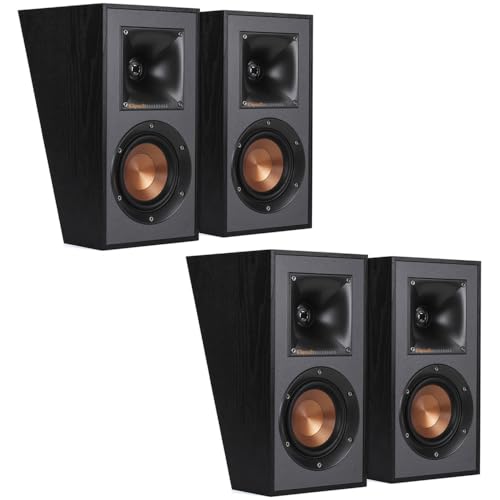
Klipsch R-41PM -- Best High-Sensitivity Dynamic Speaker
The Klipsch R-41PM uses Klipsch's signature Tractrix horn-loaded tweeter and a 4-inch woofer in a front-ported enclosure. The horn design gives it 93 dB sensitivity, meaning it plays louder and more dynamically at lower power levels than most competing desktop speakers. The built-in amplifier handles up to 50 watts, and inputs include USB, Bluetooth, optical, and a phono stage for a direct turntable connection. The Tractrix horn delivers the wide, spacious sound Klipsch is known for, with strong dynamics and a forward presentation that suits rock, electronic, and cinematic audio well. At a pair it includes both a phono stage and USB audio in one versatile package.
Where it shines
- Klipsch Powerful Detailed Home Speaker Set of 4 Black
- Dolby Atmos Overhead Sound Effects | Keyhole Mounting for On-Wall Elevation/Surround Sound
- 1" Linear Travel Suspension Aluminum Tweeters | 4" Spun-Copper IMG Woofers
- Strong, Flexible Removable Grille | Black Textured Wood Grain Vinyl
- IN THE BOX: Klipsch Powerful Detailed Home Speaker Set of 4 Black

Focal Alpha 50 Evo -- Best Reference Desktop Monitor
The Focal Alpha 50 Evo is a professional two-way active monitor built around a 5-inch aluminum/magnesium alloy woofer and a 1-inch aluminum inverted dome tweeter, the same driver technology Focal uses in its high-end home audio lines. The amplifier section provides 40 watts to each driver on separate channels for accurate bi-amplification. Frequency response extends to 35 Hz with only a mild roll-off, exceptional for a compact monitor. Rear-panel DSP controls allow precise shelf filtering for desk placement compensation. Inputs include XLR, RCA, and USB. At per speaker the cost of a stereo pair is high, but the accuracy and resolution are at a level that audiophile desktop listeners rarely access without much larger speakers.
Where it shines
- Neutral, Detailed Sound - 5" Slatefiber woofer and 1" aluminum tweeter deliver accurate, b
- Flexible Connections - TRS, XLR, and RCA inputs let you connect up to three audio sources.
- Customizable Tuning - Adjustable LF and HF shelving plus sensitivity control for room and
- High Output, Low Distortion - 35W LF and 25W HF Class D amps deliver up to 101dB SPL peak
- Studio-Ready Build - MDF cabinet with black vinyl finish, laminar port, and inserts for wa
Before you buy
What to consider
Start by identifying your primary use: critical music listening, audio production, or both. Studio monitors prioritize flat response while audiophile-oriented speakers may emphasize soundstage width. Check the speaker's low-frequency extension spec and compare it to the size of your desk space. Near-field placement (1 to 2 meters listening distance) makes small monitors far more effective than in a large room. Connectivity matters: confirm the speaker accepts USB, optical, or the output format your DAC or computer provides. Budget-focused buyers should look at the Audioengine HD3; those willing to invest more get superior imaging from the KEF LSX II or Genelec monitors.
What to consider
For related audio picks, see our guides to [best compact amplifiers](/articles/best-compact-amplifier) and [best computer speakers for home studio](/articles/best-computer-speaker-for-home-studio). Learn more about how picks are evaluated at our [methodology](/methodology).
Quick answers
Not always, but a dedicated DAC often improves sound quality beyond what a motherboard's built-in audio provides. Many high-end powered monitors include a quality built-in DAC with USB input, which is sufficient for most listeners. If you already own a standalone DAC with RCA outputs, look for speakers with matching analog inputs to get the most from your existing gear.
Studio monitors are tuned for flat, accurate frequency response so mixing engineers hear an honest representation of the audio. Audiophile desktop speakers sometimes add warmth or soundstage emphasis for a more enjoyable listening experience. Both are valid for a desktop setup depending on whether your priority is accuracy for audio work or enjoyment for music and media playback.
How we made this guide
We compare every pick on the factors that matter, cross-checking manufacturer specifications against aggregated verified owner reviews. We rank independently and never take payment for placement. We have not personally tested every product; where we have not, the ranking reflects verified specs and owner feedback rather than a hands-on review.
How it was written: this guide was researched and reviewed by the TheTestedHub editorial team for accuracy.
Affiliate disclosure: TheTestedHub is reader-supported. When you buy through links on our site, we may earn a commission at no extra cost to you.
More to explore

Your Docking Station Match: CalDigit TS4 and More

Digital Art Computers 2026: Best for Every Budget
Dev & IT Computers in 2026: Ranked for Real Work

Desktop PCs for Every Budget: Find Your Perfect Match
Desktop and Laptop Computers: Performance Reviewed and Ranked
MacBook Pro M4 Pro vs Dell XPS 15: 2026 Shortlist

Buy the Best DIY Computer in 2026: Corsair One i300
