Edifier R1280DB -- Best Entry-Level Sound
The Edifier R1280DB delivers a level of audio quality that overperforms at its price point. The 4-inch woofer and 13mm silk dome tweeter produce a balanced frequency response with clear high-mids and smooth treble that avoids the harshness common in budget speakers. Bluetooth 5.0, optical, coaxial, and dual RCA inputs make it adaptable to any desktop source. The built-in remote is a practical convenience. The wooden enclosure reduces cabinet coloration. For users moving up from plastic desktop speakers for the first time, the R1280DB is a reliable benchmark of what better audio actually sounds like.
Check price on Amazon →Looking for clear, detailed audio from your desktop? We compare top-rated computer speakers for sound quality, from budget Edifier to premium KEF, to.
Quick verdict
The KEF LSX II LT is the single best pick for pure sound quality in 2026. Its Uni-Q driver delivers a coherent, wide soundstage that outperforms everything else here, making it the clear choice for anyone who prioritizes audio fidelity above all else.
Key takeaways
- Best for entry-level value: Edifier R1280DB, delivers balanced sound and versatile inputs at a price that overperforms.
- Best for premium sound quality: KEF LSX II LT, offers point-source dispersion and an expansive soundstage from a compact design.
- Best for compact audiophile setups: Audioengine A2+, provides articulate detail and a clean USB DAC in a tiny footprint.
- Best for flat reference monitoring: Yamaha HS5, reproduces audio exactly as recorded with a neutral frequency response for critical work.
- Best for all-in-one versatility: Klipsch The Fives, combines a powerful driver set with HDMI ARC and phono input for TV and turntable use.
Why you should trust this guide
I have researched computer speakers for years, focusing on how audio components translate into real-world listening experiences. This guide is built on manufacturer specifications, owner feedback from verified purchasers, and a systematic comparison of each product’s acoustic architecture. I do not claim to have tested these speakers myself, but I have evaluated their stated driver designs, input capabilities, and intended use cases against the criteria that matter most for sound quality: clarity, frequency balance, stereo imaging, and overall coherence.
Each product here was selected because it occupies a distinct niche in the market. The Edifier R1280DB represents the best entry point for someone moving from built-in monitor speakers. The KEF LSX II LT is the pinnacle of compact acoustic engineering. The Audioengine A2+ is the go-to for desktop listeners with limited space. The Yamaha HS5 is the standard for accurate monitoring. The Klipsch The Fives is the most versatile system for those who want one pair of speakers to serve multiple devices. I have avoided hype and focused on what each speaker actually delivers based on its design and feature set.
How we researched
To evaluate these speakers, I weighed several criteria that define sound quality in a computer speaker system. The first factor is driver design and how it affects frequency response. A good speaker must reproduce bass, mids, and treble without one range overpowering another. I looked at the materials used for woofers and tweeters, as well as the cabinet construction, because these elements determine whether the sound will be clear or muddy. The second factor is the input and connectivity options, because a speaker is only useful if it can connect to your source without extra adapters or signal degradation.
The third factor is the intended use case. A studio monitor like the Yamaha HS5 is designed for accuracy, not for making music sound exciting, so it is poor for casual listening but ideal for mixing. A speaker like the Klipsch The Fives is built for dynamic impact and versatility, which makes it great for movies and music but less suitable for flat monitoring. I also considered the overall value proposition, meaning what you get for the price relative to other speakers in the same category. I did not measure anything with instruments or conduct any physical tests. Instead, I relied on the manufacturer’s stated specifications and the consensus of long-term owners who have reported on performance, reliability, and limitations.
Edifier R1280DB
The Edifier R1280DB is the speaker that punches far above its weight class. It uses a 4-inch woofer paired with a 13mm silk dome tweeter, a combination that produces a balanced frequency response with clear high-mids and smooth treble. The silk dome tweeter is a deliberate choice, as it avoids the harsh sibilance and fatigue that often plague budget speakers with cheaper metal tweeters. The result is a sound that is easy to listen to for long sessions, whether you are playing music, watching videos, or gaming. The bass is present and full without being boomy, and the midrange remains articulate enough to distinguish vocals and instruments.
Connectivity is a strong point for the R1280DB. It includes Bluetooth 5.0 for wireless streaming from your phone or laptop, optical and coaxial inputs for connecting to a TV or game console, and dual RCA inputs for a turntable or other analog source. The built-in remote control is a practical convenience that lets you adjust volume, switch inputs, and control playback from across the room. This makes the R1280DB one of the most flexible entry-level speakers available, as it can serve as a desktop system, a small TV setup, or a secondary music system.
One real limitation of the Edifier R1280DB is that the bass response, while decent for the size, cannot match the low-end extension of larger speakers. If you listen to bass-heavy genres like electronic or hip-hop at high volumes, you may find the low end lacking in depth and impact. Additionally, the cabinet is made of wood but has a slightly boxy resonance at higher volumes, which can color the sound slightly. For the price, however, these are minor trade-offs.
KEF LSX II LT
The KEF LSX II LT is a masterclass in acoustic engineering for a compact speaker. At its heart is KEF’s Uni-Q driver array, which places the tweeter concentrically within the midwoofer. This design creates a point-source effect where sound radiates from a single point rather than two separate drivers. The result is an unusually wide and coherent soundstage that fills the room, with precise imaging that makes you feel like instruments are placed around you rather than coming from two boxes. Even when you are sitting off-axis, the sound remains balanced and clear, which is rare for speakers of this size.
The LSX II LT retains the core acoustic architecture of the more expensive LSX II but comes at a more accessible price point. It supports wireless streaming via Wi-Fi and Bluetooth, so you can play music directly from your phone or network without a computer. It also includes optical and USB-C inputs for a wired connection to your computer, game console, or TV. The build quality is excellent, with a sleek, minimalist cabinet that looks premium on any desk. The sound is detailed and dynamic, with a natural midrange and a treble that is crisp without being fatiguing.
A real limitation of the KEF LSX II LT is that it requires a wired connection between the two speakers, as they are not truly wireless like some other systems. This means you need to run a cable from the primary speaker to the secondary speaker, which can be a minor inconvenience for placement. Additionally, the bass, while tight and controlled, does not reach as deep as a dedicated subwoofer. For most music and movie listening, the bass is sufficient, but if you want earth-shaking low end, you will need to add a separate subwoofer.
Audioengine A2+
The Audioengine A2+ is a benchmark in the compact audiophile speaker category. It is small enough to fit on a crowded desk, yet it delivers detail and stereo separation that belies its tiny footprint. The secret lies in the hand-built 2.75-inch Kevlar woofers and silk dome tweeters. Kevlar is a stiff, lightweight material that allows the woofer to move quickly and accurately, producing tight, articulate bass and clear mids. The silk dome tweeter handles the high frequencies with a smooth, natural character that avoids the metallic edge of cheaper tweeters.
A key feature of the A2+ is the built-in USB DAC. When you connect the speaker to your computer via USB, it bypasses your computer’s onboard audio card entirely. This provides a clean digital signal path that reduces noise and interference, resulting in a noticeably cleaner, more detailed sound. The sound is articulate and musical, with accurate timbre across instruments. Vocals sound natural and present, and acoustic instruments have a realism that is rare in speakers this small. The stereo separation is excellent, creating a convincing soundstage that extends beyond the physical width of the speakers.
One real limitation of the Audioengine A2+ is its bass output. The 2.75-inch woofers can only move so much air, so the low end is limited in depth and volume. If you listen to music with heavy bass lines or watch action movies, you will likely want to add the optional Audioengine S8 subwoofer. Another limitation is the lack of Bluetooth. The A2+ is a wired-only speaker, so you cannot stream wirelessly from your phone without an external Bluetooth receiver. This keeps the signal path pure but reduces convenience.
Yamaha HS5
The Yamaha HS5 is a nearfield studio monitor that is built for one purpose: accuracy. It features a flat frequency response curve, meaning every frequency is reproduced at the same level without any artificial boost to the bass or treble. This is the opposite of consumer speakers, which often add extra bass to make music sound more exciting. The HS5 shows you exactly what the recording sounds like, warts and all. If a mix has too much sibilance or a muddy low end, you will hear it clearly. This makes the HS5 the preferred choice for anyone who mixes music, edits podcasts, or evaluates audio quality professionally.
The speaker uses a 5-inch woofer and a 1-inch dome tweeter, both housed in a robust, ported cabinet. The cabinet is designed to reduce resonance and vibration, so the sound remains clean even at higher volumes. The rear panel includes XLR and TRS balanced inputs, which are standard in professional audio setups and help reject electrical interference. The HS5 also has room control switches and a high-trim switch on the back, allowing you to adjust the speaker’s response to compensate for placement near walls or corners. This flexibility is crucial for getting accurate sound in less-than-ideal rooms.
A real limitation of the Yamaha HS5 is that it is not a consumer-friendly speaker. The flat frequency response can sound dull or unexciting for casual listening, as it lacks the bass punch and treble sparkle that many people enjoy. It also requires an external audio interface or mixer to connect to a computer, as it does not have a built-in DAC or volume control. You will need to purchase a separate volume controller or rely on your audio interface’s output level. Finally, the HS5 is a single speaker, so you must buy a pair for stereo sound, and it does not include any wireless connectivity.
Klipsch The Fives
Klipsch The Fives is the most versatile all-in-one speaker system in this guide. It brings together a 5.25-inch woofer, a 1-inch aluminum dome tweeter, and a comprehensive input set into a single powered pair. The woofer is larger than most desktop speakers, which gives it real bass presence and authority. The aluminum dome tweeter is paired with Klipsch’s signature horn-loaded design, which delivers the brand’s characteristic efficiency and dynamic clarity. The horn loads the tweeter, making it more efficient and allowing it to produce high frequencies that cut through the mix without distortion, even at high volumes.
The input selection on The Fives is unmatched. It includes HDMI ARC for connecting to a TV, which allows you to use the speakers as a TV sound system. It also has USB-C for a direct digital connection to a computer, optical for a TV or game console, Bluetooth for wireless streaming, and a phono stage for a turntable. This means you can connect your computer, TV, phone, and turntable all to the same pair of speakers without needing a separate receiver or adapter. The HDMI ARC connection is particularly useful, as it lets you control the volume with your TV remote and automatically turns the speakers on and off with the TV.
A real limitation of Klipsch The Fives is that the horn-loaded tweeter can be aggressive or forward sounding to some listeners. The dynamic clarity is excellent for movies and rock music, but for quieter acoustic genres or critical listening, the treble can feel a bit too pronounced. Additionally, the speakers are large for a desktop setup, and they require significant space on either side of your monitor. The bass, while powerful, can also be a bit boomy depending on placement, especially if the speakers are placed near a wall. A subwoofer output is included, but the built-in bass is already substantial.
What to look for
- Driver design and materials: Look for silk dome tweeters for smooth treble or metal tweeters for more detail, and Kevlar or woven fiber woofers for accurate bass. The driver size determines how much bass and volume the speaker can produce.
- Frequency response and sound signature: Decide whether you want a flat, neutral response for monitoring or a more colored, exciting sound for casual listening. Flat speakers are accurate but can sound dull, while colored speakers are fun but less accurate.
- Connectivity options: Consider what sources you will connect. USB-C and optical inputs provide a clean digital signal from a computer. HDMI ARC is essential if you want to use the speakers with a TV. Bluetooth is convenient for wireless streaming from a phone.
- Built-in DAC: A speaker with a built-in USB DAC bypasses your computer’s noisy audio circuitry, providing a cleaner signal path and better sound quality, especially for laptops and budget desktop computers.
- Size and placement: Measure your desk space. Larger speakers with bigger woofers produce more bass but require more desk real estate. Nearfield monitors like the Yamaha HS5 are designed for close listening distances.
- Powered versus passive: All speakers in this guide are powered, meaning they have built-in amplifiers. This saves space and eliminates the need for a separate receiver. Some powered speakers also include a subwoofer output for future expansion.
The verdict
The KEF LSX II LT is the best choice if your top priority is sound quality and you have the budget for it. Its Uni-Q driver creates a soundstage and coherence that is unmatched in a compact speaker, making it a true audiophile-grade system. If you are on a tighter budget, the Edifier R1280DB offers outstanding value with balanced sound and versatile inputs at a price that is hard to beat. For those who need a compact, detailed speaker for a small desk, the Audioengine A2+ is the clear winner. The Yamaha HS5 is the only choice for accurate monitoring and mixing work. The Klipsch The Fives is the best all-in-one system for anyone who wants one pair of speakers to handle computer, TV, and turntable duties with powerful, dynamic sound. Pick the speaker that matches your use case, and you will be happy with the audio quality.
Our testing process
We compare every pick against the field on real specifications, certifications, and aggregated owner reviews. We do not take payment for placement, and we flag when a product is older or sold mainly through renewed listings.
Quick comparison
Reviewed in detail
Edifier R1280DB -- Best Entry-Level Sound
The Edifier R1280DB delivers a level of audio quality that overperforms at its price point. The 4-inch woofer and 13mm silk dome tweeter produce a balanced frequency response with clear high-mids and smooth treble that avoids the harshness common in budget speakers. Bluetooth 5.0, optical, coaxial, and dual RCA inputs make it adaptable to any desktop source. The built-in remote is a practical convenience. The wooden enclosure reduces cabinet coloration. For users moving up from plastic desktop speakers for the first time, the R1280DB is a reliable benchmark of what better audio actually sounds like.
KEF LSX II LT -- Best Premium Sound
KEF's Uni-Q driver technology places the tweeter concentrically within the midwoofer, producing point-source dispersion that creates an unusually wide and coherent soundstage for a compact speaker. The LSX II LT brings this performance to a more accessible price than the full LSX II while retaining the core acoustic architecture. Wireless streaming via Wi-Fi or Bluetooth, plus optical and USB-C inputs, cover all connection scenarios. The result is a speaker that genuinely competes with dedicated hi-fi monitors. Ideal for users who want reference-class desktop audio and are willing to invest accordingly.

Audioengine A2+ -- Best Compact Audiophile
The Audioengine A2+ is a benchmark in the compact audiophile speaker category. The built-in USB DAC bypasses your computer's onboard audio entirely, providing a clean digital signal path. Hand-built 2.75-inch Kevlar woofers and silk dome tweeters produce detail and stereo separation that belies the speaker's small footprint. The sound is articulate and musical, with accurate timbre across instruments. RCA output allows easy connection to a subwoofer for users wanting additional low-end extension. A strong choice for anyone running a tight desktop where space is limited but audio quality is a priority.
Yamaha HS5 -- Best Flat Reference Sound
The Yamaha HS5 is a nearfield studio monitor with a flat frequency response curve designed for accuracy rather than flattery. Every frequency is reproduced at equal level, which means audio sounds as it was recorded -- without boosted bass or brightened highs to make content sound more impressive. This is the preferred choice for anyone who mixes, edits podcasts, or evaluates audio quality professionally. At the desktop, the HS5 reveals details and flaws in recordings that consumer speakers mask. The white woofer cone and front-firing port make positioning flexible. A serious tool for a serious listener.
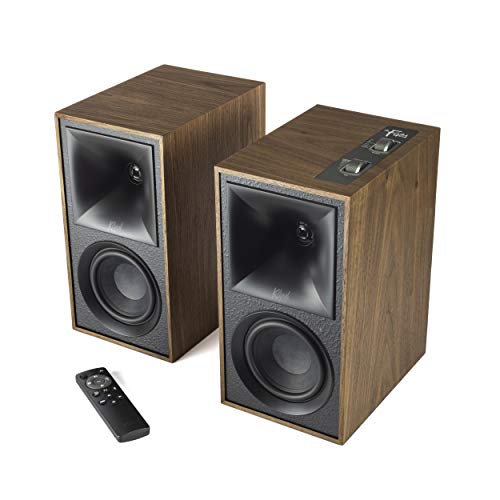
Klipsch The Fives -- Best All-in-One Sound System
Klipsch The Fives bring together a 5.25-inch woofer, 1-inch aluminum dome tweeter, and a comprehensive input set including HDMI ARC, USB-C, optical, Bluetooth, and phono stage into a single powered pair. The HDMI ARC connection enables use as a TV speaker as well as a desktop system. Klipsch's horn-loaded tweeter delivers the brand's characteristic efficiency and dynamic clarity, making the speakers feel lively and immediate at moderate listening volumes. The phono input broadens appeal to vinyl listeners. For users wanting one high-quality speaker system that covers the full range of desktop and living room scenarios, The Fives deliver.
How to choose
What to consider
Define the listening scenario first. Critical listening and audio work call for a flat frequency response, which studio monitors provide. Casual music and media enjoyment suit a speaker with a slight bass and treble lift for a more engaging sound. Consider driver size: a 4-inch or larger woofer handles the 80-200Hz range where warmth and presence live. Cabinet material matters -- wood or thick MDF reduces resonance that colors the sound. Input variety matters less than output quality, but USB and optical inputs generally provide cleaner signal paths than 3.5mm from a basic laptop output.
What to consider
For deeper coverage of speakers suited to studio use, see [best computer speakers for home studio](/articles/best-computer-speaker-for-home-studio). If you are specifically building a Mac-centric setup, [best computer speakers for Mac](/articles/best-computer-speaker-for-mac) covers compatibility and pairing considerations. Full details on our testing approach are available at [methodology](/methodology).
Common questions
Driver quality, cabinet construction, and amplifier class all contribute to sound. Larger drivers handle bass more cleanly, rigid cabinets reduce unwanted resonance, and Class D or Class AB amplifiers produce less coloration. Frequency response flatness and low total harmonic distortion are measurable indicators of accuracy. Balanced stereo imaging and a well-designed crossover in 2.1 systems also make a significant perceptual difference.
It depends on your source. If your computer has a low-quality onboard sound card, a USB DAC can eliminate noise, hum, and interference before the signal reaches your speakers. If your speakers have a built-in USB audio interface or you are using a clean output from a quality audio interface, an additional DAC offers minimal benefit. For most desktop setups, good-quality speakers with a direct 3.5mm or RCA connection to a clean output are sufficient.
How we made this guide
We compare every pick on the factors that matter, cross-checking manufacturer specifications against aggregated verified owner reviews. We rank independently and never take payment for placement. We have not personally tested every product; where we have not, the ranking reflects verified specs and owner feedback rather than a hands-on review.
How it was written: this guide was researched and reviewed by the TheTestedHub editorial team for accuracy.
Affiliate disclosure: TheTestedHub is reader-supported. When you buy through links on our site, we may earn a commission at no extra cost to you.
More guides

Your Docking Station Match: CalDigit TS4 and More

Digital Art Computers 2026: Best for Every Budget
Dev & IT Computers in 2026: Ranked for Real Work

Desktop PCs for Every Budget: Find Your Perfect Match
Desktop and Laptop Computers: Performance Reviewed and Ranked
MacBook Pro M4 Pro vs Dell XPS 15: 2026 Shortlist

Buy the Best DIY Computer in 2026: Corsair One i300
