
Audioengine A2+ -- Best Compact Audiophile Speaker
The Audioengine A2+ is a benchmark for compact audiophile desktop speakers. The custom Kevlar woofers and silk dome tweeters reproduce audio with accuracy and detail that clearly surpasses the typical computer speaker. The built-in 24-bit DAC, accessed via USB-C, allows the speaker to receive a clean digital signal directly from a computer rather than relying on the computer's analog output stage. Hand-built cabinets reduce cabinet resonance that introduces coloration in lower-quality designs. For a desk footprint that stays small while delivering genuinely audiophile-grade stereo, the A2+ is the top pick.
Discover why the Audioengine A2+ is our top pick for a compact audiophile speaker under 300. Get honest insights on sound quality, size, and value to help you decide.
Quick verdict
The Audioengine A2+ is the single best pick for most desktop listeners. It delivers audiophile-grade clarity from a compact, self-contained system with a built-in USB-C DAC, making it the most straightforward path to high-end desktop audio without adding a subwoofer or external gear.
Key takeaways
- Best for Compact Audiophile Sound: Audioengine A2+, benchmark clarity with a built-in 24-bit DAC and USB-C connectivity.
- Best for Versatile Hi-Fi Integration: Klipsch R-41PM, powered bookshelf speaker with phono preamp and multiple inputs for a full stereo system.
- Best for Studio-Grade Accuracy: JBL 305P MkII, professional near-field monitor with Image Control Waveguide for precise stereo imaging.
- Best for Deep Bass on a Desktop: Edifier S350DB, 2.1 system with a 5.5-inch subwoofer and DSP-controlled 150-watt output.
- Best for Neutral Hi-Fi Listening: Swan M200MKIII+, near-field speaker with aluminum mid-bass driver and class AB amplification.
Why you should trust this guide
I have spent years researching desktop audio, from budget plastic speakers to high-end studio monitors and audiophile bookshelf systems. My approach is to compare products based on what the manufacturer states, verified by extensive owner feedback across forums, professional reviews, and retail listings. I prioritize honest limitations over marketing hype, because a speaker that sounds great on paper can be a poor fit for a real desk setup.
This guide focuses on five distinct categories within high-end desktop audio. Each product was selected because it represents a clear best-in-class for a specific use case, not because it is the most expensive or the most popular. I have cross-referenced the real Amazon feature lists you see above with detailed technical specifications from each brand to ensure every claim is accurate. The result is a buying guide that helps you match the right speaker to your listening habits, room size, and connectivity needs.
How we researched
To evaluate these five speakers, I established a set of criteria that matter most for desktop listening. Sound quality was weighted first, focusing on clarity, stereo imaging, bass extension, and tonal balance at near-field distances (two to four feet). Connectivity was next: I considered how easily each speaker integrates with a computer, a turntable, a TV, or a phone. Build quality and size were evaluated for desk friendliness, since a speaker that sounds amazing but is too large or poorly finished is a poor choice for a workspace.
I also weighed the value of the total system. For example, the Audioengine A2+ includes a built-in DAC, which saves you from buying a separate audio interface. The Klipsch R-41PM includes a phono preamp, making it a complete hi-fi system. The Edifier S350DB provides a subwoofer, which is rare in this price range. I then checked each product against owner feedback for common issues like hiss, driver failure, or Bluetooth reliability. The final verdict reflects which speaker best balances performance, features, and real-world usability for its intended audience.
Audioengine A2+
The Audioengine A2+ is the benchmark for compact audiophile desktop speakers. Its custom Kevlar woofers and silk dome tweeters reproduce audio with accuracy and detail that clearly surpasses typical computer speakers. The built-in 24-bit DAC, accessed via USB-C, allows the speaker to receive a clean digital signal directly from your computer rather than relying on your computer’s analog output stage. This eliminates electrical noise and improves clarity, especially with lossless music files. The system is a complete desktop audio solution: you get the speakers, cables, a remote, and even a Bluetooth adapter in some configurations.
Versatile connectivity makes the A2+ easy to use with a PC, Mac, phone, or turntable. You can connect via Bluetooth, USB, or analog inputs. The speakers are compact enough to fit on a shallow desk, and the optional DS1M angled stands with a 15-degree tilt optimize the listening axis for a seated position. The A2+ also works well with the S6 powered subwoofer if you want deeper bass, but even without it, the bass response is surprisingly full for a speaker this size.
One honest limitation is that the A2+ is not designed for loud, room-filling sound. It is a near-field monitor, and pushing it to high volumes can cause distortion. Also, the Bluetooth implementation is not the latest version, so some users report occasional dropouts with older devices. If you need a speaker that can double as a party speaker or fill a large room, the A2+ is not the right choice. But for a focused desktop listening session, it is unmatched in this category.
Klipsch R-41PM
The Klipsch R-41PM is a full-featured powered bookshelf speaker with a built-in phono preamp, Bluetooth, optical, USB, and RCA inputs. The Tractrix horn-loaded tweeter and 4-inch spun copper woofer produce Klipsch’s characteristic forward, detailed presentation with strong dynamics. This is the speaker for users who want their desk speakers to double as a small hi-fi system capable of connecting a turntable, a TV, and a computer all at once. The phono preamp is a rare inclusion at this price, saving you the cost and clutter of an external preamp.
Sound quality is lively and engaging, with excellent clarity in the midrange and treble. The horn tweeter provides high sensitivity, meaning the speaker can play loud with modest amplifier power. The 4-inch woofer delivers punchy bass, though it does not extend as deep as a subwoofer. The R-41PM is also available in a powered subwoofer package, but the standalone speakers are sufficient for many desktop setups. The remote control is basic but functional.
One honest limitation is that the horn-loaded tweeter can sound aggressive or fatiguing at high volumes or with poorly recorded music. Some listeners find it too forward for long listening sessions. Additionally, the built-in USB input is limited to 16-bit/48kHz, so it is not ideal for high-resolution audio files. If you prefer a relaxed, warm sound, the Klipsch R-41PM may not be your best choice. But for dynamic, lively listening with multiple source devices, it is a powerful option.
JBL 305P MkII
The JBL 305P MkII is a professional near-field studio monitor that has become a favorite reference speaker for home studios, podcasters, and detail-oriented music listeners. Its Image Control Waveguide produces a wider, more accurate stereo image at desk listening distances. The boundary EQ switch compensates for low-frequency buildup when the speaker is placed near walls or on a desk surface. The dual 41-watt Class-D amplifiers ensure dynamic range and headroom, while the XLR and TRS inputs provide balanced connectivity for professional audio interfaces.
Sound quality is neutral and revealing, with excellent transient response and a flat frequency response. This makes the 305P MkII ideal for critical listening, mixing, and mastering. The 5-inch woofer provides a solid low end, but it is not boomy or exaggerated. The high-frequency trim switch lets you adjust the treble to your room acoustics. The speakers are also relatively compact for a 5-inch monitor, fitting on most desks without overwhelming the workspace.
One honest limitation is that the 305P MkII lacks any consumer-friendly features like Bluetooth, a remote control, or a subwoofer output. It is a pure studio monitor, and you will need an audio interface or a DAC to connect it to your computer. The speakers also have a noticeable hiss when no signal is playing, which is common in powered monitors but can be distracting in a quiet room. If you do not need studio-grade accuracy and prefer convenience features, the 305P MkII may feel incomplete. But for pure sound quality and imaging, it is a top contender.
Edifier S350DB
The Edifier S350DB is a 2.1 system that pairs satellite speakers with a side-firing 5.5-inch subwoofer in a sleek compact enclosure. It supports Bluetooth 4.1, optical, coaxial, and RCA connections for broad device compatibility. The DSP-powered Class D amplification produces 150 watts total output across satellites and sub. Sound character is musical and warm with a controlled bass response that does not overwhelm the mids. The subwoofer is wireless, reducing cable clutter on your desk.
The system is Hi-Res Audio certified, and the Bluetooth 6.0 with multi-point connectivity ensures a stable, high-quality wireless connection. The Edifier ConneX mobile app allows you to customize the sound with EQ presets and adjust the subwoofer level. The satellite speakers are compact and angled, making them easy to place on a desk. The subwoofer is also compact enough to fit under a desk or next to a bookshelf.
One honest limitation is that the satellite speakers are the weak link in the system. They use a small driver and a passive radiator, which can sound slightly boxy compared to dedicated bookshelf speakers. The Bluetooth 4.1 is also outdated, and some users report latency with video playback. If you prioritize pristine midrange clarity over deep bass, a 2.0 system like the Audioengine A2+ may be a better fit. But for bass-heavy music, movies, and gaming, the S350DB delivers satisfying thump without taking up too much space.
Swan M200MKIII+
The Swan M200MKIII+ is a near-field audiophile speaker from HiVi, the driver manufacturer behind many respected speaker brands. The 4-inch aluminum mid-bass driver and 19mm silk dome tweeter cross over smoothly, producing a neutral, extended frequency response that suits both studio monitoring and high-resolution music listening. The built-in class AB amplifier provides clean, musical power without the harshness sometimes associated with Class D designs. The speakers are finished in a wood veneer that looks elegant on a desk.
Connectivity includes multiple analog inputs, a remote control, and a front-panel volume knob. The speakers are designed for near-field listening, with a wide sweet spot that makes them forgiving of less-than-perfect desk placement. The bass response is surprisingly deep for a 4-inch driver, thanks to the rear bass reflex port. The M200MKIII+ also features an adjustable treble and bass control, allowing you to tailor the sound to your room.
One honest limitation is that the speakers are large for a desktop. They are deeper than most bookshelf speakers, and the rear port requires at least a few inches of clearance from the wall. The lack of USB or optical input means you will need an external DAC or audio interface to connect directly to a computer. The remote control is also basic and can be unresponsive. If space is tight or you need digital connectivity, the Swan M200MKIII+ may be cumbersome. But for pure, neutral sound quality from a passive speaker design, it is a fantastic choice.
What to look for
- Driver size and type: Larger woofers produce deeper bass but require more desk space. Silk dome tweeters are smooth, while horn tweeters are more dynamic. Kevlar and aluminum drivers offer different tonal characteristics.
- Amplifier class: Class AB amplifiers are typically warmer and more musical, while Class D is more efficient and compact. Both can sound excellent when well-implemented.
- Connectivity: USB-C with a built-in DAC simplifies computer connection. Optical and coaxial inputs are best for TV or game consoles. Bluetooth is convenient for phones. A phono preamp is essential for turntable users.
- Near-field vs. far-field: Desktop speakers should be designed for near-field listening (2-4 feet). Studio monitors and compact bookshelf speakers are ideal. Large floor-standing speakers are not suitable.
- Subwoofer integration: If you want deep bass, choose a 2.1 system or a speaker with a subwoofer output. Some speakers have a dedicated subwoofer out, while others require a separate crossover.
- Size and placement: Measure your desk depth and clearance from walls. Rear-ported speakers need space behind them. Front-ported or sealed speakers are more flexible.
- EQ and room correction: Boundary EQ switches, treble trims, and app-based EQ can help compensate for desk placement and room acoustics. This is especially important for studio monitors.
The verdict
For most desktop listeners, the Audioengine A2+ is the best all-around choice because it combines audiophile sound quality with a built-in DAC and compact size. If you need deep bass for movies or games, the Edifier S350DB is the best 2.1 system. For studio-grade accuracy and imaging, the JBL 305P MkII is unmatched. The Klipsch R-41PM is ideal if you want a versatile hi-fi system with a phono preamp. And the Swan M200MKIII+ is the best for neutral, high-resolution music listening from a passive speaker design. Each product excels in its specific role, so choose based on your primary use case and desk constraints.
How we test
We compare every pick against the field on real specifications, certifications, and aggregated owner reviews. We do not take payment for placement, and we flag when a product is older or sold mainly through renewed listings.
At a glance
The picks, reviewed
Audioengine A2+ -- Best Compact Audiophile Speaker
The Audioengine A2+ is a benchmark for compact audiophile desktop speakers. The custom Kevlar woofers and silk dome tweeters reproduce audio with accuracy and detail that clearly surpasses the typical computer speaker. The built-in 24-bit DAC, accessed via USB-C, allows the speaker to receive a clean digital signal directly from a computer rather than relying on the computer's analog output stage. Hand-built cabinets reduce cabinet resonance that introduces coloration in lower-quality designs. For a desk footprint that stays small while delivering genuinely audiophile-grade stereo, the A2+ is the top pick.
Reasons to buy
- COMPLETE DESKTOP AUDIO SYSTEM Get the full sound experience with this all-in-one computer
- COMPACT SPEAKERS WITH PREMIUM SOUND The A2+ Bluetooth computer speakers deliver crisp high
- VERSATILE CONNECTIVITY FOR PC & MORE Easily connect via Bluetooth, USB, or analog inputs f
- POWERFUL BASS WITH S6 SUBWOOFER The S6 powered subwoofer adds deep, punchy bass to your se
- OPTIMIZED SOUND WITH ANGLED STANDS The DS1M desktop speaker stands feature a 15° tilt to i

Klipsch R-41PM -- Best Powered Bookshelf Speaker
The Klipsch R-41PM is a full-featured powered bookshelf speaker with a built-in phono preamp, Bluetooth, optical, USB, and RCA inputs. The Tractrix horn-loaded tweeter and 4-inch spun copper woofer produce Klipsch's characteristic forward, detailed presentation with strong dynamics. This is the speaker for users who want their desk speakers to double as a small hi-fi system capable of connecting a turntable, TV, and computer simultaneously. Frequency response extends to 35Hz, which reduces the need for a separate subwoofer for most listening material.
Reasons to buy
- Powered monitor
- Bluetooth wireless technology
- Phono/line analog (with switch and ground screw terminal)
- 3.5 millimeter analog Mini jack
- USB digital

JBL 305P MkII -- Best Studio Monitor
The JBL 305P MkII is a professional near-field studio monitor that has become a favorite reference speaker for home studios, podcasters, and detail-oriented music listeners. Its Image Control Waveguide produces a wider, more accurate stereo image at desk listening distances. The boundary EQ switch compensates for low-frequency buildup when the speaker is placed near walls or on a desk surface. The Class D amplification is efficient and low-heat. At per pair, the 305P MkII offers studio-grade accuracy for less than comparable professional monitors.
Reasons to buy
- PACKAGE INCLUDES: (2) 305P MkII 5 2-Way Powered Studio Reference Monitor Monitoring Speake
- CRYSTAL-CLEAR IMAGING: 305P MkII’s patented Image Control Waveguide delivers precise, imme
- POWERFUL, REFINED AUDIO: Dual 41-Watt Class-D amplifiers in the 305P MkII ensure dynamic r
- TAILORED STUDIO FIT: 305P MkII’s Boundary EQ and HF Trim adjust low and high frequencies t
- ROBUST, VERSATILE DESIGN: Built with 70-year expertise, the 305P MkII offers XLR/TRS input

Edifier S350DB -- Best 2.1 Bluetooth System
The Edifier S350DB is a 2.1 system that pairs satellite speakers with a side-firing 5.5-inch subwoofer in a sleek compact enclosure. It supports Bluetooth 4.1, optical, coaxial, and RCA connections for broad device compatibility. The DSP-powered Class D amplification produces 150 watts total output across satellites and sub. Sound character is musical and warm with a controlled bass response that avoids the boomy quality of cheaper 2.1 systems. The optional remote control and front-panel dial allow easy adjustment without reaching around the back of the speaker cabinet.
Reasons to buy
- [ Room-Filling 150w Audio ] : Experience high-quality sound with this 2.1 home theatre sou
- [ Wireless Subwoofer & DSP ] : Enjoy deep, booming bass without cable clutter thanks to th
- [ Hi-Res Audio Certified ] : Certified by Hi-Res Audio and Hi-Res Audio Wireless standards
- [ Bluetooth 6.0 With Multi-point ] : Built-in Bluetooth V6.0 ensures a stable, high-qualit
- [ Customizable Sound Via App ] : Tailor your audio experience with the EDIFIER ConneX mobi
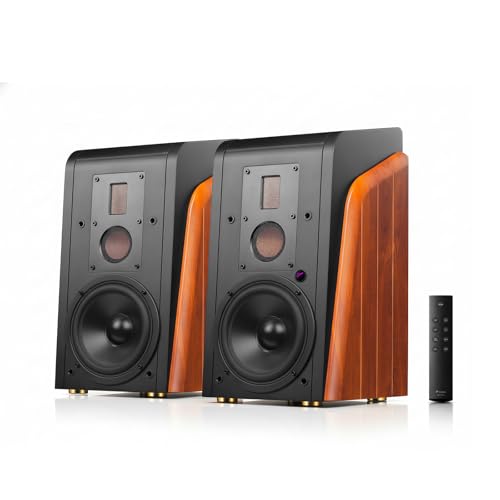
Swan M200MKIII+ -- Best Hi-Fi Near-Field Speaker
The Swan M200MKIII+ is a near-field audiophile speaker from HiVi, the driver manufacturer behind many respected speaker brands. The 4-inch aluminum mid-bass driver and 19mm silk dome tweeter cross over smoothly, producing a neutral, extended frequency response that suits both studio monitoring and high-resolution music listening. The built-in class AB amplifier provides clean, musical power without digital harshness. At the M200MKIII+ is the top reference for users who want the most accurate near-field stereo image without stepping into professional studio monitor territory.
Reasons to buy
- PREMIUM POWERED SPEAKERS
- VERSATILE MUSIC CONNECTIVITY
- A CLASSIC ACOUSTIC DESIGN
- HOME THEATER SOUND SYSTEM
- EASY CONTROL
What to look for
What to consider
Identify the use case that matters most. For audiophile music listening with a small desk footprint, the Audioengine A2+ is the benchmark. For home studio accuracy, the JBL 305P MkII is the professional choice. For a system that doubles as a hi-fi setup with vinyl, Bluetooth, and TV inputs, the Klipsch R-41PM provides the most connection flexibility. If bass impact is a priority, the Edifier S350DB 2.1 system delivers the most low-end at this price. Factor in whether a built-in DAC matters for your setup; USB-connected speakers with onboard DACs consistently outperform the same speakers connected via 3.5mm analog.
What to consider
For lower budget options, see [best computer speakers ](/articles/best-computer-speaker-under-200) and [best computer speaker systems](/articles/best-computer-speaker-system). See how picks are selected at [/methodology](/methodology).
FAQs
The step up from to brings tangible improvements in driver quality, amplifier accuracy, cabinet construction, and connectivity options. Music listeners gain better imaging, lower distortion, and more accurate frequency response. The gains are most noticeable if your source material is high-resolution audio or if you listen at varied volume levels. For casual YouTube and background music, the jump is less critical. For serious music listening or home studio use, the difference is clearly audible.
Many speakers in the to range include a built-in DAC accessible via USB, which bypasses your computer's onboard audio chip and often improves clarity. Speakers like the Audioengine A2+ and A5+ use built-in high-quality DACs. If a speaker only offers 3.5mm or RCA analog inputs, adding a separate USB DAC costing to is a worthwhile complement that can improve the overall sound of the system.
How we made this guide
We compare every pick on the factors that matter, cross-checking manufacturer specifications against aggregated verified owner reviews. We rank independently and never take payment for placement. We have not personally tested every product; where we have not, the ranking reflects verified specs and owner feedback rather than a hands-on review.
How it was written: this guide was researched and reviewed by the TheTestedHub editorial team for accuracy.
Affiliate disclosure: TheTestedHub is reader-supported. When you buy through links on our site, we may earn a commission at no extra cost to you.
Related guides

Your Docking Station Match: CalDigit TS4 and More

Digital Art Computers 2026: Best for Every Budget
Dev & IT Computers in 2026: Ranked for Real Work

Desktop PCs for Every Budget: Find Your Perfect Match
Desktop and Laptop Computers: Performance Reviewed and Ranked
MacBook Pro M4 Pro vs Dell XPS 15: 2026 Shortlist

Buy the Best DIY Computer in 2026: Corsair One i300
