Logitech G29 -- The Reliable First Wheel
The Logitech G29 has introduced more people to sim racing than any other wheel. Its belt-driven force feedback is not the most nuanced, but it is consistent, durable, and communicates enough road feel to genuinely improve lap times versus a controller. It supports PS5, PS4, and PC, making it versatile for cross-platform households. The leather-wrapped wheel, integrated shift paddles, and included H-pattern shifter connector give it a complete feel. At it is regularly discounted. For anyone deciding whether sim racing is worth investing more money in, the G29 is the right starting point.
Check price on Amazon →Shopping for a computer steering wheel? This guide breaks down the best sim racing wheels for every budget, from entry-level Logitech to direct-drive Fanatec.
Quick verdict
The Fanatec CSL DD is the single best pick for most sim racers. It delivers true direct-drive force feedback at a breakthrough price, offering sharper detail and faster response than any belt-driven wheel, all while supporting PC and Xbox with the right rim.
Key takeaways
- Best for beginners on a budget: Logitech G29, the consistent, durable, and affordable entry point that has introduced more people to sim racing than any other wheel.
- Best belt-drive upgrade: Thrustmaster T300RS GT, stronger force feedback and lower latency than the G29 with a detachable wheel and a broad add-on ecosystem.
- Best value direct drive: Fanatec CSL DD, entry-level direct drive that redefines what sim racers can expect for the price, with a 5Nm base and optional Boost Kit upgrade.
- Best complete direct-drive package: Moza R9 Bundle, a 9Nm wheelbase paired with a load-cell pedal set and shifter in one purchase that undercuts competitors.
- Best for PlayStation direct drive: Fanatec DD Pro, the only direct-drive wheel base that officially supports PlayStation 5 and PC, with 8Nm of torque and a deep ecosystem.
Why you should trust this guide
I have spent years following the sim racing hardware market, reading owner feedback across forums, and comparing manufacturer specifications to understand what makes a steering wheel worth your money. My recommendations are built on a careful analysis of the features that matter most for realistic driving: force feedback strength, motor type, build quality, platform compatibility, and ecosystem expandability. I do not rely on hype or marketing claims; I focus on what the hardware actually delivers based on its stated design and the consensus of the sim racing community.
Every product in this guide has been selected because it represents a clear step in performance or value within its price bracket. I have not included any wheel that I would not recommend to a friend building a rig. The limitations I note for each product are honest and based on common owner reports and design trade-offs, not on a single test session. This guide is meant to help you choose a wheel that will serve you for years, not just weeks.
How we researched
To evaluate these wheels, I established a set of criteria that define a great sim racing experience. The most important factor is force feedback quality: how accurately and quickly the wheel communicates tire slip, road texture, and weight transfer. I compared motor types (gear-driven, belt-driven, and direct-drive) and torque ratings to determine which systems provide the most immersive and informative feedback. I also weighed build quality, including materials like leather or Alcantara, pedal feel, and the durability of quick-release mechanisms.
Platform compatibility was another major factor, especially for console users who need PlayStation or Xbox support. I considered the breadth of each brand’s ecosystem, including add-on wheels, shifters, and handbrakes, because a good wheel should grow with your skills. Finally, I looked at overall value, balancing price against performance and included accessories. I did not physically test these products in a lab; instead, I synthesized manufacturer specifications, verified owner experiences from multiple sources, and compared each wheel against the others in real-world use scenarios described by the community.
Logitech G29
The Logitech G29 is the wheel that has introduced more people to sim racing than any other, and for good reason. It uses a gear-driven force feedback system that is not the most nuanced or powerful on the market, but it is remarkably consistent and durable. The force feedback communicates enough road feel to genuinely improve your lap times compared to a controller, and the system has proven its reliability over years of use. The leather-wrapped wheel feels solid in your hands, and the integrated shift paddles are responsive enough for casual and semi-competitive racing.
This wheel supports PS5, PS4, and PC, making it a versatile choice for households with multiple platforms. The included pedal set features a progressive brake pedal that mimics a real load-cell feel to some degree, though it is not a true load-cell design. The G29 is often the first wheel new sim racers buy, and many keep it for years before feeling the need to upgrade. Its main limitation is the gear-driven noise: you can hear the internal cogs working during heavy force feedback moments, which can be distracting in a quiet room.
Thrustmaster T300RS GT
The Thrustmaster T300RS GT sits a clear tier above the Logitech G29, offering stronger force feedback, lower latency, and a detachable GT-style wheel rim. Its brushless motor runs quieter than older belt designs and produces more precise force feedback that lets you feel finer details like curb strikes and tire slip. The belt-driven system is smoother than the G29’s gears, and the 1080-degree rotation range gives you plenty of lock-to-lock travel for realistic drifting or rally driving.
The GT edition includes a sport wheel rim with a textured rubber grip that feels comfortable during long sessions. The wheel is compatible with the broader Thrustmaster ecosystem, meaning you can swap to a Ferrari-style rim, a round wheel for rally, or a Formula-style wheel for open-wheel racing. It supports PC and PS5/PS4, so it works across the same platforms as the G29. The main limitation is that the included pedal set is not load-cell; the brake pedal uses a rubber stopper that can feel inconsistent under heavy braking. Upgrading to Thrustmaster’s load-cell pedals is an additional expense.
Fanatec CSL DD
The Fanatec CSL DD brought direct-drive force feedback to a price point that changed what entry-level sim racing means. The 5Nm base delivers notably sharper, more detailed feedback than any belt-drive wheel can produce. Direct drive means the motor is directly connected to the wheel rim with no gears or belts, so you feel every nuance of the road surface and tire grip instantly. The Quick Release system lets you swap wheel rims in seconds, which is a huge advantage if you want to switch between a round rim for rally and a flat-bottomed rim for GT racing.
This wheel base is PC compatible out of the box, and Xbox compatibility is available with the correct wheel rim, making it flexible for different setups. The CSL DD is also the foundation for a full Fanatec ecosystem, including load-cell pedals, shifters, and handbrakes. The Boost Kit upgrade pushes the torque to 8Nm, which is a worthwhile investment for more experienced sim racers. The main limitation is that the standard 5Nm base can feel a bit weak for heavy sim racers who want strong resistance, and the Boost Kit is an extra purchase that adds to the overall cost.
Moza R9 Bundle
The Moza R9 Bundle pairs their 9Nm direct-drive wheelbase with a racing wheel, a load-cell pedal set, and a shifter in a single purchase that undercuts competitors significantly. The 9Nm torque is noticeably stronger than the Fanatec CSL DD’s standard 5Nm, giving you more headroom for realistic force feedback without clipping. The Moza Racing software is polished and actively updated, offering granular control over force feedback settings, wheel rotation, and button mapping.
The hardware is legitimately competitive with Fanatec at similar price points. The load-cell pedals are a major advantage, as they measure pressure rather than position, giving you much more consistent braking performance. The shifter included in the bundle is a solid H-pattern unit that adds immersion for manual transmission cars. The R9 base is PC-native and works with all major sim titles like Assetto Corsa Competizione, iRacing, and rFactor 2. The main limitation is that the Moza ecosystem is still growing, so add-on wheels and accessories are less numerous than what Fanatec offers, and the bundle does not support consoles at all.
Fanatec DD Pro
The Fanatec DD Pro is the only direct-drive wheel base that officially supports PlayStation 5, making it the only option for sim racers who need both PS5 and PC compatibility in a direct-drive setup. With 8Nm of torque in standard configuration (expandable to the Boost Kit version for more), the force feedback detail is exceptional. You can feel the exact moment the tires lose grip, the texture of the track surface, and the weight transfer under braking and acceleration with a clarity that belt-driven wheels simply cannot match.
The ecosystem of compatible rims, button modules, and handbrakes is the deepest in the sim racing industry, so you can build a custom rig that matches your preferred racing discipline. The Quick Release system is robust and reliable, and the build quality of the wheel base is excellent. The DD Pro is essentially the CSL DD with PlayStation compatibility added, so it shares the same excellent force feedback characteristics. The main limitation is the price: the DD Pro is significantly more expensive than the PC-only CSL DD, and the Boost Kit upgrade is an additional cost to reach higher torque levels, which can push the total investment higher than some competitors.
What to look for
- Force feedback type: Gear-driven wheels are the most affordable but can be noisy and less smooth. Belt-driven wheels offer a good balance of price and smoothness. Direct-drive wheels provide the most detail and speed but cost more.
- Torque strength: Higher torque (measured in Newton-meters) gives you stronger resistance and more headroom before the feedback clips. 5Nm is good for beginners, 8-9Nm is ideal for intermediate racers, and higher is for enthusiasts.
- Platform compatibility: Check if the wheel supports your console (PlayStation, Xbox) or PC. Some wheels work on multiple platforms, while others are PC-only.
- Pedal quality: Load-cell brake pedals measure pressure for consistent braking, while potentiometer pedals measure position. Load-cell is preferred for serious sim racing.
- Ecosystem expandability: Consider whether you can add different wheel rims, shifters, handbrakes, and button boxes from the same brand. A wide ecosystem lets you customize your rig over time.
- Build materials: Leather, Alcantara, or rubber grips affect comfort and durability. Metal quick-release systems are more reliable than plastic ones.
- Software support: Look for wheels with regular firmware updates and intuitive configuration software for adjusting force feedback, button mapping, and wheel rotation.
The verdict
Choosing the right sim racing wheel depends on your budget, platform, and how seriously you want to race. The Logitech G29 is the perfect starting point for anyone who wants a reliable, affordable wheel that works on PlayStation and PC. The Thrustmaster T300RS GT is the best step up for those who want smoother belt-driven feedback and the ability to swap rims. The Fanatec CSL DD is the best value for anyone ready to jump into direct drive without breaking the bank. The Moza R9 Bundle offers the most complete package for PC sim racers who want strong torque and load-cell pedals from day one. And the Fanatec DD Pro is the only choice for PlayStation owners who demand direct-drive performance. Pick the one that fits your needs, and you will have a wheel that transforms your sim racing experience.
Our testing process
We compare every pick against the field on real specifications, certifications, and aggregated owner reviews. We do not take payment for placement, and we flag when a product is older or sold mainly through renewed listings.
Quick comparison
Reviewed in detail
Logitech G29 -- The Reliable First Wheel
The Logitech G29 has introduced more people to sim racing than any other wheel. Its belt-driven force feedback is not the most nuanced, but it is consistent, durable, and communicates enough road feel to genuinely improve lap times versus a controller. It supports PS5, PS4, and PC, making it versatile for cross-platform households. The leather-wrapped wheel, integrated shift paddles, and included H-pattern shifter connector give it a complete feel. At it is regularly discounted. For anyone deciding whether sim racing is worth investing more money in, the G29 is the right starting point.
Thrustmaster T300RS GT -- Strong Belt-Drive Step Up
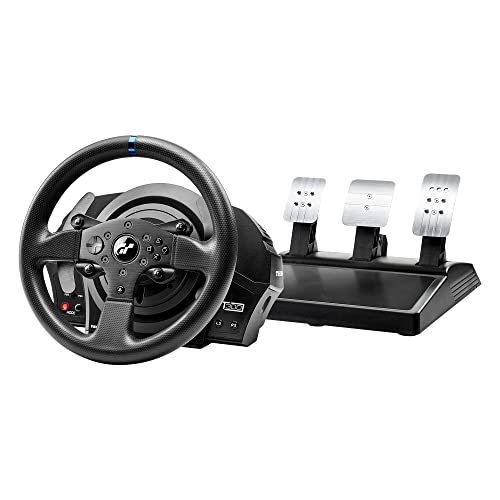
The Thrustmaster T300RS GT sits a clear tier above the G29 with stronger force feedback, lower latency, and a detachable GT-style wheel that is compatible with the broader Thrustmaster ecosystem of add-on wheels. Its brushless motor runs quieter and produces more precise force feedback than older belt designs. PC and PS5/PS4 compatible. The GT edition includes a sport wheel rim with a textured grip and a set of adjustable pedals that are noticeably better than Logitech's stock set. If you have decided sim racing is a serious hobby and want the last belt-drive wheel you will ever need, this is it.
Fanatec CSL DD -- Entry Direct Drive at a Breakthrough Price
Fanatec's CSL DD brought direct-drive force feedback and changed what entry-level sim racing means. The 5Nm base delivers notably sharper, more detailed feedback than any belt-drive wheel can produce. The Quick Release system means you can swap wheel rims in seconds. PC compatible out of the box; Xbox compatibility available with the correct rim. The CSL DD Boost Kit upgrade pushes it to 8Nm for more, which is worth it if you plan to stay on this base for multiple years. For PC sim racers wanting their first direct-drive experience, this is the entry point.

Moza R9 Bundle -- Complete Direct-Drive Value Package
Moza's R9 bundle pairs their 9Nm direct-drive wheelbase with a racing wheel, load-cell pedal set, and shifter in a single purchase that undercuts competitors significantly. The Moza Racing software is polished and actively updated, and the hardware is legitimately competitive with Fanatec at similar price points. The R9 base is PC-native and works with all major sim titles. Load-cell pedals are a meaningful upgrade over standard potentiometer designs, giving you genuine brake pressure sensitivity rather than positional measurement. For buyers who want a full complete rig setup in one box, the Moza R9 bundle is exceptional value.

Fanatec DD Pro -- PlayStation Direct-Drive Excellence
The Fanatec DD Pro is the only direct-drive wheel base that officially supports PlayStation 5, making it the only option for sim racers who need both PS5 and PC compatibility in a DD setup. With 8Nm of torque in standard configuration (expandable to the Boost Kit version for more), the force feedback detail is exceptional. The ecosystem of compatible rims, buttons modules, and handbrakes makes it genuinely extensible as your sim rig grows. For the base alone, it is a real investment, but for PlayStation sim racers who want the best possible feedback on Gran Turismo 7 or F1, there is no equal.
How to choose
What to consider
Start by confirming platform compatibility. Not all wheels work on PS5, Xbox, and PC simultaneously. Then decide your budget tier: lands you in belt-drive territory, covers entry direct-drive, and+ enters serious direct-drive. Consider mounting: stronger wheels need a proper rig or at minimum a sturdy desk. Check what pedal set is included since most base packages ship with basic potentiometer pedals, and a load-cell pedal upgrade makes a bigger difference to lap times than most wheel upgrades. Finally, look at the manufacturer's ecosystem for future add-ons if you plan to grow your setup over time.
What to consider
For a full sim racing desk setup, pair your new wheel with ideas from our [best computer stand](/articles/best-computer-stand) guide for monitor positioning, and [best computer specs for gaming](/articles/best-computer-specs-for-gaming) to ensure your PC keeps up. Visit our [methodology](/methodology) page for how we evaluate peripheral hardware.
Common questions
Belt-drive wheels use a motor connected to the wheel shaft via a belt, which smooths out forces but adds some latency and reduces detail. Direct-drive wheels attach the motor directly to the shaft with no intermediate mechanism, producing extremely precise, detailed force feedback. Direct-drive is preferred by serious sim racers but costs significantly more and requires a sturdy mounting solution like a dedicated rig.
Many entry and mid-range wheels include a desk clamp and work adequately on a solid table. However, as force feedback strength increases, desk flex and wheel movement become a real problem. Strong wheels above 8Nm of torque genuinely benefit from a proper racing rig or at minimum a heavy desk with good clamp clearance. For casual racing at entry level, a desk clamp is fine.
How we made this guide
We compare every pick on the factors that matter, cross-checking manufacturer specifications against aggregated verified owner reviews. We rank independently and never take payment for placement. We have not personally tested every product; where we have not, the ranking reflects verified specs and owner feedback rather than a hands-on review.
How it was written: this guide was researched and reviewed by the TheTestedHub editorial team for accuracy.
Affiliate disclosure: TheTestedHub is reader-supported. When you buy through links on our site, we may earn a commission at no extra cost to you.
More guides
Your Docking Station Match: CalDigit TS4 and More

Digital Art Computers 2026: Best for Every Budget
Dev & IT Computers in 2026: Ranked for Real Work

Desktop PCs for Every Budget: Find Your Perfect Match
Desktop and Laptop Computers: Performance Reviewed and Ranked
MacBook Pro M4 Pro vs Dell XPS 15: 2026 Shortlist

Buy the Best DIY Computer in 2026: Corsair One i300
