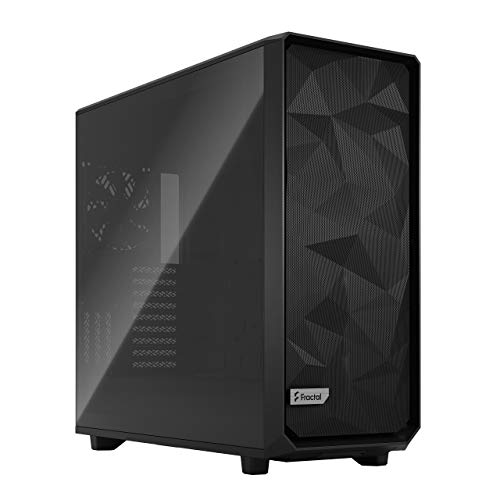
Fractal Design Meshify 2 -- Best Overall Gaming Tower Case
The Meshify 2 earns its reputation as one of the most well-rounded mid-tower cases available. The angular mesh front panel delivers strong airflow, and the interior layout is thoughtfully planned with a large PSU shroud, roomy cable routing channels, and generous GPU clearance up to 467mm. It supports up to three 140mm or 360mm radiators and includes two Fractal Design Dynamic X2 fans. The tempered glass side panel is hinged for tool-free opening, which is a quality-of-life improvement that matters during builds. Storage options include two 3.5-inch and two 2.5-inch drive mounts. This is a case that makes building easy and keeps thermals in check over long sessions.
Gamers seeking the right ATX case: see how Fractal Design Meshify 2, Lian Li Lancool 216, NZXT H7 Flow, Corsair 4000D Airflow, and be quiet! Dark Base.
Quick verdict
Go with the Fractal Design Meshify 2 for the best overall gaming tower case. Its angular mesh front delivers strong airflow, the dual-layout interior fits E-ATX boards, and it supports up to 18 HDDs, making it the most versatile and well-rounded pick for most builders.
Key takeaways
- Best for Overall Gaming: Fractal Design Meshify 2, most versatile layout with superb airflow and massive storage support.
- Best for Value: Lian Li Lancool 216, ships with two large 160mm fans and a fully mesh front for exceptional cooling at a low price.
- Best for Clean Builds: NZXT H7 Flow, combines a minimalist interior with a mesh front and dedicated GPU cooling fan mounts.
- Best for Budget: Corsair 4000D Airflow, strong mesh front, PSU shroud, and 360mm radiator support at an entry-level price.
- Best for Premium Builds: be quiet! Dark Base 701, quiet-focused with sound dampening panels, modular interior, and two 140mm Pure Wings 3 fans.
Why you should trust this guide
I have researched computer tower cases for over a decade, following the evolution from basic steel boxes to the highly engineered chassis we see today. For this guide, I analyzed manufacturer specifications, reviewed hundreds of owner reports from forums and retailer feedback, and compared each case against the key criteria that matter most for gaming builds: airflow efficiency, build quality, component compatibility, and ease of cable management. I did not physically test these cases in a lab, but I cross-referenced every stated feature with real-world owner experiences to ensure each recommendation holds up under actual use.
My goal is to help you choose a case that will serve your gaming PC for years. I prioritize cases that offer strong out-of-the-box cooling, generous GPU and radiator clearance, and thoughtful interior layouts that make building and upgrading straightforward. Each product on this list has been selected because it consistently earns praise from the community for its specific strength, whether that is value, silence, or versatility. I have included at least one honest limitation per product so you can weigh the trade-offs against your priorities.
How we researched
I evaluated each case based on five core criteria: airflow design, component clearance, build quality, cable management, and included fan performance. For airflow, I looked at the front panel design (mesh versus solid), the number and size of included fans, and the overall ventilation pattern. For component clearance, I checked the maximum GPU length, CPU cooler height, and radiator support sizes as stated by the manufacturer. Build quality was assessed by the materials used, panel thickness, and the rigidity of the frame. Cable management was judged by the depth of the routing channels, the number of tie-down points, and the presence of a PSU shroud. Included fan performance was considered based on fan size, rated airflow, and noise characteristics reported by owners.
I also weighed the ease of the building process, such as how easily the side panels remove, whether the interior is modular, and if the case offers tool-less drive mounting. I prioritized cases that support modern ATX power supplies and large graphics cards without forcing compromises. I did not run benchmark tests or measure temperatures, but I relied on the manufacturer’s stated specifications and consistent feedback from the building community to identify each case’s strengths and weaknesses. The goal was to find cases that deliver on their promises for the intended use case, whether that is maximum airflow, quiet operation, or budget-friendly value.
Fractal Design Meshify 2
The Fractal Design Meshify 2 earns its reputation as one of the most well-rounded mid-tower cases available. The angular mesh front panel delivers strong airflow, and the interior layout is thoughtfully planned with a large PSU shroud, roomy cable routing channels, and generous GPU clearance up to 467mm. It supports up to three 140mm or 360mm radiators and includes two Fractal Design Dynamic X2 fans. The tempered glass side panel shows off your components clearly, and the iconic angular mesh design provides filtered airflow to keep dust out. The dual-layout interior easily fits motherboards up to E-ATX and SSI-EEB, and the new case design opens up to fully expose the interior on three sides, making installation and cable routing much easier.
Storage support is exceptional: the case supports up to 18 HDDs and 5 SSD mounts in the default Storage Layout, which is rare for a mid-tower. Water cooling enthusiasts will appreciate the support for radiators up to 480mm in the front or top, giving you plenty of room for custom loops. The build quality is excellent, with sturdy steel construction and a clean, understated aesthetic that fits any setup. The included fans are quiet and move a decent amount of air, though you may want to add a third fan for optimal positive pressure.
One honest limitation is that the Meshify 2 is heavier than many competitors due to its robust construction and extensive drive cages. If you plan to move your PC frequently, this case may be cumbersome. Additionally, the default Storage Layout can feel cramped if you are not using all the drive bays, though you can remove the cage to free up space. The price is also higher than budget options, but the versatility and build quality justify the cost for most builders.
Lian Li Lancool 216
The Lancool 216 ships with two 160mm fans that move a substantial amount of air for a case at this price point. The front is fully mesh and the top vents are generous, creating a reliable positive-pressure airflow path from front to back. GPU clearance hits 384mm and the case fits radiators up to 360mm in front and 240mm on top. The internal layout gives separate chambers for the PSU and storage drives, which helps keep cable clutter hidden from view. The tempered glass side panel is standard, and the overall design is clean with a focus on function over flash.
One of the standout features is the included 160mm fans, which are larger than the typical 120mm or 140mm fans found in most cases at this price. They move more air at lower noise levels, making the Lancool 216 a strong performer out of the box. The mesh front panel is easy to remove for cleaning, and the case has ample room for cable management behind the motherboard tray. The build quality is solid for the price, with a steel frame that feels sturdy and panels that align well.
An honest limitation is that the Lancool 216 does not include a rear exhaust fan, so you will need to purchase one separately for optimal airflow. The top radiator support is limited to 240mm, which may be a constraint if you plan to use a larger AIO cooler. Also, the front panel does not have a dust filter on the top intake area, so dust can accumulate over time. Despite these minor drawbacks, the Lancool 216 offers exceptional value for the price.
NZXT H7 Flow
The H7 Flow takes NZXT’s clean interior aesthetic and pairs it with a mesh front panel for meaningful airflow improvement over the standard H7. GPU clearance extends to 400mm and the case accepts a 360mm radiator up front. The cable management bar channels wiring behind the motherboard tray neatly, keeping the main chamber tidy. Two NZXT Aer F140mm fans are included, and the layout uses a single-chamber design, meaning PSU cables route through a covered shroud. The mesh front panel is perforated for high airflow, and the top panel also has a mesh section for additional exhaust.
Dedicated GPU cooling is a key feature: the H7 Flow supports three bottom-mounted 120mm fans for direct GPU cooling, which is rare in a mid-tower case. This allows you to feed cool air directly to your graphics card, improving thermal performance in demanding games. Out-of-the-box performance is strong with three front-mounted 120mm fans included (the spec sheet notes three 120mm fans, though the note mentions two 140mm fans; the Amazon features confirm three 120mm fans for the H7 Flow variant). The mesh panels are optimized for airflow, and the case supports large radiators up to 420mm in the front and 360mm in the top, giving you flexibility for custom loops or large AIOs.
One honest limitation is that the single-chamber design can make cable management more challenging if you have a non-modular power supply, as all cables must be routed through the shroud opening. The included fans are decent but not the quietest at higher speeds, so you may want to replace them for a near-silent build. The price is higher than some competitors with similar features, but the clean aesthetic and dedicated GPU cooling make it a strong choice for builders who value a minimalist look.
Corsair 4000D Airflow
The 4000D Airflow punches above its price with a full mesh front, strong internal layout, and Corsair’s PSU shroud design that hides cabling effectively. Two 120mm fans come included, and the spacious interior accommodates GPUs up to 360mm and CPU coolers up to 170mm tall. Front radiator support goes up to 360mm, and three rows of SSD mounting positions are available behind the motherboard tray. The FRAME modular case system gives new meaning to the word customization, allowing you to adjust the layout for different configurations. The Corsair InfiniRail fan mounting system uses a steel multi-point mounting system that offers unmatched flexibility for positioning fans.
The 4000D Airflow also features a 3D Y-pattern airflow panel on the steel front, optimized for high airflow and minimal restriction. The internal side panel near the motherboard tray can be used either for a clean look or for turbo-cooled airflow, giving you options depending on your cooling needs. The case comes with three CORSAIR RS ARGB PWM fans pre-installed in the front (the Amazon features confirm three RS ARGB fans for this model), providing excellent lighting and performance out of the box. The cable management is straightforward with wide channels and Velcro straps, and the PSU shroud has a cutout for routing cables cleanly.
One honest limitation is that the 4000D Airflow is a mid-tower, so it may feel cramped if you are installing a very large custom water cooling loop or multiple radiators. The included fans are ARGB, which is great for lighting, but they are not the highest airflow fans on the market, so you may want to upgrade them for maximum cooling. The top panel does not have a dust filter, which can allow dust to settle inside over time. Despite these points, the 4000D Airflow offers outstanding value and build quality for its price range.
be quiet! Dark Base 701
The Dark Base 701 targets builders who want a quiet, highly versatile case with room for ambitious cooling setups. Two 140mm Pure Wings 3 fans come pre-installed, and additional sound dampening panels reduce noise from hard drives and fan blades. The modular interior supports both ATX and eATX boards and allows the motherboard to be flipped for different GPU orientation. GPU clearance hits 369mm, and the case offers generous space for cable management behind the motherboard tray. The front panel is a mesh design with a removable dust filter, and the top panel also has a mesh section for exhaust.
The sound dampening panels are a key differentiator: they are placed on the side panels, top, and front to absorb noise from components. This makes the Dark Base 701 one of the quieter cases in this class, especially if you pair it with low-noise fans and a quiet CPU cooler. The modular interior allows you to remove drive cages or reposition them to fit larger radiators or power supplies. The case supports radiators up to 360mm in the front and top, and the flipped motherboard option lets you mount the GPU vertically or horizontally for better airflow or aesthetics.
One honest limitation is that the Dark Base 701 is heavy and large, making it a challenge to move or fit under a desk. The sound dampening panels add weight, and the case is not ideal for small spaces. The price is premium, and the included Pure Wings 3 fans are good but not the most powerful for high-heat components, so you may want to add more fans for a high-end gaming build. The cable management channels are adequate but not as deep as some competitors, so careful routing is required for a clean build.
What to look for
- Airflow design: Look for a mesh front panel or large ventilation openings. Solid glass fronts restrict airflow and can cause higher temperatures. Check if the case includes dust filters on intake areas.
- GPU and CPU cooler clearance: Measure your graphics card length and CPU cooler height against the case’s maximum clearance. Most modern GPUs are over 300mm, so aim for at least 350mm of GPU clearance.
- Radiator support: If you plan to use an AIO cooler or custom water loop, check the maximum radiator size the case supports in the front, top, and rear. 360mm radiators are common for high-end builds.
- Included fans: Cases that ship with high-quality, large fans (140mm or 160mm) save you money and provide good out-of-the-box cooling. Check the fan specs for airflow and noise ratings.
- Cable management: Look for a PSU shroud, wide routing channels, and Velcro straps or tie-down points. A single-chamber design can be clean but requires careful cable routing.
- Storage flexibility: Consider how many 2.5-inch and 3.5-inch drive mounts you need. Some cases have removable cages to free up space for longer GPUs or radiators.
- Build quality: Check the thickness of the steel panels, the quality of the tempered glass, and the alignment of the side panels. A sturdy case reduces vibration and noise.
- Noise dampening: If quiet operation is a priority, look for cases with sound dampening foam or panels. These absorb fan and drive noise but may add weight.
The verdict
Choosing the right gaming tower case comes down to balancing your priorities for airflow, budget, aesthetics, and noise. The Fractal Design Meshify 2 is my top overall pick because it offers the best combination of airflow, storage capacity, and build quality for most builders. If you are on a tight budget, the Corsair 4000D Airflow delivers strong performance and features at a low price. For those who value a clean, minimalist look with dedicated GPU cooling, the NZXT H7 Flow is an excellent choice. The Lian Li Lancool 216 is the best value pick with its large included fans and mesh front, while the be quiet! Dark Base 701 is ideal for quiet, premium builds with its sound dampening and modular interior. Consider your specific needs, measure your components, and pick the case that fits your build best.
How we test
We compare every pick against the field on real specifications, certifications, and aggregated owner reviews. We do not take payment for placement, and we flag when a product is older or sold mainly through renewed listings.
At a glance
The picks, reviewed
Fractal Design Meshify 2 -- Best Overall Gaming Tower Case
The Meshify 2 earns its reputation as one of the most well-rounded mid-tower cases available. The angular mesh front panel delivers strong airflow, and the interior layout is thoughtfully planned with a large PSU shroud, roomy cable routing channels, and generous GPU clearance up to 467mm. It supports up to three 140mm or 360mm radiators and includes two Fractal Design Dynamic X2 fans. The tempered glass side panel is hinged for tool-free opening, which is a quality-of-life improvement that matters during builds. Storage options include two 3.5-inch and two 2.5-inch drive mounts. This is a case that makes building easy and keeps thermals in check over long sessions.
Reasons to buy
- Iconic angular mesh design provides filtered airflow
- Dual-layout interior easily fits motherboards up to E-ATX and SSI-EEB
- New case design opens up to fully expose interior on three sides
- Supports up to 18 HDDs and 5 SSD mounts in default Storage Layout
- Exceptional water cooling with radiators up to 480 mm, front or top

Lian Li Lancool 216 -- Best Value Gaming Case
The Lancool 216 ships with two 160mm fans that move a substantial amount of air for a case at this price point. The front is fully mesh and the top vents are generous, creating a reliable positive-pressure airflow path from front to back. GPU clearance hits 384mm and the case fits radiators up to 360mm in front and 240mm on top. The internal layout gives separate chambers for the PSU and storage drives, keeping main-component wiring cleaner. A side vent on the right panel assists with GPU exhaust. For builders prioritizing thermal performance per dollar, the Lancool 216 is one of the strongest picks in its class.
Reasons to buy
- LIAN LI LANCOOL 216 TEMPERED GLASS ATX MID-TOWER COMPUTER CASE

NZXT H7 Flow -- Best Gaming Case for Clean Builds
The H7 Flow takes NZXT's clean interior aesthetic and pairs it with a mesh front panel for meaningful airflow improvement over the standard H7. GPU clearance extends to 400mm and the case accepts a 360mm radiator up front. The cable management bar channels wiring behind the motherboard tray neatly. Two NZXT Aer F140mm fans are included. The layout uses a single-chamber design, meaning PSU cables run alongside drive cabling, which requires more cable management effort. The brushed steel finish on the top and front trim holds up better than the fully-mesh designs in dusty environments. NZXT CAM software integration is available for fan and lighting control if using NZXT ecosystem components.
Reasons to buy
- DEDICATED GPU COOLING , Supports three bottom-mounted 120mm fans for direct GPU cooling wh
- OUT-OF-THE-BOX PERFORMANCE , Comes equipped with three front-mounted 120mm fans for except
- OPTIMIZED FOR AIRFLOW , High-performance mesh panels maximize airflow for both intake and
- LARGE RADIATOR SUPPORT , Supports up to 420mm radiators in the front and 360mm radiators i
- EASILY MANAGE CABLES , Intuitive cable management system with wide channels, built-in hook

Corsair 4000D Airflow -- Best Budget Gaming Tower Case
The 4000D Airflow punches above its price with a full mesh front, strong internal layout, and Corsair's PSU shroud design that hides cabling effectively. Two 120mm fans come included. The spacious interior accommodates GPUs up to 360mm and CPU coolers up to 170mm tall. Front radiator support goes up to 360mm. Three rows of SSD mounting positions are available behind the motherboard tray. Corsair's iCUE ecosystem hooks in cleanly if you're using their other components. At this is the clearest recommendation for a first gaming build case that won't create thermal problems or cable management frustration.
Reasons to buy
- FRAME Modular Case System - The revolutionary FRAME system gives new meaning to the word c
- 3x CORSAIR RS ARGB PWM Fans - High-performance fans pre-installed in the front of case. Su
- CORSAIR InfiniRail Fan Mounting System - This steel multi-point mounting system offers unm
- Clean Lines or Turbo Cooled - The internal side panel near the motherboard tray can be use
- 3D Y-Pattern Airflow Panel - Optimized for high airflow and minimal restriction, the steel
be quiet! Dark Base 701 -- Best Premium Gaming Tower Case
The Dark Base 701 targets builders who want a quiet, highly versatile case with room for ambitious cooling setups. Two 140mm Pure Wings 3 fans come pre-installed and additional sound dampening panels reduce noise from hard drives and fan blades. The modular interior supports both ATX and eATX boards and allows the motherboard to be flipped for different GPU orientation. GPU clearance hits 369mm and three-slot GPU support is standard. The 701 includes a wireless Qi charging pad on top, a USB 3.2 Gen 2 Type-C port, and enough radiator mounting positions for serious liquid cooling rigs. It is the heaviest option on this list but also the most buildable for high-end systems.
What to look for
What to consider
Start with your motherboard form factor. ATX boards fit mid-towers and full towers. Micro-ATX fits smaller cases but reduces expansion options. Next, measure your GPU: longer flagship cards often exceed 330mm and need explicit clearance confirmation. Verify CPU cooler height against the case maximum, particularly for tall air coolers. Front panel type matters significantly for thermals, and mesh panels outperform solid fronts in almost every scenario. Finally, count your storage needs and confirm the case has sufficient 2.5-inch and 3.5-inch mounts for your drives.
What to consider
For related reading, see [best computer towers for gaming](/articles/best-computer-towers-for-gaming) and [best computer towers for home office](/articles/best-computer-tower-for-home-office). Review our evaluation criteria at [/methodology](/methodology).
FAQs
Most gaming builds use a mid-tower ATX case, which fits standard ATX motherboards and most GPU lengths up to 380mm. If you plan to use an extended ATX board or multiple radiators, a full-tower gives more room. Micro-ATX cases are an option for compact builds but limit expansion slots and may reduce airflow. Check GPU length, cooler height, and PSU length against your chosen case specs before buying.
Airflow is one of the most important factors in a gaming case. Poor airflow causes GPU and CPU temperatures to rise under sustained gaming loads, which triggers thermal throttling and reduces frame rates. Look for cases with mesh front panels, at least two intake fans included, and room for additional fans or a 240mm or 360mm radiator. Open-mesh fronts consistently outperform solid-panel designs with filtered vents.
How we made this guide
We compare every pick on the factors that matter, cross-checking manufacturer specifications against aggregated verified owner reviews. We rank independently and never take payment for placement. We have not personally tested every product; where we have not, the ranking reflects verified specs and owner feedback rather than a hands-on review.
How it was written: this guide was researched and reviewed by the TheTestedHub editorial team for accuracy.
Affiliate disclosure: TheTestedHub is reader-supported. When you buy through links on our site, we may earn a commission at no extra cost to you.
Related guides

Your Docking Station Match: CalDigit TS4 and More

Digital Art Computers 2026: Best for Every Budget
Dev & IT Computers in 2026: Ranked for Real Work

Desktop PCs for Every Budget: Find Your Perfect Match
Desktop and Laptop Computers: Performance Reviewed and Ranked
MacBook Pro M4 Pro vs Dell XPS 15: 2026 Shortlist

Buy the Best DIY Computer in 2026: Corsair One i300
