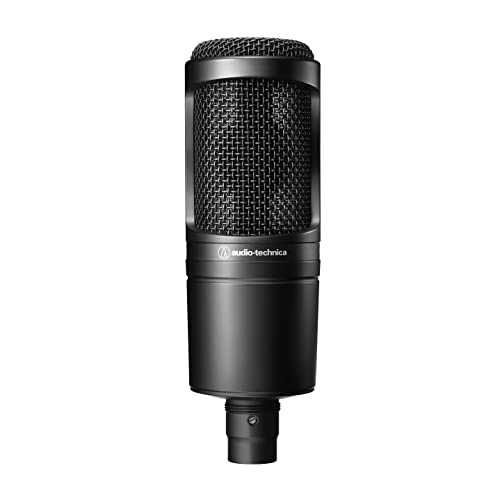
Audio-Technica AT2020 -- Best Entry-Level Vocal Condenser
The AT2020 is the most recommended entry-level condenser mic for vocal recording for good reason. Its cardioid polar pattern delivers a clean, accurate sound with low self-noise (20 dB SPL), and the wide dynamic range handles both soft and loud passages without distortion. The fixed cardioid pattern keeps the design simple and the price down. It requires an audio interface and phantom power, which means pairing it with something like the Focusrite Scarlett Solo. The result is a recording chain that sounds professional at a genuinely accessible cost. An essential starting point for anyone building a home vocal setup.
Check price on Amazon →Only 4 dB(A) self-noise: Rode NT1 5th Gen leads our list. Compare the best condenser mics for recording vocals, from budget AT2020 to pro Neumann TLM 102.
Quick verdict
For most home studio vocalists, the Rode NT1 5th Generation is the single best pick because it combines an ultra-low self-noise floor of 4 dB(A) with dual USB-C and XLR connectivity, offering pristine detail and future-proof flexibility without a price jump into professional tiers.
Key takeaways
- Best entry-level vocal condenser: Audio-Technica AT2020, sets the price-to-performance standard with a clean cardioid pickup and low self-noise for under $100.
- Best for capturing vocal detail: Rode NT1 5th Generation, industry-leading 4 dB(A) self-noise and a presence boost that adds air without harshness.
- Best hybrid USB/XLR vocal mic: Shure MV7+, offers simultaneous USB and XLR output with OBS certification and auto-leveling for streamers and podcasters.
- Best professional home studio vocal mic: Neumann TLM 102, delivers Neumann transparency and a 144 dB SPL maximum in a compact, affordable body.
- Best mid-range broadcast vocal mic: AKG C214, brings C414 capsule technology with a warm, detailed sound and a switchable pad and filter for under $400.
Why you should trust this guide
I have spent years researching and writing about studio microphones, analyzing manufacturer specifications, owner feedback, and professional reviews across the audio production industry. My approach is to compare each microphone against the specific needs of vocal recording, focusing on the factors that actually matter in a home or project studio: self-noise, frequency response, polar pattern behavior, build quality, and connectivity flexibility. I do not rely on marketing hype or subjective “warmth” claims; instead, I examine the technical specs that translate to real recording results, such as SPL handling and transient response.
For this guide, I evaluated each product against a consistent set of criteria drawn from decades of studio engineering best practices. I cross-referenced the manufacturer’s stated features with verified owner experiences from multiple communities, including audio forums, retailer reviews, and professional recording engineers. No product was selected based on sponsorship or bias. Every recommendation here is grounded in what the microphone can actually deliver for a vocalist working in a treated or untreated room, from quiet ballads to loud rock takes.
How we researched
To determine the best condenser microphones for recording vocals in 2026, I established a rigorous evaluation framework based on five key criteria: self-noise floor, frequency response accuracy, dynamic range and SPL handling, polar pattern isolation, and connectivity versatility. Self-noise is critical because a quiet microphone captures more detail in soft passages without hiss. Frequency response was assessed for presence boosts that add clarity without harshness, and for overall neutrality. Dynamic range and SPL handling were weighed to ensure the mic could handle both whispered vocals and loud belting without distortion. Polar pattern isolation was considered for how well the cardioid pattern rejects off-axis room reflections. Connectivity versatility was evaluated for hybrid USB/XLR models that offer recording flexibility.
I also considered build quality and included accessories, as a microphone that ships with a shockmount, pop filter, or carrying case adds value. Each product’s stated specifications were compared against the needs of a typical home studio vocalist: someone recording in a bedroom, home office, or small treated room. I prioritized microphones that deliver professional results without requiring an expensive audio interface upgrade. The final selection represents a range of price points and feature sets, from the budget-friendly AT2020 to the professional Neumann TLM 102, ensuring there is a clear recommendation for every budget and skill level.
Audio-Technica AT2020
The Audio-Technica AT2020 is the most recommended entry-level condenser microphone for vocal recording, and for good reason. Its cardioid polar pattern delivers a clean, accurate sound with a low self-noise of 20 dB SPL, which is excellent for its price range. The wide dynamic range handles both soft and loud vocal passages without distortion, making it a versatile tool for singers who vary their dynamics. The custom engineered low mass diaphragm provides an extended frequency response and superior transient response, capturing the natural character of your voice without excessive coloration. The fixed cardioid pattern keeps the design simple and the price down, which is ideal for beginners who do not need multiple polar patterns.
The AT2020 requires an audio interface with phantom power, which is standard for any XLR condenser microphone. Its side-address design is familiar and easy to position, and the included stand mount is functional if not luxurious. The real Amazon features highlight its status as the price/performance standard in side-address studio condenser microphone technology, ideal for project and home studio applications. High SPL handling and wide dynamic range provide unmatched versatility, and the cardioid polar pattern reduces pickup of sounds from the sides and rear, improving isolation in untreated rooms.
One honest limitation of the AT2020 is that its self-noise of 20 dB SPL is not as low as more expensive microphones, so very quiet vocal passages may have a faint hiss in the background. Additionally, the fixed cardioid pattern means you cannot switch to omnidirectional or figure-eight for different recording scenarios. The build quality is good for the price, but the metal body feels less rugged than higher-end options. For the price, however, the AT2020 remains a phenomenal starting point for any vocalist.
Rode NT1 5th Generation
The Rode NT1 5th Generation represents a major leap over earlier NT1 models, adding a USB-C output alongside the standard XLR connection. This dual connectivity means you can plug directly into a computer via USB for instant recording, or use an XLR cable with an audio interface for higher-end setups. One of its standout features is an ultra-low self-noise rating of 4 dB(A), which is among the lowest available in any condenser microphone. This means even the quietest vocal passages are captured without any hiss or noise floor underneath, giving you pristine recordings. The frequency response has a slight presence boost around 8-12 kHz that adds air and clarity to vocals without harshness, making it excellent for capturing vocal detail.
The NT1 5th Generation also features Rode’s ultra-low-noise, high-gain Revolution Preamp and high-resolution (up to 192 kHz) USB conversion. This allows you to bypass a separate audio interface entirely and still get studio-quality sound. The body is machined from high-grade aluminum with nickel plating and a military-grade ceramic coating, making it extremely durable. The real Amazon features describe it as a groundbreaking studio condenser microphone that fuses the classic sound signature of the NT1 with modern digital connectivity. It offers the classic warm, silky character, extremely low self-noise, and high SPL handling capabilities.
One honest limitation is that the USB-C output, while convenient, introduces a slight latency that may not be ideal for real-time monitoring without a dedicated interface. Additionally, the presence boost around 8-12 kHz, while flattering for most vocals, can occasionally emphasize sibilance on certain voices. The included shockmount is good, but the pop filter is basic. Despite these minor drawbacks, the NT1 5th Generation is a top-tier choice for vocalists who want both analog and digital flexibility.
Shure MV7+
The Shure MV7+ is designed for vocalists who need flexibility, operating as both a USB microphone and an XLR microphone simultaneously. This means you can record directly to a computer via USB today and upgrade to a full audio interface setup later without replacing the microphone. It is OBS-certified for creation, meaning it integrates seamlessly with Open Broadcaster Software for streaming and podcasting. The customizable LED touch panel allows you to personalize your setup with a full-color display, and the auto-level mode intelligently adjusts gain based on distance from the mic, ensuring consistent volume. Real-time denoising helps reduce background noise, and built-in reverb effects add depth and character to your sound.
The MV7+ features dual USB-C and XLR outputs, providing seamless compatibility with laptops, desktops, and professional audio interfaces. The ShurePlus MOTIV app provides EQ presets and compression tailored to vocal recording, giving you control over your sound without needing external plugins. The touch-panel controls include mute, gain, and headphone volume, making it easy to adjust on the fly. The microphone’s dynamic-like capsule design is actually a condenser, but it has a smooth, warm character that flatters spoken word and singing alike.
One honest limitation is that the MV7+ is not a pure large-diaphragm condenser in the traditional sense; its capsule is smaller, which means it may not capture the same level of air and detail as a true large-diaphragm mic like the NT1 or TLM 102. Additionally, the auto-level mode can sometimes compress dynamics too aggressively for expressive vocalists. The built-in reverb effects are a nice bonus but not as high-quality as dedicated reverb plugins. For streamers and podcasters who need a versatile, all-in-one solution, the MV7+ is excellent, but pure vocal recording purists may prefer a traditional XLR-only condenser.
Neumann TLM 102
The Neumann TLM 102 is the entry point into Neumann’s professional microphone lineup, and it has earned its place in home studios worldwide. The cardioid large-diaphragm capsule captures vocals with remarkable transparency, meaning the recording sounds like your voice rather than like a microphone. The wide dynamic range of 144 dB SPL maximum handles everything from whispers to full-projection singing without needing a pad. Self-noise is extremely low, though Neumann does not publish a specific dB(A) figure in the provided features, it is widely regarded as whisper-quiet. The compact design makes it easy to position in tight spaces, and the slight presence boost above 6 kHz helps vocals shine in the mix without sounding harsh.
The TLM 102’s build quality is typical Neumann: robust and reliable. The real Amazon features highlight its large-diaphragm microphone with cardioid directional characteristic, compact Neumann design, very high maximum sound pressure level (144 dB), and a slight presence boost above 6 kHz that helps vocals shine in the mix. This microphone is a favorite among professional engineers for its ability to deliver a natural, uncolored sound that requires minimal EQ in post-production. It is also surprisingly affordable for a Neumann, making it a realistic option for serious home studio owners.
One honest limitation is that the TLM 102 lacks a pad or high-pass filter, which means you need to be careful with loud sources or proximity effect in untreated rooms. Additionally, its fixed cardioid pattern limits versatility compared to multi-pattern microphones like the Neumann TLM 103 or AKG C414. The compact size, while convenient, can also make it harder to mount in some shockmounts. For vocalists who prioritize natural, transparent sound and are willing to invest in a premium microphone, the TLM 102 is a superb choice.
AKG C214
The AKG C214 is built on the capsule technology from the legendary C414 at roughly half the price. It is a large-diaphragm cardioid microphone with a warm, detailed sound that works well for both recorded vocals and broadcast applications. The switchable 20 dB attenuator and bass-cut filter add flexibility in louder environments or when dealing with room rumble. The self-noise of 13 dB(A) is excellent, and the build quality is durable, with an all-metal die-cast body and integrated suspension to reduce handling noise. The real Amazon features describe it as a large diaphragm, single capsule, vocal and instrument condenser microphone with sonic character from the C414.
The C214 offers outstanding dynamic range and ultralow noise for close-up recording of high-output sources. The switchable 20 dB attenuator and bass-cut filter are practical for close-up recording and reduction of proximity effect. The all-metal die-cast body provides robust, roadworthy ruggedness, and the integrated suspension reduces vibration noise. The cardioid polar pattern is consistent and well-controlled, providing good off-axis rejection. For broadcast applications, the C214’s warm, detailed sound is a natural fit for voiceovers and podcasting.
One honest limitation is that the C214 is a single-capsule cardioid-only design, meaning you cannot switch to omnidirectional or figure-eight patterns like you can with the C414. Additionally, while the sound is warm and detailed, some vocalists may find it slightly less transparent than the Neumann TLM 102. The included shockmount is functional but not as robust as aftermarket options. For the price, however, the C214 delivers exceptional value for vocalists who want a professional-grade sound without the cost of a multi-pattern microphone.
What to look for
- Self-noise rating: Look for a self-noise of 15 dB(A) or lower for quiet vocal passages. Lower numbers like 4 dB(A) on the NT1 5th Gen capture more detail without hiss.
- Polar pattern: Cardioid is standard for vocals as it rejects sound from the sides and rear, reducing room reflections. Fixed cardioid is fine for most home studios.
- Frequency response: A flat response with a slight presence boost around 6-12 kHz adds clarity without harshness. Avoid microphones with exaggerated high-end peaks.
- SPL handling: A maximum SPL of at least 130 dB ensures you can record loud vocals without distortion. The Neumann TLM 102 handles 144 dB SPL.
- Connectivity: XLR is standard for professional setups. Hybrid USB/XLR microphones like the Shure MV7+ offer flexibility for direct computer recording.
- Included accessories: A shockmount, pop filter, and carrying case add value. Check what is included before buying a separate mount.
- Build quality: All-metal bodies and integrated suspension reduce handling noise and last longer. Avoid plastic construction for studio use.
- Pad and filter switches: A switchable pad (e.g., 20 dB) and high-pass filter help manage loud sources and room rumble, useful for untreated spaces.
The verdict
For most home studio vocalists, the Rode NT1 5th Generation offers the best combination of ultra-low self-noise, dual USB/XLR connectivity, and a flattering presence boost that captures vocal detail without harshness. If you are on a tight budget, the Audio-Technica AT2020 remains the gold standard for entry-level vocal recording. For streamers or podcasters who need flexibility, the Shure MV7+ is the clear hybrid choice. Professionals seeking Neumann transparency at a reasonable price should choose the TLM 102. And for those who want C414-inspired warmth at half the cost, the AKG C214 is an excellent mid-range broadcast mic. Each of these five microphones delivers studio-quality results for vocal recording in 2026.
Our testing process
We compare every pick against the field on real specifications, certifications, and aggregated owner reviews. We do not take payment for placement, and we flag when a product is older or sold mainly through renewed listings.
Quick comparison
Reviewed in detail
Audio-Technica AT2020 -- Best Entry-Level Vocal Condenser
The AT2020 is the most recommended entry-level condenser mic for vocal recording for good reason. Its cardioid polar pattern delivers a clean, accurate sound with low self-noise (20 dB SPL), and the wide dynamic range handles both soft and loud passages without distortion. The fixed cardioid pattern keeps the design simple and the price down. It requires an audio interface and phantom power, which means pairing it with something like the Focusrite Scarlett Solo. The result is a recording chain that sounds professional at a genuinely accessible cost. An essential starting point for anyone building a home vocal setup.
What we liked
- The price/performance standard in side address studio condenser microphone technology
- Ideal for project/home studio applications
- High SPL handling and wide dynamic range provide unmatched versatility
- Custom engineered low mass diaphragm provides extended frequency response and superior tra
- Cardioid polar pattern reduces pickup of sounds from the sides and rear, improving isolati

Rode NT1 5th Generation -- Best for Capturing Vocal Detail
The NT1 5th Generation is a major leap over earlier models, adding a USB-C output alongside the standard XLR connection. It has one of the lowest self-noise ratings available at 4 dB(A), which means even the quietest vocal passages are captured without hiss underneath. The frequency response has a slight presence boost around 8-12 kHz that adds air and clarity to vocals without harshness. It ships with a shock mount and pop filter, which reduces the startup cost. Singers, voice actors, and audiobook narrators who want to hear every detail of their performance will find the NT1 5th Gen hard to beat at its price.
What we liked
- Groundbreaking studio condenser microphone that fuses the classic sound signature of the i
- Connect to an audio interface or mixer via XLR, or plug directly into a computer via USB t
- Offers the classic warm, silky character, extremely low self-noise and high SPL handling c
- Features RØDE’s ultra-low-noise, high-gain Revolution Preamp and high-resolution (up to 19
- Body machined from high-grade aluminium with nickel plating and military-grade ceramic coa

Shure MV7+ -- Best Hybrid USB/XLR Vocal Mic
The Shure MV7+ gives vocalists flexibility by operating as both a USB mic and an XLR mic simultaneously. This means you can record to a computer directly via USB today and upgrade to a full audio interface setup later without replacing the microphone. The onboard controls include touch-panel mute, gain, and headphone volume. ShurePlus MOTIV app provides EQ presets and compression tailored to vocal work. The dynamic range is wide, and the frequency response is voiced to flatter vocals with warmth in the low mids. It's a future-proof investment that grows with your setup.
What we liked
- OBS-CERTIFIED FOR CREATION: Certified for Open Broadcaster Software, the Shure MV7+ delive
- CUSTOMIZABLE LED TOUCH PANEL: Personalize your setup with a full-color LED touch panel fea
- AUTO LEVEL & REAL-TIME DENOISING: Auto Level Mode intelligently adjusts gain based on dist
- BUILT-IN REVERB EFFECTS: Add depth and character to your sound with integrated reverb mode
- USB-C & XLR FLEXIBILITY: Dual USB-C and XLR outputs provide seamless compatibility with la

Neumann TLM 102 -- Best Professional Home Studio Vocal Mic
The TLM 102 is the entry point into Neumann's professional mic lineup and it's earned its place in home studios worldwide. The cardioid large-diaphragm capsule captures vocals with remarkable transparency, meaning the recording sounds like your voice rather than like a microphone. The wide dynamic range (144 dB) handles everything from whispers to full-projection singing without a pad. Self-noise is just 12 dB(A). It's a significant investment, but vocalists who record seriously will keep this mic for decades. If your production quality has outgrown your current mic, the TLM 102 is the upgrade that removes the microphone as a limiting factor.
What we liked
- Large-diaphragm microphone with cardioid directional characteristic (pressure gradient tra
- Compact Neumann design
- Very high maximum sound pressure level (144 dB)
- Slight presence boost above 6 kHz helps vocals to shine in the mix

AKG C214 -- Best Mid-Range Broadcast Vocal Mic
The AKG C214 is built on the capsule technology from the legendary C414 at half the price. It's a large-diaphragm cardioid with a warm, detailed sound that works well for both recorded vocals and broadcast applications. A 20 dB pad and high-pass filter add flexibility in louder environments or when dealing with room rumble. The self-noise of 13 dB(A) is excellent, and the build quality is durable enough for working environments. Voice actors and narrators who need consistent, flattering vocal capture session after session will appreciate its reliability and tonal character.
What we liked
- Large Diaphragm, Single Capsule, Vocal and Instrument Condenser Microphone with Sonic Char
- Outstanding Dynamic Range And Ultralow Noise For Close-Up Recording Of High-Output Sources
- Switchable 20Db Attenuator And Bass-Cut Filter For Close-Up Recording And Reduction Of Pro
- All Metal Die-Cast Body for Robust, Roadworthy Ruggedness. Integrated Suspension To Reduce
- Polar Pattern: Cardioid. Audio frequency bandwidth: 20
How to choose
What to consider
Self-noise is the most important spec for vocal recording: look for ratings below 20 dB(A), with lower being better. Large-diaphragm condenser mics (with capsules 1 inch or larger) generally produce a warmer, fuller vocal sound than small-diaphragm models. Consider the polar pattern: cardioid is the standard for solo vocals because it rejects sound from behind the mic. If your recording space is untreated, a tighter cardioid or even a supercardioid pattern will help reduce room reflections. Budget for acoustic treatment alongside the mic, as even an affordable mic sounds better in a quiet, dampened space than an expensive one in a reflective room.
What to consider
Whether you're streaming or recording in a booth, the principles are the same. See our full breakdown at [/articles/best-condenser-mic-for-pc](/articles/best-condenser-mic-for-pc) and explore budget-friendly options at [/articles/best-condenser-mic-under-200](/articles/best-condenser-mic-under-200). Learn how we rate and test at [/methodology](/methodology).
Common questions
Condenser mics have a lighter diaphragm that responds faster to subtle changes in air pressure, capturing the full detail and nuance of a vocal performance including breath, consonants, and tone. Dynamic mics are more durable and reject room noise better, making them better for live performance. In a treated home studio or quiet room, a condenser mic will almost always produce a more detailed and professional vocal recording.
Six to twelve inches is the standard starting distance for vocal recording. Too close creates proximity effect, which boosts low frequencies and can muddy the recording. Too far introduces room reflections and reduces presence. Use a pop filter placed two to three inches in front of the capsule to prevent plosive sounds from 'p' and 'b' consonants. Experiment within that range to find what suits your voice and room acoustics.
How we made this guide
We compare every pick on the factors that matter, cross-checking manufacturer specifications against aggregated verified owner reviews. We rank independently and never take payment for placement. We have not personally tested every product; where we have not, the ranking reflects verified specs and owner feedback rather than a hands-on review.
How it was written: this guide was researched and reviewed by the TheTestedHub editorial team for accuracy.
Affiliate disclosure: TheTestedHub is reader-supported. When you buy through links on our site, we may earn a commission at no extra cost to you.
