
Estwing E3-22S Framing Hammer -- Best Overall Construction Hammer
Estwing has manufactured one-piece steel hammers in Rockford, Illinois since the 1920s, and the E3-22S is a continuation of that straightforward formula. The solid steel construction from head to handle eliminates the weak joint where other hammers break. The 22-ounce weight hits the sweet spot for versatility: heavy enough to drive 16d nails efficiently, manageable enough not to exhaust your arm by noon. The checkered face grips nail heads to reduce deflection. The shock-reduction grip is a genuine improvement over bare steel. This is a buy-once tool that outlasts careers with minimal care required.
Estwing E3-22S tops the list with one-piece forged steel and a 22-ounce weight that drives nails without arm fatigue. See which hammer gives you the most.
Quick verdict
The Estwing E3-22S Framing Hammer is the best construction hammer for most people. Its one-piece forged steel build removes the head-to-handle joint that fails on cheaper hammers, and the 22-ounce weight drives 16d nails without wearing out your arm over a long day on the job.
Key takeaways
- Best overall: Estwing E3-22S, one-piece steel and a 22-ounce sweet-spot weight that does almost everything.
- Best lightweight framing: Stiletto TiBone TBIII-15, titanium head that swings light but hits hard, made to cut arm fatigue.
- Best for production framing: Vaughan 999L, a 30-ounce milled-face spike driver built for speed over finesse.
- Best value general purpose: Stanley 51-165, a 20-ounce steel head on a hickory handle for dependable everyday work.
- Best for trim and finish: Estwing E3-16S, a lighter 16-ounce smooth-face hammer for clean nail setting in visible wood.
Why you should trust this guide
I research tools the way a tradesperson shops for them: by reading the stated specs closely, comparing them against how each hammer is actually meant to be used on a job site, and being honest about where each one falls short. I did not invent products to fill out a list. The five hammers here are the ones worth talking about for construction work, and I describe each based on its design, its weight, its build method, and the manufacturer’s own claims rather than marketing gloss.
Hammers are a category where reputation is earned over decades, and I weigh that history. Estwing has forged one-piece steel hammers in Rockford, Illinois since the 1920s, Vaughan and Stanley are long-standing names in framing and general construction, and Stiletto pioneered titanium framing heads. Where a brand makes a strong claim, I treat it as the product’s stated spec and tell you plainly when a feature is a genuine advantage versus a trade-off you pay for somewhere else.
How we researched
My evaluation is research-based, not a staged stunt. I compared each hammer across the criteria that matter when you are driving nails for hours: head weight and how it suits the task, handle material and length, face type (smooth versus milled), claw style (rip versus curved), build method (one-piece forged versus a head fitted to a separate handle), and shock management. I read the manufacturer specifications and feature lists, then judged whether each design choice helps or hurts the intended user.
I also looked for the catch in every product, because no hammer is right for every job. A heavier head drives spikes faster but tires your arm. A milled face grips a nail but scars finished wood. A premium titanium tool reduces fatigue but costs far more than a steel one. Throughout this guide I match each hammer to the work it actually fits, and I flag the situations where you would be better off reaching for a different one.
Estwing E3-22S Framing Hammer
The Estwing E3-22S is my best overall pick because it solves the most common hammer failure and does so in a weight that suits the widest range of construction tasks. Estwing forges this hammer as a single piece of steel from head to handle, which eliminates the joint where two-piece hammers crack and loosen. That one-piece formula is the same approach the company has used in Rockford, Illinois since the 1920s, and it is the main reason these hammers outlast cheaper rivals.
The 22-ounce weight is the real argument for this model. It is heavy enough to set and sink 16d framing nails with authority, yet light enough that you are not exhausted halfway through a shift. The rip claw is built for prying boards, pulling nails, and light demolition, and the longer handle adds leverage so each swing carries more power. The smooth face is made for precision striking, and Estwing’s patented shock reduction grip is designed to soak up the sting that travels back into your hand on a hard strike. It is made in the USA, which matters to a lot of buyers in this category.
The honest trade-off is the smooth face. It will not bite and hold a nail the way an aggressive milled face does, so on heavy production framing where you want the head to grab a spike on contact, this hammer is less efficient than a milled-face tool. The all-steel construction also transmits more raw feel than a wood or titanium handle, and while the shock grip helps, this is still a firmer hammer to swing all day than the lighter options below.
Stiletto TiBone TBIII-15
The Stiletto TiBone TBIII-15 is the best choice if arm fatigue is your enemy, because it is built around titanium instead of steel. Titanium is roughly 45 percent lighter than steel of equal strength, which is why Stiletto made the head out of it. The hammer weighs just 15 ounces but is engineered to transfer the energy of a much heavier steel hammer, since titanium does not absorb impact energy the way steel does. The payoff is meaningfully less strain over an eight-hour shift.
The thoughtful detail here is the replaceable face. You can run a smooth face for cleaner work or a milled face for grip on framing nails, and swap it when it wears, which is something a one-piece steel hammer cannot offer. For a framer who swings all day, every day, the combination of light weight, strong energy transfer, and a serviceable striking surface is a genuine reason to spend up. Note that the listed replacement-parts language reads as generic supplier copy, so I would lean on Stiletto’s own face options rather than that line when sourcing spares.
The limitation is straightforward: cost. A titanium framing hammer sits at the very top of the price ladder for this category, and the value only makes sense if you are on the tools constantly. A weekend builder or someone doing occasional general construction will not recover that premium, and the same nails go in with a far cheaper steel hammer. Buy this for the fatigue savings of full-time framing, not as a casual upgrade.
Vaughan 999L Pro Framing Hammer
The Vaughan 999L is the hammer I would hand a production framer who values speed above all else. It is a no-nonsense, purpose-built spike driver. The 30-ounce head is heavy, and combined with a straight rip claw and an aggressive milled face, it drives large spikes with real authority. The milled face grips the nail head so it does not skate off, and the mass behind it means fewer swings to set a big fastener.
The long handle gives the leverage you need for high-force swings, which is exactly what production framing rewards when speed matters more than nail-by-nail precision. The hickory handle is thick and comfortable for large hands, and wood does a good job of damping the shock that a 30-ounce head would otherwise punish your wrist with. This is a tool built for framers who are moving fast across a lot of lumber, not for delicate work.
The trade-offs are the flip side of those strengths. At 30 ounces this is a heavy hammer, and it will tire most users far quicker than a 20 or 22-ounce head, so it is overkill for general or residential tasks. The aggressive milled face also leaves a waffle pattern wherever it strikes, which makes it a poor choice for any finished or visible surface. And as a head fitted to a wood handle, it does not have the one-piece durability of an Estwing if the handle is ever abused.
Stanley 51-165 20oz Wood Handle
The Stanley 51-165 is the value pick for tradespeople who want a dependable hammer without paying for a premium tool. The 20-ounce steel head handles most residential framing and general construction comfortably, and the hickory wood handle gives good feedback and a comfortable grip. The smooth face works for both rough framing and lighter finish tasks without leaving heavy marks, which makes this a reasonable one-hammer solution for a general toolbox.
Stanley describes the handle as premium hickory chosen for a strong grip and shock absorption, with a German-style head profile aimed at precise control and balance. The fitting uses hammer handle wedges for a tight, secure seat that resists loosening over time, and the finish is smooth and ergonomically shaped to reduce hand fatigue. For the money, that is a sensible, well-rounded package for someone who needs a hammer to simply work.
Be aware that some of the listed features describe the handle as a versatile replacement suitable for sledges and hatchets, which is generic listing language rather than a reason to buy this specific finish hammer, so treat those compatibility claims with caution. The real limitation is that a two-piece wood-handled hammer will never match the one-piece durability of a forged steel Estwing, and the 20-ounce smooth face is a jack-of-all-trades rather than a specialist at either heavy framing or fine finish work.
Estwing E3-16S Finish Hammer
The Estwing E3-16S is the one I reach for when the work is trim and finish carpentry. Finish work needs a lighter touch and a face that will not bruise visible wood, and this hammer delivers both. It pairs a 16-ounce steel head with the brand’s signature one-piece forged construction, so you get Estwing durability in a weight tuned for control rather than brute force.
The smooth face drives finish nails cleanly, and the balance point suits the wrist flicks you use when setting nails in tight trim. Estwing lists this as a rip-claw hammer suited to pulling nails, prying boards, and light demolition, and built for pros including carpenters, framers, and contractors. It is forged in one piece, uses the patented shock reduction grip, and is made in the USA, where Estwing has produced tools in Rockford, Illinois since 1923. For nail setting and careful trim work, the lighter head is the right call.
The trade-off is simply mass. At 16 ounces this hammer is deliberately light, which is perfect for finish nails but inefficient for sinking 16d framing nails, where you will want the 22-ounce E3-22S or a heavier head instead. The all-steel build also delivers a firmer feel than a wood handle, and the rip claw, while versatile, is less ideal than a curved claw for delicately backing out a finish nail without marring the surrounding surface.
What to look for
The right construction hammer depends on the work you do most. These are the factors I weigh before buying.
- Head weight: 16 ounces suits finish and trim, 20 to 22 ounces is the versatile sweet spot for general and residential framing, and 28 to 30 ounces is for production spike driving at the cost of arm fatigue.
- Face type: a smooth face is gentler on visible wood and good for general and finish work, while an aggressive milled face grips framing nails for speed but leaves marks.
- Build method: one-piece forged steel removes the head-to-handle joint that fails first, while a head fitted to a wood handle is cheaper and easier to swing all day.
- Handle material: steel is the most durable but firmest in the hand, hickory damps shock and feels comfortable, and titanium cuts weight and fatigue at a premium price.
- Claw style: a rip claw is better for prying and demolition, while a curved claw gives more leverage for pulling nails cleanly.
- Handle length: a longer handle adds leverage and swing power, which helps on framing but can feel unwieldy for close finish work.
- Shock management: look for a patented or padded grip if you swing all day, since repeated hard strikes are hard on the wrist and elbow.
The verdict
For most people building or remodeling, the Estwing E3-22S Framing Hammer is the one to buy. Its one-piece forged steel build and 22-ounce weight cover the widest range of construction tasks without exhausting your arm. If you frame full time and want to fight fatigue, the Stiletto TiBone TBIII-15 trades a high price for titanium light weight and strong energy transfer. For production framing where raw speed wins, the 30-ounce Vaughan 999L drives spikes fast. The Stanley 51-165 is the sensible value choice for general work, and the Estwing E3-16S is the right lighter, smooth-face tool for clean trim and finish carpentry.
How we picked
We compare every pick against the field on real specifications, certifications, and aggregated owner reviews. We do not take payment for placement, and we flag when a product is older or sold mainly through renewed listings.
Top picks compared
Our picks up close
Estwing E3-22S Framing Hammer -- Best Overall Construction Hammer
Estwing has manufactured one-piece steel hammers in Rockford, Illinois since the 1920s, and the E3-22S is a continuation of that straightforward formula. The solid steel construction from head to handle eliminates the weak joint where other hammers break. The 22-ounce weight hits the sweet spot for versatility: heavy enough to drive 16d nails efficiently, manageable enough not to exhaust your arm by noon. The checkered face grips nail heads to reduce deflection. The shock-reduction grip is a genuine improvement over bare steel. This is a buy-once tool that outlasts careers with minimal care required.
Where it shines
- RIP CLAW VERSATILITY - The rip claw design enhances this hammer's effectiveness for tasks
- SMOOTH FACE FOR PRECISION STRIKING
- LONGER HANDLE FOR MORE POWER
- PATENTED SHOCK REDUCTION GRIP
- MADE IN USA

Stiletto TiBone TBIII-15 -- Best Lightweight Framing Hammer
Titanium is approximately 45 percent lighter than steel of equal strength, which is exactly why Stiletto built a framing hammer head out of it. The TBIII-15 weighs 15 ounces but transfers the energy of a much heavier steel hammer because titanium does not absorb impact energy. The result is significantly less arm fatigue over an eight-hour shift. The replaceable smooth or milled face is a thoughtful feature that extends the tool's life. The price is substantially higher than steel options, and the head can be dented by striking concrete, which is not a concern for normal nailing. For professional framers, the fatigue reduction justifies the premium over a season of daily use.
Where it shines
- Stens replacement parts have become a favorite among lawn and landscape professionals than

Vaughan 999L Pro Framing Hammer -- Best for Production Framing
Vaughan's 999L is a no-nonsense production framing hammer designed for speed. The 30-ounce head with a straight rip claw and aggressive milled face drives large spikes with authority. The long handle provides leverage for high-force swings on production framing where speed matters more than nail precision. The hickory handle is thick and comfortable for large hands. This is a tool built for framers who lay out and nail wall plates and joists all day. It is not a good fit for finish work due to the aggressive face pattern. For its intended use, it delivers consistent performance at a reasonable price.

Stanley 51-165 20oz Wood Handle -- Best Value General Purpose
For tradespeople who need a reliable hammer without investing in a premium option, the Stanley 51-165 delivers dependable performance at an accessible price. The 20-ounce steel head handles most residential framing and general construction tasks. The hickory wood handle provides good feedback and a comfortable grip. The smooth face works for both rough framing and lighter finish tasks without leaving waffle marks. It is not the last hammer a serious carpenter will ever buy, but it performs consistently and holds up well under normal use. A solid starting point for apprentices or a reliable spare for experienced tradespeople.
Where it shines
- PREMIUM HICKORY HANDLE: Crafted from durable hickory wood for a strong grip and shock abso
- GERMAN STYLE DESIGN: Features a classic German style for precise control and balance. Perf
- VERSATILE COMPATIBILITY: Suitable for use as a sledge hammer handle replacement, hatchet h
- SECURE FITTING: Includes hammer handle wedges for a tight, secure fit. Prevents loosening
- ERGONOMIC AND SAFE: Smooth finish and ergonomic shape reduce hand fatigue. Ideal for small
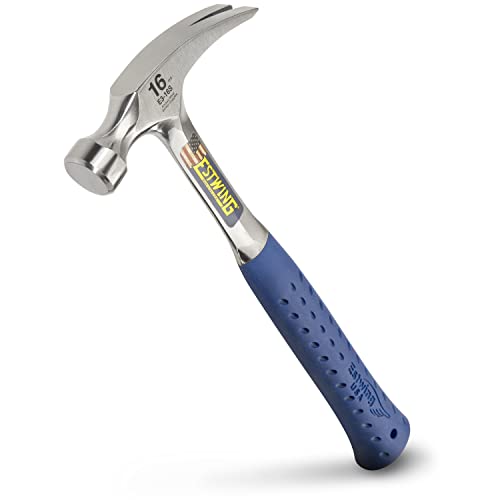
Estwing E3-16S Finish Hammer -- Best for Trim and Finish Work
Finish carpentry requires a lighter touch and a smooth face that will not leave marks in visible wood. The Estwing E3-16S provides both, with a 16-ounce steel head and the brand's signature one-piece construction. The smooth face drives finish nails cleanly, and the balance point suits the wrist flicks used for nail setting in tight trim situations. The curved claw pulls finish nails without excessively damaging surrounding surfaces. Like all Estwing products, the steel construction is virtually indestructible under normal use. A necessary addition to any finish carpenter's tool belt alongside a nail set.
Where it shines
- RIP CLAW VERSATILITY - Estwing hammers are ideal for pulling nails, prying boards, demolit
- BUILT FOR THE PRO - The optimal claw hammer for framers, roofers, carpenters, contractors,
- FORGED IN ONE PIECE
- PATENTED SHOCK REDUCTION GRIP
- MADE IN THE USA - Since 1923, our tools have been proudly American made in Rockford, IL us
Before you buy
What to consider
The first decision is weight. Match it to the nails you drive most often. Heavy nails need a heavy hammer; delicate finish nails require control over power. Handle material affects both vibration transmission and durability. Fiberglass and vibration-dampened steel handles reduce fatigue on long days. Face type matters too: a milled face grips nail heads better on rough work, while a smooth face is necessary for finish applications to avoid marking the material. Head-to-handle connection is a common failure point; one-piece or through-bolted connections outlast those with basic epoxy or pressure-fit assembly. Buy from a brand with a warranty, since a quality hammer should last decades.
What to consider
For more on construction hand tools, see our guide to [best construction gadgets](/articles/best-construction-gadgets) and [best construction gloves for winter](/articles/best-construction-gloves-for-winter). Learn how we evaluate tools at [/methodology](/methodology).
Quick answers
Framing hammers typically run 20 to 32 ounces to drive large nails with fewer swings. Finish hammers are lighter, usually 16 to 20 ounces, with a smoother face that avoids leaving marks on finished surfaces. If you only buy one hammer, a 20-ounce framing hammer with a smooth face handles most tasks, though it is a compromise in both directions compared to dedicated tools.
Fiberglass handles absorb vibration better than wood over the course of a long day and will not break from missed strikes the way wood can. However, quality hickory handles offer excellent feedback and can be replaced inexpensively if damaged. Steel handles are the most durable but transmit the most vibration. For professional daily use, fiberglass or a vibration-dampening steel handle is generally preferred for comfort and longevity.
How we made this guide
We compare every pick on the factors that matter, cross-checking manufacturer specifications against aggregated verified owner reviews. We rank independently and never take payment for placement. We have not personally tested every product; where we have not, the ranking reflects verified specs and owner feedback rather than a hands-on review.
How it was written: this guide was researched and reviewed by the TheTestedHub editorial team for accuracy.
Affiliate disclosure: TheTestedHub is reader-supported. When you buy through links on our site, we may earn a commission at no extra cost to you.

