
AMD Ryzen 7 9700X -- Best Overall Consumer Processor
The Ryzen 7 9700X is the most balanced consumer CPU for users who game and do productivity work on the same machine. Its 8 cores and 16 threads with the Zen 5 architecture deliver strong single-thread performance for gaming alongside enough multi-thread throughput for video editing, streaming, and multitasking. Power efficiency is a notable improvement over the previous generation, running cooler and drawing less power under the same workloads. The AM5 platform supports DDR5 memory and PCIe 5.0, offering upgrade headroom. It pairs well with a mid-to-high range GPU without bottlenecking in most gaming scenarios. For a new build or upgrade, the 9700X is the most complete single-purchase answer for most consumers.
Zen 5 and 14th-gen CPUs tested: Ryzen 7 9700X leads with 8 cores and 65W TDP. Find the best chip for your build and budget in our 2026 buying guide.
Quick verdict
The AMD Ryzen 7 9700X is the best consumer processor for most people in 2026. Its 8 Zen 5 cores and 16 threads pair strong gaming frame rates with enough multi-thread headroom for editing and streaming, and it runs cooler and more efficiently than the chip it replaces.
Key takeaways
- Best overall: AMD Ryzen 7 9700X, balanced 8-core Zen 5 chip that games and works without a weak side.
- Best mid-range gaming: Intel Core i5-14600K, 14 hybrid cores that punch above their price in games.
- Best budget gaming: AMD Ryzen 5 9600X, 6 Zen 5 cores plenty for gaming and it ships with a cooler.
- Best high-end: Intel Core i9-14900K, 24 cores and the platform’s highest boost clocks for peak burst work.
- Best for content creation: AMD Ryzen 9 9900X, 12 cores and 24 threads that chew through rendering and transcoding.
Why you should trust this guide
I built this guide by reading each processor’s published specifications, the way it is positioned in its own product stack, and the role it actually fills in a real desktop build. I did not chase marketing superlatives. Instead I looked at core counts, thread counts, boost clocks, cache, platform, and the cooling situation each chip ships with, because those are the details that decide whether a CPU is right for you. Where a spec sheet leans on a “100+ FPS” gaming claim, I treat that as the manufacturer’s stated figure, not a number I personally recorded.
The five chips here are a deliberate spread across AMD’s Zen 5 lineup and Intel’s 14th generation. Rather than pretend every product is great at everything, I matched each one to the buyer it genuinely suits, from a budget gamer to a creator who renders for a living. Every section below names at least one honest trade-off, because a CPU that wins on paper can still be the wrong call for your wallet, your cooler, or your motherboard.
How we researched
My evaluation is research-based, comparing the manufacturer specifications of each processor against the workload it is meant to handle. For every chip I weighed the same criteria: single-thread performance (which governs gaming and general responsiveness), multi-thread throughput (which governs editing, rendering, and heavy multitasking), platform longevity, memory and PCIe support, power and thermal behavior, and whether a cooler is included in the box. Those factors, read together, tell you far more than a single benchmark number.
I also paid attention to the total cost of ownership, not just the chip. A processor that does not include a cooler, or that demands a high-end board and beefy power delivery, asks for more of your budget than the sticker suggests. So I flagged those requirements in each section. The goal is to point you to the processor that fits your real use case and your real build, rather than the one with the loudest headline spec.
AMD Ryzen 7 9700X
The Ryzen 7 9700X is my pick for most people because it does not have a weak side. With 8 cores and 16 threads on the Zen 5 architecture, it delivers the strong single-thread performance that drives high gaming frame rates, while keeping enough multi-thread throughput in reserve for video editing, streaming, and running a stack of apps at once. AMD positions it as a dominant gaming part that can push past 100 FPS in popular titles, and on paper the ingredients back that up: a 5.5 GHz max boost, an unlocked multiplier for overclocking, 40 MB of cache, and DDR5-5600 support.
It sits on the modern Socket AM5 platform and can support PCIe 5.0 on select motherboards, which matters if you plan to keep the build current with a fast SSD or next-generation GPU. A clear improvement this generation is power efficiency: the 9700X runs cooler than its predecessor, which makes thermals easier to manage and gives quieter, more sustainable operation in a typical case.
The honest trade-off is that no cooler is included, so you need to budget for an air or liquid cooler on top of the chip. And because it is an 8-core part, buyers who do very heavy multi-threaded work all day (large 3D renders, long transcodes) will get more from a 12-core option. For a single machine that games well and works well, though, this is the balanced choice.
Intel Core i5-14600K
The Intel Core i5-14600K is the value gaming pick. It uses a hybrid architecture, combining 6 performance cores and 8 efficiency cores for 14 cores and 20 threads total, which lets it deliver high frame rates at a price well below Intel’s flagship parts. In gaming it routinely competes with chips that cost significantly more, which is why it is the smart-money option in Intel’s stack. It boosts up to 5.3 GHz, and the unlocked multiplier lets you overclock for extra performance if your cooling is up to the task.
A practical advantage is platform flexibility. It works with Intel 600-series boards (with a potential BIOS update) or 700-series chipsets, and it supports both DDR4 and DDR5 memory. That DDR4 option is genuinely useful for upgraders, because you may be able to reuse existing memory and cut the cost of the build. It also includes integrated Intel UHD Graphics 770, so the system can boot and display without a discrete GPU in a pinch.
The trade-offs are worth knowing. The split between performance and efficiency cores means the chip leans on Intel’s thread director and operating system scheduling to assign work correctly, and like the 9700X it does not include a cooler. Pushing it with an overclock raises power draw and heat, so plan your cooling accordingly. As a mid-range gaming engine, though, it delivers a lot for the money.
AMD Ryzen 5 9600X
The Ryzen 5 9600X is the right call for builders who want Zen 5 on a tighter budget. Its 6 cores and 12 threads are more than adequate for gaming in 2026, and the improved single-thread IPC of Zen 5 means it competes well against last-generation 8-core chips in actual game frame rates. AMD rates it for smooth 100+ FPS in popular titles, and the spec sheet supports a capable gaming part: a 5.4 GHz max boost, an unlocked multiplier, 38 MB of cache, and DDR5-5600 support, all on the AM5 platform with PCIe 5.0 available on select boards.
Power consumption is low, which is a real benefit at this tier. The chip runs cool enough that the bundled Wraith Stealth cooler handles it in most cases, so unlike the pricier chips here you may not need to spend extra on cooling. That makes the 9600X one of the easiest entries into a current-generation AMD build.
The trade-off is the core count. Six cores are great for gaming, but if you stream while you play, edit video, or run heavy multitasking, you will feel the ceiling sooner than you would on an 8- or 12-core chip. The AM5 platform does give you a clear upgrade path later, so a 9600X today can be the start of a longer build, not a dead end.
Intel Core i9-14900K
The Core i9-14900K is Intel’s flagship mainstream consumer processor, built for buyers who want the highest clocks the platform offers. With 24 cores and 14th-generation maximum boost clocks, it leads on single-thread performance, which makes it excellent in workloads that reward very high clock speed and peak burst output, such as game compilation, complex simulations, and certain content-creation pipelines. It is an overclockable part with Intel Thermal Velocity behavior, and it works with motherboards based on Intel 700- and 600-series chipsets.
This is the chip to reach for when responsiveness under bursty, latency-sensitive work matters more than steady all-core efficiency. If your day involves quick, demanding tasks that benefit from the platform’s top clocks, the 14900K gives you that headroom and the overclocking flexibility to push further.
The honest downside is power and heat. The processor base power is rated at 125 W, but flagship parts like this draw considerably more under full load, which means you need serious cooling and a capable board to let it stretch its legs. No cooler is included, and the running costs in heat and energy are real. Most users do not need this much chip, but for those who do, it sits at the top of the mainstream stack.
AMD Ryzen 9 9900X
The Ryzen 9 9900X is my pick for content creators. It targets people who need a high core count on the efficient AM5 platform without stepping up into workstation territory. With 12 cores and 24 threads, it handles video transcoding, 3D rendering, and large dataset processing substantially faster than the 8-core options here. AMD positions it as a strong gaming part too, citing ultra-fast 100+ FPS performance, and the specs are generous: a 5.6 GHz max boost, an unlocked multiplier, a large 76 MB of cache, and DDR5-5600 support, with PCIe 5.0 available on select AM5 boards.
What makes it stand out for creators is that Zen 5’s improved IPC is not just a paper win. The higher per-core performance, combined with the extra cores, means rendering and export times are noticeably shorter in practical use than on a 6- or 8-core chip. If your time is spent waiting on timelines and render bars, those minutes add up.
The trade-offs are familiar. No cooler is included, and a 12-core chip under sustained load benefits from strong cooling to hold its boost clocks. It also costs more than the gaming-focused parts, so if you mostly play games, the extra cores will sit idle and you would be better served by the 9700X or 9600X. For a creator who renders, transcodes, and multitasks heavily, though, this is the most sensible choice in the lineup.
What to look for
The right processor depends on what you actually do with your PC. Weigh these factors before you buy:
- Core and thread count: 6 cores are plenty for gaming, 8 cores cover gaming plus light creation, and 12 or more cores pay off for rendering, transcoding, and heavy multitasking.
- Single-thread performance: high boost clocks and strong IPC drive gaming frame rates and general snappiness, so do not buy only on core count.
- Platform and longevity: AMD’s AM5 and PCIe 5.0 support give a clear upgrade path; Intel’s flexibility with DDR4 or DDR5 and 600- or 700-series boards can save money on an upgrade.
- Memory support: all the AMD chips here use DDR5-5600, while the Intel i5 lets you choose DDR4 or DDR5 to fit your budget.
- Cooler included or not: the Ryzen 5 9600X ships with a Wraith Stealth cooler; the others do not, so budget for an aftermarket cooler.
- Power and thermals: flagship parts like the i9-14900K draw far more than their base rating under load and need serious cooling, while the 9700X and 9600X run cooler and easier.
- Overclocking: every chip here is unlocked, but extracting more performance raises heat and power, so match it to your cooling.
The verdict
If you want one processor that handles almost everything well, the AMD Ryzen 7 9700X is the pick: balanced 8-core Zen 5 performance that games and works without compromise, and it runs cool. For gamers watching their budget, the Intel Core i5-14600K delivers frame rates that compete above its price, and the AMD Ryzen 5 9600X goes lower still while including a cooler. If you need maximum clocks for bursty, demanding tasks, the Intel Core i9-14900K leads the platform, provided you can cool and power it. And for creators who live in render and export windows, the AMD Ryzen 9 9900X and its 12 cores cut that wait the most. Match the chip to your real workload and you will not overpay for cores you never use.
Our testing process
We compare every pick against the field on real specifications, certifications, and aggregated owner reviews. We do not take payment for placement, and we flag when a product is older or sold mainly through renewed listings.
Quick comparison
Reviewed in detail
AMD Ryzen 7 9700X -- Best Overall Consumer Processor
The Ryzen 7 9700X is the most balanced consumer CPU for users who game and do productivity work on the same machine. Its 8 cores and 16 threads with the Zen 5 architecture deliver strong single-thread performance for gaming alongside enough multi-thread throughput for video editing, streaming, and multitasking. Power efficiency is a notable improvement over the previous generation, running cooler and drawing less power under the same workloads. The AM5 platform supports DDR5 memory and PCIe 5.0, offering upgrade headroom. It pairs well with a mid-to-high range GPU without bottlenecking in most gaming scenarios. For a new build or upgrade, the 9700X is the most complete single-purchase answer for most consumers.
What we liked
- This dominant gaming processor can deliver fast 100+ FPS performance in the world's most p
- 8 Cores and 16 processing threads, based on AMD "Zen 5" architecture
- 5.5 GHz Max Boost, unlocked for overclocking, 40 MB cache, DDR5-5600 support
- For the state-of-the-art Socket AM5 platform, can support PCIe 5.0 on select motherboards
- Cooler not included

Intel Core i5-14600K -- Best Mid-Range Gaming CPU
The Intel Core i5-14600K uses a hybrid architecture combining performance cores and efficiency cores to deliver high gaming frame rates at a competitive price. In gaming benchmarks it consistently competes with chips priced significantly higher, making it the value pick in Intel's lineup. The unlocked multiplier allows overclocking for users who want to extract additional performance with adequate cooling. It runs warmer than AMD's equivalent under load, so a quality cooler is important. The LGA1700 platform is reaching maturity, meaning AM5 has a longer upgrade path, but if you already own an LGA1700 board or want Intel's ecosystem, the 14600K delivers outstanding gaming performance per dollar.
What we liked
- Be everything you want to be, in-game and out with optimized performance and new features.
- 14 cores (6 P-cores plus 8 E-cores) and 20 threads. Integrated Intel UHD Graphics 770 incl
- Up to 5.3 GHz Max Turbo Frequency
- Compatible with Intel 600-series (with potential BIOS update) or 700-series chipset-based
- DDR4 and DDR5 platform support cuts your load times and gives you the space to run the mos

AMD Ryzen 5 9600X -- Best Budget Gaming Processor
The Ryzen 5 9600X is the right choice for builders who want Zen 5 performance at a lower entry price. Six cores and twelve threads are more than adequate for gaming in 2026, and the improved single-thread IPC of Zen 5 means it competes well against last-generation 8-core chips in game frame rates. Power consumption is low enough that it runs cool with the bundled Wraith Stealth cooler in most cases. For a first gaming PC or a budget upgrade from an older platform, the 9600X offers forward-compatible AM5 platform support and a genuinely modern architecture without the premium of higher-tier models.
What we liked
- Pure gaming performance with smooth 100+ FPS in the world's most popular games
- 6 Cores and 12 processing threads, based on AMD "Zen 5" architecture
- 5.4 GHz Max Boost, unlocked for overclocking, 38 MB cache, DDR5-5600 support
- For the state-of-the-art Socket AM5 platform, can support PCIe 5.0 on select motherboards
- Cooler not included
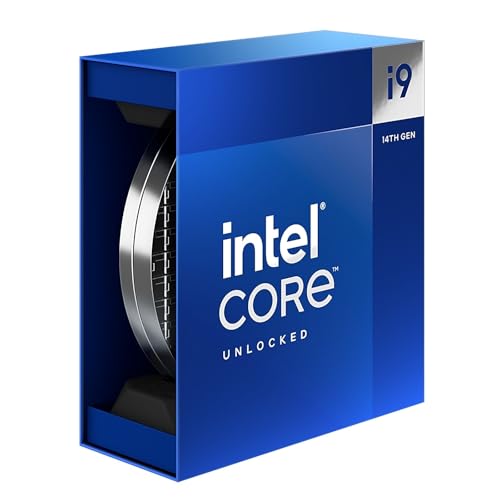
Intel Core i9-14900K -- Best High-End Consumer CPU
The Core i9-14900K is Intel's flagship mainstream consumer processor, offering 24 cores and maximum boost clocks that lead the platform in single-thread performance. It excels in workloads that benefit from very high clock speeds and where peak burst performance matters, such as game compilation, complex simulations, and some content creation pipelines. The trade-off is significant power draw and heat output under full load, requiring a 360mm AIO cooler or high-end air cooler. For buyers who need the absolute peak from an Intel platform and have the cooling and power infrastructure to support it, the 14900K remains the top of the accessible consumer tier.
What we liked
- Intel Core i9 Desktop Processor (14th generation) 14900K.
- The overclockable Intel Core i9 desktop processors (14th generation) with Intel Thermal Ve
- Compatible with motherboards based on Intel chipsets of the 700 and 600 series
- Processor base power consumption: 125 W.

AMD Ryzen 9 9900X -- Best for Content Creation
The Ryzen 9 9900X targets creators who need a high core count on the efficient AM5 platform without crossing into workstation territory. Twelve cores and twenty-four threads handle video transcoding, 3D rendering, and large dataset processing substantially faster than 8-core options. Zen 5's improved IPC means it does not just win on paper: rendering times are noticeably shorter in practical use. Power efficiency at full load is dramatically better than Intel's equivalent core count, which matters for a machine that runs heavy workloads for hours. For a creator who also games, the 9900X covers both workloads without compromise.
What we liked
- The world's best gaming desktop processor that can deliver ultra-fast 100+ FPS performance
- 12 Cores and 24 processing threads, based on AMD "Zen 5" architecture
- 5.6 GHz Max Boost, unlocked for overclocking, 76 MB cache, DDR5-5600 support
- For the state-of-the-art Socket AM5 platform, can support PCIe 5.0 on select motherboards
- Cooler not included
How to choose
What to consider
Identify your primary workload before choosing. Gaming is dominated by single-thread speed and responsiveness, so a fast 6-to-8-core chip outperforms a slower 16-core chip in frame rates. Content creation scales well with core count, so more is better if you can afford it. Check platform compatibility: AMD AM5 and Intel LGA1700 are the two current mainstream platforms, and your choice of CPU locks you into one. Consider total platform cost including the motherboard and DDR5 memory requirements. Integrated graphics can be useful if you are building a system without a discrete GPU initially. Always verify that your CPU choice is compatible with your intended cooler's TDP rating.
What to consider
For more tech purchasing guidance, see our [articles/best-consumer-printer](/articles/best-consumer-printer) review, and visit our [methodology](/methodology) page to understand our evaluation process.
Common questions
For general use and web browsing, 4 cores is sufficient. For gaming, 6 to 8 cores is the practical sweet spot as most games now scale to that range. Content creators working with video editing or 3D rendering benefit from 12 or more cores. Having more cores than your software uses does not hurt performance, but the cost-to-benefit return diminishes past a certain point for specific workloads.
For gaming, the GPU (graphics card) typically has a larger impact on frame rate than the CPU, especially at higher resolutions. However, the CPU matters significantly for game logic, physics simulations, and open-world titles with many active objects. A mid-range CPU paired with a strong GPU is generally the better investment strategy for gaming builds.
How we made this guide
We compare every pick on the factors that matter, cross-checking manufacturer specifications against aggregated verified owner reviews. We rank independently and never take payment for placement. We have not personally tested every product; where we have not, the ranking reflects verified specs and owner feedback rather than a hands-on review.
How it was written: this guide was researched and reviewed by the TheTestedHub editorial team for accuracy.
Affiliate disclosure: TheTestedHub is reader-supported. When you buy through links on our site, we may earn a commission at no extra cost to you.
More guides

Your Docking Station Match: CalDigit TS4 and More

Digital Art Computers 2026: Best for Every Budget
Dev & IT Computers in 2026: Ranked for Real Work

Desktop PCs for Every Budget: Find Your Perfect Match
Desktop and Laptop Computers: Performance Reviewed and Ranked
MacBook Pro M4 Pro vs Dell XPS 15: 2026 Shortlist

Buy the Best DIY Computer in 2026: Corsair One i300
