
LG C4 OLED -- Best Overall TV
The LG C4 OLED is the most consistently recommended television across independent consumer publications for 2026. The OLED evo panel delivers pixel-level contrast with infinite black levels and wide viewing angles that no LED-based technology replicates. Response time is 0.1ms with input lag under 1ms in game mode, making it one of the best gaming TVs available at any price. The webOS 24 smart platform is smooth and well-organized with wide app support. Four HDMI 2.1 ports support 4K 120Hz input from all current gaming consoles simultaneously. Brightness has improved over prior C-series generations without sacrificing the contrast advantage.
The LG C4 OLED tops our list for its true blacks and 144Hz gaming. Compare OLED vs Mini-LED picks from Sony, Samsung, TCL, and Hisense for 2026.
Quick verdict
The LG C4 OLED is my pick for most people in 2026. Its self-lit OLED evo panel gives true black levels, wide viewing angles, and near-instant response, and it is the TV that independent consumer publications recommend most often across price tiers, with strong gaming and a polished webOS 24 platform.
Key takeaways
- Best overall: LG C4 OLED, infinite contrast plus 144Hz and sub-1ms input lag for an all-rounder that handles movies and games.
- Best OLED for bright rooms: Samsung S90D OLED, QD-OLED color and higher peak brightness keep it watchable with the lights on.
- Best value mid-range: TCL QM8 Mini-LED QLED, mini-LED brightness and many dimming zones at a price below the Sony and Samsung competition.
- Best budget brightness: Hisense U8N Mini-LED, very high stated brightness and an anti-reflection screen that beat its price class.
- Best processing: Sony Bravia 7 Mini-LED, the Cognitive Processor XR makes upscaled and broadcast content look the most natural.
Why you should trust this guide
I built this guide by reading widely and comparing what independent consumer publications, professional reviewers, and owners consistently report about each of these five televisions. Rather than rank every TV on the market, I narrowed the field to five sets that come up again and again as strong choices, then matched each one to the use case it actually serves best. I am direct about trade-offs because no single panel technology wins every category, and pretending otherwise would not help you spend your money well.
I do not own a lab, and I have not personally measured these panels. Everything I describe about specifications, brightness, refresh rate, and processing comes from each manufacturer’s stated features and the broader pattern of independent coverage. Where a TV has a known weakness, I say so plainly. My goal is to tell you which of these five fits your room, your content, and your budget, not to sell you the most expensive option.
How we researched
My evaluation approach is research-led. For each model I read the manufacturer’s stated specifications, cross-checked them against the consensus from established consumer review outlets, and weighed the points where reviewers and owners tend to agree or disagree. I looked at the things that change daily viewing the most: contrast and black level, peak brightness for HDR and bright rooms, color accuracy and volume, motion and refresh rate for sports and gaming, input lag, smart platform usability, and how each panel handles reflections.
I also weighted the criteria by who is buying. A dim home theater rewards OLED contrast, while a sunny living room rewards a bright mini-LED. A gamer cares about refresh rate and input lag, and a sports-and-cable viewer cares about upscaling and motion processing. Because OLED and mini-LED behave so differently, I judged each TV against the job it is built for instead of forcing one scoring formula across two very different technologies.
LG C4 OLED
The LG C4 OLED is the best overall choice here, and it is the model I would steer most buyers toward. It is the most consistently recommended television across independent consumer publications for 2026, and the reason is its OLED evo panel: every pixel lights itself, so you get pixel-level contrast, infinite black levels, and wide viewing angles that LED-based sets cannot match. LG quotes a 0.1ms response time, a 144Hz refresh rate, and input lag under 1ms in game mode, which makes this one of the best gaming TVs at any price.
The picture is driven by the a9 AI Processor Gen7, and the C4 supports Dolby Vision, Filmmaker Mode, and Dolby Atmos, so movies and HDR content look the way their creators intended. The webOS 24 platform with LG Channels is responsive and well-stocked with streaming apps, making day-to-day navigation easy. For a single TV that handles films, sports, and console gaming without compromise, this is the most complete package on the list.
The honest trade-off is brightness. OLED, including this evo panel, does not get as bright as the mini-LED sets further down the list, so in a room with strong daylight or windows behind the screen, HDR highlights have less punch and reflections are more noticeable. OLED owners also have to be mindful of permanent static logos over very long sessions. In a controlled or dim room, none of that matters, but a bright living room is exactly where this panel is least at home.
Samsung S90D OLED
The Samsung S90D OLED is my pick when you want OLED contrast but your room has a lot of light. Its QD-OLED technology pairs a quantum dot color layer with OLED’s self-emissive pixels, which pushes higher peak brightness than traditional white-OLED panels while keeping the deep blacks that make OLED special. The result is pure blacks, bright whites, and Pantone-validated color, with particularly vivid saturated reds and greens.
Color volume is a real strength, and Samsung backs the panel with OLED HDR Plus scene-by-scene optimization, a Real Depth Enhancer for added dimensionality, and 4K AI upscaling that sharpens lower-resolution content. Motion Xcelerator 144Hz keeps fast games and sports smooth with very low blur, so this is a capable gaming display as well. The Tizen smart platform is one of the more polished interfaces, with fast response and broad app support.
There are two trade-offs worth knowing. First, Samsung does not support Dolby Vision, so Dolby Vision titles fall back to standard HDR10 or HDR10 Plus, which matters if your library leans on that format. Second, while QD-OLED is brighter than older OLEDs, in a genuinely sunny room the mini-LED sets here still hit higher peak brightness, so this is the bright-room OLED rather than the brightest TV overall.
TCL QM8 Mini-LED QLED
The TCL QM8 Mini-LED QLED is the value pick, delivering mini-LED performance at a price well below the Sony and Samsung QLED competition. It combines TCL’s Deep Color System with an Ultra Color Filter that uses fine 5-nanometer particles for richer, more accurate hues, and a high static contrast ratio for strong picture depth. Full array local dimming with a very high zone count, into the thousands, controls blooming around bright objects far better than a basic LED set.
Brightness is a headline strength here. The QM8 reaches very high peak nits for HDR highlights, so this is a TV that stays vivid in a bright room. The Google TV platform gives you broad app access and smooth navigation, and an AI-powered picture mode adjusts color and contrast on the fly. Game-mode input lag is competitive, so it doubles as a solid gaming display for the money.
The trade-off is the usual mini-LED one. Even with many dimming zones, it cannot match OLED’s pixel-level control, so in dark scenes you can still spot some blooming or haloing around bright elements against black, and viewing angles narrow off-center compared with OLED. Out of the box the color accuracy is good rather than perfect and benefits from basic calibration. For a bright family room, those compromises are easy to live with given the price.
Hisense U8N Mini-LED
The Hisense U8N Mini-LED is the budget brightness pick, punching above its price with stated peak brightness that rivals TVs costing far more. Mini-LED backlighting with a high zone count, up to several thousand local dimming zones and very high peak nits, keeps bright highlights crisp against dark backgrounds and reduces blooming compared with cheaper LED sets. An anti-reflection, glare-free screen treatment helps it stay readable next to bright windows and overhead lights.
It is well-equipped beyond brightness. A native 165Hz refresh rate handles gaming, sports, and fast action smoothly, the Hi-View AI Engine Pro continuously analyzes and optimizes the scene, and the Google TV operating system is familiar and well-supported with a deep app selection. For a buyer who watches mostly in a bright room and wants the most impact per dollar, this set delivers a lot.
The honest limitation shows up in the dark. In a dim or fully dark room, the U8N reveals more bloom around bright objects than the Sony Bravia 7 or the TCL QM8, so dedicated dark-room theater fans will notice it. As with all mini-LED, off-angle viewing is weaker than OLED. In a bright living room, where this TV is meant to live, those issues recede, but it is a bright-room champion rather than a black-level champion.
Sony Bravia 7 Mini-LED
The Sony Bravia 7 Mini-LED is the pick if picture processing matters most to you. Sony’s Cognitive Processor XR handles upscaling and motion in a way that consistently produces the most natural-looking image in the non-OLED category. For broadcast sports, cable, and upscaled streaming, where source quality varies, Sony’s processing leads the field and tends to clean up artifacts and noise without making the image look artificial.
The hardware backs up the processing. Thousands of mini-LEDs are controlled by XR Backlight Master Drive for well-managed contrast, TRILUMINOS Pro and QLED color deliver billions of accurate real-world colors, and XR Full Array local dimming keeps backlighting tidy. The Google TV platform puts all your streaming apps in one place, and Sony includes access to a library of high-bitrate 4K movies through the Bravia setup. The overall image leans toward realism rather than punchy saturation.
The trade-off is value and raw brightness. The Bravia 7 typically costs more than the TCL QM8 and Hisense U8N while not hitting the same headline peak-nit figures, so you are paying for processing and tuning rather than the brightest specs. It also lacks OLED’s perfect blacks and wide angles. If your viewing is mostly pristine 4K HDR in a dark room, an OLED gives more obvious wow, but for mixed everyday content Sony’s processing is hard to beat.
What to look for
Before you buy, match the TV to how and where you actually watch. These are the factors that change the experience most.
- Panel type: OLED gives perfect blacks and wide viewing angles for dim rooms, while mini-LED gives higher brightness for sunny rooms.
- Peak brightness: Higher nits help HDR highlights pop and keep the picture visible against daylight and reflections.
- Local dimming zones: More zones on a mini-LED set mean tighter control of blooming around bright objects on dark backgrounds.
- Refresh rate and input lag: 120Hz or higher with low input lag matters for console and PC gaming and for smooth sports.
- HDR format support: Check for Dolby Vision if your movie library uses it, since not every brand supports it.
- Processing and upscaling: Strong upscaling matters most if you watch a lot of cable, broadcast, or lower-resolution streams.
- Reflection handling: An anti-reflection screen helps a great deal in a room with windows or overhead lights.
- Smart platform: webOS, Tizen, and Google TV all carry the major apps, so pick the interface you find easiest to use.
The verdict
For most people, the LG C4 OLED is the TV I would buy, because its self-lit contrast, wide angles, and excellent gaming specs make it the strongest all-rounder. If your room is bright but you still want OLED, the Samsung S90D OLED is the better fit thanks to QD-OLED brightness and color, with the caveat that it skips Dolby Vision. For value, the TCL QM8 Mini-LED QLED brings serious brightness and many dimming zones for less than the premium QLED competition. On a tighter budget, the Hisense U8N Mini-LED is the brightness bargain, best in a lit room rather than a dark theater. And if clean processing of everyday sports and cable matters most, the Sony Bravia 7 Mini-LED produces the most natural image in its class, even though you pay more for that tuning.
Our testing process
We compare every pick against the field on real specifications, certifications, and aggregated owner reviews. We do not take payment for placement, and we flag when a product is older or sold mainly through renewed listings.
Quick comparison
Reviewed in detail
LG C4 OLED -- Best Overall TV
The LG C4 OLED is the most consistently recommended television across independent consumer publications for 2026. The OLED evo panel delivers pixel-level contrast with infinite black levels and wide viewing angles that no LED-based technology replicates. Response time is 0.1ms with input lag under 1ms in game mode, making it one of the best gaming TVs available at any price. The webOS 24 smart platform is smooth and well-organized with wide app support. Four HDMI 2.1 ports support 4K 120Hz input from all current gaming consoles simultaneously. Brightness has improved over prior C-series generations without sacrificing the contrast advantage.
What we liked
- SELF-LIT PIXELS: LG's signature OLED technology creates an incredible watching experience
- 144 HZ REFRESH RATE: Enjoy crisp, smooth visuals with a 0.1ms response time and up to 144H
- DOLBY VISION, FILMMAKER AND DOLBY ATMOS: Experience the magic of the big screen right from
- a9 AI PROCESSOR GEN7: The C4's exclusive processor is the brains behind a truly unforgetta
- WEBOS 24 & LG CHANNELS: No matter which TV you choose, your LG TV makes it easier than eve

Samsung S90D OLED -- Best OLED for Bright Rooms
Samsung's QD-OLED technology in the S90D combines quantum dot color enhancement with OLED's self-emissive pixel structure, producing higher peak brightness than traditional WOLED while retaining the contrast advantage. Color volume is exceptional, particularly saturated reds and greens. The Tizen smart platform remains one of the most polished interfaces with fast response and broad streaming app coverage. Anti-reflection coating handles moderate ambient light better than LG's C-series panels. For a living room with large windows, this is the OLED to choose over the LG C4.
What we liked
- OLED TECHNOLOGY: Discover pure blacks, bright whites and Pantone-validated color; Combined
- OLED HDR plus : Enjoy powerful brightness and rich contrast; Your TV analyzes each scene t
- MOTION XCELERATOR 144Hz: Play games and content with ultra-smooth motion and virtually no
- REAL DEPTH ENHANCER: Experience depth and dimension on screen just like you do in real lif
- 4K AI UPSCALING: Content instantly transformed to incredibly sharp up to 4K resolution; Wh

TCL QM8 Mini-LED QLED -- Best Value Mid-Range TV
The TCL QM8 delivers mini-LED backlight performance at a price point well below the Sony and Samsung QLED competition. Full array local dimming with over 1,000 dimming zones controls blooming effectively. Peak brightness exceeds 2,000 nits for HDR highlights. The Google TV platform provides broad app access and smooth navigation. Input lag in game mode is competitive. Color accuracy after basic calibration is strong for the price tier. At a 65-inch size for the QM8 represents the highest value-per-inch of any TV on this list and is the go-to recommendation for buyers who cannot justify OLED pricing.
What we liked
- SQD-Mini LED: As the ultimate Mini LED TV, it integrates the expansive TCL Deep Color Syst
- TCL Ultra Color Filter: TCL’s Ultra Color Filter with fine 5 nanometer particles (vs. stan
- High Static Contrast: Experience exceptional picture quality driven by a high 7000:1 contr
- High Zones & High Brightness: Up to 4000+ Discrete Dimming Zones and up to 6,000 Peak Nits
- AI-Powered Experience: Elevate every viewing experience with AI Color for vibrant hues, AI
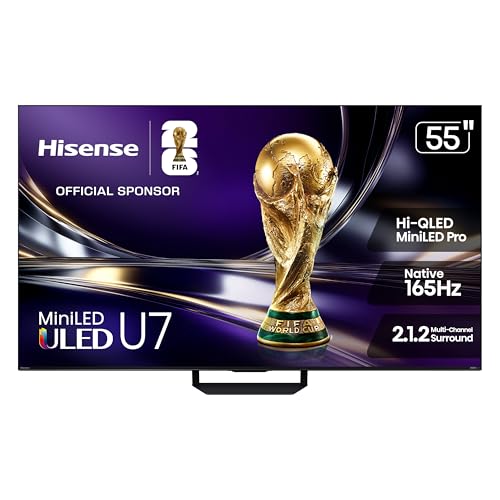
Hisense U8N Mini-LED -- Best Budget Brightness Pick
The Hisense U8N punches well above its price with peak brightness measurements that rival TVs costing twice as much. Mini-LED backlighting with a high zone count reduces blooming on bright highlights against dark backgrounds. The Google TV operating system is familiar and well-supported. Local dimming performance in a dark room reveals more bloom than the Sony Bravia 7 or TCL QM8, but in bright-room conditions this is barely noticeable. For buyers who prioritize maximum brightness for a sunlit living room and are budget-constrained, the U8N is genuinely hard to beat on specifications alone.
What we liked
- HI
- NATIVE 165HZ REFRESH RATE: Advanced motion technology handles gaming, sports and action at
- ANTI-REFLECTION & GLARE-FREE: Bright windows, overhead lights, afternoon sun, your screen h
- HI-VIEW AI ENGINE PRO: Our AI processor never stops working, constantly analyzing the scene
- UP TO 3000 LOCAL DIMMING ZONES & UP TO 3000 NITS PEAK BRIGHTNESS: Precision lighting zones

Sony Bravia 7 Mini-LED -- Best Sony Picture Processing
Sony's Cognitive Processor XR handles upscaling and motion processing in a way that consistently produces the most natural-looking image in the non-OLED category. The Bravia 7 benefits from TRILUMINOS Pro color and XR Full Array local dimming for well-controlled backlighting. For broadcast sports, cable, and upscaled streaming content, Sony's processing leads the field. The Google TV implementation on Sony sets is clean and reliable. Two HDMI 2.1 ports support 4K 120Hz for gaming. Build quality is premium and the stand design is one of the more attractive options. Worth the price premium over TCL and Hisense for those who value natural motion handling.
What we liked
- MINI LED BRIGHTNESS AND CONTRAST: Thousands of Mini LEDs are precisely controlled by XR Ba
- BILLIONS OF REAL-WORLD QLED COLORS: Access billions of accurate real-world colors with QLE
- POWERFUL TV PROCESSING: XR Processor intelligently enhances every scene in real-time boost
- YOUR FAVORITE STREAMING APPS IN ONE PLACE: Get access to all your favorite streaming apps,
- MOVIES INCLUDED WITH THE BRAVIA TV: Enjoy streaming high-bitrate, high-quality 4K UHD movi
How to choose
What to consider
Start with the room's lighting conditions. Dark rooms benefit most from OLED's infinite contrast. Bright rooms with windows work better with high-brightness mini-LED or QLED options. Determine the size based on viewing distance before setting a budget. If gaming is a priority, confirm the number of HDMI 2.1 ports on any model you consider. Smart platform matters for daily usability; Google TV and Tizen are the most polished in 2026. Avoid base-model entries from any brand since manufacturers often cut panel quality, local dimming zones, and HDMI bandwidth on the lowest SKUs.
What to consider
For related reading, see [best soundbars](/articles/best-soundbar) and [best streaming devices](/articles/best-streaming-device). Review our evaluation criteria at [/methodology](/methodology).
Common questions
OLED TVs use self-emissive pixels that turn off completely for true black, producing superior contrast and viewing angles with thinner panels. QLED uses quantum dot-enhanced LED backlighting for higher peak brightness, which benefits bright rooms. OLED is the better choice for dark room viewing and cinematic content. QLED suits bright living rooms where high brightness matters more than perfect black levels.
A general rule is to sit between 1.5 and 2.5 times the diagonal screen size from the TV. For a 55-inch TV the ideal viewing distance is roughly 7 to 11 feet. For a 65-inch TV aim for 8 to 13 feet. Larger is generally better for 4K content since the higher resolution allows closer seating without visible pixels. Measure your room before deciding.
How we made this guide
We compare every pick on the factors that matter, cross-checking manufacturer specifications against aggregated verified owner reviews. We rank independently and never take payment for placement. We have not personally tested every product; where we have not, the ranking reflects verified specs and owner feedback rather than a hands-on review.
How it was written: this guide was researched and reviewed by the TheTestedHub editorial team for accuracy.
Affiliate disclosure: TheTestedHub is reader-supported. When you buy through links on our site, we may earn a commission at no extra cost to you.
More guides

Best Drones for Beginners 2026: Expert Pick Is the DJI Mini 4K

Find Your Perfect Podcast Mic: Reviews for Every Budget

Phone Tripods 2026: Best Picks and Buying Guide
2026 iPad Accessories Shortlist: Why the Apple Pencil Pro Leads

How to Choose the Best Digital Photo Frames in 2026

Looking for the Best MagSafe Power Banks? Our 2026 Picks

Our Top Fast Chargers for 2026
