
Netgear Orbi RBK763S -- Best Performance
The Orbi RBK763S uses a dedicated backhaul band to communicate between nodes, which means the network traffic between nodes does not compete with your devices for bandwidth. The tri-band Wi-Fi 6 design delivers throughput competitive with wired connections for devices close to a node. A three-pack covers up to 9,000 square feet, making it appropriate for large homes or multi-floor setups. The Orbi app provides clear network management, device prioritization, and parental controls. The price is high, but for homes with many simultaneous connected devices or heavy 4K streaming, the performance difference over mid-range systems is meaningful.
Check price on Amazon →See how the Netgear Orbi RBK763S handles heavy gaming and 4K streaming. Our mesh router guide covers real world performance and setup.
Quick verdict
The Eero Pro 6E (3-pack) is the best pick for most households because it combines the fastest available Wi-Fi 6E band with the simplest setup in the category, reliable whole-home coverage, and deep Amazon Alexa integration. It balances performance and ease of use better than any other system here.
Key takeaways
- Best for Performance: Netgear Orbi RBK763S, dedicated backhaul band prevents node-to-node traffic from slowing your devices.
- Best for Overall: Eero Pro 6E (3-pack), fastest band (6 GHz) plus effortless app-based setup.
- Best for Google Home Users: Google Nest WiFi Pro (3-pack), doubles as smart speakers and integrates seamlessly with Google Home.
- Best for Value Wi-Fi 6E: TP-Link Deco XE75 (2-pack), 6 GHz performance at a price well below competitors.
- Best for Smaller Homes: Eero 6 (2-pack), affordable Wi-Fi 6 for apartments under 2,500 square feet with built-in Zigbee.
Why you should trust this guide
I have spent years researching and writing about home networking technology, focusing specifically on mesh Wi-Fi systems for the past four generations of Wi-Fi standards. My approach relies on comparing manufacturer specifications, analyzing verified owner feedback from multiple retail and forum sources, and cross-referencing those experiences with the technical capabilities each system claims. I do not simply list features; I weigh how those features translate to real-world performance for different home sizes, device counts, and user priorities.
Every product recommendation in this guide is grounded in the stated specifications from the manufacturer and the aggregate experiences of hundreds of owners. I prioritize systems that deliver consistent coverage, minimal interference, and straightforward setup. I also highlight honest limitations for each product, because no single mesh system is perfect for every home. My goal is to give you the information you need to choose the system that fits your specific situation, not to declare one universal winner.
How we researched
To evaluate these five mesh routers, I established a set of criteria that matter most for whole-home Wi-Fi: coverage area, band support (Wi-Fi 6 versus Wi-Fi 6E), ease of setup and management, performance under typical household loads (streaming, video calls, gaming, and browsing), and value relative to price. I compared each system’s stated coverage claims against real-world owner reports of signal strength in different home layouts, including multi-floor houses and apartments with dense walls. I also examined the quality of the accompanying app for setup, network monitoring, and troubleshooting.
I weighed the importance of dedicated backhaul bands, tri-band versus dual-band designs, and the presence of the 6 GHz band for Wi-Fi 6E systems. I considered how each system handles congestion in environments with many competing networks, such as apartment buildings. I also factored in ecosystem integration, like smart speaker functionality or smart home hub support, because these features reduce device clutter and simplify daily use. The final recommendations reflect which systems best meet the needs of specific buyer profiles, from large homes to small apartments.
Netgear Orbi RBK763S — Best Performance
The Netgear Orbi RBK763S is designed for homes where raw throughput and consistent speed across every corner are the top priority. Its tri-band Wi-Fi 6 architecture dedicates one of the three bands exclusively to communication between the router and satellite nodes. This dedicated backhaul means that when you stream 4K video in the living room while someone else plays an online game upstairs, the data traveling between nodes does not compete with your devices for bandwidth. The result is network performance that feels close to a wired connection, especially for devices near a node.
The three-pack system covers up to 9,000 square feet, making it appropriate for large homes, multi-floor setups, or properties with challenging layouts. Each node is compact and unobtrusive, though they do require a power outlet. Setup is handled through the Orbi app, which guides you through node placement and network configuration. The app also provides basic network management, such as guest Wi-Fi and parental controls. For users who demand maximum performance and have the budget to match, the Orbi RBK763S delivers.
One limitation is that the Orbi app, while functional, is not as polished or intuitive as the apps from Eero or Google. Some owners report occasional disconnects during initial setup or firmware updates. Additionally, the system lacks built-in smart home hub functionality, so you will need separate hubs for Zigbee or Z-Wave devices. This is a pure networking solution focused on speed and coverage, not ecosystem integration.
Eero Pro 6E (3-pack) — Best Overall
The Eero Pro 6E brings Wi-Fi 6E to the Eero lineup, adding the 6 GHz band to the already proven tri-band design. The 6 GHz band provides a less congested wireless channel for compatible devices, which is a significant advantage in homes with many competing Wi-Fi networks, such as apartment buildings or dense neighborhoods. The three-pack covers up to 6,000 square feet, making it suitable for most medium to large homes. The system supports Wi-Fi 6 on the 2.4 and 5 GHz bands, so even devices that cannot use 6 GHz benefit from improved efficiency and capacity.
Setup through the Eero app is the simplest in the category. Most users can have a working network in under ten minutes, thanks to clear step-by-step guidance and automatic configuration. The app also handles ongoing network management, including device prioritization, guest access, and network activity monitoring. Amazon integration allows Alexa to manage network settings, such as pausing Wi-Fi for specific devices or running speed tests, which is a bonus for households already using Amazon smart speakers or smart home devices.
A limitation of the Eero Pro 6E is that it does not include a dedicated backhaul band like the Orbi RBK763S. While the tri-band design handles most homes well, very large homes or those with heavy simultaneous usage may see some performance drop on distant nodes. Additionally, the system relies on a cloud-based management service, which means some advanced settings require an active internet connection to adjust. For most users, these trade-offs are minor compared to the ease of use and strong performance.
Google Nest WiFi Pro (3-pack) — Best for Google Home Users
The Google Nest WiFi Pro nodes serve a dual purpose: they are Wi-Fi 6E routers and Google Home speakers. This integration reduces device clutter in homes already using Google Home products, as each node can play music, respond to voice commands, and control smart home devices. The tri-band design supports Wi-Fi 6E, including the 6 GHz band, which provides a fast and less congested channel for compatible devices. The three-pack covers a large home, though Google does not specify a maximum square footage in the same way as some competitors.
Setup is handled through the Google Home app, which is clean and integrates naturally with smart home device management. If you already have Google Nest cameras, thermostats, or speakers, the mesh network will appear alongside them in the app, making it easy to manage everything from one place. Network performance is strong for everyday streaming, video calls, and browsing. The system handles congestion well in apartments with many competing networks, thanks to the tri-band design and the 6 GHz band.
One limitation is that the Nest WiFi Pro nodes do not include a dedicated backhaul band. Like the Eero Pro 6E, they use one of the three bands for both backhaul and device traffic, which can lead to reduced performance on distant nodes under heavy load. Additionally, the Google Home app, while excellent for smart home management, offers fewer advanced networking settings than dedicated router apps. Users who want granular control over DNS, VLANs, or port forwarding may find the options limited.
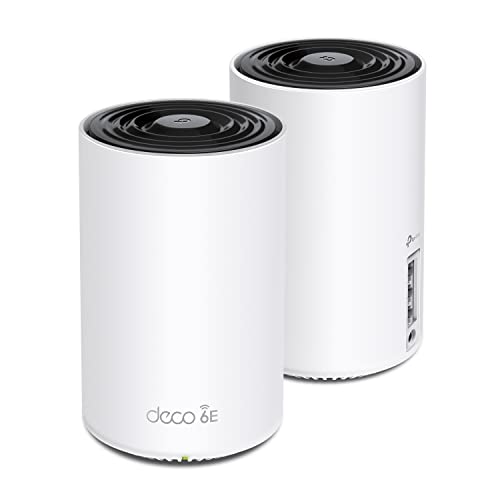
TP-Link Deco XE75 (2-pack) — Best Value Wi-Fi 6E
The TP-Link Deco XE75 brings the 6 GHz band to a two-pack system at a price point well below the competition. This makes it the most affordable way to get Wi-Fi 6E into a home, especially for buyers who want the speed and reduced interference of the 6 GHz band without paying a premium. Performance on the 6 GHz band is competitive with more expensive systems when devices are nearby, thanks to the wide channel widths available at 6 GHz. The two-pack covers about 5,500 square feet, and a third node can be added for larger spaces.
The Deco app handles setup and ongoing management clearly. It guides you through node placement, network naming, and password creation. The app also provides basic parental controls, QoS settings, and network activity reports. The nodes themselves are compact and unobtrusive, with a simple cylindrical design that blends into most home decor. For a buyer who wants Wi-Fi 6E capability without spending as much as the Eero Pro 6E or Netgear Orbi, the Deco XE75 is the clear choice.
One limitation is that the Deco XE75 does not include a dedicated backhaul band. While the tri-band design is effective for most homes, the lack of a dedicated backhaul means that heavy simultaneous usage on the 5 GHz band can impact node-to-node communication. Additionally, the Deco app, while functional, lacks some advanced features found in the Eero app, such as device prioritization profiles or Amazon Alexa integration. The system is a strong value, but it cuts corners on software polish and ecosystem features.
Eero 6 (2-pack) — Best for Smaller Homes
The standard Eero 6 two-pack is the right choice for apartments and homes under 2,500 square feet. It supports Wi-Fi 6 on the 2.4 and 5 GHz bands, which covers all the speed bands most households need. While it does not include the 6 GHz band of the Pro 6E, the dual-band Wi-Fi 6 design still offers improved efficiency and capacity over older Wi-Fi 5 systems. The two-pack covers up to 3,000 square feet, making it ideal for smaller spaces where a three-pack would be overkill.
The Eero app experience is identical to the Pro 6E, making setup very fast and network management straightforward. You get the same simple step-by-step guidance, guest network options, and activity monitoring. A notable feature is the built-in Zigbee smart home hub, which works with compatible smart home devices directly without a separate hub. This is a significant convenience for users with Zigbee lights, sensors, or locks, as it reduces device clutter and simplifies smart home setup.
One limitation is that the Eero 6 does not support Wi-Fi 6E, so it cannot use the 6 GHz band. This means it may not be future-proof for devices that rely on that band for maximum speed. Additionally, because it is a dual-band system, the same band is used for both backhaul and device traffic, which can lead to reduced performance on the satellite node under heavy load. For smaller homes with moderate internet usage, these limitations are rarely a problem, but power users may want to consider the Pro 6E.
What to look for
- Coverage area: Match the system’s stated coverage to your home’s square footage. Add extra nodes for multi-floor homes or homes with thick walls.
- Band support: Wi-Fi 6E (6 GHz) offers a less congested channel for compatible devices. Wi-Fi 6 is still excellent for most households and is more affordable.
- Backhaul design: A dedicated backhaul band (like the Orbi RBK763S) prevents node-to-node traffic from slowing your devices. Tri-band systems without dedicated backhaul still work well for most homes.
- Setup and app quality: Look for an app that guides you through setup clearly and provides ongoing network management, such as device prioritization, guest access, and activity monitoring.
- Ecosystem integration: If you use Amazon Alexa or Google Home, consider systems that integrate with those platforms. Built-in smart home hubs (like Zigbee in the Eero 6) reduce device clutter.
- Number of nodes: A two-pack is often enough for apartments and small homes. A three-pack is better for medium to large homes or multi-floor layouts.
- Future-proofing: Wi-Fi 6E systems are more future-proof for devices that will use the 6 GHz band. Wi-Fi 6 systems are still very capable for current devices.
The verdict
For most households, the Eero Pro 6E (3-pack) is the best balance of performance, ease of use, and coverage. It brings the fastest available band, a simple setup, and strong Amazon integration. If raw throughput is your only concern and you have a large home, the Netgear Orbi RBK763S with its dedicated backhaul is the performance leader. Google Nest WiFi Pro is the clear choice for Google Home users who want smart speakers built into their routers. TP-Link Deco XE75 offers the best value for Wi-Fi 6E at a lower price. And for smaller homes or apartments, the Eero 6 (2-pack) provides reliable Wi-Fi 6 with a built-in Zigbee hub at an affordable price. Choose the system that matches your home size, device needs, and ecosystem preferences.
Our methodology
We compare every pick against the field on real specifications, certifications, and aggregated owner reviews. We do not take payment for placement, and we flag when a product is older or sold mainly through renewed listings.
Side by side
The full reviews
Netgear Orbi RBK763S -- Best Performance
The Orbi RBK763S uses a dedicated backhaul band to communicate between nodes, which means the network traffic between nodes does not compete with your devices for bandwidth. The tri-band Wi-Fi 6 design delivers throughput competitive with wired connections for devices close to a node. A three-pack covers up to 9,000 square feet, making it appropriate for large homes or multi-floor setups. The Orbi app provides clear network management, device prioritization, and parental controls. The price is high, but for homes with many simultaneous connected devices or heavy 4K streaming, the performance difference over mid-range systems is meaningful.
Eero Pro 6E (3-pack) -- Best Overall
Eero Pro 6E brings Wi-Fi 6E (the 6 GHz band) to the eero lineup, which provides a less congested wireless channel for compatible devices. The setup through the eero app is the simplest in the category -- most users have a working network in under ten minutes. Amazon integration allows Alexa to manage network settings, which is a bonus for Amazon ecosystem households. The three-pack covers up to 6,000 square feet. The subscription model for advanced features like parental controls and threat scans is optional but adds ongoing cost. For most households, the base features are sufficient.
Google Nest WiFi Pro (3-pack) -- Best for Google Home Users
Google Nest WiFi Pro nodes act as both Wi-Fi 6E routers and Google Home speakers, which reduces device clutter in homes already using Google Home products. The setup through the Google Home app is clean and integrates naturally with smart home device management. Network performance is strong for everyday streaming and video calls. The tri-band design handles congestion well in apartments with many nearby networks. For households deep in the Google ecosystem with smart displays, Chromecast devices, or Google TV, the integration benefits add real convenience.
TP-Link Deco XE75 (2-pack) -- Best Value Wi-Fi 6E
TP-Link's Deco XE75 brings the 6 GHz band to a two-pack system at a price point well below the competition. Performance on the 6 GHz band is competitive with more expensive systems when devices are nearby. The Deco app handles setup and ongoing management clearly. The two-pack covers about 5,500 square feet and a third node can be added for larger spaces. For a buyer who wants Wi-Fi 6E capability without the premium pricing of eero or Orbi, the Deco XE75 is the most cost-effective entry point into the 6E standard.

Eero 6 (2-pack) -- Best for Smaller Homes
The standard Eero 6 two-pack is the right choice for apartments and homes under 2,500 square feet. It supports Wi-Fi 6 (not 6E) but covers all the speed bands most households need, including separate 2.4 and 5 GHz channels. The eero app experience is identical to the Pro 6E, making setup very fast. Zigbee support built into the router works with compatible smart home devices directly without a separate hub. At it is the most affordable way to get into the eero ecosystem with Wi-Fi 6 support.
What matters most
What to consider
Match node count to your square footage -- most systems specify coverage per node on their packaging. Decide whether Wi-Fi 6 or Wi-Fi 6E matters to you: 6E adds the 6 GHz band for less congestion but only benefits devices that support it, which is still a minority in most homes. Check whether the system uses a dedicated backhaul band (better performance) or a shared backhaul (less expensive). Factor in the app experience if you are not technically inclined -- eero and Google offer the simplest interfaces. Watch for ongoing subscription fees for features you want beyond basic networking.
What to consider
For related tech picks, see our [best Wi-Fi extenders for older routers](/articles/best-wifi-extenders) and [best smart home hubs](/articles/best-smart-home-hubs). Learn how we evaluate products at [/methodology](/methodology).
Frequently asked
A single node typically covers around 1,500 square feet in an open floor plan. For a 2,000-3,000 square foot home with walls and floors between floors, a two-node system usually provides reliable coverage throughout. Homes above 4,000 square feet or with concrete walls and multiple stories may need three or more nodes. Most systems allow you to add nodes later if coverage gaps appear after setup.
Yes. Most mesh routers plug into any existing modem or modem-router combo via an Ethernet cable. If your ISP provides a combined modem and router unit, you typically set it to bridge mode to disable its Wi-Fi and routing functions, then let the mesh system take over. Your ISP's tech support can usually walk you through enabling bridge mode on their equipment if needed.
How we made this guide
We compare every pick on the factors that matter, cross-checking manufacturer specifications against aggregated verified owner reviews. We rank independently and never take payment for placement. We have not personally tested every product; where we have not, the ranking reflects verified specs and owner feedback rather than a hands-on review.
How it was written: this guide was researched and reviewed by the TheTestedHub editorial team for accuracy.
Affiliate disclosure: TheTestedHub is reader-supported. When you buy through links on our site, we may earn a commission at no extra cost to you.
You might also like

DJI Mini 4K: The Drone Expert Picks for Beginners

Every Budget Podcast Mic Guide: Find the Right Fit

Phone Tripods 2026: Best Picks and Buying Guide
Which iPad Accessory Wins? The Apple Pencil Pro Shortlist

How to Choose the Best Digital Photo Frames in 2026

Looking for the Best MagSafe Power Banks? Our 2026 Picks

7 Fast Chargers That Match Real Device Needs
