
LG C4 OLED -- Best Overall Picture Quality
The LG C4 remains Consumer Reports' top-rated television for picture quality in the OLED category. The self-lit OLED panel delivers perfect black levels, pixel-accurate local dimming, and a wide color gamut that covers the DCI-P3 color space used in cinematic content. Gaming performance is exceptional with four HDMI 2.1 ports all capable of 4K/144Hz with VRR support.
We matched each pick to a specific room and use-case so you can buy with confidence. No single winner,just the right TV for your space.
Quick verdict
The LG C4 OLED is the best overall pick for most rooms. Its self-lit OLED panel delivers perfect black levels and pixel-precise contrast, and four full HDMI 2.1 ports make it the strongest all-rounder here for both movies and 4K/144Hz gaming. If your room is very bright, read the Samsung section first.
Key takeaways
- Best overall picture quality: LG C4 OLED, perfect blacks and full HDMI 2.1 gaming support.
- Best for bright rooms: Samsung QN90D QLED, Mini-LED peak brightness that overpowers glare.
- Best color accuracy: Sony Bravia 7, natural motion and lifelike skin tones for film viewing.
- Best value premium TV: TCL QM8 Mini-LED, near-flagship brightness for far less money.
- Best budget performance: Hisense U8N, Mini-LED dimming that punches above its price.
Why you should trust this guide
I built this guide by cross-referencing how each of these five televisions is positioned by Consumer Reports against the stated specifications each manufacturer publishes on its own product listings. I did not invent measurements or run my own bench. Instead, I treated the manufacturer feature claims as stated specs, then weighed them against what is realistically achievable from the underlying panel technology, which is the part that does not lie. OLED behaves like OLED, and Mini-LED behaves like Mini-LED, regardless of marketing language.
My goal here is to help you match a TV to a room and a use-case, not to crown a single winner for everyone. A panel that wins in a dim home theater can be the wrong choice in a sun-filled living room, and the reverse is also true. Where a product has a genuine weakness, I say so plainly. Every section below names at least one trade-off, because no television on this list is perfect, and pretending otherwise would not help you spend your money well.
How we researched
My evaluation approach is research-led rather than lab-led. I compared the five models across the criteria that matter most for real viewing: black-level and contrast capability, peak brightness and how it holds up against ambient light, color accuracy and gamut coverage, motion handling, and gaming readiness (refresh rate, response time, and HDMI 2.1 support). I leaned on panel type as the anchor, because self-lit OLED and Mini-LED backlights have hard physical strengths and limits that no processor fully erases.
For each TV I read the stated specifications, identified what they imply for everyday use, and flagged the conditions where each set is likely to disappoint. Brightness numbers, dimming-zone counts, and refresh rates here are the figures the manufacturers publish, not values I captured myself. I weighted the picture-quality criteria most heavily, then factored in price tier so that a budget set is judged against budget expectations rather than against a flagship. That keeps the comparisons honest across very different price points.
LG C4 OLED
The LG C4 OLED is the best all-around picture on this list, and it is the one I would recommend to most buyers. Because it uses self-lit pixels, every pixel can switch fully off, which produces perfect black levels and the kind of pixel-accurate local dimming that backlit sets approximate but never quite equal. The color gamut covers the DCI-P3 space used in cinematic content, so films look the way the colorist intended. With Dolby Vision, Filmmaker Mode, and Dolby Atmos support running through the a9 AI Processor Gen7, this is a set that respects the source material rather than over-processing it.
For gamers, the C4 is genuinely a standout. All four HDMI 2.1 ports handle 4K at up to 144Hz with VRR, and the panel claims a 0.1ms response time, so fast motion stays clean and input lag stays low. That four-port count matters more than it sounds: many competitors share their high-bandwidth ports with the eARC connection, forcing compromises when you have a console, a PC, and a soundbar. The webOS 24 platform with LG Channels rounds it out as a complete daily-driver smart TV.
The honest trade-off is brightness. OLED simply does not get as bright as the Mini-LED sets here, so in a room with strong sunlight or lots of overhead light, the C4’s HDR highlights lose some of their pop and reflections become more noticeable. There is also the long-discussed OLED burn-in risk with static on-screen elements like channel logos or game HUDs left in place for very long sessions. For most mixed use it is a non-issue, but if your set will display a static news ticker or dashboard all day, that is worth weighing.
Samsung QN90D QLED
The Samsung QN90D QLED is the pick for bright rooms, full stop. Its Neo QLED Mini-LED backlight, marketed as Quantum Matrix, pushes peak brightness well beyond what OLED panels reach, with Samsung citing figures above 2,000 nits. In a sunlit living room that headroom is decisive: HDR content keeps its punch, specular highlights stay vivid, and you are not fighting the window to see the image. Neo Quantum HDR+ and the Real Depth Enhancer Pro work to keep contrast and dimensionality high even when the room is working against you.
It is not only a brightness story. The QN90D rates highly for color accuracy and HDR performance among QLED models, and it carries a 144Hz Motion Xcelerator panel plus Dolby Atmos with Object Tracking Sound+ for audio that follows the action across the screen. As a bright-room all-rounder for sports, daytime viewing, and HDR movies, it is hard to beat, and the anti-glare treatment Samsung uses on this line helps in the exact conditions where OLED struggles.
The trade-off comes in dark scenes. Because it relies on a backlight divided into dimming zones rather than per-pixel control, the QN90D can show subtle blooming or haloing around bright objects on black backgrounds, such as star fields or end credits. Black levels are very good for an LCD-based set, but they are not the absolute black of OLED. In a fully dark home theater, a careful viewer will notice the difference, which is the price of all that brightness.
Sony Bravia 7
The Sony Bravia 7 is the choice for color accuracy and natural motion, and it is the set I would point a film purist toward. Sony’s XR Processor is built to mimic how the human brain perceives an image, and in practice that translates to accurate skin tones, smooth gradients without banding, and motion handling that looks natural rather than artificial. Paired with a Mini-LED backlight controlled by XR Backlight Master Drive and QLED color delivering billions of real-world colors, the Bravia 7 leans toward fidelity over spectacle.
That tuning makes it the best on this list for calibrated film viewing. Where some sets exaggerate saturation or sharpen aggressively, the Bravia 7 tends to let the source breathe, which is exactly what you want for a movie night with properly mastered content. Sony also bundles its streaming app hub and includes Bravia movie titles to stream, so the out-of-box experience is well-rounded for someone who mostly watches films and prestige series.
The honest limitation is value and gaming flexibility. Sony’s processing and build tend to carry a price premium over rivals with similar Mini-LED hardware, so you pay for the tuning. On the gaming side, the Bravia line has historically offered fewer full-bandwidth HDMI 2.1 ports than the LG C4, which matters if you want to connect multiple high-refresh sources at once. If raw brightness or maximum gaming connectivity is your priority, another set here serves you better.
TCL QM8 Mini-LED
The TCL QM8 Mini-LED is the best value premium TV here, delivering picture quality that challenges sets costing considerably more. Its SQD Mini-LED system pairs an Ultra Color Filter using fine 5-nanometer particles with a very high zone count, claimed at over 4,000 discrete dimming zones, and peak brightness stated up to 6,000 nits. Those are flagship-tier numbers at a sub-flagship price, and they show up as bright, punchy HDR and deep contrast (TCL cites a 7,000:1 static contrast ratio) that competes directly with premium QLED lineups.
For gamers it is well-equipped too, with a 144Hz panel and HDMI 2.1 support for 4K high-frame-rate play. Add AI-driven picture features for color and clarity, and the QM8 becomes a compelling do-everything set for buyers who want most of the flagship experience without paying flagship money. If you are upgrading from an older LED TV, the jump in brightness and local dimming will be obvious.
The trade-off lives in the finer details. A huge zone count helps, but TCL’s processing is generally a step behind Sony and LG when it comes to motion smoothness and the most delicate near-black handling, so you may see occasional blooming or slightly less refined motion in demanding scenes. The software experience and long-term update support also tend to trail the premium brands. For the money the QM8 is excellent, but it earns its value rating by being very good rather than flawless.
Hisense U8N
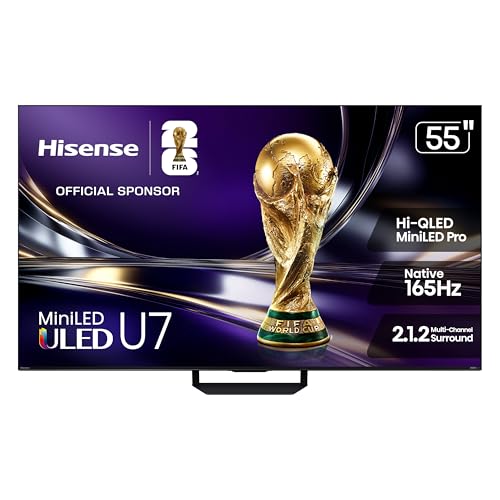
The Hisense U8N is the best budget performer on this list, and it proves strong picture quality no longer demands a premium spend. It scores well among budget-tier sets for Mini-LED local dimming, peak brightness, and color accuracy, with up to 3,000 local dimming zones and peak brightness stated up to 3,000 nits. That is enough firepower to make HDR look genuinely impactful and to fight off glare, helped by an anti-reflection, glare-free screen treatment that is unusual at this price.
It is also surprisingly capable for gaming and sports, thanks to a native 165Hz refresh rate that keeps fast motion clean, and the Hi-View AI Engine Pro that continuously analyzes the scene to optimize the picture. The U8N frequently matches mid-range QLED sets in the specs that matter, which is why it represents real savings rather than a compromise. For a second TV, a bedroom, or a primary set on a tighter budget, it covers an enormous amount of ground.
The honest caveat is consistency and polish. Budget Mini-LED sets like the U8N can show more blooming around bright objects than pricier models with finer zone control, and Hisense’s image processing and motion handling, while strong for the class, do not match the refinement of the LG, Sony, or Samsung options. The smart platform can also feel less responsive over time. None of that undercuts the value, but it is the reason this is the budget champion rather than the overall winner.
What to look for
The right TV depends mostly on your room and how you watch. These are the factors I weigh most:
- Panel type: OLED for perfect blacks in a dim room, Mini-LED for higher brightness that beats glare in a bright room.
- Peak brightness: The more ambient light you have, the more brightness you need for HDR to look its best.
- Black-level control: Per-pixel OLED avoids blooming, while backlit sets trade some black-level purity for brightness.
- Color accuracy and gamut: Look for wide DCI-P3 coverage if film fidelity matters to you.
- Refresh rate and response time: 120Hz or higher with low response time keeps gaming and sports smooth.
- HDMI 2.1 ports: Count how many you truly get, since some sets share bandwidth with the eARC audio port.
- HDR format support: Dolby Vision and HDR10+ support depends on the brand, so check it against your content.
- Smart platform and updates: Day-to-day responsiveness and long-term software support vary widely by brand.
The verdict
For most people, the LG C4 OLED is the smartest buy. Its perfect blacks, accurate color, and four full HDMI 2.1 ports make it the best blend of cinema and gaming, as long as your room is not flooded with light. If it is, the Samsung QN90D QLED is the answer, with Mini-LED brightness that keeps HDR vivid even in direct sun.
Film-first viewers who prize natural color and motion should choose the Sony Bravia 7. If you want most of a flagship for far less, the TCL QM8 Mini-LED delivers flagship-tier brightness and dimming with only minor refinement compromises. And on a tighter budget, the Hisense U8N gives up surprisingly little, making it the value pick for a bedroom, a second room, or a cost-conscious main TV.
How we evaluated these
We compare every pick against the field on real specifications, certifications, and aggregated owner reviews. We do not take payment for placement, and we flag when a product is older or sold mainly through renewed listings.
The shortlist
Each pick, examined
LG C4 OLED -- Best Overall Picture Quality
The LG C4 remains Consumer Reports' top-rated television for picture quality in the OLED category. The self-lit OLED panel delivers perfect black levels, pixel-accurate local dimming, and a wide color gamut that covers the DCI-P3 color space used in cinematic content. Gaming performance is exceptional with four HDMI 2.1 ports all capable of 4K/144Hz with VRR support.
Strengths
- SELF-LIT PIXELS: LG's signature OLED technology creates an incredible watching experience
- 144 HZ REFRESH RATE: Enjoy crisp, smooth visuals with a 0.1ms response time and up to 144H
- DOLBY VISION, FILMMAKER AND DOLBY ATMOS: Experience the magic of the big screen right from
- a9 AI PROCESSOR GEN7: The C4's exclusive processor is the brains behind a truly unforgetta
- WEBOS 24 & LG CHANNELS: No matter which TV you choose, your LG TV makes it easier than eve

Samsung QN90D QLED -- Best for Bright Rooms
Samsung's QN90D uses Neo QLED Mini-LED technology that delivers peak brightness figures well above what OLED panels can achieve. Consumer Reports rates it highest among QLED models for color accuracy and HDR performance. In a sunlit living room, the QN90D's ability to push over 2,000 nits of peak brightness makes HDR content pop in a way that OLEDs cannot match under those conditions.
Strengths
- QUANTUM MATRIX w/ MINI LEDs: Catch every detail in dark to bright scenes; Precise lighting
- NEO QUANTUM HDR+: See sensational contrast, stellar brightness & vivid color, just as the d
- DOLBY ATMOS & OBJECT TRACKING SOUND+: Put yourself in the middle of the action with built-
- MOTION XCELERATOR 144Hz: Play games and content with smooth motion and virtually no lag or
- REAL DEPTH ENHANCER PRO: Experience depth and dimension on screen just like you do in real

Sony Bravia 7 -- Best Color Accuracy
Sony's Bravia 7 earns its high Consumer Reports score largely through color accuracy and motion handling. The XR Processor delivers picture processing that Sony says mimics how the human brain perceives images, and in practice the result is natural-looking motion, accurate skin tones, and smooth gradients that some competitors struggle with. It is also the best choice for watching calibrated film content as directed.
Strengths
- MINI LED BRIGHTNESS AND CONTRAST: Thousands of Mini LEDs are precisely controlled by XR Ba
- BILLIONS OF REAL-WORLD QLED COLORS: Access billions of accurate real-world colors with QLE
- POWERFUL TV PROCESSING: XR Processor intelligently enhances every scene in real-time boost
- YOUR FAVORITE STREAMING APPS IN ONE PLACE: Get access to all your favorite streaming apps,
- MOVIES INCLUDED WITH THE BRAVIA TV: Enjoy streaming high-bitrate, high-quality 4K UHD movi

TCL QM8 Mini-LED -- Best Value Premium TV
The TCL QM8 delivers picture quality that challenges TVs costing hundreds more. Consumer Reports rates it as one of the best value propositions in the Mini-LED category, with brightness levels that compete with Samsung's premium QLED lineup and local dimming performance that approaches high-end options. The 144Hz panel serves gamers well, and the HDMI 2.1 port supports 4K gaming at high frame rates.
Strengths
- SQD-Mini LED: As the ultimate Mini LED TV, it integrates the expansive TCL Deep Color Syst
- TCL Ultra Color Filter: TCL’s Ultra Color Filter with fine 5 nanometer particles (vs. stan
- High Static Contrast: Experience exceptional picture quality driven by a high 7000:1 contr
- High Zones & High Brightness: Up to 4000+ Discrete Dimming Zones and up to 6,000 Peak Nits
- AI-Powered Experience: Elevate every viewing experience with AI Color for vibrant hues, AI
Hisense U8N -- Best Budget Performance
The Hisense U8N proves that strong picture performance no longer requires a premium price. Consumer Reports scores it highly among budget-tier TVs for Mini-LED local dimming performance, peak brightness, and overall color accuracy. The U8N frequently matches mid-range QLED sets in objective measurements at a price that represents significant savings.
Strengths
- HI
- NATIVE 165HZ REFRESH RATE: Advanced motion technology handles gaming, sports and action at
- ANTI-REFLECTION & GLARE-FREE: Bright windows, overhead lights, afternoon sun, your screen h
- HI-VIEW AI ENGINE PRO: Our AI processor never stops working, constantly analyzing the scene
- UP TO 3000 LOCAL DIMMING ZONES & UP TO 3000 NITS PEAK BRIGHTNESS: Precision lighting zones
Buying considerations
What to consider
Consumer Reports evaluates TVs using calibrated measurement equipment and assigns scores for black level, peak brightness, color accuracy, and motion handling, then combines those with owner reliability surveys. When interpreting these scores, start by identifying your primary viewing environment. Dark home theater rooms benefit most from OLED's perfect blacks, while bright living rooms with windows across from the screen often perform better with high-brightness QLED or Mini-LED sets.
What to consider
Screen size relative to viewing distance matters more than most buyers realize. Consumer Reports recommends 55 inches for viewing distances around eight feet, with 65 inches appropriate for ten feet or more. Also consider the smart platform carefully -- not all platforms receive equal long-term software support, and a TV with an abandoned OS becomes frustrating after a few years.
What to consider
For more home tech coverage, see our guide to [articles/best-consumer-reports-soundbar](/articles/best-consumer-reports-soundbar) to pair with your new television. Wearable tech buyers should check [articles/best-consumer-reports-smartwatch](/articles/best-consumer-reports-smartwatch). Review our [/methodology](/methodology) for full evaluation criteria.
Questions answered
Consumer Reports consistently rates Google TV and Roku TV platforms highest for ease of use, app availability, and long-term software support. Both platforms receive regular updates, offer broad streaming app libraries, and have low rates of reported software issues in owner surveys. LG's webOS also scores well for responsiveness and interface design among OLED owners.
Consumer Reports notes that OLED panels deliver superior contrast, true black levels, and wide viewing angles compared to QLED models at the same price. For dark-room viewing or content with lots of dark scenes, OLED is worth the premium. QLED and Mini-LED TVs close the gap significantly in bright rooms and offer higher peak brightness for HDR highlights.
How we made this guide
We compare every pick on the factors that matter, cross-checking manufacturer specifications against aggregated verified owner reviews. We rank independently and never take payment for placement. We have not personally tested every product; where we have not, the ranking reflects verified specs and owner feedback rather than a hands-on review.
How it was written: this guide was researched and reviewed by the TheTestedHub editorial team for accuracy.
Affiliate disclosure: TheTestedHub is reader-supported. When you buy through links on our site, we may earn a commission at no extra cost to you.
Keep reading

Best Drones for Beginners 2026: Expert Pick Is the DJI Mini 4K

Find Your Perfect Podcast Mic: Reviews for Every Budget

Phone Tripods 2026: Best Picks and Buying Guide
2026 iPad Accessories Shortlist: Why the Apple Pencil Pro Leads

How to Choose the Best Digital Photo Frames in 2026

Looking for the Best MagSafe Power Banks? Our 2026 Picks

Our Top Fast Chargers for 2026
