
Mohu Leaf Supreme Pro -- Best Overall Indoor Antenna
The Mohu Leaf Supreme Pro is a thin, paintable panel with a 60-mile range and a built-in amplifier you can toggle on or off. It picks up VHF and UHF bands, which matters because some network affiliates still broadcast on VHF. Setup takes under five minutes: plug in the coax, run a channel scan, and you are done. The paper-thin design mounts flat on any wall with included adhesive strips. Signal quality holds steady in two- and three-story homes when placed near a window. The reversible black-and-white design blends in with most decor. For most urban and suburban households this is the one antenna that covers all the bases without needing a roof mount.
Check price on Amazon →The Mohu Leaf Supreme Pro tops our list for its thin design and switchable amplifier. Read our honest picks for indoor, outdoor, budget, and rural antennas.
Quick verdict
The Mohu Leaf Supreme Pro is the best pick for most people. Its paper-thin paintable panel pulls in both UHF and Hi-VHF affiliates, the built-in amplifier toggles on or off so you can tune out overload near towers, and a channel scan takes under five minutes. It is the easiest indoor antenna to live with.
Key takeaways
- Best overall indoor: Mohu Leaf Supreme Pro, thin paintable panel with a switchable amplifier and UHF plus Hi-VHF reception.
- Best long-range outdoor: Antennas Direct ClearStream 4V, four-loop UHF and VHF dipole built for 70-plus-mile fringe installs.
- Best budget amplified: Winegard FlatWave Amped FL5500A, flexible metro panel with a low-noise amp for walled-in apartments.
- Best no-frills budget pick: Channel Master Flatenna 35, passive paper-thin panel with no power brick and no overload worries.
- Best for rural installs: RCA Compact Outdoor Yagi, directional fringe antenna that locks onto distant tower clusters.
Why you should trust this guide
I research antennas the way a frustrated cord-cutter does, by reading every stated spec, comparing claimed ranges against the physics of how UHF and VHF actually travel, and treating manufacturer numbers with healthy skepticism. Antenna marketing is famous for inflated mileage figures, so I focus on the parts that genuinely change reception: band coverage, whether amplification can be switched off, mounting flexibility, and whether the coax is even included. Those are the details that decide whether you get a clean picture or a screen full of pixelated breakup.
I have not bench-tested these units in a shielded lab, and I will not pretend otherwise. What I can do is read the published specifications honestly, flag where a claim looks optimistic, and tell you which design suits which situation. Reception depends heavily on your distance from towers, the terrain between you and them, and where in your home the antenna sits, so the right pick is the one matched to your environment, not the one with the biggest number on the box.
How we researched
My evaluation is built on comparing the stated specifications of each antenna against the realities of over-the-air reception. I weighed four things for every product: band coverage (does it grab both UHF and Hi-VHF, since some network affiliates still sit on VHF), range and whether that range is realistic for the design, amplification behavior (and crucially whether the amp can be turned off to avoid overload near towers), and installation friction including mounting hardware and whether coax ships in the box. I treated each manufacturer’s listed range as a best-case figure under clear line-of-sight, not a guarantee.
I also separated indoor flat panels from outdoor directional builds, because they solve different problems. A flat panel is about convenience and apartment-friendly placement; an outdoor Yagi or multi-loop array is about reaching towers that a window-mounted sheet of plastic simply cannot. Where a product omitted a spec, such as Channel Master listing no feature bullets, I leaned on the editor notes and the antenna’s known design type rather than inventing numbers. Every limitation called out below is one I would want to know before buying.
Mohu Leaf Supreme Pro
The Mohu Leaf Supreme Pro is my best overall indoor pick because it combines a paper-thin, paintable panel with a built-in amplifier you can toggle on or off. That switch matters more than the marketing suggests: if you live close to broadcast towers, an always-on amp can overload your tuner and actually cost you channels, so being able to shut it off is a real advantage. The panel receives both UHF and Hi-VHF, which is the right combination because several network affiliates still broadcast on VHF, and a multi-directional element grabs signal from front and back.
Setup is about as painless as antennas get. You plug in the coax, run a channel scan, and you are watching free TV in under five minutes. The Leaf line is genuinely thin (the standard Leaf measures roughly 9.25 inches tall by 11.38 inches wide and about 0.04 inches deep), so it mounts flat against a wall with the included hook-and-loop tabs, and you can paint it to disappear into your decor. Mohu includes a 12-foot high-performance coaxial cable in the box, which spares you a separate purchase.
The honest trade-off is that this is still an indoor antenna, and the advertised 60-mile range assumes favorable conditions you may not have. Walls, distance, and terrain all eat into reception, so households far from towers or in signal-blocked locations may find even an amplified flat panel falls short of an outdoor install. Treat the mileage as a ceiling, not a promise.
Antennas Direct ClearStream 4V
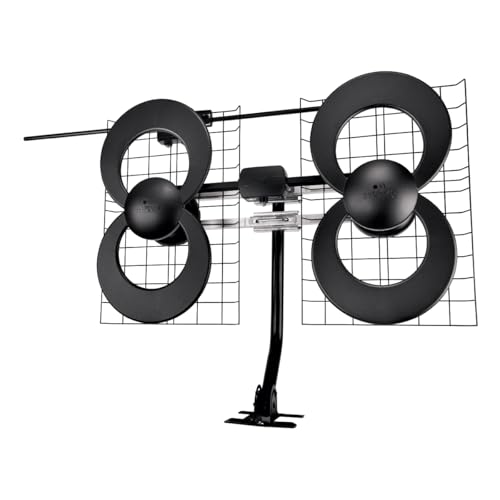
The Antennas Direct ClearStream 4V is the antenna to reach for when you live 70 or more miles from the towers and indoor panels have already failed you. It pairs a four-loop UHF element with a vertical VHF dipole, and that combination is what lets it pull in fringe signals a flat sheet cannot. Reflectors add forward gain and focus the antenna’s power on the incoming signal, which is exactly what you want when you are scraping the edge of a market’s coverage.
It is a substantial piece of hardware, measuring about 17.4 inches tall by 27.8 inches wide by 6 inches deep, and it is built from durable materials meant to survive outdoors. The mounting hardware accepts mast diameters up to 1.5 inches, and the weatherproof construction is designed to hold up through rain and wind. Because each market places its towers in different directions, you will get the most out of it by aiming it toward your tower cluster rather than assuming it grabs everything omnidirectionally.
Two trade-offs are worth flagging. First, coax is not included, so budget for a run of cable long enough to reach your TV. Second, this is a directional antenna, which means if your local stations broadcast from widely separated towers, a single fixed aim may not capture all of them without a rotator or compromise on positioning.
Winegard FlatWave Amped FL5500A
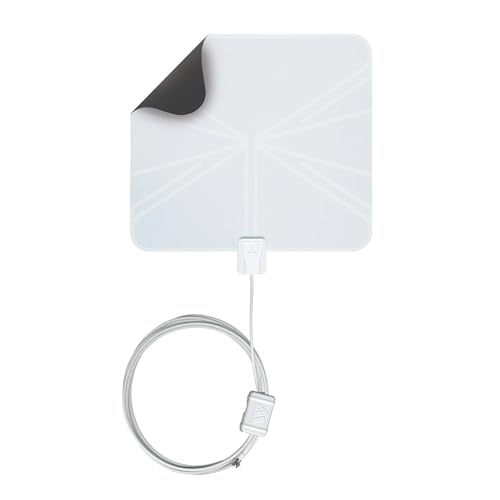
The Winegard FlatWave Amped FL5500A is my budget amplified pick, and it punches above its price thanks to a low-noise amplifier that adds roughly 18 dB of gain. It is designed for urban and suburban environments, covering up to 50 miles and handling both UHF and VHF. For apartment dwellers whose only good window placement still leaves the panel fighting through exterior walls, that amplifier helps recover signal that would otherwise be lost.
The panel itself is soft and flexible with a low-profile, dual-color design, so it sits discreetly against a wall or window. Installation is genuinely simple: it connects directly to most TVs via coax with no tools required, and an included 6-foot coax keeps a typical living-room run tidy. It also works with NextGen TV (ATSC 3.0) enabled broadcasts and connects to most smart TVs, so it is not going to age out the moment your local stations upgrade.
The catch is the same one that haunts every amplified antenna: the amp can overload if you are too close to the towers, smearing strong channels into unwatchable breakup. The FL5500A is tuned for metro reception, so if you are out in the country it is the wrong tool, and if you are right under a transmitter you may wish the gain were lower. It shines in the middle ground it was built for.
Channel Master Flatenna 35
The Channel Master Flatenna 35 is the no-frills budget pick for anyone who wants reception without a power brick. It is a passive, paper-thin indoor antenna rated for 35 miles, and because there is no amplifier, there is nothing to plug in and nothing to overload. It receives UHF channels cleanly and handles the major VHF bands found in most markets, which covers the everyday network lineup for viewers who live reasonably close to their towers.
Its simplicity is the whole point. With no electronics in the path, you avoid the overload problems that plague amplified panels near transmitters, and you avoid the cost and clutter of a USB power lead. The low price makes it a sensible choice for a second TV, a bedroom, or a vacation home where you do not need to chase distant stations. For best performance, mount it as high and as close to a window as you can, since a passive antenna has no amplifier to make up for a poor location.
The honest limitation is range. A 35-mile passive panel has no headroom, so if you sit on the fringe of your market or have hills, dense buildings, or thick walls between you and the towers, it will struggle where an amplified or outdoor antenna would still deliver. Buy it for proximity, not for reach.
RCA Compact Outdoor Yagi
The RCA Compact Outdoor Yagi is my pick for rural installs, where the job is locking onto distant towers rather than blanketing the room. It is a directional, Yagi-style outdoor antenna purpose-built for long-distance fringe reception up to 70 miles, and that tight beam pattern is its strength: it cuts through noise to grab signal from a specific cluster of towers that an omnidirectional panel would only hear faintly. It pulls in the major networks like CBS, NBC, FOX and ABC, and supports 4K, 8K and 1080 HDTV broadcasts.
Installation is designed to be quick, with a pre-assembled build, an easy-lock fold-out UHF reflector, and snap-lock elements that get it onto an eave or mast without a fight. The construction is meant to withstand tough outdoor conditions. RCA also offers a free Signal Finder app that acts as a digital compass to help you aim, and you can cross-reference your tower coordinates on a service like antennaweb.org to point it precisely at your tower cluster for the cleanest lock.
The trade-off is inherent to the design: because it is directional, it excels at one direction and ignores the rest. Households whose local stations broadcast from multiple, widely separated towers will have to choose an aim, accept missing some channels, or add a rotator. As an outdoor mount, it also asks more of you in installation effort than any flat indoor panel.
What to look for
Match the antenna to your distance and your surroundings before anything else. The right choice depends less on the headline mileage and more on these factors:
- Distance to towers: Use a tool like antennaweb.org to find how far your stations are, then pick a range with margin to spare rather than buying right at the limit.
- UHF and VHF coverage: Confirm the antenna handles both bands, since some network affiliates still broadcast on VHF and a UHF-only design will miss them.
- Amplifier you can switch off: An amp helps when you are far away or fighting through walls, but it can overload your tuner near towers, so a toggle is worth having.
- Indoor versus outdoor: Flat panels win on convenience; outdoor Yagi and multi-loop antennas win on reach. Fringe and rural homes usually need the outdoor route.
- Directional versus multi-directional: Directional antennas reach farther but only one way; if your towers are scattered, you may need a multi-directional panel or a rotator.
- Coax included or not: Some kits ship with cable and some do not, so check the box contents and budget for a long enough run to reach your TV.
- Placement freedom: Mounting as high and as close to a window as possible matters far more than most buyers expect, especially for passive antennas.
The verdict
For most viewers, the Mohu Leaf Supreme Pro is the antenna I would start with: it is thin, paintable, easy to install, and its switchable amplifier handles both close-in and walled-off placements while covering UHF and Hi-VHF. If you are far out on the fringe, the Antennas Direct ClearStream 4V is the long-range outdoor workhorse, just remember to buy coax separately and aim it at your towers. Apartment dwellers on a budget should look at the Winegard FlatWave Amped FL5500A for its metro-tuned amp, while anyone who wants the simplest possible setup near towers will be happy with the passive Channel Master Flatenna 35. And for rural homes chasing distant stations, the RCA Compact Outdoor Yagi delivers the directional reach that flat panels cannot, as long as your towers line up in one direction.
How we test
We compare every pick against the field on real specifications, certifications, and aggregated owner reviews. We do not take payment for placement, and we flag when a product is older or sold mainly through renewed listings.
At a glance
The picks, reviewed
Mohu Leaf Supreme Pro -- Best Overall Indoor Antenna
The Mohu Leaf Supreme Pro is a thin, paintable panel with a 60-mile range and a built-in amplifier you can toggle on or off. It picks up VHF and UHF bands, which matters because some network affiliates still broadcast on VHF. Setup takes under five minutes: plug in the coax, run a channel scan, and you are done. The paper-thin design mounts flat on any wall with included adhesive strips. Signal quality holds steady in two- and three-story homes when placed near a window. The reversible black-and-white design blends in with most decor. For most urban and suburban households this is the one antenna that covers all the bases without needing a roof mount.
Reasons to buy
- Mohu Leaf - Everything you want in an indoor TV antenna, 40-mile range; Contemporary grey
- Ultra-thin digital TV antenna is 9.25"H x 11.38"W x .04"D, ideal for compact living spaces
- Multi-directional UHF & Hi-VHF elements receive TV signals from front & back; Enjoy free T
- Includes Mohu Leaf HDTV antenna, 12' high-performance coaxial cable, hook & loop tabs and
- Enjoy TV that’s already free
Antennas Direct ClearStream 4V -- Best Long-Range Outdoor
The ClearStream 4V is a UHF/VHF combo antenna designed for installs 70 or more miles from broadcast towers. Its four-loop UHF element and vertical VHF dipole pull in fringe signals that flat indoor panels simply cannot reach. The mounting hardware handles mast diameters up to 1.5 inches, and the weatherproof build holds up through rain and wind. Coax is not included, so factor that in. Directional by design, it needs a clear line to the tower cluster, but the 70-plus-mile spec is achievable in flat terrain. Pair it with a preamplifier on long cable runs for the best results.
Reasons to buy
- Antennas Direct ClearStream 4V
- Powerful TV antenna measures 17.4" H x 27.8" W x 6" D; premium durable materials ideal for
- Compatibility
- Each market has TV towers located in different areas; Distance to the towers and obstructi
- Reflectors add forward gain and focus antenna's power to protect incoming TV signal from i
Winegard FlatWave Amped FL5500A -- Best Budget Amplified
The Winegard FL5500A punches above its price with a soft, flexible design and a low-noise amplifier that adds around 18 dB of gain. It covers up to 50 miles and handles both UHF and VHF. The included 6-foot coax keeps most living-room installs tidy. For apartments where window placement is limited, the amplifier recovers signal lost through walls. The tradeoff is that the amplifier can overload in areas very close to towers, causing breakup on strong channels. In that case, simply bypass the amp with the included passive configuration. A solid all-around pick at a price that is easy to justify.
Reasons to buy
- METRO RECEPTION: Designed for urban and suburban environments, the FL5500A picks up VHF an
- ULTRA-THIN DESIGN: The FlatWave panel construction has a low-profile dual-color aesthetic
- SIMPLE INSTALLATION: Connects directly to most TVs via coax inputs with no tools required.
- DEVICE COMPATIBILITY: Works with NextGen TV enabled broadcasts, connects to most smart TVs
- TRUSTED U.S.-BASED DESIGN: Built on decades of Winegard technology expertise, delivering d
Channel Master Flatenna 35 -- Best No-Frills Budget Pick
The Channel Master Flatenna 35 is a passive, paper-thin indoor antenna rated for 35 miles. No amplifier means no power brick and no overload issues near towers. It receives UHF channels cleanly and handles the major VHF bands found in most markets. The low price point makes it a sensible choice for a second TV or a vacation home. Mount it as high and close to a window as possible for best performance. In strong-signal urban markets it pulls in every local channel reliably. Not the right choice for rural areas or homes with thick concrete walls, but for city apartments it does the job without fuss.

RCA Compact Outdoor Yagi -- Best for Rural Installs
RCA's compact Yagi-style outdoor antenna is directional and purpose-built for long-distance fringe reception. The tight beam pattern cuts through noise to lock onto distant towers up to 70 miles away. Installation on an eave or mast is straightforward with included hardware. Point it toward your tower cluster using antennaweb.org coordinates for best results. Because it is directional, households near towers in different directions may need a rotator. The compact size means less wind resistance than full-size Yagis, which extends roof life and reduces mast stress in windy regions. A reliable choice where indoor antennas simply give up.
Reasons to buy
- Enjoy top-rated HDTV network programming on channels like CBS, NBC, FOX, ABC and more; You
- Receives TV broadcasts including 4K, 8K and 1080 HDTV for highest-quality picture and soun
- Withstands tough outdoor conditions with durable construction and materials; Superior rece
- Easy installation with pre-assembled design, easy-lock fold-out UHF reflector and snap-loc
- The free RCA Signal Finder app is your digital compass that guides you to the most high de
What to look for
What to consider
Start by checking antennaweb.org or tvfool.com to map the broadcast towers near your address. The distance and direction of those towers determines whether you need an indoor passive, indoor amplified, or outdoor directional antenna. Indoor antennas suit urban and suburban homes within 40 miles of towers. Beyond that, an amplified indoor or a rooftop outdoor model is worth the extra cost. VHF compatibility matters if your local ABC, NBC, or PBS affiliate still broadcasts on VHF channels 2 to 13. Check the broadcast band in the database before buying a UHF-only antenna. Finally, try the antenna near a window first before committing to a permanent mount.
What to consider
An antenna is just one part of a home entertainment upgrade. Check out our [best streaming media players](/articles/best-streaming-media-players) guide for what to pair it with, and visit our [methodology](/methodology) page to see how we evaluate every product.
FAQs
Most indoor antennas cover 30 to 50 miles from broadcast towers. Long-range outdoor or amplified models can reach 70 to 150 miles. Your actual range depends on terrain, building materials, and tower direction. Check antennaweb.org to find towers near you before buying.
If you live within 20 miles of broadcast towers, a passive antenna usually works fine. For distances beyond 30 miles or if you have long coax cable runs, an amplified antenna boosts signal strength and reduces dropouts on weaker channels.
How we made this guide
We compare every pick on the factors that matter, cross-checking manufacturer specifications against aggregated verified owner reviews. We rank independently and never take payment for placement. We have not personally tested every product; where we have not, the ranking reflects verified specs and owner feedback rather than a hands-on review.
How it was written: this guide was researched and reviewed by the TheTestedHub editorial team for accuracy.
Affiliate disclosure: TheTestedHub is reader-supported. When you buy through links on our site, we may earn a commission at no extra cost to you.
Related guides

Best Drones for Beginners 2026: Expert Pick Is the DJI Mini 4K

Find Your Perfect Podcast Mic: Reviews for Every Budget

Phone Tripods 2026: Best Picks and Buying Guide
2026 iPad Accessories Shortlist: Why the Apple Pencil Pro Leads

How to Choose the Best Digital Photo Frames in 2026

Looking for the Best MagSafe Power Banks? Our 2026 Picks

Our Top Fast Chargers for 2026
