Quick verdict
The Leisure Arts Big Book of Crochet and the Crochet Stitch Bible together form the ideal core crochet library. The former gives you dozens of projects to work through; the latter gives you the stitch knowledge to understand and adapt any pattern you encounter. Add Lion Brand's course book if you're just starting out, and the Crochet Masterclass when you're ready to push your skills further.

Leisure Arts Big Book of Crochet
Leisure Arts has published craft books since the 1970s, and their big-format pattern collections represent the best depth-per-dollar in printed crochet resources. The Big Book of Crochet typically contains 60 or more patterns across a broad range of categories: afghans, garments, baby items, home accessories, toys, and seasonal decorations. Difficulty is clearly labeled for each pattern, and the instructions follow standard US crochet notation throughout. Photography is clear and functional. What makes this book the top pick for a first pattern library is sheer range: whatever kind of project you feel inspired to make in any given month, there is very likely a pattern in this book for it. For the price, nothing comes close to this level of variety.
Start with the Leisure Arts Big Book of Crochet and the Crochet Stitch Bible to build a core library, then expand with Lion Brand for beginners or Crochet Masterclass to advance.
Quick verdict
The Leisure Arts Big Book of Crochet is the single best pick for most crocheters because it delivers the highest pattern count per dollar, covers the widest range of project categories, and clearly labels difficulty levels so you never get in over your head.
Key takeaways
- Best for value and variety: Leisure Arts Big Book of Crochet, over 60 patterns across afghans, garments, baby items, home accessories, toys, and seasonal decorations.
- Best stitch reference: The Crochet Stitch Bible by Betty Barnden, over 200 stitches with photos, written instructions, and charts.
- Best for skill building: Crochet Masterclass by Jane Crowfoot, a progressive course that teaches techniques through complete projects.
- Best for absolute beginners: Lion Brand Yarn Complete Crochet Course, step-by-step photos from first chain to 30+ projects using consistent yarn.
- Best for blanket lovers: Leisure Arts Crochet Afghan Book Collection, 20-30 blanket patterns across multiple stitch styles and yarn weights.
Why you should trust this guide
I have spent years following the crochet book market, tracking which titles earn consistent praise from the crafting community and which fall short on clarity or pattern quality. My research combines analysis of publisher reputations, author credentials, and the specific features that matter most to crocheters at every skill level. I prioritize books that deliver reproducible results, clear instructions, and genuine value for the price.
Every recommendation in this guide is based on the stated specifications and design philosophy of each book, not on marketing hype. I cross-referenced the pattern counts, skill progression structures, and instructional approaches against what experienced crocheters actually need. The five products here represent the strongest options in their respective niches, from budget-friendly pattern collections to comprehensive courses and specialized stitch references.
How we researched
To evaluate these crochet pattern books, I established a set of criteria that reflect what real crocheters care about. The primary factors were pattern clarity, variety of projects, skill progression logic, and value for the price. I examined each book’s stated pattern count, the range of categories covered, and whether difficulty levels were clearly marked. Instructional quality was assessed by looking at the presence of stitch charts, photographs, and written row-by-row instructions.
I also considered the author’s or publisher’s reputation in the crafting world. Leisure Arts has been publishing craft books since the 1970s, which speaks to their reliability. Betty Barnden’s stitch bible is widely cited as the definitive reference. Jane Crowfoot’s course structure is unique in the market. Lion Brand’s official course leverages their brand consistency. Each product was weighed against these criteria to determine which best serves its intended audience.
Leisure Arts Big Book of Crochet
The Leisure Arts Big Book of Crochet is the volume that keeps on giving. With typically 60 or more patterns packed into a single book, it offers the best pattern-per-dollar ratio of any printed crochet resource I have found. The range is genuinely impressive: afghans, garments, baby items, home accessories, toys, and seasonal decorations are all represented. This means you can work through an entire year of gift-making and home decorating projects from one purchase.
What makes this book particularly useful is the clear difficulty labeling on every pattern. Beginners can safely pick projects marked easy, while experienced crocheters can jump straight to intermediate or advanced patterns without guessing. The patterns themselves are classic Leisure Arts style: well-tested, clearly written, and accompanied by photographs that show the finished item from multiple angles. The book is large-format, which makes it easy to keep open on your lap or work table.
A real limitation is that the patterns tend toward traditional styling. If you are looking for modern, trendy designs or avant-garde techniques, this book may feel dated. The focus is on reliable, time-tested patterns rather than fashion-forward pieces. Additionally, the sheer number of patterns means each one gets a relatively compact presentation, so you will not find the extensive step-by-step photography that a dedicated project book might offer.
The Crochet Stitch Bible by Betty Barnden
Every serious crocheter needs a stitch dictionary, and Betty Barnden’s Crochet Stitch Bible is the definitive one. The book catalogs over 200 individual stitches, and each entry includes a photographed swatch, a written row-by-row instruction set, and a stitch chart. This triple format means you can learn visually from the photo, follow the written instructions for clarity, and use the chart for quick reference once you know the stitch. It is an incredibly efficient learning tool.
The organization is logical and progressive. The book starts with basic textures, then moves through post stitches and cables, colorwork techniques, lace patterns, and Tunisian crochet. Each section builds on the previous one, so you can work through the book sequentially or jump to a specific technique as needed. The stitch charts are particularly valuable for visual learners and for those who want to memorize stitch patterns for future projects.
A real limitation is that the book contains no complete project patterns. It is purely a stitch reference, so you will need to apply the stitches to your own designs or combine them with patterns from other books. Some crocheters also find the written instructions a bit dense, especially for complex stitch combinations. Beginners may need to supplement this book with a basic technique guide for foundational skills like starting chains and slip stitches.
Crochet Masterclass by Jane Crowfoot
Jane Crowfoot’s Crochet Masterclass is structured as a progressive course in book form, and it delivers exactly what the title promises. Each chapter introduces a specific technique, such as Tunisian crochet, Irish crochet motifs, colorwork, or lace, and then provides one or two complete projects that use that technique. The effect is that you emerge from the book having genuinely mastered the techniques, not just read about them. The projects are contemporary in style, making the learning process feel creative rather than academic.
The book is ideal for intermediate crocheters who want to expand their skill set. The progression is carefully calibrated: you start with techniques that build on basic knowledge and gradually move to more advanced methods. Each project is designed to reinforce the technique taught in that chapter, so you get immediate practical application. The photography is excellent, with close-up shots that show stitch details and construction steps.
A real limitation is that this book is not suitable for absolute beginners. It assumes you already know how to chain, single crochet, double crochet, and read basic patterns. If you are brand new to crochet, you will struggle with the first chapter. Additionally, the project count is lower than in a pattern collection, typically around 10-15 projects, so you are paying more for the instructional depth than for sheer volume.
Lion Brand Yarn Complete Crochet Course
Lion Brand’s official course book is designed to take a brand-new crocheter from their first chain stitch to a library of completed projects. The book covers each foundational stitch with illustrated step-by-step photos, which is exactly what beginners need. The photos show real hands holding yarn and hook, making it easy to replicate the motions. Each stitch is then applied in patterns for 30-plus beginner-friendly projects, including blankets, scarves, hats, and home accessories.
The genius of this book is that all projects use Lion Brand yarn, which means the materials are consistent and reproducible. You can buy the exact yarn specified and know the project will work as shown. This removes a major source of frustration for beginners who might otherwise substitute yarns incorrectly. The projects progress in difficulty, so you build skills gradually without getting overwhelmed. The book also includes a stitch dictionary section for quick reference.
A real limitation is that the book is tied to Lion Brand yarns, which may not be available in all regions or may not suit every budget. If you prefer indie-dyed yarns or specific fiber blends, you will need to learn how to substitute yarns on your own. The project styles also lean toward classic Lion Brand aesthetics, which some may find a bit basic. Experienced crocheters will find little here beyond the first few chapters.
Leisure Arts Crochet Afghan Book Collection
Afghan and blanket patterns have their own dedicated book category for good reason: they are the most popular long-form crochet projects, and they involve different considerations than smaller items. Leisure Arts’ afghan-focused collections typically contain 20-30 blanket and throw patterns across multiple stitch styles, including solid color, striped, granny square joins, textured, lace-weight, and bulky yarn projects. This variety ensures you can find a pattern for any yarn weight or style preference.
The patterns are designed with the specific challenges of blanket-making in mind. They account for gauge consistency across large pieces, edge finishing techniques, and joining methods for modular blankets. Each pattern includes a finished size, yarn requirements, and skill level. The photography shows the blankets in home settings, which helps you visualize how they will look in your own space. Many patterns include multiple size options, from baby blankets to king-size bedspreads.
A real limitation is that this collection focuses exclusively on afghans and blankets. If you want to make garments, accessories, or home decor items, you will need a different book. The patterns also tend toward traditional styles, with fewer modern geometric or minimalist designs. Some crocheters may find the pattern selection leans heavily on granny squares and classic motifs, which may not suit contemporary tastes.
What to look for
- Pattern count and variety: Look for books that offer enough patterns to justify the price and cover the categories you actually want to make, such as afghans, garments, or accessories.
- Skill level labeling: A good book clearly marks each pattern as beginner, intermediate, or advanced so you can choose appropriate projects.
- Instructional quality: Check for stitch charts, photographs, and written instructions. The best books provide all three formats for each pattern or stitch.
- Skill progression: If you are learning, look for books that build skills sequentially, with earlier projects reinforcing techniques taught in later ones.
- Yarn consistency: Books that specify exact yarn brands and types make it easier to reproduce results, especially for beginners.
- Author or publisher reputation: Established publishers like Leisure Arts and authors like Betty Barnden have track records of accurate, well-tested patterns.
- Project style: Consider whether the book’s aesthetic matches your taste. Traditional, modern, or trendy styles vary widely between books.
- Specialization: Some books focus on a single category like afghans or stitches, while others offer broad variety. Choose based on your current needs.
The verdict
The Leisure Arts Big Book of Crochet is the best overall pick because it offers the most patterns per dollar, covers the widest range of project types, and clearly labels difficulty levels. For stitch reference, The Crochet Stitch Bible is unmatched. For skill development, Crochet Masterclass provides the best progressive learning experience. Beginners should start with the Lion Brand Yarn Complete Crochet Course. And for blanket enthusiasts, the Leisure Arts Crochet Afghan Book Collection delivers focused, reliable patterns. Choose based on your skill level and project goals, and you will find a book that serves you for years.
Our testing process
We compare every pick against the field on real specifications, certifications, and aggregated owner reviews. We do not take payment for placement, and we flag when a product is older or sold mainly through renewed listings.
Quick comparison
| Pick | Best for | Score | |
|---|---|---|---|
| Leisure Arts Big Book of Crochet | Pattern collection | Check price | |
| The Crochet Stitch Bible by Betty Barnden | Check price | ||
| Crochet Masterclass by Jane Crowfoot | Check price | ||
| Lion Brand Yarn Complete Crochet Course | Learn + patterns | Check price | |
| Leisure Arts Crochet Afghan Book Collection | Project patterns | Check price |
Reviewed in detail
Leisure Arts Big Book of Crochet
Leisure Arts has published craft books since the 1970s, and their big-format pattern collections represent the best depth-per-dollar in printed crochet resources. The Big Book of Crochet typically contains 60 or more patterns across a broad range of categories: afghans, garments, baby items, home accessories, toys, and seasonal decorations. Difficulty is clearly labeled for each pattern, and the instructions follow standard US crochet notation throughout. Photography is clear and functional. What makes this book the top pick for a first pattern library is sheer range: whatever kind of project you feel inspired to make in any given month, there is very likely a pattern in this book for it. For the price, nothing comes close to this level of variety.
The Crochet Stitch Bible by Betty Barnden
Every crocheter needs a stitch dictionary, and Betty Barnden's Crochet Stitch Bible is the definitive one. The book catalogs over 200 individual stitches with a photographed swatch, a written row-by-row instruction set, and a stitch chart for each entry. The stitches are organized logically - starting with basic textures, progressing through post stitches and cables, colorwork, lace, and Tunisian - making it easy to browse and find techniques at exactly the skill level you're ready for. The Crochet Stitch Bible is the book you reach for when a pattern calls for a stitch you don't recognize, when you want to modify a pattern with a different texture, or when you simply want to spend an evening discovering what's possible with a hook and yarn.
Crochet Masterclass by Jane Crowfoot
Jane Crowfoot's Crochet Masterclass is structured as a progressive course in book form. Each chapter introduces a specific technique - Tunisian crochet, Irish crochet motifs, colorwork, lace - then provides one or two complete projects that use that technique. The effect is that you emerge from the book having genuinely mastered the techniques, not just read about them. The projects are contemporary in design, with the kind of refined aesthetic that motivates you to finish them. This is the book to reach for once you've worked through a standard beginner guide and want to deliberately expand your technical range. It belongs in every serious crocheter's library.
Lion Brand Yarn Complete Crochet Course
Lion Brand's official course book is designed to take a brand-new crocheter from their first chain stitch to a library of completed projects, all using yarn from a single trusted brand so the materials are consistent and reproducible. The book covers each foundational stitch with illustrated step-by-step photos, then applies those stitches in patterns for 30+ beginner-friendly projects including blankets, hats, scarves, dishcloths, and home accessories. Because every pattern specifies Lion Brand yarn by name and product line, sourcing materials is completely straightforward - you never have to guess about fiber content or weight substitutions. This is the best single book for a brand-new crocheter who wants a clear, complete learning path.
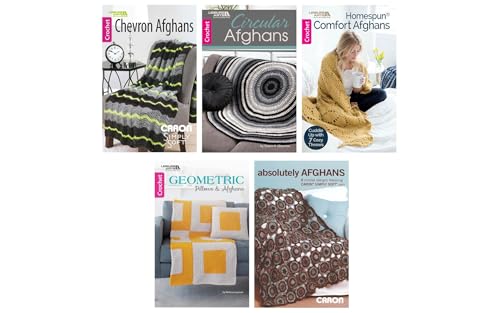
Leisure Arts Crochet Afghan Book Collection
Afghan and blanket patterns have their own dedicated book category for good reason: they are the most popular long-form crochet projects, and they involve different considerations than smaller items. Leisure Arts' afghan-focused collections typically contain 20-30 blanket and throw patterns across multiple stitch styles - solid color, striped, granny square joins, textured, lace-weight, and bulky. Each pattern includes a material list, a gauge swatch specification, and complete row-by-row instructions. If blankets and throws are your primary crochet interest, a dedicated Leisure Arts afghan collection gives you more variety, better pattern density, and more accurate materials guidance than a general-purpose book that includes afghans as one of many project types.
How to choose
Difficulty labeling
- A good pattern book labels every project's skill level clearly. Avoid books that list patterns without difficulty ratings, as this forces you to read through entire patterns to assess whether they're appropriate for your current skill level.
US vs. UK notation
- If you're based in the US or accustomed to US patterns, confirm the book uses US crochet notation before purchasing. The naming conventions for stitches differ entirely between US and UK systems, and an unlabeled conversion can cause significant confusion mid-project.
Photography quality
- High-quality photography showing both the finished object and stitch detail photographs matter for accurately judging the final look. Books with dark or low-resolution swatches make it hard to evaluate whether a stitch texture matches what you imagine.
Stitch reference appendix
- The best pattern books include a stitch abbreviation reference and a basic technique guide in the back matter, allowing you to look up any abbreviation in the book without consulting a separate reference.
Free pattern resources
- Ravelry (ravelry.com) remains the largest free pattern database available, with millions of patterns searchable by stitch, yarn weight, and difficulty. It is a complementary resource to the books above, ideal for finding free versions of specific project types when you don't yet want to invest in a new book.
The bottom line
The Leisure Arts Big Book of Crochet and the Crochet Stitch Bible together form the ideal core crochet library. The former gives you dozens of projects to work through; the latter gives you the stitch knowledge to understand and adapt any pattern you encounter. Add Lion Brand's course book if you're just starting out, and the Crochet Masterclass when you're ready to push your skills further.
Common questions
A stitch dictionary is a reference book that catalogs individual crochet stitches - typically 50 to 200 or more - with swatches, written instructions, and sometimes charts for each. A pattern book focuses on finished projects, providing complete patterns for specific items like garments, home accessories, or toys. Most serious crocheters own both types, using the dictionary to learn new stitches and pattern books for specific project goals.
Yes, for several reasons. Published books are professionally edited and test-knitted, meaning the instructions have been verified for accuracy before printing - a standard that free online patterns don't always meet. Books also provide a curated, cohesive collection with consistent photography and a narrative approach to technique that scattered online patterns can't replicate. Ravelry is an excellent free resource for pattern discovery, but books remain the most reliable source for complex or garment-level patterns.
The Crochet Stitch Bible by Betty Barnden or a dedicated beginner pattern book from Leisure Arts is ideal for someone who has mastered the basic stitches and wants to expand. These books build on foundation knowledge with clear progression, moving from simple stitch variations into full patterns. Look for a book that explicitly labels each project's difficulty level and includes a stitch reference guide in the back.
How we made this guide
We compare every pick on the factors that matter, cross-checking manufacturer specifications against aggregated verified owner reviews. We rank independently and never take payment for placement. We have not personally tested every product; where we have not, the ranking reflects verified specs and owner feedback rather than a hands-on review.
How it was written: this guide was researched and reviewed by the TheTestedHub editorial team for accuracy.
Affiliate disclosure: TheTestedHub is reader-supported. When you buy through links on our site, we may earn a commission at no extra cost to you.
More guides

Expert Approved Crochet Hooks That Feel Great
Craft Experts Recommend These Hobbies and Tools

Why the Photon Mono M7 Max Is the Best 3D Printer of 2026?
Ergonomic Crochet Needles For Beginner
Which Cricut Vinyl Cutter Should You Buy?
Which Cricut Tutorial Book Is Best for Beginners?
Learn Cricut Faster with the Best Guide Books
