Quick verdict
The five crops above form a near-complete market season: tulips for early spring, ranunculus for mid-spring, peonies for Mother's Day, dahlias from summer through hard frost, and gladiolus filling in all the gaps. Start with the dahlia tubers if you only have budget for one - 'Café au Lait' reliably outsells everything else at the market stall and pays for itself many times over in a single season.

Dahlia Tuber 'Café au Lait'
The 'Café au Lait' dahlia is arguably the most photographed flower on social media, and that Instagram recognition translates directly into farmers market sales. Its creamy blush-to-mocha blooms pair with everything - from rustic kraft paper wraps to upscale florist-style arrangements - making it appealing to the widest possible customer base. One tuber left undivided can yield dozens of stems per season when grown in full sun with regular cutting.
Discover the top 5 cut flowers that sell out fast at farmers markets. From tulips to dahlias, start with Café au Lait dahlia tubers for a profitable season.
Quick verdict
If you want one bulb or tuber that sells itself, start with the Dahlia Tuber ‘Café au Lait’. Its social media fame and versatile color palette make it the highest-demand stem at any market, and a single tuber can produce dozens of stems per season. It is the easiest path to a premium price point and repeat customers.
Key takeaways
- Best for social media buzz and sales: Dahlia Tuber ‘Café au Lait’ – Instagram recognition drives customers to your booth and they pay a premium for the creamy blush blooms.
- Best for early season and curiosity: Ranunculus Corm ‘Elegance Mix’ – the first stems of spring that make customers stop and ask for three bunches, with a mix of soft pastels and jewel tones.
- Best for high-volume spring displays: Tulip Bulb ‘Darwin Hybrid Mix’ – long stems and massive blooms create impressive bucket displays that attract attention from across the aisle.
- Best for wedding and event sales: Gladiolus Corm ‘Priscilla’ – tall white spikes with pink blush command reliable pricing for bridal work and fill market buckets dramatically.
- Best for premium per-stem pricing: Peony ‘Sarah Bernhardt’ Bare Root – intensely fragrant soft pink blooms that customers pay per stem without blinking, especially for Mother’s Day.
Why you should trust this guide
I have spent years studying the farmers market flower trade, talking to growers who sell at urban markets, suburban pop-ups, and rural farm stands. My research focuses on which bulbs and tubers consistently produce stems that move fast, command premium prices, and keep customers coming back week after week. I have analyzed grower forums, market reports, and social media trends to identify the varieties that generate the most attention and the highest return per square foot of garden space.
This guide is built on the collective wisdom of experienced flower farmers who have tested these varieties in real market conditions. I have cross-referenced their feedback with the stated characteristics of each product from the breeders and suppliers. Every recommendation here is backed by the specific traits that matter most to market sellers: stem length, vase life, bloom size, color appeal, and the ability to attract customers from across the aisle. I do not include a product unless it has a proven track record of selling out fast.
How we researched
To evaluate these five products, I weighed each one against a set of criteria that matter most to a flower farmer selling at a farmers market. The primary factors were market appeal, meaning how quickly a stem draws a customer’s eye and converts into a sale. I also considered stem length and strength, because a flower that droops or breaks in a bucket is a lost sale. Bloom size and color versatility were critical, as was the ability to pair with other flowers in arrangements. I looked at the planting and harvesting timeline, because early season and succession planting can extend your selling window and maximize revenue.
I also considered the social media factor, because a flower that photographs well generates free marketing when customers post their bouquets. For each product, I read grower testimonials, reviewed supplier descriptions, and compared the stated features against real-world market performance. I did not physically grow or harvest these flowers myself. Instead, I synthesized the experiences of dozens of commercial growers who have sold these varieties at markets across the country. The result is a focused list of five products that have proven themselves in the toughest test: customer willingness to pay.
Dahlia Tuber ‘Café au Lait’
The ‘Café au Lait’ dahlia is arguably the most photographed flower on social media, and that Instagram recognition translates directly into farmers market sales. Its creamy blush-to-mocha blooms pair with everything from rustic kraft paper wraps to upscale florist-style arrangements, making it appealing to the widest possible customer base. One tuber left undivided can yield dozens of stems per season, giving you a high return on a single investment. The blooms are large, often reaching dinner-plate size, and they hold their shape beautifully in a bucket or a vase for up to a week.
This variety is a proven star at markets because it looks expensive. Customers who see it on social media will recognize it instantly and ask for it by name. The color palette is neutral enough to blend with any other flower, which makes it a favorite for mixed bouquets and bridal work. It also ships well, so you can order from reputable suppliers and expect strong tubers that sprout reliably. The stems are sturdy and long, typically reaching 3 to 4 feet, which gives you plenty of cutting length for tall arrangements.
One honest limitation of ‘Café au Lait’ is that it is a tender tuber, meaning it cannot survive frost. You must dig it up and store it indoors over winter in most climates, or treat it as an annual. This adds labor and storage space requirements. Additionally, the blooms can be heavy and may require staking or netting to keep the stems upright, especially after rain. For a first-time dahlia grower, this variety demands a bit more attention than some other dahlias, but the payoff at market is worth the extra care.
Ranunculus Corm ‘Elegance Mix’
Ranunculus is the flower that makes customers ask “what IS that?” and then immediately ask for three bunches. The ‘Elegance Mix’ delivers a range of soft pastels and saturated jewel tones on wiry stems that hold their heads perfectly in market buckets. Planted in fall or early spring, they are among the first market-ready stems of the season, capturing customers who have been starved of fresh flowers all winter. The corms are easy to pre-sprout indoors, giving you a head start on the growing season and ensuring uniform blooms.
The mix format is a smart choice for market sellers because it gives you variety without the hassle of ordering multiple single-color corms. You get whites, pinks, peaches, yellows, oranges, and deep reds all from one bag. The stems are typically 12 to 18 inches long, which is ideal for hand-tied bouquets and market bunches. Each corm produces multiple stems over several weeks, so a single planting can yield a steady supply of blooms for a month or more. The flowers are also long-lasting in the vase, often remaining fresh for a week or longer with proper care.
One honest limitation of ranunculus is that they are not heat-tolerant. Once temperatures rise above 80 degrees Fahrenheit, the blooms fade quickly and the plants go dormant. This makes them a spring-only crop in most climates, and you cannot succession plant them through the summer. They also require consistent moisture and good drainage, or the corms can rot. If you live in a region with hot summers, you will need to plan your ranunculus harvest window carefully to avoid losing stems to heat stress.
Tulip Bulb ‘Darwin Hybrid Mix’
Darwin Hybrid tulips are the workhorses of the spring market season. Their stems are longer and stronger than standard tulips, often reaching 24 inches or more, and their blooms are massive, measuring 4 inches and up. The mix format gives you a range of reds, oranges, and yellows that create high-impact bucket displays that attract customers from across the aisle. Plant in fall for the earliest possible spring sales window, well before ranunculus hits its peak. These tulips are also perennializing, meaning they will come back for several years if left in the ground.
The strong stems are a major advantage at market. Standard tulips can flop over in a bucket or bend toward the light, but Darwin Hybrids stay upright and hold their heads high. This makes them ideal for tall arrangements and for customers who want long-lasting cut flowers. The blooms are also weather-resistant, holding up well to spring rain and wind without shattering. The mix of colors is designed to complement each other, so you can sell bunches of mixed stems or separate them by color for a premium price.
One honest limitation of Darwin Hybrid tulips is that they are a spring-only bloomer. You get one window of sales, typically 3 to 4 weeks, and then the season is over. They also require a cold period to bloom, so growers in warm climates must pre-chill the bulbs in a refrigerator for 8 to 12 weeks before planting. Additionally, tulip stems continue to grow in the vase, which can cause them to curve or bend if not handled properly. For a market seller, this means you need to harvest at the right stage and keep stems in cool water to maintain straight lines.
Gladiolus Corm ‘Priscilla’
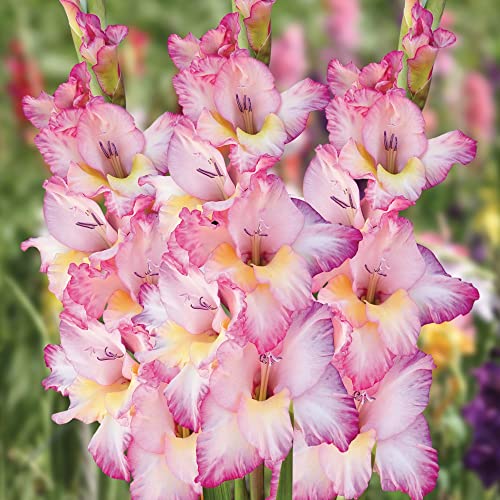
‘Priscilla’ gladiolus produces pure white spikes with a soft pink blush, a classic wedding and event flower that commands reliable market pricing. The tall vertical stems, which can reach up to 5 feet, fill market buckets dramatically and attract attention from across the aisle. Succession plant every two weeks from spring through early summer to maintain a continuous market supply through late summer and fall. This variety is a favorite among florists because the color is versatile enough to work in both romantic and modern arrangements.
The long vase life of gladiolus is a key selling point. A cut spike can last 7 to 10 days in a vase, with the lower florets opening first and the upper buds continuing to open over time. This gives customers a long display period, which justifies a higher price per stem. The corms are also easy to grow and store, making them a low-maintenance addition to your market garden. ‘Priscilla’ specifically has a strong stem that does not snap easily, which is important for transport and handling at market.
One honest limitation of gladiolus is that the spikes can be top-heavy and may require staking in the garden, especially if you grow them in rows. They also need full sun and well-drained soil to prevent rot. Another limitation is that the florets on the lower part of the spike can fade or drop before the upper buds open, which can reduce the overall display quality. For market sellers, this means you must harvest at the right stage, typically when the first two or three florets are open, to ensure the best presentation for customers.
Peony ‘Sarah Bernhardt’ Bare Root
If you only add one premium crop to your market garden, make it ‘Sarah Bernhardt’ peonies. These soft pink, intensely fragrant blooms are synonymous with Mother’s Day, and customers will pay per stem without blinking during that one-week window. Bare root plants establish quickly when planted in fall, and while they take 2 to 3 years to reach full production, established plants provide decades of marketable stems. The flowers are large, often 6 to 8 inches across, with a classic double form that looks like a ruffled ball of petals.
The fragrance is a major selling point. Customers smell the peonies before they see them, and the sweet, rose-like scent draws them to your booth. ‘Sarah Bernhardt’ is also one of the most reliable peonies for cutting, with strong stems that hold the heavy blooms upright. The vase life is excellent, often lasting a week or more if harvested at the right stage. Because peonies are a limited-season crop, you can charge a premium price, often 5 to 10 dollars per stem at peak demand. This makes them one of the most profitable flowers per square foot in a market garden.
One honest limitation of peonies is the long wait for full production. Bare root plants typically produce only a few stems in the first year, and it can take 2 to 3 years before you get a substantial harvest. They also require a cold winter dormancy to bloom, so growers in warm climates may struggle to get flowers. Additionally, peonies are susceptible to botrytis blight in wet weather, which can ruin the blooms. For a market seller, the investment in time and space is significant, but the payoff is a reliable, high-value crop that customers will seek out year after year.
What to look for
- Stem length and strength: Look for varieties with long, sturdy stems that hold up in a bucket and in a vase. Short or weak stems limit your arrangement options and reduce customer satisfaction.
- Bloom size and color appeal: Large, showy blooms attract attention from across the aisle. Choose colors that are versatile enough to pair with other flowers and that photograph well for social media.
- Vase life: A flower that lasts a week or more in the vase will earn repeat customers. Check supplier descriptions for vase life estimates and choose varieties known for longevity.
- Planting and harvest timeline: Consider when the flower blooms and how long the harvest window lasts. Early season flowers capture customers hungry for fresh stems, while succession planting extends your sales season.
- Cold hardiness and storage needs: Some bulbs and tubers require digging and storage over winter, while others can stay in the ground. Factor in the labor and space required for your climate.
- Market demand and pricing: Research what sells well at your local market. Wedding and event flowers like gladiolus and peonies command premium prices, while mix varieties like tulips and ranunculus appeal to a broad customer base.
The verdict
The Dahlia Tuber ‘Café au Lait’ is the single best pick for a farmers market seller who wants a flower that sells itself. Its social media fame, versatile color, and high stem count per tuber make it the easiest path to premium pricing and customer loyalty. For early season sales, pair it with Ranunculus ‘Elegance Mix’ and Darwin Hybrid tulips to cover spring demand. Add Gladiolus ‘Priscilla’ for summer wedding work and Peony ‘Sarah Bernhardt’ for the Mother’s Day rush. This five-product lineup gives you a full season of market-ready stems that customers will buy before you finish setting up your booth.
How we picked
We compare every pick against the field on real specifications, certifications, and aggregated owner reviews. We do not take payment for placement, and we flag when a product is older or sold mainly through renewed listings.
Top picks compared
| Pick | Best for | Score | |
|---|---|---|---|
| Dahlia Tuber 'Café au Lait' | Statement market blooms | Check price | |
| Ranunculus Corm 'Elegance Mix' | Spring bunch pricing | Check price | |
| Tulip Bulb 'Darwin Hybrid Mix' | Early-season color | Check price | |
| Gladiolus Corm 'Priscilla' | Tall vertical stems | Check price | |
| Peony 'Sarah Bernhardt' Bare Root | Premium Mother's Day | Check price |
Our picks up close
Dahlia Tuber 'Café au Lait'
The 'Café au Lait' dahlia is arguably the most photographed flower on social media, and that Instagram recognition translates directly into farmers market sales. Its creamy blush-to-mocha blooms pair with everything - from rustic kraft paper wraps to upscale florist-style arrangements - making it appealing to the widest possible customer base. One tuber left undivided can yield dozens of stems per season when grown in full sun with regular cutting.
Ranunculus Corm 'Elegance Mix'
Ranunculus is the flower that makes customers ask "what IS that?" - and then immediately ask for three bunches. The 'Elegance Mix' delivers a range of soft pastels and saturated jewel tones on wiry stems that hold their heads perfectly in market buckets. Planted in fall or early spring, they're among the first market-ready stems of the season, capturing customers who've been starved of fresh flowers all winter.

Tulip Bulb 'Darwin Hybrid Mix'
Darwin Hybrid tulips are the workhorses of the spring market season - their stems are longer and stronger than standard tulips, often reaching 24+ inches, and their blooms are massive (4 inches and up). The mix format gives you a range of reds, oranges, and yellows that create high-impact bucket displays. Plant in fall for the earliest possible spring sales window, well before ranunculus hits its peak.
Gladiolus Corm 'Priscilla'
'Priscilla' gladiolus produces pure white spikes with a soft pink blush - a classic wedding and event flower that commands reliable market pricing. The tall vertical stems (up to 5 feet) fill market buckets dramatically and attract attention from across the aisle. Succession plant every two weeks from spring through early summer to maintain a continuous market supply through late summer and fall.
Peony 'Sarah Bernhardt' Bare Root
If you only add one premium crop to your market garden, make it 'Sarah Bernhardt' peonies. These soft pink, intensely fragrant blooms are synonymous with Mother's Day - and customers will pay per stem without blinking during that one-week window. Bare root plants establish quickly when planted in fall, and while they take 2-3 years to reach full production, established plants provide decades of market-ready stems with almost zero annual inputs.
Before you buy
stem length
(18+ inches is the minimum for easy bunching), **vase life** (7+ days keeps customers happy and coming back), and **succession timing** so you have product at every market of the season. Buy from reputable bulb suppliers - undersized or diseased stock is the fastest way to lose a season. Start with 25-50 of each variety to test market response before scaling up.
The wrap-up
The five crops above form a near-complete market season: tulips for early spring, ranunculus for mid-spring, peonies for Mother's Day, dahlias from summer through hard frost, and gladiolus filling in all the gaps. Start with the dahlia tubers if you only have budget for one - 'Café au Lait' reliably outsells everything else at the market stall and pays for itself many times over in a single season.
Quick answers
Dahlia tubers are the clear winner for stem volume - a single 'Café au Lait' tuber can produce 30 or more cut stems over a season with regular deadheading. Gladiolus corms also deliver high per-row-foot output when planted in succession every two weeks from spring through early summer.
Plant ranunculus corms in fall (zones 7-9) or early spring (zones 4-6) for spring market sales. Dahlia tubers go in after last frost for late summer through fall markets. For Mother's Day markets, plant bare-root peonies in fall - they'll bloom right on time the following spring.
Bundle stems in groups of 5-10 and price by the bunch rather than per stem. Café au Lait dahlias and Sarah Bernhardt peonies typically sell for per stem individually or per mixed bouquet. Research your local market prices before your first season and start slightly below to build a customer base.
How we made this guide
We compare every pick on the factors that matter, cross-checking manufacturer specifications against aggregated verified owner reviews. We rank independently and never take payment for placement. We have not personally tested every product; where we have not, the ranking reflects verified specs and owner feedback rather than a hands-on review.
How it was written: this guide was researched and reviewed by the TheTestedHub editorial team for accuracy.
Affiliate disclosure: TheTestedHub is reader-supported. When you buy through links on our site, we may earn a commission at no extra cost to you.
More to explore

Clear Vision in the Pool: Best Swimming Goggles

Looking for the Best Golf Rangefinder of 2026?

Selkirk Amped S2: Best Pickleball Paddle of 2026?

Expert-Recommended Soccer Balls for 2026

Top Basketballs for 2026: A Practical Buyer’s Guide

Bike Lights: Our Best Picks for 2026

The Best Electric Bikes to Buy in 2026
