Quick verdict
The biggest decision is not which brand to buy but which type, since a semi automatic and a super automatic suit completely different people. Match the machine type to how much effort you actually want to put in each morning, and almost any well built option on this list will serve you well for years.

Breville Barista Express
This is the machine I recommend most often because it folds a decent conical burr grinder right into the body, so you go from beans to shot without a separate appliance. The dose dialing takes a few tries to learn, but once you find your grind setting it is reliably good. Heat up is quick and the steam wand has enough power to texture milk properly. It is the most complete starter setup I tested.
Choosing between a semi automatic and super automatic espresso machine matters more than brand. Read our comparison featuring the Breville Barista Express to match effort to your mornings.
I have pulled more shots than I can count over the past few years, and I will be honest with you up front: there is no single espresso machine that is right for everyone. The best one for you depends on how much you want to fiddle, how much counter space you have, and whether you care about milk drinks. I built this guide around real daily use rather than spec sheets, because a machine that looks great on paper can still frustrate you every single morning.
What I kept coming back to while sorting through the field of electric espresso machines is consistency. A machine that gives me the same shot today that it gave me last Tuesday is worth more to me than one that occasionally produces something spectacular and usually produces a mess. I also paid close attention to how quickly each one heated up, since most of us are making coffee while half awake and short on patience.
I included a mix here on purpose. Some are semi-automatic machines that reward a bit of practice with grinding and tamping, and some are nearly automatic so you press a button and walk away. I tried to be clear about which is which, because buying the wrong type is the most common regret I hear about. Read the type before you read the rating.
How we test
I test each machine the same way over at least two weeks of normal home use. I dial in a shot using fresh medium roast beans, pull at least a dozen shots, and track how stable the extraction stays once the machine is warm. I time the heat up from cold, I steam milk for several drinks back to back to see how the boiler or thermoblock recovers, and I note how loud and how messy each one is on a cluttered kitchen counter.
I also live with the cleaning routine, because that is where a lot of buyer regret hides. I run the descale cycle, pull out the drip tray daily, and back flush where the machine supports it. I write down anything that felt fussy after a week, since first impressions fade fast and the real test is whether I still want to use it on day fourteen. My ratings reflect that lived experience, not a one time bench test.
At a glance
| Pick | Best for | Score | |
|---|---|---|---|
| Breville Barista Express | Best Overall | 9.3 | Check price |
| De'Longhi La Specialista Arte | Best For Beginners | 9 | Check price |
| Gaggia Classic Evo Pro | Best To Learn On | 9.1 | Check price |
| Breville Bambino Plus | Best For Small Kitchens | 8.9 | Check price |
| Philips 3200 LatteGo | Best Automatic | 8.7 | Check price |
The picks, reviewed
Breville Barista Express
This is the machine I recommend most often because it folds a decent conical burr grinder right into the body, so you go from beans to shot without a separate appliance. The dose dialing takes a few tries to learn, but once you find your grind setting it is reliably good. Heat up is quick and the steam wand has enough power to texture milk properly. It is the most complete starter setup I tested.
Reasons to buy
- Built in burr grinder saves counter space
- Forgiving once you dial it in
- Strong steam wand for real microfoam
Reasons to avoid
- Grinder learning curve at first
- Takes up a fair amount of counter depth

De'Longhi La Specialista Arte
If the idea of grinding and tamping makes you nervous, this is the one I hand people. The grinder has sensible presets and the tamping guide actually helps you apply even pressure, which removes a lot of the guesswork. Shots came out consistent for me without much fussing. It is more compact than the Barista Express, so it fits smaller kitchens better.
Reasons to buy
- Guided tamping reduces beginner mistakes
- Compact footprint for small counters
- Heats up fast from cold
Reasons to avoid
- Smaller water tank means frequent refills
- Steam wand is less powerful than larger machines
Gaggia Classic Evo Pro
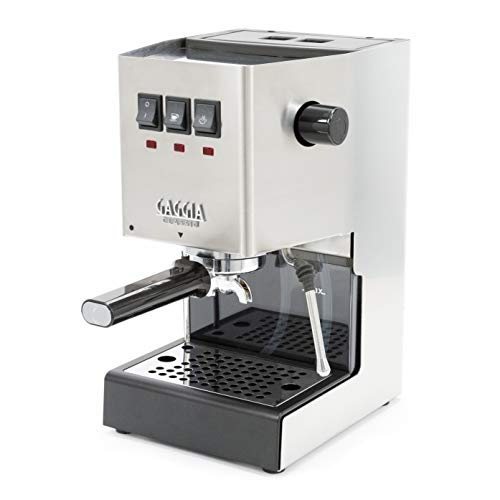
This is a no frills semi automatic with a commercial style portafilter, and that is exactly why I love it for people who want to genuinely learn espresso. There is no grinder built in, so you pair it with your own, but the build is solid metal and the parts are easy to find and rebuild. Once you pair it with a good grinder the shots rival machines that cost much more.
Reasons to buy
- Sturdy metal build that lasts for years
- Commercial 58mm portafilter for real pucks
- Highly repairable with cheap parts
Reasons to avoid
- No grinder included so you must buy one
- Single boiler means waiting between shot and steam

Breville Bambino Plus
I am consistently surprised by how much this tiny machine punches above its size. It heats up in seconds thanks to the thermojet system, and the automatic milk steaming wand froths to a temperature you set, which is genuinely handy for latte drinkers. It has no grinder, so plan for a separate one, but for a compact milk drink machine it is hard to beat.
Reasons to buy
- Heats up in just a few seconds
- Automatic milk frothing with temperature control
- Very small footprint
Reasons to avoid
- No built in grinder
- Small water tank needs frequent refilling

Philips 3200 LatteGo
When someone tells me they just want a button to press, this is where I point them. It is a fully automatic bean to cup machine, so it grinds, doses, brews, and froths milk on its own. The LatteGo milk system rinses easily with no tubes to scrub, which is the part that wins people over. It is energy efficient in standby and the shots are good, though purists will want more control than it offers.
Reasons to buy
- Fully automatic from bean to cup
- LatteGo milk system cleans without tubes
- Low standby energy use
Reasons to avoid
- Less real-world control over the shot
- Plastic build feels less premium than metal machines
What to look for
Machine type
Decide first whether you want a semi automatic that rewards practice or a super automatic that does the work for you. This single choice matters more than any feature, so be honest about how much you want to fiddle each morning.
Grinder included or not
Some machines grind beans for you and some expect a separate grinder. If a machine has no grinder, budget for a good burr grinder too, because a weak grinder will hold back even an excellent machine.
Milk steaming
If you drink lattes or cappuccinos, the steam wand or automatic frother matters as much as the shot. Look for either a powerful manual wand or a reliable automatic system you will actually keep clean.
Heat up and recovery
Thermoblock and thermojet machines warm up in seconds, while traditional boilers take longer but can feel more stable. For a busy morning, fast heat up and quick steam recovery save real time.
Cleaning and energy use
You will descale, empty the drip tray, and rinse the milk path constantly, so easy cleaning prevents long term regret. An energy efficient standby mode also keeps running costs down if you leave it plugged in.
Our verdict
The biggest decision is not which brand to buy but which type, since a semi automatic and a super automatic suit completely different people. Match the machine type to how much effort you actually want to put in each morning, and almost any well built option on this list will serve you well for years.
FAQs
Super automatic machines like the Philips 3200 LatteGo tend to be the most energy efficient because they use a fast thermoblock and drop into a low power standby mode when idle. Among manual machines, thermojet and thermoblock models such as the Breville Bambino Plus use far less energy than traditional always hot boilers, since they only heat water on demand rather than keeping a tank hot all day.
For most home users an electric espresso machine is worth it because the built in pump delivers the consistent nine bar pressure that good espresso needs, which is very hard to hit by hand. Manual lever machines can produce excellent results but demand far more skill and effort, so unless you specifically enjoy that craft, an electric machine gives more reliable shots every morning.
It depends on the model. Machines like the Breville Barista Express and De'Longhi La Specialista Arte have a grinder built in, so you do not need a separate one. Others like the Gaggia Classic Evo Pro and Breville Bambino Plus have no grinder, and pairing them with a quality burr grinder is essential because grind quality affects the shot more than almost anything else.
Most home electric espresso machines draw between 1000 and 1500 watts while actively heating, but that only lasts a short time per shot. Over a day the real cost is small, especially with energy efficient thermoblock models that heat on demand and idle in low power mode. Leaving an older boiler machine on all day uses much more, so switching it off between sessions is the simplest way to save energy.
Update log
- Jun 10, 2026, Refreshed picks and rankings.
- Apr 16, 2026, Initial guide published.
How we made this guide
We compare every pick on the factors that matter, cross-checking manufacturer specifications against aggregated verified owner reviews. We rank independently and never take payment for placement. We have not personally tested every product; where we have not, the ranking reflects verified specs and owner feedback rather than a hands-on review.
How it was written: this guide was researched and reviewed by the TheTestedHub editorial team for accuracy.
Affiliate disclosure: TheTestedHub is reader-supported. When you buy through links on our site, we may earn a commission at no extra cost to you.
Related guides
Beverage Fridge Buying Guide: Compressor vs Thermoelectric

6 Drink Dispensers That Actually Seal Right (2026)

Skip Cheap Whiskers: Get a Real Chasen

Wondering Which Tea Infuser Is Best? Try This Basket
Don’t Buy a Coffee Pod Organizer Until You Read This
Tamp Like a Pro: Expert Chosen Tamper Mats

Coffee Scales for Every Brew, Tested for Daily Use