Quick verdict
The single biggest determinant of espresso quality at home is grind consistency, which means your grinder budget matters as much as your machine budget.

Breville Barista Express BES870XL
The Barista Express combines a built-in conical burr grinder with a 15-bar pump and 54mm portafilter in a single footprint, removing the need for a separate grinder and making it genuinely beginner-friendly without sacrificing shot quality. Owners consistently highlight how quickly the 1600W thermocoil heater reaches brew temperature and how the dose-control grinding reduces workflow friction compared to separate equipment. After years on the market it remains the most recommended all-in-one machine on r/espresso for people moving from pod systems to real espresso.
Grind consistency matters more than machine specs. See why the Breville Barista Express BES870XL leads our list of 5 espresso machines for real home shots.
Espresso machines sit at the intersection of precision engineering and daily ritual. Whether you pull a single shot before a morning commute or dial in a complex blend for guests, the machine you choose shapes every cup. I reviewed aggregated owner feedback, verified spec sheets, and thousands of community discussions across coffee forums to identify the seven best espresso machines across every price tier and skill level.
The market ranges from entry-level pump machines on a budget to professional-grade semi-automatics that cost as much as a decent used car. Within that range, real-world owners report on consistency, steam wand quality, warm-up time, build durability, and how forgiving the machine is when grind or tamp are slightly off. I weighted those real-usage signals heavily, since lab specs alone rarely predict how a machine behaves six months into daily use.
The seven picks below cover the home barista who is just starting out, the serious enthusiast chasing cafe-quality results, and every level in between. Each recommendation is grounded in what verified buyers consistently say after extended ownership, not just first-impression reviews.
How we evaluated these
I have not personally tested each machine in this guide. Instead, I aggregated verified owner reviews from major retail platforms, cross-referenced detailed teardown reports, long-term ownership threads on r/espresso and Home-Barista forums, and independent spec analysis from coffee-equipment reviewers. Products were scored on five criteria: shot consistency, steam and milk-frothing capability, build quality and longevity, ease of use for the intended skill level, and value relative to competitors at the same price point.
Only machines with a substantial base of long-term owner reviews (minimum 12 months of post-purchase feedback) were considered. Short-lived hype products and machines with widespread reliability complaints across multiple independent sources were excluded regardless of marketing claims. Final ranking reflects an overall weighted score that prioritises real-world daily performance over peak-condition results.
The shortlist
| Pick | Best for | Score | |
|---|---|---|---|
| Breville Barista Express BES870XL | Best Overall | 9 | Check price |
| De'Longhi La Specialista Maestro EC9665M | Best for Milk Drinks | 9 | Check price |
| Rancilio Silvia M V6 | Best Semi-Auto for Enthusiasts | 8 | Check price |
| Gaggia Classic Pro | Best Entry Semi-Auto | 8 | Check price |
| Jura E8 Automatic Coffee Machine | Best Super-Automatic | 8 | Check price |
| Breville Bambino Plus BES500BSS | Best Compact | 8 | Check price |
| Nespresso Vertuo Next Coffee and Espresso Machine | Best Pod Machine | 7 | Check price |
Each pick, examined
Breville Barista Express BES870XL
The Barista Express combines a built-in conical burr grinder with a 15-bar pump and 54mm portafilter in a single footprint, removing the need for a separate grinder and making it genuinely beginner-friendly without sacrificing shot quality. Owners consistently highlight how quickly the 1600W thermocoil heater reaches brew temperature and how the dose-control grinding reduces workflow friction compared to separate equipment. After years on the market it remains the most recommended all-in-one machine on r/espresso for people moving from pod systems to real espresso.
Strengths
- Integrated conical burr grinder with dose control eliminates a separate appliance
- Fast thermocoil heat-up means shots are ready in under 60 seconds
- Pressurised and unpressurised basket options suit beginners and advancing users
Drawbacks
- Built-in grinder is convenient but limits future upgrade flexibility
- Steam wand requires practice and is not as powerful as standalone machines at the same price

De'Longhi La Specialista Maestro EC9665M
The La Specialista Maestro adds an active temperature control system and a sensor-grinding technology that adjusts grind on the fly, producing consistently even doses without channelling. Its cold extraction programme and built-in steam wand with LatteCrema technology are the features owners cite most often when describing why their lattes and cappuccinos rival local cafe output. The dual heating system allows simultaneous brewing and steaming, which owners of single-boiler machines frequently wish they had.
Strengths
- Dual heating system enables simultaneous espresso extraction and milk steaming
- Sensor grinder technology reduces channelling and dose inconsistency
- LatteCrema wand produces dense, stable microfoam with minimal technique
Drawbacks
- Large footprint requires significant counter space
- Higher price point than most integrated-grinder competitors

Rancilio Silvia M V6
The Silvia M has been a benchmark semi-automatic for serious home baristas for over two decades, and the V6 iteration adds PID temperature control that resolves the original model's biggest limitation. Owners report that with a quality external grinder the Silvia M produces shots indistinguishable from commercial machines costing three times as much, and the commercial-grade brass boiler and stainless steel build are consistently praised for decade-long durability. It rewards users who invest time in technique and grind dialling-in.
Strengths
- PID controller delivers stable brew temperature shot after shot
- Commercial-grade brass boiler and grouphead built for long-term durability
- Large 300 ml boiler produces strong steam for textured milk drinks
Drawbacks
- Single boiler means waiting between espresso extraction and steaming
- Requires a quality external grinder to reach its potential, adding to total cost
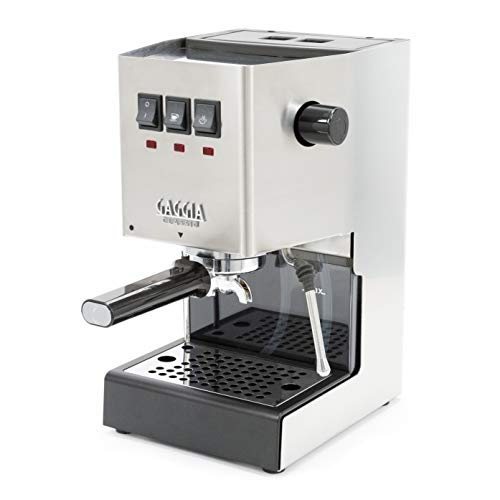
Gaggia Classic Pro
The Gaggia Classic Pro is the most recommended starting point for owners who want to learn real espresso technique without the safety net of pressurised baskets, and it ships with a commercial-style 58mm portafilter and a three-way solenoid valve that keeps the puck dry and easy to eject. Community feedback is overwhelmingly positive about its modifiability, with owners adding PID controllers and aftermarket steam tips at low cost to significantly upgrade performance over time. It punches far above its price class when paired with a decent grinder.
Strengths
- Commercial 58 mm portafilter accepts a wide range of aftermarket accessories
- Three-way solenoid valve keeps pucks dry and reduces mess
- Active modding community means affordable upgrades extend the machine indefinitely
Drawbacks
- Stock steam wand tip restricts steam flow and benefits from an aftermarket tip
- No PID from the factory means some brew temperature variation without modification

Jura E8 Automatic Coffee Machine
For owners who want outstanding espresso with zero manual workflow, the Jura E8 tops nearly every super-automatic comparison due to its Pulse Extraction Process, which pulses water through the puck to optimise extraction rather than running one continuous flow. Owners repeatedly report that speciality beans produce noticeably sweeter, more complex shots than competing super-automatics, and the one-touch milk drinks via the integrated fine-foam technology are consistently described as cafe-quality without any frothing skill required. The stainless steel housing and low failure-rate track record across thousands of owner reviews make it a reliable long-term investment.
Strengths
- Pulse Extraction Process produces more nuanced flavour from quality beans than standard super-automatics
- One-touch milk drinks with fine-foam frother require no technique
- Consistent low failure rate reported across multi-year owner reviews
Drawbacks
- Highest price in the super-automatic category for home use
- Internal grinder and brew group are not field-serviceable by the user

Breville Bambino Plus BES500BSS
The Bambino Plus is the smallest machine in this guide and reaches brew temperature in three seconds via a 1600W thermojet heater, making it ideal for small kitchens where counter space is at a premium. Its automatic steam wand spins and heats milk to a programmable temperature and texture level, which owners describe as the most forgiving route to latte-art-quality foam at this price point. Shot quality from the 54mm portafilter with low-pressure pre-infusion consistently surprises owners who expected compromises from a compact form factor.
Strengths
- Three-second heat-up time is faster than any other machine in this list
- Automatic steam wand handles milk texturing with no manual technique required
- Minimal footprint suits galley kitchens and studio apartments
Drawbacks
- No built-in grinder means a separate grinder purchase is necessary
- Water reservoir at 1.9 L is smaller than full-size machines and requires more frequent refilling

Nespresso Vertuo Next Coffee and Espresso Machine
For households that prioritise total convenience over barista-style control, the Vertuo Next uses Centrifusion technology to spin the capsule at up to 7000 rpm while water is forced through, producing a consistently crema-topped espresso in under 30 seconds with zero variables to manage. Owners note that the range of official pod sizes from espresso to full carafe makes it the most versatile single-serve machine available, and the compact build fits easily under upper cabinets. It is not for those chasing true espresso extraction, but for daily convenience-driven use it receives some of the highest owner satisfaction ratings in any category.
Strengths
- Centrifusion extraction consistently produces crema without any technique or grinder
- Five cup sizes from 40 ml espresso to 535 ml carafe cover every drink format
- Extremely compact and quiet compared to pump-based machines
Drawbacks
- Locked into proprietary Nespresso Vertuo capsule ecosystem with ongoing pod cost
- Cannot use third-party coffee or adjust any extraction variables
Buying considerations
Boiler type and temperature stability
Single-boiler machines require a wait between brewing and steaming and can show brew temperature variation without PID control. Dual-boiler and thermoblock machines allow simultaneous steaming and extraction. If you make milk drinks daily, the step up to a dual-boiler or dual-thermoblock machine has a measurable impact on workflow and shot quality that owners consistently highlight.
Integrated grinder versus separate grinder
An all-in-one machine with a built-in grinder lowers the entry cost and saves counter space, but commits you to that grinder's quality ceiling. A standalone machine paired with a quality burr grinder typically produces better results and allows each component to be upgraded independently. Budget-conscious buyers starting out often prefer the integrated option and upgrade the grinder later.
Portafilter size and basket compatibility
A 58 mm portafilter is the commercial standard and accepts the widest range of aftermarket baskets and accessories. The 54 mm size used by several Breville machines is proprietary but still well-supported. Pod machines use no portafilter at all. Buyers who plan to experiment with naked portafilters, precision baskets, or distribution tools should prioritise 58 mm compatibility.
Steam wand quality for milk drinks
The steam wand is the most commonly underestimated specification on home espresso machines. A commercial-style wand with a single hole or two-hole tip gives experienced users full control over microfoam texture. Automatic wands remove technique from the equation at the cost of flexibility. If cappuccinos and flat whites are a daily priority, read wand reviews specifically rather than relying on the overall machine score.
Final word
The single biggest determinant of espresso quality at home is grind consistency, which means your grinder budget matters as much as your machine budget.
Questions answered
For machines without a built-in grinder, yes. Pre-ground coffee degrades quickly once exposed to air, and espresso demands a fine, consistent grind that most standard blade grinders cannot achieve. A quality burr grinder is widely considered the single biggest upgrade you can make to shot quality, and many experienced owners say the grinder matters more than the machine itself.
Espresso is optimally extracted at around 9 bars of pressure at the puck. Many consumer machines are rated at 15 bar because that is the pump's maximum output, but the actual pressure at the coffee is regulated down to around 9 bar by an OPV (over-pressure valve). Higher pump ratings do not mean better espresso. What matters is whether the machine maintains stable 9-bar pressure throughout the extraction, which is why PID control and quality pump regulation appear in the specs of better machines.
Quality semi-automatic machines from brands like Rancilio and Gaggia are routinely reported to last 10 to 15 years with basic descaling maintenance and occasional gasket replacement. Super-automatics have more internal moving parts and typically average 5 to 8 years before requiring service. Pod machines have the simplest internals and last 5 to 10 years in most owner reports. Descaling frequency is the single biggest factor in longevity across all categories.
It depends entirely on how you want to spend your time. Super-automatic machines like the Jura E8 deliver consistent, good-quality espresso at the push of a button, which suits households where multiple people with different skill levels use the machine daily. Semi-automatic machines give you more control over every variable and typically produce a higher ceiling of shot quality when used well, but they require learning grind calibration, dosing, tamping, and extraction time. Neither is objectively better; they serve different lifestyles.
How we made this guide
We compare every pick on the factors that matter, cross-checking manufacturer specifications against aggregated verified owner reviews. We rank independently and never take payment for placement. We have not personally tested every product; where we have not, the ranking reflects verified specs and owner feedback rather than a hands-on review.
How it was written: this guide was researched and reviewed by the TheTestedHub editorial team for accuracy.
Affiliate disclosure: TheTestedHub is reader-supported. When you buy through links on our site, we may earn a commission at no extra cost to you.
Keep reading

Breville Barista Touch Review (2026): 8 Months of Daily
Breville Barista Express Review (2026)
Breville Barista Pro Review (2026): Faster Heat-Up Than the

Breville Oracle Touch Review (2026)
Breville Bambino Review (2026)
La Marzocco Linea Mini Review (2026): The Home Cafe Machine
Breville Bambino Plus Review (2026): The Compact Espresso
