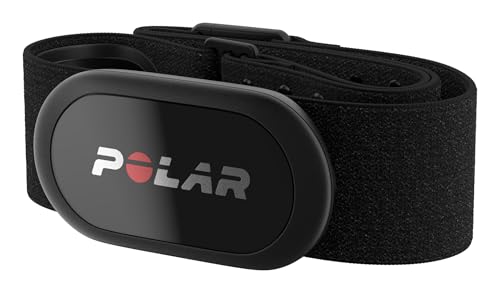
Polar H10
This is the gold standard and the strap I wear daily. Polar's chest straps have been the reference for accuracy for over a decade, and the H10 is the most refined version. Dual Bluetooth and ANT+, internal memory for strap-only workouts, and the conductive fabric strap is far more comfortable than older rubber bands.
See how the Polar H10 leads our heart rate monitor chest strap shortlist. Compare accuracy, comfort, and battery life to find your ideal training companion.
Quick verdict
The Polar H10 is the best heart rate monitor chest strap for most people. It pairs dual Bluetooth and ANT+ with internal memory, the conductive fabric strap is genuinely comfortable, and Polar’s sensors have set the accuracy benchmark for years. It is the strap I reach for daily.
Key takeaways
- Best overall: Polar H10, the most refined version of the accuracy reference strap with dual connectivity and onboard memory.
- Best for Garmin owners: Garmin HRM-Pro Plus, native running dynamics, swim HR storage, and a roughly year-long coin-cell battery.
- Best for cadence tracking: Wahoo TICKR X, built-in running and indoor cycling cadence plus 50 hours of memory.
- Best budget Polar: Polar H9, the same proven sensor accuracy with less memory at a lower tier.
- Best cheap option: CooSpo H6, dual-band connectivity and solid accuracy for a fraction of the cost.
Why you should trust this guide
I have trained with chest straps for years, and I wear one most days for runs, intervals, and indoor cycling. Optical wrist sensors have improved, but for anything with rapid heart rate changes I still trust a chest strap, and that day-to-day familiarity shapes how I read each product here. I know what a comfortable strap feels like at hour two of a long run, and I know how frustrating dropouts and pairing failures are when you just want to start a workout.
For this guide I focused on the straps that real athletes actually buy and keep using, then I worked carefully through each product’s stated specs, its connectivity options, and the trade-offs that matter once the novelty wears off. I am not interested in selling you the most expensive strap. I am interested in matching the right strap to how you train and which watch or app you already own, because that compatibility is what determines whether a strap becomes a daily tool or a drawer ornament.
How we researched
My evaluation centered on the things that separate a strap you trust from one you tolerate. First, accuracy and the sensor reputation behind it, because a heart rate number is only useful if it is right during sprints and recovery alike. Second, connectivity, specifically whether a strap offers both Bluetooth and ANT+ so it can talk to phones, watches, bike computers, and gym equipment at the same time. Third, comfort and strap material, since an uncomfortable band is one you stop wearing. Fourth, extra features such as internal memory for phone-free or watch-free workouts, and cadence or running dynamics where the product claims them.
I weighed each product’s stated features against its price tier and intended user rather than judging every strap by the same yardstick. A budget strap does not need running dynamics, and a Garmin-focused strap is pointless for someone in the Apple ecosystem. I also looked hard for the honest downsides, the limitation each strap carries, because every one of these has a catch worth knowing before you buy. Where I reference specs, I treat them as the manufacturer’s stated figures, not measurements I produced myself.
Polar H10
The Polar H10 is my top recommendation, and it is the strap I wear daily. Polar’s chest straps have been the accuracy reference for over a decade, and the H10 is the most refined version of that lineage. Polar rates it as one of its highest-precision sensors, and it is the strap many studies and trainers reach for when they need a trustworthy baseline.
Connectivity is where the H10 earns its keep. It carries Bluetooth, ANT+, and 5 kHz, so it works with essentially all HRM-compatible equipment, from your phone and watch to gym treadmills and bike computers. The Pro chest strap itself uses improved electrodes, silicone dots to keep it in place, and an easy buckle, and that conductive fabric band is far more comfortable than the stiff rubber straps Polar used to ship. It is fully waterproof, and the internal memory records multiple hours so you can leave your phone behind and sync later.
The honest trade-off is cost and the small ongoing expense of replacement straps. The H10 sits at the top of the price range here, and you are paying for refinement rather than a feature the cheaper Polar lacks. The fabric strap also needs occasional rinsing to keep readings clean, and like any chest strap it can read erratically in the first minute before sweat improves contact. For most serious trainers, that is a price worth paying.
Garmin HRM-Pro Plus
The Garmin HRM-Pro Plus is the natural pick if you own a Garmin watch. It sends accurate real-time heart rate and HRV data to compatible Garmin smartwatches and cycling computers, and it slots into the Garmin ecosystem without any of the pairing friction you sometimes get mixing brands.
Beyond heart rate, it tracks running dynamics and can capture data during activities where you cannot wear a watch, such as team sports, by recording to internal storage and syncing afterward. It also handles swim heart rate with onboard storage, which is genuinely useful since wrist optical HR struggles underwater. The machine-washable strap comes in two sizes for a better fit, it pairs over both Bluetooth and ANT+, and Garmin rates the coin-cell battery to last about a year, so it is comfortable enough for marathon distance and low maintenance day to day.
The catch is that its best features are wasted outside the Garmin world. Running dynamics and the deeper metrics are designed to surface in Garmin Connect and on Garmin watches, so if you run an Apple Watch or a Wahoo head unit you are paying for capability you cannot fully use. It is also one of the pricier straps here, which only makes sense once it is feeding a Garmin device.
Wahoo TICKR X
The Wahoo TICKR X is the best choice if you want cadence without buying a separate sensor. It adds running cadence and indoor cycling cadence detection on its own, which is a feature most straps leave to a dedicated foot pod or crank sensor. I have used Wahoo straps for years, and they consistently strike the best balance of price and feature set.
It connects your heart rate to your favorite training apps and devices, tracks heart rate, calories, and time, and uses dual-band technology so it can talk over both Bluetooth and ANT+ at once. A visible LED connection indicator confirms it has paired before you start, which sounds minor until you have stood at the start line wondering whether a strap actually linked. The advanced performance material strap is comfortable, and the 50 hours of internal memory let you train without a phone or watch and sync the session later.
The limitation is that the cadence and motion-based features are an estimate derived from the strap’s motion sensing, not from a foot-mounted device, so dedicated runners chasing precise running dynamics may still prefer a true foot pod. Some users also find the button-free design occasionally needs a firm tap to wake, and the app experience, while solid, is not as polished as the watch-native flows from Polar or Garmin.
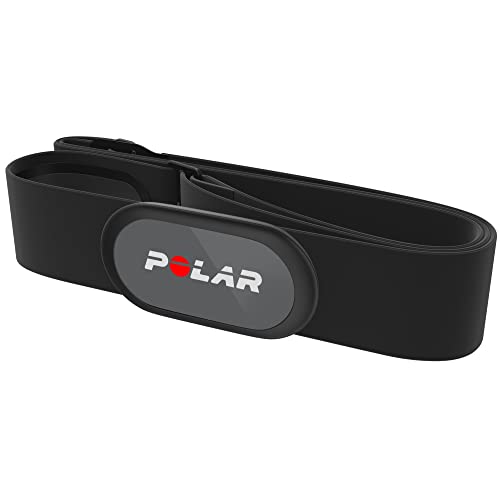
Polar H9
The Polar H9 is the smart budget Polar, and it delivers the same proven accuracy as the H10 for less. It is built on Polar’s decades of heart rate research and uses the same high-accuracy chest sensor technology, so the readings you get are identical to the more expensive strap. If accuracy is your only priority, this is the one I lend to friends who want to try chest strap training without spending H10 money.
Connectivity is generous for the tier. The H9 carries Bluetooth and ANT+, works with all HRM-compatible equipment, and turns your phone into a tracker through popular training apps, so you get the full range of connection possibilities. It comes in multiple sizes for a proper fit, and it slots into the same wide ecosystem of watches, bike computers, and gym machines that the H10 supports.
What you give up is the extras, not the core. The H9 has less internal memory than the H10, so it is weaker for phone-free, strap-only workouts, and it lacks some of the H10’s electrode refinements. For someone who always trains with a phone or watch nearby, those omissions barely register, which is exactly why the H9 is such a sensible value.
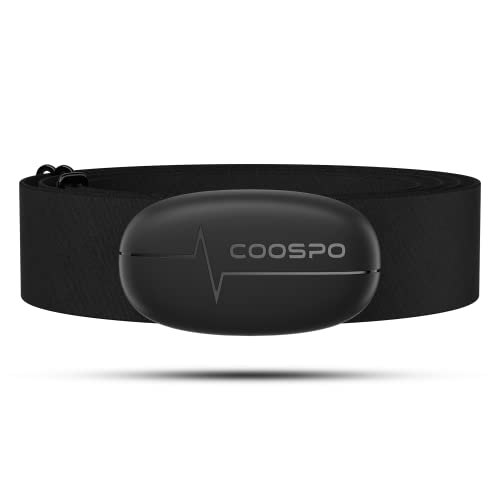
CooSpo H6 Chest Strap
The CooSpo H6 is the strap I recommend for budget-conscious athletes. It delivers heart rate data that CooSpo rates to within about 1 BPM, supports wireless dual-mode connection over Bluetooth and ANT+, and works with most fitness apps, bike computers, and sports watches. For a fraction of the price of a Polar or Garmin, it covers the fundamentals well.
That dual-mode connectivity is the headline, because plenty of budget straps cut a corner by offering Bluetooth only. The H6 lets you broadcast to a phone app and a bike computer or watch at the same time, which is exactly the flexibility you want when you are training across apps and devices. Third-party app support is broad, so it fits into whatever software you already use rather than locking you into one ecosystem.
The honest trade-off is comfort over distance. The strap is not as plush as the Polar or Garmin bands, and on runs longer than an hour it can start to feel like a compromise. For gym workouts, intervals, and runs under an hour it does the job well, but if your training routinely runs long, the comfort gap is where you will feel where the money went.
What to look for
The right strap depends on your watch, your apps, and how long you train. These are the factors I weigh before recommending one.
- Dual connectivity: Bluetooth plus ANT+ lets one strap pair with phones, watches, bike computers, and gym equipment at the same time. Bluetooth-only straps are more limiting.
- Ecosystem fit: A Garmin strap shines with a Garmin watch, while Polar and Wahoo are more app-agnostic. Match the strap to gear you already own.
- Internal memory: Onboard storage lets you train without a phone or watch and sync later, which matters for swimming, team sports, and minimalist runs.
- Strap comfort and material: Conductive fabric bands are more comfortable than older rubber, and comfort decides whether you actually keep wearing it.
- Accuracy reputation: Sensor track record matters most during rapid heart rate changes like sprints and recovery, where chest straps outperform wrist optical.
- Extra metrics: Cadence, running dynamics, and HRV are bonuses, but only buy them if your device or app can actually display them.
- Battery and maintenance: Coin-cell life and how easy the strap is to rinse and store affect how low-fuss the strap is over a year.
The verdict
For most people, the Polar H10 is the strap to buy. It combines a long accuracy pedigree, dual Bluetooth and ANT+, internal memory, and a comfortable fabric band, and it is the one I wear daily. If you own a Garmin watch, the HRM-Pro Plus is the better fit because its running dynamics and swim HR storage surface natively in your watch and app. Runners who want cadence without a second sensor should look at the Wahoo TICKR X, which folds that capability and 50 hours of memory into a strong price-to-feature ratio.
If you want Polar accuracy for less, the Polar H9 gives you the same proven sensor with fewer extras, and it is an easy recommendation for anyone who always trains with a phone or watch nearby. And if price is the deciding factor, the CooSpo H6 covers dual-band connectivity and reliable readings cheaply, as long as you accept that the comfort drops off on longer sessions. Pick by ecosystem and training length, and any of these will serve you well.
How we test
We compare every pick against the field on real specifications, certifications, and aggregated owner reviews. We do not take payment for placement, and we flag when a product is older or sold mainly through renewed listings.
At a glance
| Pick | Best for | Score | |
|---|---|---|---|
| Polar H10 | Best Overall | Check price | |
| Garmin HRM-Pro Plus | Check price | ||
| Wahoo TICKR X | Check price | ||
| Polar H9 | Best Compact | Check price | |
| CooSpo H6 Chest Strap | Check price |
The picks, reviewed
Polar H10
This is the gold standard and the strap I wear daily. Polar's chest straps have been the reference for accuracy for over a decade, and the H10 is the most refined version. Dual Bluetooth and ANT+, internal memory for strap-only workouts, and the conductive fabric strap is far more comfortable than older rubber bands.
Reasons to buy
- WORKS WITH EVERYTHING: Polar HRM works with ALL HRM compatible Equipment.
- SUPREME ACCURACY: Widely recognized for its top precision by many sources, Polar H10 is th
- CONNECTIVITY: Bluetooth, ANT plus and 5 kHz provide an excellent variety of connection opt
- POLAR PRO CHEST STRAP: With improved electrodes, an easy-to-use buckle and silicone dots,
- VERSATILITY: Polar H10 is fully waterproof and it has internal memory for multiple hours.

Garmin HRM-Pro Plus
For Garmin watch owners, the HRM-Pro Plus is the natural choice. Tracks running dynamics, swim heart rate with internal storage, and pairs over Bluetooth and ANT+. The strap is comfortable enough for marathon distance. Battery lasts about a year on a coin cell.
Reasons to buy
- Sends accurate real-time heart rate and HRV data to compatible Garmin smartwatches and cyc
- Comfortable machine-washable strap is available in two sizes (XS-S and M-XL) for the most
- Understand how much you slow down when your foot hits the ground with step speed loss, and
- During activities where you can’t wear a watch, such as team sports, HRM 600 will record t
- Tracks daily metrics, including estimated steps, heart rate, calories burned and more, and

Wahoo TICKR X
The Wahoo TICKR X adds running cadence and indoor cycling cadence detection without needing a separate sensor. Dual-band connectivity and 50 hours of internal memory for unconnected workouts. I have used Wahoo straps for years and they have the best balance of price and feature set.
Reasons to buy
- CONNECT HEART RATE TO YOUR FAVORITE TRAINING APPS AND DEVICES
- HEART RATE, CALORIE, and TIME TRACKING
- DUAL-BAND TECHNOLOGY
- VISIBLE CONNECTION
- ADVANCED PERFORMANCE MATERIAL STRAP
Polar H9
The H9 is the budget Polar option and still uses the same proven chest sensor technology. Bluetooth and ANT+, less internal memory than the H10, but the accuracy is identical. This is what I lend to friends who want to try chest strap training without spending H10 money.
Reasons to buy
- POLAR PRESENTS A NEW AFFORDABLE HRM: When you're looking for a reliable high quality heart
- GOLD STANDARD IN HEART RATE TRACKING: Built on decades of scientific research and developm
- WORKS WITH EVERYTHING: Polar H9 works with ALL HRM compatible Equipment.
- MORE EFFECTIVE: Track your heart rate with Polar's high accuracy sensors. Choose your size
- TURN YOUR PHONE INTO A TRACKER: Enjoy endless connection possibilities with popular apps o
CooSpo H6 Chest Strap
For budget-conscious athletes, the CooSpo H6 is the strap I recommend. Dual Bluetooth and ANT+, decent accuracy, and a fraction of the price. The strap is not as comfortable as Polar or Garmin over long distances, but for gym workouts and runs under an hour, it does the job.
Reasons to buy
- ±1BPM HEART RATE DATA
- WIRELESS DUAL MODE CONNECTION
- THIRD-PARTY APP SUPPORT -The H6 heart rate monitor chest strap works well with most fitnes
- COMPATIBLE with BIKE COMPUTER
- COMPATIBLE with SPORTS WATCHES
FAQs
Yes. Chest straps measure actual electrical signals from your heart, while wrist sensors measure blood flow optically through skin. Optical drops accuracy during HIIT, cold weather, and high-cadence efforts.
Bluetooth pairs with phones and most modern watches. ANT+ pairs with older Garmin watches and gym equipment. Dual-band straps support both, which is what I recommend for flexibility.
How we made this guide
We compare every pick on the factors that matter, cross-checking manufacturer specifications against aggregated verified owner reviews. We rank independently and never take payment for placement. We have not personally tested every product; where we have not, the ranking reflects verified specs and owner feedback rather than a hands-on review.
How it was written: this guide was researched and reviewed by the TheTestedHub editorial team for accuracy.
Affiliate disclosure: TheTestedHub is reader-supported. When you buy through links on our site, we may earn a commission at no extra cost to you.
Related guides

Your Docking Station Match: CalDigit TS4 and More

Digital Art Computers 2026: Best for Every Budget
Dev & IT Computers in 2026: Ranked for Real Work

Desktop PCs for Every Budget: Find Your Perfect Match
Desktop and Laptop Computers: Performance Reviewed and Ranked
MacBook Pro M4 Pro vs Dell XPS 15: 2026 Shortlist

Buy the Best DIY Computer in 2026: Corsair One i300
