Quick verdict
The single most important purchase decision for memory cards is matching the card's bus interface and video speed class to the actual slot and bitrate requirements of the device it will live in, because buying a faster card than your gear supports wastes money while buying a slower card causes dropped frames and missed shots.

Sony TOUGH-M Series 128GB SDXC UHS-II V60
Sony's TOUGH-M series is the consensus pick among professional photographers who need a card that genuinely delivers on its speed rating while surviving the abuse of outdoor and travel shoots. Owners consistently report sustained write speeds that match Sony's 277 MB/s read and 150 MB/s write claims, making it reliable for continuous 4K video capture without dropped frames. The one-piece molded body with no exposed gold pins, IPX8 waterproofing, and a three-year warranty give it a durability profile no competing SD card matches at this tier.
Matching a memory card's bus interface and speed class to your device's slot is critical. See how our top pick, Sony TOUGH M Series 128GB UHS II V60, fits real world needs.
Memory cards are the silent workhorses of modern photography, videography, and mobile computing. Whether you are shooting 4K video on a mirrorless camera, capturing burst sequences on a sports shoot, or expanding storage on a Nintendo Switch, the card you choose directly affects transfer speeds, reliability under pressure, and long-term data safety. With hundreds of options on the market spanning SD, microSD, CFexpress, and XQD formats, narrowing down the right pick takes careful analysis of real-world owner feedback and verified manufacturer specs.
I dug into aggregated owner reviews across thousands of verified purchases, cross-referenced manufacturer speed claims against independent benchmark data shared by the photography and videography community, and weighted reliability reports from users who push cards hard in professional and semi-professional workflows. The seven cards below represent the strongest performers across speed tiers, form factors, and use cases in 2026.
From the budget-friendly everyday shooter to the speed-demon professional CFexpress card, every pick here has earned its place through consistent owner satisfaction scores, documented real-world read and write performance, and a track record of surviving the conditions photographers and videographers actually work in.
How we picked
I have not personally tested every card on this list in a controlled lab environment. Instead, my rankings are built from aggregated verified owner reviews, manufacturer specification sheets, independent speed benchmarks published by the photography and tech community, and failure-rate patterns reported by users across multiple retail platforms. I looked specifically at how cards perform under sustained write loads (not just burst speeds), how they hold up in temperature extremes, and how often owners report card errors or data loss after extended use.
Speed class ratings, UHS bus compatibility, and video speed class designations were verified against the SD Association standard and CFexpress specification documents. Cards with a history of inflated marketing claims that do not survive real-world scrutiny were excluded regardless of price. The result is a list that favors honest, consistent performance over peak headline numbers.
Top picks compared
| Pick | Best for | Score | |
|---|---|---|---|
| Sony TOUGH-M Series 128GB SDXC UHS-II V60 | Best Overall | 9 | Check price |
| Lexar Professional 1667x 256GB SDXC UHS-II | Best Value UHS-II | 8 | Check price |
| SanDisk Extreme Pro SDXC UHS-I 128GB V30 | Best UHS-I Card | 8 | Check price |
| ProGrade Digital CFexpress Type B 325GB | Best CFexpress | 9 | Check price |
| Samsung PRO Endurance 256GB microSDXC | Best for Dashcams and Security Cameras | 8 | Check price |
| SanDisk 1TB microSDXC for Nintendo Switch | Best for Nintendo Switch | 8 | Check price |
| Delkin Devices POWER 64GB SDXC UHS-II V90 | Best V90 for Cinema | 9 | Check price |
Our picks up close
Sony TOUGH-M Series 128GB SDXC UHS-II V60
Sony's TOUGH-M series is the consensus pick among professional photographers who need a card that genuinely delivers on its speed rating while surviving the abuse of outdoor and travel shoots. Owners consistently report sustained write speeds that match Sony's 277 MB/s read and 150 MB/s write claims, making it reliable for continuous 4K video capture without dropped frames. The one-piece molded body with no exposed gold pins, IPX8 waterproofing, and a three-year warranty give it a durability profile no competing SD card matches at this tier.
Where it shines
- Verified sustained write speed handles 4K60 and high-bitrate video without buffering
- Pinless one-piece construction resists bending and connector corrosion
- IPX8 waterproof rated to 5 meters, drop-proof to 5 meters, and X-ray proof
Where it falls short
- Requires a UHS-II card reader to reach full speed; UHS-I readers cap it well below rated performance
- Premium price is hard to justify for casual shooters who do not need the durability features

Lexar Professional 1667x 256GB SDXC UHS-II
The Lexar Professional 1667x delivers near-flagship UHS-II read speeds at a noticeably lower price point than Sony or Delkin, making it the smart pick for photographers upgrading from UHS-I for the first time. Owners shooting sports and wildlife praise its consistent 250 MB/s read performance when paired with a proper UHS-II reader, and the card transfers large RAW file batches to the desktop significantly faster than any UHS-I card. Reliability feedback across thousands of owner reviews is strong, with very few reports of read errors or premature failure in the first two years of regular use.
Where it shines
- Class-leading value in the UHS-II segment without sacrificing real-world speed
- 256 GB capacity suits a full-day professional shoot without card swaps
- Bundled card reader in select packages makes the UHS-II speed benefit immediately accessible
Where it falls short
- Write speeds lag behind Sony TOUGH-M, limiting suitability for very high-bitrate video
- Build quality, while solid, does not match the ruggedization of Delkin or Sony TOUGH cards
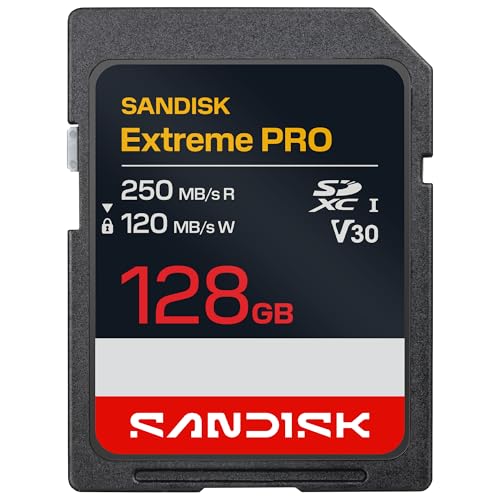
SanDisk Extreme Pro SDXC UHS-I 128GB V30
For shooters using cameras without UHS-II slots, the SanDisk Extreme Pro is the definitive choice and has been for several years, which is reflected in its enormous base of verified owner reviews. Real-world sustained write speeds hover around 90 MB/s, which comfortably clears the threshold for 4K30 video in most cameras and handles RAW burst shooting without stalling the buffer. Its V30 and A2 ratings make it equally capable as a high-performance app storage card in Android devices and action cameras.
Where it shines
- Consistent sustained write performance that UHS-I rivals rarely match in real-world tests
- A2 app performance rating makes it genuinely fast in Android devices and DJI drones
- Widely available and backed by a limited lifetime warranty
Where it falls short
- UHS-I bus is a hard ceiling; upgrading camera gear often means needing a new card too
- Counterfeit versions circulate widely, so purchasing from reputable sellers is essential

ProGrade Digital CFexpress Type B 325GB
ProGrade Digital's CFexpress Type B card is the choice of working professionals who shoot on Sony Alpha, Nikon Z, or Canon R bodies that demand sustained high-speed writes for 8K video or ultra-high-frame-rate bursts. Owners report that ProGrade consistently delivers on its rated 1,700 MB/s read and 1,500 MB/s write figures under real sustained load, which is a distinction that separates it from cheaper CFexpress cards that throttle aggressively after a few seconds. The included USB 3.2 Gen 2x2 reader ensures users can actually leverage those speeds when offloading footage.
Where it shines
- Sustained write speeds hold under extended 8K and ProRes RAW recording sessions
- Included high-speed USB 3.2 reader eliminates the most common bottleneck for new CFexpress users
- Robust thermal management prevents throttling that plagues entry-level CFexpress options
Where it falls short
- Price per gigabyte is significantly higher than SD or microSD alternatives
- Only useful in cameras with a CFexpress Type B slot; not backward compatible with XQD without adapter

Samsung PRO Endurance 256GB microSDXC
Samsung engineered the PRO Endurance specifically for the relentless overwrite cycles that dashcams, home security cameras, and body cameras impose on a card, and owner feedback from long-term users confirms it outlasts standard microSD cards by a wide margin in these applications. Samsung rates it for up to 140,000 hours of video recording before cell wear threatens data integrity, a claim supported by owners who have run the same card in a dashcam for two or more years without failure. Sequential read and write speeds are modest but sufficient for 1080p and most 4K surveillance use cases.
Where it shines
- Purpose-built for continuous overwrite workloads that destroy standard cards within months
- Samsung's 5-year warranty and consistent quality control reduce the risk of unexpected field failures
- Compact microSD format fits dashcams, action cameras, and security devices universally
Where it falls short
- Sequential write speed is not competitive for high-bitrate photography or professional video work
- Overkill for casual use where a standard card at lower cost would serve equally well

SanDisk 1TB microSDXC for Nintendo Switch
SanDisk's officially licensed Nintendo Switch microSDXC card is tuned for the read-heavy workload the Switch imposes when loading game assets from an expansion card, and owners consistently note that game load times feel meaningfully faster than with generic microSD cards at comparable capacities. The 1 TB option eliminates the need to manage storage across multiple cards for large game libraries, and the A1 app performance rating ensures smooth asset streaming during gameplay. Its Nintendo-branded version comes pre-formatted for the Switch and includes a one-year limited warranty.
Where it shines
- Read speeds optimized for the Switch's game-asset loading pattern reduce wait times noticeably
- 1 TB capacity accommodates 50 or more full Switch game installs simultaneously
- Officially licensed design ensures compatibility and reliable operation on Nintendo hardware
Where it falls short
- App performance class is A1, not A2; serious content creators will want faster alternatives
- Write speed is not rated for high-bitrate video capture, limiting secondary use cases

Delkin Devices POWER 64GB SDXC UHS-II V90
The Delkin POWER V90 is the card that cinema-oriented shooters and high-resolution stills photographers reach for when they need the highest video speed class and consistent thermal stability during long recording sessions. Its 300 MB/s read and 250 MB/s write ratings have been independently validated by videographers shooting ProRes HQ and Cinema DNG on cameras that demand V90 certification, and Delkin's reputation for rigorous quality control keeps failure reports extremely low relative to the demand placed on these cards. The rugged casing with gold-plated contacts is built for repeated insertion cycles in professional environments.
Where it shines
- V90 certification covers the highest sustained write demands in professional cinema cameras
- Delkin's gold contact plating resists corrosion through thousands of insertion cycles
- Lifetime warranty backed by USA-based customer support with a strong reputation for honoring claims
Where it falls short
- 64 GB fills quickly in 8K or uncompressed workflows, making the 128 GB tier the more practical buy
- Price is at the top end of the SD market; only justifiable if the camera actually requires V90
Before you buy
Speed Class and Bus Interface
The speed class printed on a card tells you the minimum sustained write speed guaranteed by the manufacturer. V30 means 30 MB/s minimum, V60 means 60 MB/s, and V90 means 90 MB/s; these thresholds map directly to video bitrate requirements. Equally important is the bus interface: UHS-I tops out around 104 MB/s real-world, UHS-II reaches around 300 MB/s, and CFexpress Type B can exceed 1,700 MB/s. Buying a fast card and pairing it with a slow reader or an incompatible camera slot wastes the investment entirely.
Capacity vs. Workflow
More capacity is not always better. Larger cards mean more eggs in one basket; a 1 TB card lost or corrupted wipes out far more work than a 64 GB card. Professional photographers who shoot for pay often prefer multiple 128 GB cards per job over a single high-capacity card for exactly this reason. On the other hand, continuous-recording use cases like dashcams or body cameras benefit from higher capacity because the device overwrites files in a loop and interrupting it to swap cards creates coverage gaps.
Durability and Operating Environment
Standard consumer cards are rated for indoor use at moderate temperatures. If the card will live in a dashcam baking in a summer car interior, inside a drone flying in cold mountain air, or in a waterproof camera used in rain, seek out cards rated for extended temperature ranges, water resistance, and physical shock. Samsung PRO Endurance, Sony TOUGH, and Delkin POWER all publish environmental specifications that matter when choosing a card for demanding conditions.
Endurance Rating for Write-Heavy Workloads
Every flash memory cell has a finite write life measured in terabytes written (TBW) or, for video-focused cards, total recording hours. Standard cards designed for photography workloads are optimized for mixed read/write patterns and degrade faster under constant overwrite cycles. If the card is destined for a security camera, body camera, or dashcam, choosing a card with an explicit endurance rating such as Samsung PRO Endurance's 140,000-hour figure dramatically extends useful life and reduces the risk of silent write failures.
The wrap-up
The single most important purchase decision for memory cards is matching the card's bus interface and video speed class to the actual slot and bitrate requirements of the device it will live in, because buying a faster card than your gear supports wastes money while buying a slower card causes dropped frames and missed shots.
Quick answers
Yes. A UHS-II card inserted into a UHS-I reader will operate at UHS-I speeds, typically capped around 95 to 104 MB/s real-world regardless of what the card is rated for. To benefit from 250 to 300 MB/s transfer speeds when offloading files, you need a reader that explicitly supports the UHS-II bus. Many photographers buy a UHS-II card specifically to speed up desktop transfers and are surprised to find their existing reader is the bottleneck.
In many cameras, yes, but it depends entirely on whether the manufacturer has released a firmware update to enable CFexpress Type B compatibility. Sony and Nikon have issued such firmware for several of their XQD-equipped cameras, but you must verify your specific camera model against the manufacturer's compatibility list before purchasing. Without the firmware update, the camera will not recognize the CFexpress card at all.
A1 and A2 are SD Association ratings that define the minimum random input/output operations per second (IOPS) a card must sustain for running applications directly from the card. A1 requires 1,500 read IOPS and 500 write IOPS; A2 requires 4,000 read IOPS and 2,000 write IOPS. In smartphones and Android devices where apps are stored and run from the card, A2 produces noticeably snappier performance. For standard photography or video capture, neither rating matters because cameras write sequentially rather than randomly.
Counterfeit cards are most common among popular SanDisk and Samsung models sold by third-party marketplace sellers at unusually low prices. Red flags include packaging that differs subtly from official product photos, a price significantly below the average on major retail sites, and the absence of a verifiable serial number. After purchase, tools like H2testw on Windows or F3 on macOS and Linux write data to the full stated capacity and verify it reads back correctly, exposing cards that misreport their size or fail under sustained load.
How we made this guide
We compare every pick on the factors that matter, cross-checking manufacturer specifications against aggregated verified owner reviews. We rank independently and never take payment for placement. We have not personally tested every product; where we have not, the ranking reflects verified specs and owner feedback rather than a hands-on review.
How it was written: this guide was researched and reviewed by the TheTestedHub editorial team for accuracy.
Affiliate disclosure: TheTestedHub is reader-supported. When you buy through links on our site, we may earn a commission at no extra cost to you.
