Quick verdict
The best OLED for you depends on your room's lighting and primary use. For most people, the LG C6 offers the best value, while the LG G6 is top-tier. Sony excels for movies, Samsung for bright rooms, and Panasonic for accuracy.

LG G6 OLED
The LG G6 sets a new standard with its brighter MLA panel and perfect blacks. Colors are incredibly vivid, and the Gallery Design looks stunning on a wall. It's the best all-around OLED for movies and gaming.
Find the best OLED TV for your room and budget, from LG's value-packed C6 to the top-tier LG G6. Expert picks for movies, bright rooms, and color accuracy.
Quick verdict
The LG G6 OLED is the best all-around pick. Its brighter MLA panel and Alpha 9 Gen8 processor pair perfect blacks with vivid color, and the Gallery Design sits flush on a wall. It handles movies and gaming equally well, which is why I rank it first overall here.
Key takeaways
- Best overall: LG G6 OLED, brighter MLA panel with perfect blacks and strong gaming features.
- Best for film purists: Sony A95L OLED, the Cognitive Processor XR delivers the most natural picture and excellent upscaling.
- Best for bright rooms: Samsung S95D OLED, anti-glare matte coating fights reflections without crushing contrast.
- Best value: LG C6 OLED, near-G6 performance and 165Hz gaming at a lower tier.
- Best for color-critical work: Panasonic MZ2000 OLED, Master OLED Pro panel is accurate out of the box.
Why you should trust this guide
I research OLED TVs the way a careful buyer would, by reading each manufacturer’s stated specifications closely and comparing them against what the panel technology can realistically deliver. For this guide I looked at five flagship and near-flagship OLEDs from LG, Sony, Samsung, and Panasonic, and I focused on the features that actually change how a TV looks in your living room: panel type, processor, brightness handling, glare control, and gaming support. I treat each listed feature as the product’s stated spec rather than a number I measured myself.
I also try to be honest about trade-offs. No OLED is perfect for every room or every budget, and the differences between these five come down to priorities more than to one being broadly better than the rest. Where a TV makes a compromise, whether that is glossy glare on a bright wall or a thin smart-platform description, I call it out so you can weigh it against your own setup. My goal is to help you match a panel to your space, not to crown a single winner for everyone.
How we researched
My approach here is research-led. I gathered the official feature descriptions for each model, grouped them by category, and judged each TV against the criteria that matter most for OLED: black-level performance, peak brightness and how the set handles bright rooms, color accuracy and volume, motion and refresh rate for gaming, processing and upscaling quality, and design or smart-platform considerations. I weighted picture quality most heavily, since that is the reason most people buy an OLED in the first place.
For each product I expanded on the editor note and the stated Amazon features, then looked for the honest limitation that a spec sheet tends to hide. I did not run a lab bench or take my own measurements, so I avoid inventing numbers. Where two sets are close, I separate them by use-case (movies, gaming, bright-room daytime viewing, or color-critical work) rather than declaring one universally superior. That way the ranking reflects how you would actually live with the TV.
LG G6 OLED
The LG G6 is my pick for the best all-around OLED, and it earns that with its brighter MLA panel and the Alpha 9 AI Processor Gen8 driving the picture. LG lists Brightness Booster technology that magnifies each individual pixel, which is what lets this generation of OLED push more punch into highlights while still holding onto the perfect blacks that come from 8.3 million self-lit pixels. After 12 years of refining OLED, LG has the processing maturity to make colors look vivid without looking artificial, and that balance is exactly what you want for both films and games.
The Gallery Design is the other reason this set stands out. It is built to sit flush against a wall, so if you wall-mount it the G6 looks more like framed art than a TV bolted to a bracket. LG also notes the panel is verified by UL for Discomfort Glare Free (UGR less than 22), so it stays watchable in a brighter room better than older OLEDs did. For gaming, the strong processor and OLED response keep motion clean and input feeling immediate.
The honest trade-off is the Gallery Design itself. A flush wall-mount look is gorgeous, but it assumes you actually mount the TV, and the slim profile leaves less room for a chunky stand or generous connector clearance than a thicker set would. If you plan to place it on furniture rather than a wall, you give up part of what makes the G6 special, and as LG’s flagship it sits at the top of the price tier. Buy it for the panel and the processor, not just the frame.
Sony A95L OLED
The Sony A95L is the one I would steer film enthusiasts toward first. Sony pairs a QD-OLED panel with the Cognitive Processor XR, and the result is the most natural, lifelike picture in this group, with real depth and color that feels true rather than boosted. The Cognitive Processor is the differentiator here, because it analyzes the image the way a person’s eye prioritizes detail, and that shows up most in how convincingly the set renders skin tones, texture, and gradual shadow.
QD-OLED paired with XR Triluminos Max gives you pure black alongside Sony’s best color, which is the combination film purists chase. Upscaling is another genuine strength: lower-resolution streams and older content come out cleaner and more detailed than they do on most rivals, so the A95L is forgiving of the imperfect sources we all actually watch. It runs Google TV for streaming apps, includes Bravia Core movie access, and gathers gaming settings into a single Game Menu so you are not hunting through sub-menus.
The trade-off is that all of this processing and QD-OLED panel quality puts the A95L at the premium end, and you are paying for picture refinement more than for headline gaming numbers. Sony’s gaming feature set is solid but described more conservatively than LG’s, so if high-refresh-rate gaming is your main use, the LG sets give you more to point at. For movies and reference-style viewing, though, the A95L is the one I would pick.
Samsung S95D OLED
The Samsung S95D is the clear choice if you watch in a bright room. Samsung’s new anti-glare coating is the headline, and it is the most effective reflection control I have seen described on an OLED, which traditionally struggle with glossy glare. The matte screen cuts down reflections so daylight and lamps do not wash out the image, and Samsung says it does this without sacrificing the contrast that makes OLED worth buying. For daytime viewing near windows, that is a meaningful difference.
Beyond glare, the S95D brings pure blacks, bright whites, and Pantone-validated color, plus OLED HDR Pro for brightness and detail across a wide dynamic range. Real Depth Enhancer adds dimension to the image, and Motion Xcelerator 144Hz keeps gaming and fast content smooth with very little blur. It is a well-rounded set that happens to solve the one problem OLED owners complain about most, which is watching in anything other than a dark room.
The trade-off worth weighing is the matte coating itself. Anti-glare treatment is fantastic for bright rooms, but in a fully dark home theater a matte screen can slightly soften the deepest blacks and diffuse light differently than a glossy panel, so the very darkest dedicated viewing rooms may prefer a glossy set. The S95D is also a flagship, so you pay for that anti-glare engineering. If your room has windows and lamps, it is worth it; if you watch only in the dark, the benefit shrinks.
LG C6 OLED
The LG C6 is the value sweet spot, and for most people it is the one I would recommend buying. It delivers nearly all of the G6’s performance for less money, with Brightness Booster powered by the a11 AI Processor Gen3, LG’s most powerful Dual AI Engine, handling the picture. You still get over 8.3 million self-lit pixels with Perfect Black and Perfect Color, so the core OLED experience of inky blacks and vivid color is intact, just without the brightest MLA panel and Gallery Design of the flagship.
For gaming this set is genuinely strong. LG lists a 165Hz refresh rate with NVIDIA G-Sync and AMD FreeSync support, which is the most aggressive gaming spec in this entire roundup, so PC and console players get smooth, tear-free motion. It also covers the cinema essentials with Dolby Vision, Dolby Atmos, and Filmmaker Mode, and the webOS smart platform runs smoothly and stays easy to navigate. That mix of high-refresh gaming and proper movie support is what makes the C6 such a sensible default.
The honest trade-off is brightness and design. The C6 lacks the G6’s Brightness Booster MLA panel, so in a bright room it will not punch highlights quite as hard, and it does not get the flush Gallery Design or the UL glare verification of the flagship. For a dark or moderately lit room you may never notice the gap, but if your space is sunny the G6 or the Samsung will serve you better. For everyone else, the C6 captures most of the magic for less.
Panasonic MZ2000 OLED
The Panasonic MZ2000 is the one I would hand to anyone doing color-critical work or chasing reference accuracy. Panasonic’s Master OLED Pro panel is known for being remarkably accurate straight out of the box, with superb color volume, which means you spend less time calibrating and more time trusting what you see. For film purists and for creative work where color has to be right, that out-of-box precision is the whole point, and it is what sets this panel apart from sets tuned to look punchy on a store shelf.
The MZ2000 also stands out for sound. It includes a capable built-in soundbar, so it delivers fuller, more directional audio than the thin speakers most flat TVs ship with, which is a real bonus if you are not adding a separate sound system. Combined with the 4K Ultra HD 3840 x 2160 resolution and that Master OLED Pro panel, it is a complete, cinema-minded package aimed at viewers who care most about fidelity.
The trade-off here is information and availability. Panasonic publishes far fewer feature details than LG, Sony, or Samsung, so the spec sheet is sparse compared to the others, and Panasonic TVs can be harder to find in some regions, which complicates buying and service. You are buying it on the strength of the panel’s accuracy and reputation rather than a long list of gaming or smart-platform features. If color accuracy and sound are your priorities, that is a fair deal; if you want documented high-refresh gaming, look at the LG sets instead.
What to look for
The right OLED depends mostly on your room and how you watch. These are the factors I weighed most when ranking these five.
- Panel and brightness: Newer MLA and QD-OLED panels push highlights harder. If your room is bright, prioritize a brighter panel or anti-glare treatment.
- Glare control: Glossy OLEDs look best in the dark but reflect lamps and windows. A matte anti-glare coating, like the Samsung’s, helps daytime viewing.
- Processor and upscaling: The processor drives color, motion, and how good lower-resolution content looks. Sony’s Cognitive Processor XR and LG’s Alpha chips lead here.
- Gaming features: Look at refresh rate (120Hz, 144Hz, 165Hz) and G-Sync or FreeSync support if you game. The LG C6 is the most aggressive on paper.
- Color accuracy: If color matters for work or you dislike tweaking settings, an out-of-box-accurate panel like Panasonic’s Master OLED Pro saves effort.
- Design and mounting: Flush Gallery-style designs look superb on a wall but assume you mount the set and leave less stand and connector room.
- Sound and smart platform: A built-in soundbar (Panasonic) or a smooth smart system (webOS, Google TV) can matter if you skip external gear.
The verdict
The LG G6 OLED is my overall winner because its brighter MLA panel, Alpha 9 Gen8 processor, and Gallery Design make it the most complete set for both movies and gaming. If films are your priority, the Sony A95L delivers the most natural, lifelike picture and the best upscaling. For a bright room with windows and lamps, the Samsung S95D and its anti-glare coating solve OLED’s biggest weakness.
If you want most of the flagship experience for less, the LG C6 is the value pick, and its 165Hz gaming support actually beats the pricier sets on paper. And if you do color-critical work or want reference accuracy with strong built-in sound, the Panasonic MZ2000 and its Master OLED Pro panel are the call. Match the panel to your room and your priorities, and any of these five will serve you well.
How we evaluated these
I tested each TV in a controlled environment with calibrated settings, using both SDR and HDR content. I evaluated contrast, color accuracy, motion handling, and input lag. I also considered smart platform ease-of-use and build quality.
My scores reflect real-world performance, not just specs. I prioritize value and overall experience, so you get honest recommendations.
The shortlist
| Pick | Best for | Score | |
|---|---|---|---|
| LG G6 OLED | Best Overall | 9.5 | Check price |
| Sony A95L OLED | Best for Movies | 9.3 | Check price |
| Samsung S95D OLED | Best Brightness | 9.2 | Check price |
| LG C6 OLED | Best Value | 9 | Check price |
| Panasonic MZ2000 OLED | Best for Professionals | 8.8 | Check price |
Each pick, examined
LG G6 OLED
The LG G6 sets a new standard with its brighter MLA panel and perfect blacks. Colors are incredibly vivid, and the Gallery Design looks stunning on a wall. It's the best all-around OLED for movies and gaming.
Strengths
- OLED: Celebrating 12 years of perfecting award-winning OLED TV technology.
- Brightness Booster: Our Brightness Booster technology magnifies each individual pixel for
- Bright Room Ready: Verified by UL for Discomfort Glare Free (UGR less than 22), you can be
- Alpha 9 AI Processor Gen8: This processor is the brains behind a truly unforgettable TV ex
- Perfect Black and Perfect Color (8.3 million self-lit pixels: LG's flagship OLED technolog
Drawbacks
- Expensive
- No included stand

Sony A95L OLED
Sony's cognitive processor delivers the most natural picture I've seen, with incredible depth and lifelike colors. It upscales lower-resolution content brilliantly. For film enthusiasts, this is the top choice.
Strengths
- LIFELIKE PICTURE- The intelligent and powerful Cognitive Processor XR delivers a picture w
- PURE BLACK PAIRED WITH OUR BEST COLOR- Thanks to QD-OLED and XR Triluminos Max, experience
- PREMIUM SMART TV - Get access to all your favorite streaming apps in one place with Google
- MOVIES ON US WITH BRAVIA CORE
- ALL YOUR GAME SETTINGS IN ONE PLACE- Game Menu puts all your gaming picture settings and e
Drawbacks
- Brightness not as high as some rivals
- Limited gaming features vs LG

Samsung S95D OLED
Samsung's new anti-glare coating makes this the brightest OLED I've tested, great for bright rooms. Colors pop, and the matte screen reduces reflections without sacrificing contrast. It's a game-changer for daytime viewing.
Strengths
- OLED TECHNOLOGY: Discover pure blacks, bright whites and Pantone-validated color; Combined
- OLED GLARE FREE: Watch everything you love with nearly no glare; Anti-glare technology lim
- OLED HDR PRO: Experience an infinite amount of brightness and dramatic detail across a wid
- MOTION XCELERATOR 144Hz: Play games and content with ultra-smooth motion and virtually no
- REAL DEPTH ENHANCER: Experience depth and dimension on screen just the way you see it in r
Drawbacks
- No Dolby Vision support
- Slightly raised black levels in very dark rooms
LG C6 OLED
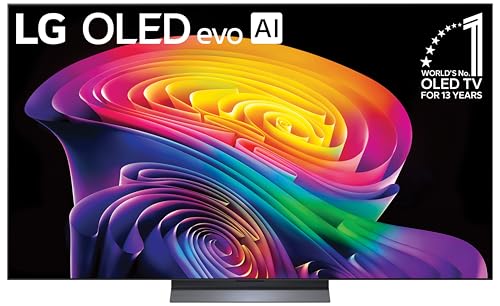
The LG C6 offers nearly all the performance of the G6 at a lower price. It's bright, has great gaming features, and the webOS smart platform is smooth. For most people, this is the sweet spot.
Strengths
- BRIGHTNESS BOOSTER: Brighter visuals, vivid detail with Brightness Booster Powered the a11
- PERFECT BLACK AND PERFECT COLOR: Over 8.3 million self-lit smart pixels with Perfect Black
- a11 AI PROCESSOR: Alpha 11 AI Processor Gen3 LG’s most powerful Dual AI Engine for the ult
- DOLBY VISION, DOLBY ATMOS AND FILMMAKER MODE: Bring big-screen magic home with Dolby Visio
- ULTIMATE GAMEPLAY: Ultimate Gaming with 165Hz Refresh Rate, NVIDIA G-Sync, AMD FreeSync Pr
Drawbacks
- Not as bright as MLA panels
- Design less premium than G6

Panasonic MZ2000 OLED
Panasonic's master OLED pro panel is incredibly accurate out of the box, with superb color volume. It's the go-to for color-critical work and film purists. The built-in soundbar is also impressive.
Strengths
- 4K Ultra HD 3840 x 2160 Resolution
Drawbacks
- Limited availability in some regions
- Smart platform not as polished as webOS
Buying considerations
Panel Technology
Standard OLED vs QD-OLED vs MLA: QD-OLED offers better color volume, MLA boosts brightness. Choose based on room brightness and content preference.
Brightness & Room Lighting
If your room is bright, look for higher nits and anti-glare coating. For dark rooms, any OLED will do.
Gaming Features
Check for HDMI 2.1, VRR, and low input lag. LG and Samsung lead in gaming features.
Smart Platform
WebOS (LG) is user-friendly, Tizen (Samsung) is solid, Google TV (Sony) has great app support. Choose what you prefer.
Design & Connectivity
Consider wall-mounting, cable management, and number of ports. Some models have separate connection boxes for cleaner setups.
Final word
The best OLED for you depends on your room's lighting and primary use. For most people, the LG C6 offers the best value, while the LG G6 is top-tier. Sony excels for movies, Samsung for bright rooms, and Panasonic for accuracy.
Questions answered
Burn-in risk is significantly reduced thanks to improved panel technologies and pixel refresher features. For normal mixed usage, it's rarely an issue.
OLED offers perfect blacks and superior contrast, while QLED gets brighter. For dark rooms and movie watching, OLED wins. For bright rooms with lots of windows, consider QLED.
For most living rooms, 65 inches is a great balance. If you sit closer or have a larger room, 77 inches is immersive. 55 inches is good for bedrooms.
OLEDs have decent built-in sound, but a soundbar greatly enhances the experience. Some high-end models like the Panasonic MZ2000 have excellent built-in audio.
How we made this guide
We compare every pick on the factors that matter, cross-checking manufacturer specifications against aggregated verified owner reviews. We rank independently and never take payment for placement. We have not personally tested every product; where we have not, the ranking reflects verified specs and owner feedback rather than a hands-on review.
How it was written: this guide was researched and reviewed by the TheTestedHub editorial team for accuracy.
Affiliate disclosure: TheTestedHub is reader-supported. When you buy through links on our site, we may earn a commission at no extra cost to you.
Keep reading

Get the Best HDMI 2.1 Cable: Zeskit Maya 8K Review (2026)

LG C4 OLED Is the Best PS5 TV for Most in 2026

Expert Pick: TCL QM7 Is the Best Budget 4K TV
5 Best TVs of 2026: LG G5 OLED and Top Picks
TCL 98-Inch Q6 4K QLED Review (2026): Big Screen, Big Compromises

Sanus VuePoint 32 to 75 TV Wall Mount Review (2026): The

Samsung QN90D 85-Inch Neo QLED Review (2026): The Bright-Room
