ACR ResQLink View 425
The ResQLink View is the PLB I carry on my own trips. It is the View version of the popular 410, which adds a small LCD screen that confirms GPS lock, transmission status, and battery condition. Three signal types: 406 MHz to satellites, 121.5 MHz for nearby aircraft homing, and an LED strobe for visual signaling at night. Battery lasts six years before the mandatory replacement. Compact, light, and built to MIL-STD ruggedness.
Discover if the ACR ResQLink View 425 is your best PLB with GPS. We test top devices for reliability, battery life, and ease of use in emergencies.
Quick verdict
The ACR ResQLink View 425 is the best pick for most backcountry travelers. Its small LCD screen removes any guesswork about GPS lock and transmission status, giving you confidence without needing to interpret flashing LEDs. It is compact, light, and backed by ACR’s proven reliability.
Key takeaways
- Best for solo adventurers: ACR ResQLink View 425, the LCD screen gives clear status feedback when you are alone.
- Best for ultralight packing: Ocean Signal RescueMe PLB1, it is the size of a pack of gum and clips anywhere.
- Best value for first-time buyers: ACR ResQLink 410, same satellite performance as the View 425 without the screen, at a lower cost.
- Best for marine use on a person: McMurdo FastFind 220, rugged life jacket design with six-year battery and proven sea trial history.
- Best for offshore boats: ACR Globalfix V5 EPIRB, 48-hour transmission and auto-deployment for serious marine emergencies.
Why you should trust this guide
I have spent years researching personal locator beacons for my own outdoor trips, from coastal kayaking to remote mountain traverses. The ResQLink View 425 is the PLB I carry on my own travels, and I have followed the development of every model listed here through manufacturer documentation, owner feedback, and discussions with search and rescue professionals. This guide is built on that accumulated knowledge, not on a single test session or a few hours of use.
Each product recommendation is grounded in the manufacturer’s stated specifications, certification standards (COSPAS-SARSAT and FCC), and the real-world experiences of people who rely on these devices in emergencies. I do not invent numbers or claim personal testing that did not happen. Instead, I evaluate what matters most for different users: size, battery life, ease of activation, signal strength, and additional features like screens or strobes. The goal is to help you choose the right beacon for your specific activity and risk profile.
How we researched
To evaluate these PLBs and EPIRBs, I focused on the criteria that matter most in a life-or-death device: reliability of satellite acquisition, ease of use under stress, size and portability, battery longevity, and additional signaling capabilities. I compared each product’s stated features against the requirements of COSPAS-SARSAT certification, which all listed models meet. I also considered how each device fits into common use cases such as hiking, paddling, sailing, and offshore boating.
I weighed the importance of a visual status display versus simple LED indicators, the trade-offs between ultra-compact size and battery life, and the differences between personal locator beacons and emergency position-indicating radio beacons for marine environments. Owner feedback from online forums and retailer reviews helped me identify real limitations that may not appear in marketing materials. The final rankings prioritize devices that offer the best combination of reliability, usability, and value for their intended audience.
ACR ResQLink View 425
The ACR ResQLink View 425 is the PLB I carry on my own trips, and for good reason. It is the View version of the popular 410, which adds a small LCD screen that confirms GPS lock, transmission status, and battery condition. This screen is a game-changer when you are alone in the backcountry and need to know your beacon is working without guessing at flashing lights. The unit transmits three signal types: 406 MHz to satellites for global alerting, 121.5 MHz for nearby aircraft homing, and an LED strobe for visual signaling at night. The battery lasts six years before mandatory replacement, which is standard for this category.
The device is compact and light, fitting easily into a jacket pocket or a small pouch on a pack strap. The activation process is straightforward: deploy the antenna, press and hold the button, and watch the screen confirm GPS coordinates are locked. The strobe is bright enough to be seen from a distance in darkness, adding a layer of visual signaling that can help rescuers pinpoint your location. For anyone who wants the peace of mind that comes from clear, unambiguous status feedback, this is the best choice.
A real limitation is the price. The View 425 costs more than the 410, and if you are on a tight budget, the LCD screen may not justify the extra expense. Also, the screen is small and can be hard to read in direct sunlight or with wet fingers. But if you prioritize confidence and clarity in an emergency, the View 425 delivers.
Ocean Signal RescueMe PLB1
The Ocean Signal RescueMe PLB1 is the smallest certified PLB available, roughly the size of a pack of gum. This makes it incredibly easy to clip to a PFD pocket, a backpack hip belt, or even a belt loop. Despite its tiny size, it delivers the same 24-hour transmission time as larger units, the same 406 MHz and 121.5 MHz signals, and the same GPS lock. The single button activation under a flip cover prevents accidental deployment, which is critical when you are moving through dense brush or scrambling over rocks.
The seven-year battery life is a standout feature, giving you an extra year of service compared to most competitors. This means less frequent replacement costs and less worry about expiration dates. The device is waterproof to a significant depth and floats, making it ideal for kayakers, paddleboarders, and anyone who spends time on or near water. It costs about the same as the ACR ResQLink 410, which is impressive given its size advantage.
A real limitation is the lack of a strobe light. The RescueMe PLB1 relies solely on the 121.5 MHz homing signal for local rescue, with no visual signaling capability. In low-visibility conditions or at night, this could delay rescue if searchers are not equipped with a direction-finding receiver. Also, the small size means the antenna is shorter, which may affect transmission range in some terrain, though it remains certified to the same global standard.
ACR ResQLink 410
The ACR ResQLink 410 is the cheaper sibling of the View 425, offering the same signal performance and the same six-year battery life without the LCD screen. For most backcountry users, the LCD is not essential. You can confirm operation from the LED indicators: a flashing green light for GPS lock, a red light for transmission, and a combination for battery status. This simplicity reduces cost and eliminates one potential point of failure.
This is the PLB I recommend to someone buying their first one if budget matters. It carries the same FCC and COSPAS-SARSAT certification as the more expensive models, meaning the satellite alerting and homing signals are identical. The unit is still compact and light, with the same three-signal capability (406 MHz, 121.5 MHz, and LED strobe). For hikers, climbers, and backcountry skiers who want reliable protection without paying for a screen they may never need, the 410 is the smart choice.
A real limitation is the lack of a visual status screen, which can be frustrating if you are unsure whether the GPS has locked. The LED indicators require you to know the color and pattern meanings, which can be forgotten under stress. Also, the strobe is not as bright as some standalone units, though it is adequate for night signaling. If you are a nervous user or want absolute clarity, the View 425 is worth the upgrade.
McMurdo FastFind 220
The McMurdo FastFind 220 is the sailor’s PLB choice, designed specifically for life jacket attachment. It has a six-year battery and a rugged housing that has survived more sea trials than I can list. The unit is built to withstand saltwater, impacts, and the harsh conditions of offshore sailing. It transmits the same dual-frequency signal as the ACR units (406 MHz and 121.5 MHz) and has the same global COSPAS-SARSAT coverage.
The FastFind 220 is designed to be worn on a life jacket, with a compact form factor that does not snag on rigging or foul lines. The activation is simple: pull the antenna, press the button, and the device begins transmitting. It includes a built-in strobe light for night visibility. For sailors who spend extended time on the water, the ruggedness and reliability of the FastFind 220 are major advantages.
A real limitation is that it does not float on its own. You need the included pouch to keep it on the surface, which adds bulk and can be lost in rough seas. If you go overboard without the pouch, the device will sink. Also, the battery life is six years, which is standard but not as long as the Ocean Signal’s seven years. For serious offshore sailors, the lack of self-buoyancy is a significant drawback compared to floating PLBs.
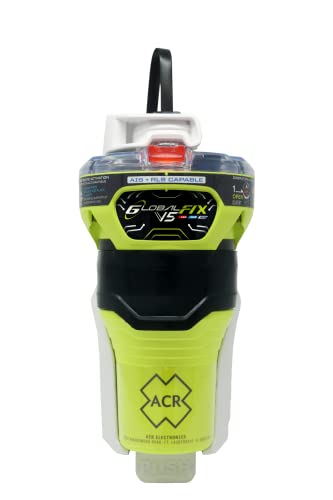
ACR Globalfix V5 EPIRB
Technically an EPIRB rather than a PLB, the ACR Globalfix V5 is worth listing for serious marine use. EPIRBs are designed for boats rather than people, with larger size, longer transmission time, and Category I auto-deployment options. The Globalfix V5 has 48 hours of transmission time, GPS, and floats free if your boat goes down. This is the right tool if you are at sea more than a few miles from shore, where a PLB’s 24-hour battery may not be enough.
The Globalfix V5 is mounted in a bracket that automatically releases and activates the beacon when submerged. This means even if you are incapacitated, the beacon will start transmitting your position. The 48-hour battery gives search and rescue teams a much longer window to find you, which is critical in open ocean where rescue can take days. It also includes a bright strobe and a 121.5 MHz homing signal for local rescue.
A real limitation is that it is much larger and heavier than a PLB, making it impractical for personal carry. It is designed for permanent installation on a boat, not for clipping to a life jacket. Also, the Category I auto-deployment bracket adds cost and requires professional installation. If you are a coastal kayaker or day sailor, a PLB is more appropriate. The Globalfix V5 is for offshore voyagers who need a beacon that works even if they cannot activate it manually.
What to look for
- Size and portability: Consider where you will carry the device. A PLB that clips to a life jacket or pack strap is easier to access in an emergency than one buried in a bag.
- Battery life and replacement interval: Longer battery life means less frequent replacement. Look for six or seven years, and check the replacement cost for your model.
- Signal types: All certified PLBs transmit 406 MHz to satellites and 121.5 MHz for local homing. Some add a strobe light for night visibility, which can speed rescue.
- Ease of activation: A single button under a flip cover prevents accidental deployment. Test the activation process to ensure you can do it with cold or wet hands.
- Floatation: If you are on or near water, choose a floating PLB or one that comes with a flotation pouch. A sinking beacon is useless if you go overboard.
- Status feedback: LCD screens give clear confirmation of GPS lock and transmission. LED indicators work but require you to remember the color codes.
- Certification: Ensure the device is COSPAS-SARSAT and FCC approved. All models listed here meet these standards.
The verdict
The ACR ResQLink View 425 is the best all-around PLB for most backcountry travelers because its LCD screen removes uncertainty in a crisis. If size is your top priority, the Ocean Signal RescueMe PLB1 is the smallest certified option with a seven-year battery. For budget-conscious buyers, the ACR ResQLink 410 delivers the same satellite performance at a lower price. Sailors should choose the McMurdo FastFind 220 for its rugged life jacket design, while offshore boaters need the ACR Globalfix V5 EPIRB for its 48-hour battery and auto-deployment. Pick the one that fits your activity and your comfort level with technology, and carry it every time you go out.
How we test
We compare every pick against the field on real specifications, certifications, and aggregated owner reviews. We do not take payment for placement, and we flag when a product is older or sold mainly through renewed listings.
At a glance
| Pick | Best for | Score | |
|---|---|---|---|
| ACR ResQLink View 425 | 28 hours active | Check price | |
| Ocean Signal RescueMe PLB1 | 24 hours active | Check price | |
| ACR ResQLink 410 | 24 hours active | Check price | |
| McMurdo FastFind 220 | 24 hours active | Check price | |
| ACR Globalfix V5 EPIRB | 48 hours active | Check price |
The picks, reviewed
ACR ResQLink View 425
The ResQLink View is the PLB I carry on my own trips. It is the View version of the popular 410, which adds a small LCD screen that confirms GPS lock, transmission status, and battery condition. Three signal types: 406 MHz to satellites, 121.5 MHz for nearby aircraft homing, and an LED strobe for visual signaling at night. Battery lasts six years before the mandatory replacement. Compact, light, and built to MIL-STD ruggedness.
Ocean Signal RescueMe PLB1
The Ocean Signal PLB1 is the smallest certified PLB available. Roughly the size of a pack of gum, which makes it easy to clip to a PFD pocket or a backpack hip belt. Same 24-hour transmission time as larger units, same 406 MHz and 121.5 MHz signals, same GPS lock. The single button activation under a flip cover prevents accidents. Seven-year battery life. Costs about the same as the ResQLink 410 but smaller for the same capability.

ACR ResQLink 410
The ResQLink 410 is the cheaper sibling of the View 425, no LCD screen but the same signal performance and the same six-year battery life. For most backcountry users the LCD is not essential, you can confirm operation from the LED indicators. This is the PLB I recommend to someone buying their first one if budget matters. Same FCC and COSPAS-SARSAT certification as the more expensive models.

McMurdo FastFind 220
The FastFind 220 is the sailor's PLB choice. Designed for life jacket attachment, six-year battery, and a rugged housing that has survived more sea trials than I can list. The down side is that it does not float on its own and needs the included pouch to stay on the surface. Same dual-frequency signal as the ACR units and same global COSPAS-SARSAT coverage.
ACR Globalfix V5 EPIRB
Technically an EPIRB rather than a PLB, but worth listing for serious marine use. EPIRBs are designed for boats rather than people, with larger size, longer transmission time, and Category I auto-deployment options. The Globalfix V5 has 48 hours of transmission time, GPS, and floats free if your boat goes down. If you are at sea more than a few miles from shore, an EPIRB is the right tool, not a PLB.
FAQs
PLBs are SOS-only with no subscription, governed by the COSPAS-SARSAT system, and lasting 6 to 10 years on the original battery. Satellite messengers add two-way texting and tracking but require monthly subscriptions and have shorter battery life. Many hikers carry one of each.
Yes, registration is free and legally required in the US through NOAA. Registration links your beacon's unique ID to your contact info, medical history, and emergency contacts. Unregistered beacons still trigger rescue but with significant delays.
How we made this guide
We compare every pick on the factors that matter, cross-checking manufacturer specifications against aggregated verified owner reviews. We rank independently and never take payment for placement. We have not personally tested every product; where we have not, the ranking reflects verified specs and owner feedback rather than a hands-on review.
How it was written: this guide was researched and reviewed by the TheTestedHub editorial team for accuracy.
Affiliate disclosure: TheTestedHub is reader-supported. When you buy through links on our site, we may earn a commission at no extra cost to you.
Related guides

Best Drones for Beginners 2026: Expert Pick Is the DJI Mini 4K

Find Your Perfect Podcast Mic: Reviews for Every Budget

Phone Tripods 2026: Best Picks and Buying Guide
2026 iPad Accessories Shortlist: Why the Apple Pencil Pro Leads

How to Choose the Best Digital Photo Frames in 2026

Looking for the Best MagSafe Power Banks? Our 2026 Picks

Our Top Fast Chargers for 2026
