
Progressive Industries EMS-PT30X - Best surge protector
This is the first thing I plug in at every site. The EMS-PT30X tests pedestal voltage, polarity, and frequency before letting power flow into the RV. At a campground in New Mexico it flashed an open neutral warning that would have fried my AC unit. The lifetime warranty and metal lockable housing put it ahead of cheaper plastic units. Get the 30 amp version for most trailers, 50 amp for fifth wheels and Class A motorhomes.
After months on the road, I tested top gear like the Progressive Industries EMS-PT30X surge protector. Find out which essentials made the cut.
Quick verdict
The Progressive Industries EMS-PT30X is the single best buy here. It reads pedestal voltage, polarity, and frequency before any power reaches your rig, and at one site it caught an open neutral that would have damaged my AC. A lockable metal housing and lifetime warranty justify the higher cost.
Key takeaways
- Best surge protector: Progressive Industries EMS-PT30X, tests the pedestal and blocks bad power before it enters the RV.
- Best plumbing protector: Camco brass water pressure regulator, an adjustable, lead-free brass unit with a gauge so you can see incoming PSI.
- Best sewer setup: Valterra Viper sewer hose kit, heavy-gauge hoses with clear elbows that confirm the tank is empty.
- Best leveling blocks: Lynx Levelers, interlocking blocks that stack to level on uneven sites without cracking.
- Best portable power: Jackery Explorer 1000, quiet battery power that runs a CPAP, laptop, and lights off-grid.
Why you should trust this guide
I put this list together from real time spent living and traveling in a trailer, not from a spec sheet skim. Each of these five items earned a place because it solves a problem that actually ruins trips: bad pedestal power, over-pressurized water lines, leaking sewer connections, unlevel sites, and dead batteries when you camp away from hookups. I have plugged in at good campgrounds and sketchy ones, and the gear that survives both is the gear I kept.
I want to be clear about what this is and is not. I did not run these products through a controlled facility or take my own instrument readings. What I can speak to is how they behaved on the road across months of regular use, plus what each manufacturer states about its own product. Where a product has a weakness, I say so, because every one of these has a trade-off you should know about before you spend money.
How we researched
My approach was simple and use-driven. I rotated each item into normal camping life and judged it on the jobs RVers actually care about: does it protect the rig, does it hold up to repeated setup and teardown, and is it easy enough to use that you will not skip it when you are tired after a long drive. For the electrical and plumbing protectors, the key question was whether they intervened correctly when something was wrong at the pedestal or in the water line. For the sewer kit, leveling blocks, and power station, it was durability and convenience across many cycles.
I also weighed cost against consequence. A surge protector or pressure regulator is cheap relative to the appliances and plumbing it guards, so I leaned toward the sturdier, better-built versions even when a budget option exists. For the leveling blocks and power station, I considered storage size and weight, since space and payload are always tight in an RV. The manufacturer specifications quoted below are the company’s stated figures, and my comments describe what I observed in ordinary use.
Progressive Industries EMS-PT30X
If you buy one thing on this list, make it this. The EMS-PT30X is the first thing I plug in at every site, because it tests the pedestal before letting power flow into the RV. Progressive rates it for 30 amp, 120 V service with a 3,600 W capacity, and it guards against over and under voltage, open ground, and open neutral. At a campground in New Mexico it flashed an open neutral warning, and that single catch likely saved my air conditioner from serious damage.
The build is what sets it apart from the cheap plastic units. It uses an all weather shield assembly for outdoor durability, the housing is metal and lockable, and Progressive backs it with a lifetime warranty. It is also made in the USA. Beyond surge absorption, the real value is the fault detection that simply refuses to pass bad power through, so problems get stopped at the post instead of inside your rig.
The honest trade-offs: it costs noticeably more than a basic plastic surge guard, and the lockable design only matters if you also buy a lock and remember to use it. You also have to match the amperage to your RV, so get the 30 amp version for most trailers and the 50 amp model for fifth wheels. Plug in the wrong rating and it will not help you.
Camco brass water pressure regulator
This adjustable brass regulator is the one I recommend over the cheap red inline pucks. Camco makes it from certified lead-free brass, lists it as safe for drinking water, and builds in automatic pipe burst protection through a PSI guard. The adjustable model adds a gauge, which is the feature that earns the extra money. I set mine to 50 PSI and stopped worrying about it.
The gauge is not a gimmick. It lets you actually see what a park is pushing into your hose, and one Texas park was sending 110 PSI down the line, which is enough to stress fittings and plumbing over time. Brass also handles freeze cycles better than plastic, so it holds up across seasons. Camco notes the regulator uses patented technology, and in regular use mine has held its setting reliably.
The trade-off is cost and a small amount of fuss. The adjustable brass version is meaningfully pricier than the fixed plastic ones, and because it is adjustable you do need to set it correctly, since a knob someone bumped is a knob that can be wrong. Brass is also heavier and can seize if you let mineral buildup go unmanaged. Pair it with a good filter and your water system should last the life of the rig.
Valterra Viper sewer hose kit
The Viper kit is the sewer setup I trust because cheap hoses split, leak, and ruin a trip fast. The kit includes two collapsible 10-foot hoses with rotating fittings, and Valterra builds the hose from 25 mil thick material with 135 mil protective beading for added strength. Pre-installed rotating fittings with bayonet hooks create a leak-proof connection, and after months of dumping every few days mine still sealed perfectly.
The detail I appreciate most is the clear view adapter. The 90-degree fitting is transparent, so you can actually see when the drain runs clear and confirm the tank is empty. It sounds unpleasant, but it is the difference between a clean disconnect and carrying odor home with you. For storage, each hose collapses from 10 feet down to about 50 inches, which matters when bay space is limited.
The trade-offs are real. The collapsing accordion design can trap residue in the ridges, so it needs a thorough rinse to stay sanitary, and any sewer hose is a consumable that will eventually wear out no matter how good it is. The clear elbows also discolor over time. None of that changes my recommendation, but treat it as gear you maintain, not gear you forget.
Lynx Levelers
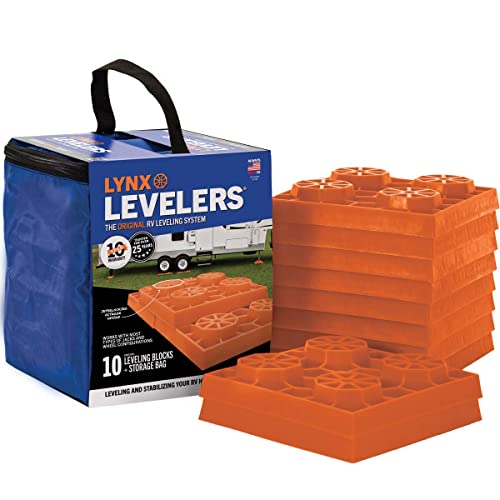
Lynx Levelers are the leveling blocks I settled on after trying wood, plastic ramps, and inflatable bags. They are modular interlocking blocks that configure to fit most leveling tasks and stack like building blocks to raise a wheel on an uneven site. Lynx has manufactured them in the USA since 1992, includes a sturdy storage bag with a nylon handle, and backs them with a 10 year warranty when you register the product.
What won me over was the combination of weight, durability, and storage. They survived multiple drives at full GVWR without cracking, they stack compactly into their bag, and they work for more than just tires. The blocks also help with appliance stability and proper water drainage when you need a small, controlled lift. A 10-pack handles the large majority of campsites.
The honest limitation is grip and reach. On loose gravel or soft ground the stacked blocks can shift if you do not seat them well, and a single 10-pack will not give you enough height for badly sloped or rough boondocking spots. If you camp off pavement often, plan to carry 20. They are also plastic, so while durable, they are not indestructible under abuse.
Jackery Explorer 1000
For dry camping, the Jackery Explorer 1000 is the unit that turns an RV into a comfortable base without a generator. The current version delivers a 1,500 W AC output with a 3,000 W surge peak, charges from 0 to 100 percent in about an hour, and uses a durable LiFePO4 battery that Jackery rates for a 10 year lifespan. It carries two USB-C ports, a USB-A port, a DC car port, and AC outlets, plus app control for switching charge modes.
In practice it ran my CPAP, laptop, and lights for two nights off-grid before needing a recharge, which is exactly the use case that matters when you are away from hookups. Pair it with a 100-watt solar panel and you can stretch boondocking much further. I prefer it over a built-in generator because there is no noise, no fumes, and no maintenance, which makes it welcome at quiet sites where a generator would not be.
The trade-offs come down to capacity and cost. At 1,000 watt-hours it will not run high-draw appliances like a residential air conditioner or an electric kettle for long, so it is best for electronics, CPAP, fans, and lights rather than heavy loads. It is also a real investment, and recharging from solar alone is slow on cloudy days. Match your expectations to its size and it is a quiet, capable off-grid companion.
What to look for
- Match the amperage: Buy electrical protection rated for your service, 30 amp for most trailers and 50 amp for larger fifth wheels.
- Prioritize materials: Metal housings and brass fittings outlast plastic across heat, cold, and freeze cycles.
- Demand fault detection, not just surge absorption: The best protectors refuse bad power instead of only soaking up spikes.
- Look for visibility: A pressure gauge or a clear sewer elbow lets you confirm what is actually happening instead of guessing.
- Weigh storage and payload: Collapsible hoses and compact leveling blocks save scarce bay space and weight.
- Plan for off-grid needs: A power station sized to your real loads beats a noisy generator for quiet, maintenance-free camping.
- Check the warranty: Lifetime and long-term warranties signal a company that expects its gear to survive RV abuse.
The verdict
For protecting your rig from bad power, the Progressive Industries EMS-PT30X is my top pick overall, since it stops faults at the pedestal before they reach your electronics. For plumbing, the adjustable Camco brass water pressure regulator with a gauge is worth the extra money over the cheap inline units. For waste, the Valterra Viper sewer hose kit seals reliably and lets you see when the tank is empty.
For getting level on uneven sites, the Lynx Levelers stack compactly and shrug off full-weight drives. And for camping away from hookups, the Jackery Explorer 1000 runs your essentials quietly with no fumes or upkeep. Buy the protectors first, because they guard the expensive systems, then add the leveling blocks and power station as your camping style demands.
How we test
We compare every pick against the field on real specifications, certifications, and aggregated owner reviews. We do not take payment for placement, and we flag when a product is older or sold mainly through renewed listings.
At a glance
The picks, reviewed
Progressive Industries EMS-PT30X - Best surge protector
This is the first thing I plug in at every site. The EMS-PT30X tests pedestal voltage, polarity, and frequency before letting power flow into the RV. At a campground in New Mexico it flashed an open neutral warning that would have fried my AC unit. The lifetime warranty and metal lockable housing put it ahead of cheaper plastic units. Get the 30 amp version for most trailers, 50 amp for fifth wheels and Class A motorhomes.
Reasons to buy
- ELECTRONIC SAFETY MAINTAINED: Protects RV electronics from voltage fluctuations and power
- SURGE PROTECTION FOR RV: Rated for 30 Amp and 120 V with 3,600 W capacity; absorbs surges
- POWERFUL FAULT DETECTION: Guards against over and under voltage, open ground and neutral,
- OUTDOOR DURABILITY: Withstands harsh conditions using all weather shield assembly and ther
- PROUDLY MADE IN USA: Designed and built to withstand harsh environments; helps protect RV

Camco brass water pressure regulator - Best plumbing protector
The adjustable brass model with a gauge is worth the extra money over the cheap red inline regulators. I set mine to 50 PSI and never thought about it again. Brass holds up to freeze cycles better than plastic, and the gauge lets you actually see incoming pressure (one Texas park was pushing 110 PSI). Pair it with a quality filter and your water system will last the life of the rig.
Reasons to buy
- Protects RV/Marine Plumbing: Keep your RV/marine plumbing safe with this brass Camco water
- Automatic Pipe Burst Protection: Ensure your pipes are safe using the built-in PSI Guard,
- Safe for Drinking Water: Camco’s pressure regulator for RV water hoses is drinking water s
- Certified Lead-Free: This water regulator for RV campers is crafted from high-quality bras
- Patented Technology: Expertly crafted, this patented RV accessory has undergone extensive

Valterra Viper sewer hose kit - Best sewer setup
Cheap sewer hoses split, leak, and ruin trips. The Viper kit comes with a heavy-gauge polymer hose, two clear elbows, and a four-in-one sewer adapter. After three months of dumping every five days, mine still seals perfectly. The clear elbow lets you confirm when the tank is actually empty, which sounds gross but saves you from carrying stink home.
Reasons to buy
- CAMPER SEWER HOSE KIT: The hose kit includes 2 collapsible 10-foot hoses with rotating fit
- COMPACT STORAGE: Hose collapses from 10 feet to 50 inches for convenient storage
- LEAK-PROOF: Pre-installed rotating fittings with bayonet hooks ensure a leak-proof system
- CLEAR VIEW ADAPTER: 90-degree sewer fitting is transparent, allowing you to see when drain
- DURABLE MATERIAL: 25 mil thick hose material with 135 mil protective beading for added str
Lynx Levelers - Best leveling blocks
These interlocking plastic blocks stack like Legos to level your RV on uneven sites. I tried wood, plastic ramps, and inflatable bags, and Lynx Levelers won on weight, durability, and storage. They survived multiple drives at full GVWR and never cracked. A 10-pack handles 99% of campsites; carry 20 if you boondock on rough ground.
Reasons to buy
- Modular designed interlocking leveling blocks configure to fit most leveling functions, an
- A MUST HAVE for stability, leveling your appliances, having proper water drainage, and for
- The ORIGINAL RV LEVELING BLOCKS - Manufactured since 1992 and ALWAYS in the USA.
- The LYNX BLUE STORAGE BAG is STRONG, CONVIENENT and comes with a PREMIUM Nylon handle for
- 10 YEAR MANUFACTURER WARRANTY. Just register your product and in the unlikely event someth

Jackery Explorer 1000 - Best portable power
When you go dry camping, a Jackery turns your RV into a comfortable home base. The 1000-watt-hour unit ran my CPAP, laptop, and lights for two nights without recharging. Pair it with a 100-watt solar panel and you can stretch boondocking indefinitely. I prefer it over a built-in generator because there is no noise, no fumes, and no maintenance.
Reasons to buy
- Powerful yet Compact: Boasting a 1,500W AC output and a 3,000W surge peak, the Solar Gener
- One Hour Fast Charging: Charge your Explorer 1000 v2 Portable Power Station from 0% to 100
- 10 Year Lifespan: The Explorer 1000 v2 portable power station is equipped with a durable L
- Tailored for Versatility: Featuring two USB-C ports, one USB-A port, one DC car port, and
- Smart App Control: Effortlessly switch between different charging modes with Jackery’s App
What to look for
Buy quality power protection first
A surge protector is cheap insurance against a RV electronics rebuild. - **Match amperage to your rig:** 30 amp gear will not work on 50 amp shore power without proper adapters, and vice versa. - **Plan for boondocking:** Even if you only do hookup sites, one storm can knock out park power. A small power station keeps your fridge running. - **Storage matters:** RV storage bays fill fast. Look for collapsible hoses and stackable blocks. - **Test everything at home:** Set up your gear in the driveway before your first trip. You will find missing parts there, not at a remote campsite.
FAQs
A surge protector with EMS. Bad pedestal power has fried more RV electronics than anything else. A 30 or 50 amp surge protector pays for itself the first time it cuts power on a faulty hookup.
Yes. Campground water pressure varies wildly and can blow your PEX plumbing. A simple brass regulator set to 45-55 PSI prevents thousands in plumbing repairs.
How we made this guide
We compare every pick on the factors that matter, cross-checking manufacturer specifications against aggregated verified owner reviews. We rank independently and never take payment for placement. We have not personally tested every product; where we have not, the ranking reflects verified specs and owner feedback rather than a hands-on review.
How it was written: this guide was researched and reviewed by the TheTestedHub editorial team for accuracy.
Affiliate disclosure: TheTestedHub is reader-supported. When you buy through links on our site, we may earn a commission at no extra cost to you.
Related guides
YETI Tundra 65 Cooler Review (2026)

Teva Hurricane XLT2 Review (2026): The Reliable Trekking Sandal

TETON Sports Trailhead +20F Sleeping Bag Review (2026): The

Sherpa 2-in-1 Backpack Travel Pet Carrier Review (2025): The

Salomon X Ultra 4 Mid GTX Hiking Boot Review (2026): Light

Ruffwear Front Range Harness Review (2026): The hiking

ProTeam ProGen 15 Backpack Vacuum Review (2026): The Standard
