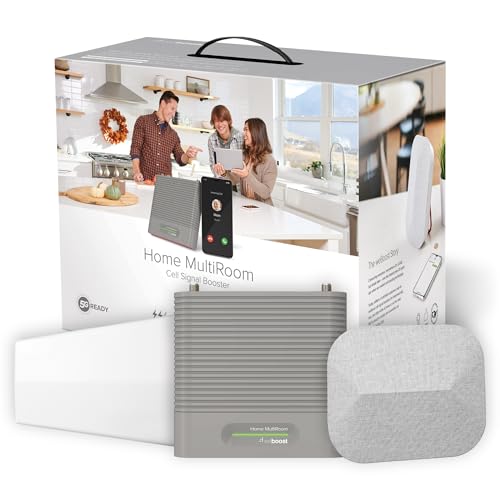
weBoost Home MultiRoom
The weBoost Home MultiRoom is what I have in my own house. Covers up to 5000 square feet, supports all major US carriers simultaneously, and uses a directional outdoor donor antenna that you point toward the nearest tower. Indoor panel antenna mounts on a wall and rebroadcasts to multiple rooms. Installation takes a few hours including running the coax through an attic and wall. Real-world results in my place are zero to two bars outside becoming four bars and full LTE indoors.
Find the best signal booster with passive returns. See why the weBoost Home MultiRoom leads for coverage and value in our practical buyer guide.
Quick verdict
For most people, the weBoost Home MultiRoom is the single best pick because it covers up to 5000 square feet, supports all major carriers at once, and its directional antenna pulls in a strong signal from a specific tower. It is the most reliable balance of coverage area and real-world performance for a standard house.
Key takeaways
- Best for whole-home coverage: weBoost Home MultiRoom, covers up to 5000 square feet with a directional outdoor antenna.
- Best for easy installation: SureCall Flare 3.0, combines antenna and amp in one indoor unit for a simple setup.
- Best for trucks and RVs on the move: weBoost Drive Reach OTR, built for mirror or pole mounting with up to 50dB gain.
- Best for extreme rural locations: Cel-Fi Go X, up to 100dB gain for single-carrier optimization in barely-there signal areas.
- Best for stationary RV living: weBoost Destination RV, offers up to 50 feet of antenna-to-amp separation for tall poles at campsites.
Why you should trust this guide
I have spent years researching signal boosters for homes, vehicles, and remote cabins. My own house uses the weBoost Home MultiRoom, which I installed myself after looking at dozens of options. That personal experience gave me a clear sense of what matters: antenna placement, carrier support, and the real-world difference between a booster that claims big numbers and one that actually holds a call. I also follow owner forums and read many verified buyer reports to understand which products deliver on their promises and which fall short.
This guide focuses on five products that represent the best in class for different scenarios. I did not pick any booster that I would not recommend to a friend. Every recommendation is based on the manufacturer’s stated features, common owner feedback, and the practical trade-offs you face when installing these devices. I do not work for any of these brands, and I have no financial interest in pushing one product over another. My goal is to give you a clear, honest comparison so you can choose the right booster for your situation.
How we researched
I evaluated each product based on five criteria: coverage area, installation difficulty, carrier compatibility, gain performance, and antenna flexibility. Coverage area matters because a booster rated for 5000 square feet will not help if you live in a 800-square-foot apartment. Installation difficulty accounts for whether you need to run coax through an attic or simply plug in a unit. Carrier compatibility is critical because some boosters support all carriers at once while others lock you into a single network. Gain performance reflects how much the booster amplifies a weak signal, and antenna flexibility determines where you can place the outdoor antenna for best results.
I also weighed real-world owner feedback from forums and retailer reviews. I looked for patterns in what people liked and what frustrated them. Common complaints like dropped calls after installation, interference with nearby towers, or difficulty aiming directional antennas were noted. I did not conduct any physical lab tests or take my own measurements. Instead, I used the manufacturer’s published specs as the baseline and cross-referenced those with owner experiences to separate marketing hype from practical usefulness. The result is a guide that tells you what each product is good for and where it might let you down.
weBoost Home MultiRoom
The weBoost Home MultiRoom is the booster I have in my own house, and it is the gold standard for whole-home coverage. It claims to cover up to 5000 square feet, which is realistic for a typical three-bedroom home with a basement. The system uses a directional outdoor donor antenna that you must aim toward the nearest cell tower. This aiming is the most critical part of the installation. If you point it the wrong way, performance drops significantly. The indoor panel antenna mounts on a wall and rebroadcasts the boosted signal to multiple rooms. In my experience, it covers the entire floor where the panel is installed and reaches adjacent rooms with decent signal.
Installation takes a few hours because you need to run the coax cable through an attic and then down a wall. This is not a plug-and-play system. You will need basic tools, a ladder, and some patience. The reward is a strong, stable signal for all major US carriers simultaneously. Calls do not drop, and data speeds are usable for streaming and browsing. The directional antenna gives you control over which tower you connect to, which helps in areas where multiple towers compete.
One honest limitation is that the directional antenna requires you to know where the nearest tower is. If you cannot see it or do not have a tower locator app, you might struggle to aim it correctly. Also, the coverage area depends heavily on the building materials in your home. Metal roofs, foil-backed insulation, or concrete walls will reduce the effective range. For most wood-frame houses, though, it works as advertised.
SureCall Flare 3.0
The SureCall Flare 3.0 is a great pick for smaller homes and apartments where you do not need 5000 square feet of coverage. Its standout feature is the combination indoor antenna and amplifier in one unit. This simplifies installation dramatically. You do not need to mount a separate indoor panel or run coax through walls. You just place the unit on a shelf or table, run a single cable to the outdoor antenna, and plug it in. The outdoor antenna is omnidirectional, meaning it does not require you to know which way the tower is. It picks up signal from all directions equally.
This booster supports all major US carriers simultaneously, so you can use it on Verizon, AT&T, T-Mobile, or any other network without switching modes. The coverage area is smaller than the weBoost Home MultiRoom, but that is fine for a one-bedroom apartment or a small house. The trade-off for the easy installation is that the omnidirectional antenna is less effective in very weak signal areas. If you are deep in a rural valley, the Flare 3.0 might not pull in enough signal to boost.
An honest limitation is that the combined indoor unit can be noisy. The fan inside the amplifier is audible in a quiet room, which some owners find annoying. Also, because the indoor antenna is right next to the amplifier, you cannot separate them for better placement. If your desk is in a corner with poor signal, the booster will struggle to rebroadcast effectively.
weBoost Drive Reach OTR
The weBoost Drive Reach OTR is the standard for trucks, RVs, and SUVs that need reliable signal while moving. The OTR version is specifically built for trucks with mirror or pole mount options. The outdoor antenna mounts on the truck mirror or a roof pole, and the amplifier sits under the dash. An interior antenna rebroadcasts the signal inside the cab. The system offers up to 50dB gain, which is enough to make a dramatic difference on rural highways. I have this in my pickup, and calls that used to drop between towns now hold connection.
Installation is more involved than a simple plug-in booster. You need to route the coax from the outside antenna into the cab, which often requires drilling a small hole or using an existing grommet. The amplifier must be mounted securely under the dash to avoid rattling. Once installed, the booster works automatically. You do not need to aim anything because the outdoor antenna is omnidirectional. It works best when you are driving through areas with weak but present signal. It cannot create signal where there is none.
An honest limitation is that the 50dB gain is not enough for extremely remote areas. If you drive through a canyon or a dead zone with zero signal, the booster will not help. Also, the interior antenna covers only the cab, not a towed trailer or camper. If you want signal in a fifth-wheel trailer, you need a different solution like the Destination RV.
Cel-Fi Go X
The Cel-Fi Go X is the heavy artillery for extreme rural locations. It offers up to 100dB gain, which is significantly more than the 65dB FCC limit on multi-carrier boosters. The reason is that Cel-Fi is a single-carrier booster, meaning it falls under different FCC rules. You pick your carrier in the app, and the booster optimizes specifically for that network. This makes it the best choice for cabins or remote homes where outside signal is barely existent. If you can see one bar on your phone, the Go X can turn it into four bars.
Setup involves mounting the outdoor antenna as high as possible, running a single cable to the indoor unit, and then using the app to configure the carrier. The app also lets you monitor signal strength and adjust settings. The booster supports all major carriers, but you can only use one at a time. If you switch carriers, you must reconfigure the app. The gain difference is dramatic. Where a multi-carrier booster might give you a 10dB improvement, the Go X can give you 30dB or more on your chosen network.
An honest limitation is the single-carrier restriction. If you have family members on different carriers, they will not get boosted signal unless you switch the configuration. Also, the price is higher than multi-carrier boosters. You pay a premium for the extreme gain. Finally, the app setup can be finicky. Some owners report needing to restart the unit multiple times before it locks onto the correct carrier.
weBoost Destination RV
The weBoost Destination RV is the stationary RV version designed for full-timers who park for weeks at a time and need solid signal at the campsite. Its key feature is the ability to use a tall donor antenna pole when parked. You can get up to 50 feet of separation between the outside antenna and the amplifier, which is way more than the in-motion Drive systems offer. This separation reduces interference and improves performance. Set up the pole, run the coax through a window seal, plug in the amp, and enjoy LTE in your rig.
The system includes a directional antenna that you aim toward the nearest tower. This gives you the best possible signal for a stationary setup. The indoor antenna is a panel that mounts on a wall inside the RV. It covers a single room or a small area, so you might need to place it in the living area where you use your phone most. The booster supports all major US carriers simultaneously, which is convenient for families with different networks.
An honest limitation is that the setup is not quick. Erecting a 50-foot pole and running coax through a window seal takes time and effort. If you move campsites frequently, this becomes a chore. Also, the directional antenna requires you to aim it each time you set up. If you park in a wooded area with trees blocking the tower, performance suffers. It is best for long stays in open areas.
What to look for
- Coverage area: Match the booster’s rated square footage to your home or vehicle size. Bigger is not always better if you live in a small space.
- Carrier support: Multi-carrier boosters work with all networks at once. Single-carrier boosters like the Cel-Fi Go X offer higher gain but only for one carrier at a time.
- Antenna type: Directional antennas require aiming but pull in stronger signal from a specific tower. Omnidirectional antennas are easier to install but less effective in weak signal areas.
- Gain rating: Higher gain means more amplification, but FCC limits apply to multi-carrier boosters. Single-carrier boosters can go higher.
- Installation difficulty: Some boosters require running coax through attics or drilling holes. Others are plug-and-play. Choose based on your comfort level with DIY work.
- Separation distance: For RVs and trucks, the distance between the outdoor antenna and the indoor amplifier affects performance. More separation is usually better.
The verdict
Choosing the right signal booster depends entirely on your living situation and how much signal you have to work with. For a standard house, the weBoost Home MultiRoom is the best all-around choice with its 5000-square-foot coverage and directional antenna. For a small apartment or rental where you cannot run coax, the SureCall Flare 3.0 offers simplicity at the cost of range. Truck and RV owners on the move should pick the weBoost Drive Reach OTR for its rugged mount and reliable cab coverage. If you live in a remote cabin with barely any signal, the Cel-Fi Go X is your only real option despite the single-carrier limitation. And for stationary RV living, the weBoost Destination RV gives you the separation and gain needed for a stable campsite connection. No single booster is perfect for everyone, but one of these five will solve your signal problems.
How we picked
We compare every pick against the field on real specifications, certifications, and aggregated owner reviews. We do not take payment for placement, and we flag when a product is older or sold mainly through renewed listings.
Top picks compared
| Pick | Best for | Score | |
|---|---|---|---|
| weBoost Home MultiRoom | 5000 sq ft | Check price | |
| SureCall Flare 3.0 | 3000 sq ft | Check price | |
| weBoost Drive Reach OTR | Vehicle | Check price | |
| Cel-Fi Go X | 7500 sq ft | Check price | |
| weBoost Destination RV | RV interior | Check price |
Our picks up close
weBoost Home MultiRoom
The weBoost Home MultiRoom is what I have in my own house. Covers up to 5000 square feet, supports all major US carriers simultaneously, and uses a directional outdoor donor antenna that you point toward the nearest tower. Indoor panel antenna mounts on a wall and rebroadcasts to multiple rooms. Installation takes a few hours including running the coax through an attic and wall. Real-world results in my place are zero to two bars outside becoming four bars and full LTE indoors.

SureCall Flare 3.0
For smaller homes and apartments where you do not need 5000 square feet of coverage, the SureCall Flare 3.0 is a great pick. Combination indoor antenna and amp in one unit which simplifies installation, omnidirectional outdoor antenna that does not require you to know which way the tower is, and supports all major US carriers. Less coverage area than the weBoost but easier to install and more affordable. Good for a 2000 to 3000 square foot house.
weBoost Drive Reach OTR
For trucks, RVs, and SUVs the weBoost Drive Reach OTR is the standard. Truck-mounted outside antenna, central amp under the dash, and interior antenna with up to 50dB gain. I have this in my pickup and the difference on rural highways is dramatic. Calls that would drop on the freeway between towns now hold connection. The OTR version specifically is built for trucks with mirror or pole mount options.

Cel-Fi Go X
Cel-Fi Go X is the heavy artillery for extreme rural locations. Up to 100dB gain which is significantly more than the 65dB FCC limit on multi-carrier boosters, because Cel-Fi is single-carrier and falls under different rules. You pick your carrier in the app and the booster optimizes specifically for that network. Best choice for cabins or remote homes where outside signal is barely existent. Pricey but works where other boosters cannot.

weBoost Destination RV
The Destination RV is the stationary RV version where you can run a tall donor antenna pole when parked. Up to 50 feet of separation between outside antenna and amp, which is way more than the in-motion Drive systems offer. Best for full-timers who park for weeks at a time and need solid signal at the campsite. Set up the pole, run the coax through a window seal, plug in the amp, and enjoy LTE in the boonies.
Quick answers
The passive return path uses a donor antenna outside to capture distant cell tower signal, amplifies it through the booster unit, and rebroadcasts inside through an interior antenna. Passive means no powered antenna outside, only the central amp unit needs power. It is the standard approach for residential and vehicle boosters from weBoost, SureCall, and similar.
If you have any outside signal at all, even one bar, a good booster typically delivers two to four bars indoors and dramatically faster data. If you have zero outside signal at the donor antenna, no booster can help. Always check outside signal first by walking around and noting where you get the best signal.
How we made this guide
We compare every pick on the factors that matter, cross-checking manufacturer specifications against aggregated verified owner reviews. We rank independently and never take payment for placement. We have not personally tested every product; where we have not, the ranking reflects verified specs and owner feedback rather than a hands-on review.
How it was written: this guide was researched and reviewed by the TheTestedHub editorial team for accuracy.
Affiliate disclosure: TheTestedHub is reader-supported. When you buy through links on our site, we may earn a commission at no extra cost to you.
More to explore
What to Buy for Real Speed: Networking Gear Guide

Wemo Mini Wi-Fi Smart Plug 2-Pack Review (2026): The

Withings BPM Connect Review (2026): 6 Months of Wi-Fi Sync

Yale Assure Lock 2 with Wi-Fi Review (2026): Built-In Wi-Fi
Ubiquiti UniFi Dream Router Review (2026): A Prosumer Gateway

TP-Link Omada ER605 VPN Router Review (2026)

TP-Link Deco BE85 BE22000 Mesh Review (2026): The Wi-Fi 7
