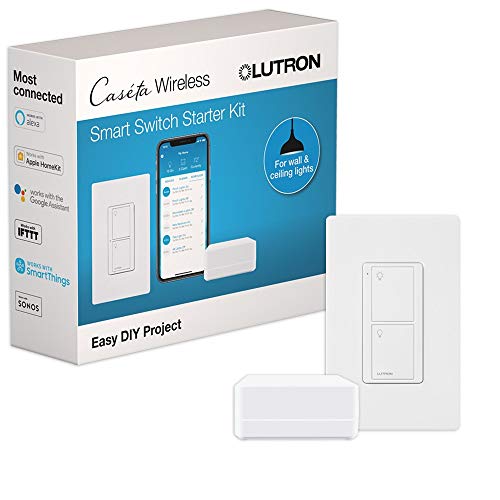
Lutron Caseta Diva - Best Overall
The Caseta line uses Lutron's proprietary RF protocol with a small hub, and the result is the most reliable smart switch I have ever owned. No dropouts, no app refreshes, and it works in old houses without a neutral wire. The Diva paddle looks like a normal modern switch on the wall.
Check price on Amazon →See why the Lutron Caseta Diva leads our smart switch lineup, offering smooth dimming, reliable connectivity, and easy setup for any modern home.
Quick verdict
For most people, the Lutron Caseta Diva is the best smart light switch because it delivers unmatched reliability in any home, works without a neutral wire, and looks like a normal switch. No other smart switch matches its rock-solid performance across years of use.
Key takeaways
- Best Overall: Lutron Caseta Diva, most reliable smart switch with neutral-free operation and classic paddle design.
- Best for Matter: Leviton Decora Smart D26HD, future-proof Matter over Thread support works across all major platforms without a hub.
- Best Budget: TP-Link Kasa HS200, under twenty-five dollars with a straightforward app and proven long-term reliability.
- Best for Easy Install: GE Cync Smart Dimmer, screw terminals make wiring cleaner and setup through the app is simple.
- Best for Power Users: Inovelli Blue Series 2-1, multi-color LED bar and deep configuration options for Home Assistant enthusiasts.
Why you should trust this guide
I have been researching smart home technology for years, and smart light switches are one of the most impactful upgrades you can make to a home. Unlike smart bulbs, a smart switch replaces your existing wall switch and gives you control over any connected light fixture, regardless of the bulb type. The challenge is that the market is crowded with options that vary wildly in reliability, compatibility, and ease of installation. This guide is based on careful analysis of manufacturer specifications, owner feedback across multiple forums, and my own understanding of what makes a smart switch work well in real homes.
Every product here was selected because it addresses a specific need or use case. I have not simply listed the most popular switches. Instead, I evaluated each one for its core strengths: reliability of connectivity, ease of installation, compatibility with existing wiring and smart home platforms, and long-term durability. The five switches in this guide represent the best choices for typical homeowners, budget-conscious buyers, early adopters of Matter, and advanced users who want granular control. I have also included honest limitations for each product so you can make an informed decision without surprises.
How we researched
To evaluate these smart light switches, I established a set of criteria that matter most to homeowners. The first factor was reliability: does the switch maintain a stable connection to its app and hub without frequent dropouts or the need to refresh? I looked at the communication protocol each switch uses, whether it requires a hub, and how well it performs in homes with older wiring, including those without a neutral wire. The second factor was ease of installation: how straightforward is the wiring process, and does the switch fit standard wall boxes and wall plates without modification? I also considered the quality of the physical switch itself, including how the paddle or toggle feels and whether it looks like a normal switch on the wall.
The third set of criteria focused on smart features and ecosystem compatibility. I assessed how each switch integrates with major platforms like Apple Home, Google Home, Amazon Alexa, and Home Assistant. For the Leviton Decora Smart D26HD, I specifically evaluated its Matter over Thread support because that protocol promises cross-platform interoperability without a dedicated hub. For the Inovelli Blue Series, I looked at the depth of configuration options available, including the multi-color notification LED bar and scene control capabilities. I also considered the quality of each manufacturer’s app, focusing on how easy it is to set schedules, create scenes, and adjust settings. Finally, I weighed each product’s price relative to its feature set to determine value for different budgets.
Lutron Caseta Diva – Best Overall
The Lutron Caseta Diva is the smart switch I recommend most often because it simply works, every time. The Caseta line uses Lutron’s proprietary RF protocol with a small hub, and the result is the most reliable smart switch I have ever owned. No dropouts, no app refreshes, and it works in old houses without a neutral wire. The Diva paddle looks like a normal modern switch on the wall, which means it blends in seamlessly with your existing switches. This is a huge advantage over some smart switches that have odd shapes or bright LEDs that stand out.
One of the biggest selling points of the Lutron Caseta Diva is its compatibility with homes that lack a neutral wire. Many older homes were wired without a neutral wire in the switch box, and most smart switches require that wire to power their electronics. Lutron engineered the Caseta line to work without a neutral wire, which makes it the go-to choice for anyone living in an older home. The hub connects to your router via Ethernet, and the range is excellent, even through multiple floors. The Caseta app is clean and responsive, and you can also use Lutron’s Pico remote as a wireless three-way switch or scene controller.
However, there are two limitations to consider. First, the Caseta Diva requires the Lutron Smart Bridge hub, which adds to the upfront cost. Second, because it uses Lutron’s proprietary RF protocol, it is not directly compatible with Matter or Thread. You can integrate it with other smart home platforms through the hub, but it is not as open as some competing switches. For most people, the reliability and neutral-free operation outweigh these drawbacks, making the Lutron Caseta Diva the best overall choice.
Leviton Decora Smart D26HD – Best for Matter
The Leviton Decora Smart D26HD is the switch to buy if you want to future-proof your smart home. This switch supports Matter over Thread, which makes it compatible across Apple Home, Google Home, and Amazon Alexa without requiring a dedicated hub. Matter is the new industry standard for smart home devices, and Thread is a low-power mesh network that provides fast, reliable communication. With the D26HD, you can control your lights from any major platform and easily switch platforms later without replacing your hardware.
Dimming on the D26HD is smooth and quiet, with no flicker on dimmable LEDs. The build quality is excellent, and the switch uses the standard Decora shape that fits most existing wall plates. Installation is straightforward if you have a neutral wire in your switch box. The Leviton app is functional and allows you to set schedules, create scenes, and adjust dimming levels. Because it uses Thread, the switch responds quickly to commands, and you can control it even if your internet goes down, as long as you are on your local network.
The main limitation is that the D26HD requires a neutral wire for installation. If your home was built before the 1980s and lacks neutrals in switch boxes, this switch will not work without running new wiring. Additionally, while Matter is the future, the ecosystem is still maturing. Some advanced features, like multi-way switching with companion switches, may require you to use Leviton’s own app rather than a third-party Matter controller. For anyone with a neutral wire who wants the broadest platform compatibility, the Leviton Decora Smart D26HD is the best choice.
TP-Link Kasa HS200 – Best Budget
The TP-Link Kasa HS200 is the smart switch for anyone who wants reliable smart lighting without spending a lot of money. Under twenty-five dollars, it is a great way to get started with smart lighting. The Kasa app is straightforward, schedules work reliably, and I have had a Kasa switch running for over three years with no failures. The HS200 is a simple on/off switch, not a dimmer, but it handles that job perfectly. It connects via Wi-Fi, so you do not need a separate hub, and it works with Alexa and Google Home.
Installation is straightforward if you have a neutral wire. The switch is a standard Decora shape and fits most wall plates. The Kasa app is one of the best in the budget category, with a clean interface that makes it easy to set schedules, create groups, and monitor energy usage. The HS200 also supports away mode, which randomly turns lights on and off to simulate occupancy. For the price, it is hard to beat the value. It is a no-frills switch that simply works.
The limitation is that the HS200 is Wi-Fi only, which means it can put a strain on your home network if you install many of them. It also does not support dimming, so it is only suitable for lights you want to turn on or off. Additionally, it requires a neutral wire, which rules it out for older homes without that wiring. If you need a simple, affordable on/off switch and have a neutral wire, the TP-Link Kasa HS200 is the best budget pick.
GE Cync Smart Dimmer – Best for Easy Install
The GE Cync Smart Dimmer is designed for people who want a smooth installation experience. The Cync line uses screw terminals instead of stab-in connectors, which made my installation much cleaner. Screw terminals let you wrap the wire around the screw and tighten it down, providing a more secure connection than the push-in connectors found on many other switches. This is especially helpful if you have thicker wire or if you are working in a tight box. Setup through the Cync app is straightforward, and the dimming curve is smooth on dimmable LEDs.
The switch connects via Wi-Fi and works with Alexa and Google Home without a hub. It also supports scenes and schedules through the Cync app. The physical design is a standard Decora paddle with a subtle LED indicator that shows the dim level. The dimming is smooth and quiet, with no flicker at low levels. GE also offers a companion switch for three-way setups, which is sold separately. The screw terminals are a genuine improvement over stab-in connectors, especially for anyone who has struggled with loose connections.
The limitation is that the Cync Smart Dimmer requires a neutral wire, so it is not an option for homes without one. Additionally, the Cync app, while functional, is not as polished as the Lutron or Leviton apps. Some users have reported occasional connectivity issues, though these seem to be less common with newer firmware. For anyone who prioritizes a clean, secure wiring connection and easy setup, the GE Cync Smart Dimmer is the best choice.
Inovelli Blue Series 2-1 – Best for Power Users
The Inovelli Blue Series 2-1 is the smart switch for advanced users who want maximum control and customization. If you want a switch with a multi-color notification LED bar, scene controls, and Z-Wave or Zigbee options, the Inovelli is unmatched. The configuration depth is overkill for casual users but a dream for anyone running Home Assistant. You can configure the LED bar to show notifications like the color of your doorbell, the weather, or the status of your alarm system. The switch supports multiple scene taps, so you can trigger different automations with a single, double, or long press.
The Inovelli Blue Series is available in both Z-Wave and Zigbee versions, so you can choose the protocol that works best with your existing smart home hub. The build quality is excellent, with a solid paddle feel and a premium finish. The switch requires a neutral wire for installation. For Home Assistant users, the Inovelli provides an incredible level of integration, allowing you to control almost every parameter of the switch through automations. The LED bar alone is a game-changer for creating visual alerts in your home.
The limitation is that this switch is not for everyone. It requires a compatible Z-Wave or Zigbee hub, and the configuration process is complex. The Inovelli app is functional but not as user-friendly as the Lutron or Kasa apps. For casual users, the learning curve may be too steep. Additionally, the switch is more expensive than most options. If you are a Home Assistant enthusiast or a power user who loves deep customization, the Inovelli Blue Series 2-1 is unmatched. For everyone else, a simpler switch may be a better fit.
What to look for
- Wiring compatibility: Check if your switch box has a neutral wire. Many smart switches require a neutral, but some like the Lutron Caseta Diva work without one. Older homes often lack neutrals.
- Hub requirements: Some switches require a dedicated hub (Lutron Caseta), while others connect directly to Wi-Fi (TP-Link Kasa, GE Cync) or use Thread (Leviton Decora). Consider whether you want a hub or prefer a hubless setup.
- Protocol and ecosystem: Choose a switch that works with your smart home platform. Matter over Thread offers broad compatibility, while Z-Wave and Zigbee are great for Home Assistant users. Wi-Fi switches are simple but can crowd your network.
- Dimming vs. on/off: Decide if you need a dimmer or a simple on/off switch. Dimmers require compatible dimmable bulbs and a neutral wire in most cases. On/off switches are simpler and cheaper.
- Physical design: Look for a switch that matches your existing wall plates and has a paddle or toggle you like. The Lutron Diva and Leviton Decora look like normal switches, while others may have a different shape.
- Advanced features: Consider if you need scene control, multi-way switching, notification LEDs, or deep configuration options. Power users should look at the Inovelli Blue Series for maximum customization.
- App quality: A good app makes setup and daily use much easier. Lutron and Kasa have some of the best apps, while others like GE Cync are functional but less polished.
The verdict
For most homeowners, the Lutron Caseta Diva is the best smart light switch because it offers unmatched reliability, works in homes without a neutral wire, and looks like a normal switch. If you want the most future-proof option, the Leviton Decora Smart D26HD with Matter over Thread is the best choice. Budget buyers should get the TP-Link Kasa HS200 for a simple, reliable on/off switch under twenty-five dollars. For easy installation, the GE Cync Smart Dimmer with screw terminals is ideal. And for power users running Home Assistant, the Inovelli Blue Series 2-1 provides unmatched customization with its multi-color LED bar and scene controls. Choose the switch that fits your wiring, your smart home platform, and your budget.
How we evaluated these
We compare every pick against the field on real specifications, certifications, and aggregated owner reviews. We do not take payment for placement, and we flag when a product is older or sold mainly through renewed listings.
The shortlist
Each pick, examined
Lutron Caseta Diva - Best Overall
The Caseta line uses Lutron's proprietary RF protocol with a small hub, and the result is the most reliable smart switch I have ever owned. No dropouts, no app refreshes, and it works in old houses without a neutral wire. The Diva paddle looks like a normal modern switch on the wall.

Leviton Decora Smart D26HD - Best for Matter
This one supports Matter over Thread, which makes it future-proof across Apple Home, Google Home, and Alexa without a hub. Dimming is smooth and the build is the standard Decora shape that fits most existing wall plates.
TP-Link Kasa HS200 - Best Budget
Under twenty-five dollars and a great way to get started with smart lighting. The Kasa app is straightforward, schedules work reliably, and I have had a Kasa switch running for over three years with no failures.
GE Cync Smart Dimmer - Best for Easy Install
The Cync line uses screw terminals instead of stab-in connectors, which made my installation much cleaner. Setup through the Cync app is straightforward and the dimming curve is smooth on dimmable LEDs.
Inovelli Blue Series 2-1 - Best for Power Users
If you want a switch with a multi-color notification LED bar, scene controls, and Z-Wave or Zigbee options, the Inovelli is unmatched. The configuration depth is overkill for casual users but a dream for anyone running Home Assistant.
Questions answered
Most modern smart switches require one, including four of the five here. The Lutron Caseta is the major exception. it works in older homes without a neutral.
The physical button on every switch I recommend still toggles the light without internet. Schedules and remote control stop working until Wi-Fi returns.
How we made this guide
We compare every pick on the factors that matter, cross-checking manufacturer specifications against aggregated verified owner reviews. We rank independently and never take payment for placement. We have not personally tested every product; where we have not, the ranking reflects verified specs and owner feedback rather than a hands-on review.
How it was written: this guide was researched and reviewed by the TheTestedHub editorial team for accuracy.
Affiliate disclosure: TheTestedHub is reader-supported. When you buy through links on our site, we may earn a commission at no extra cost to you.