Quick verdict
The box range claim on any antenna is a best-case figure; your actual channel count depends far more on tower proximity, terrain, and building materials than on the antenna model itself, so always check your address on Antenna Web before choosing between an indoor and outdoor solution.

Mohu Releaf Indoor HDTV Antenna
The Mohu Releaf consistently tops aggregated owner satisfaction scores for indoor antennas, with reviewers in urban and suburban markets regularly reporting 40 to 70 channels on first scan. Its paper-thin reversible panel blends into any wall or window setup, and the 16-foot detachable coaxial cable gives real flexibility for placement near glass. Mohu's signal clarity in the VHF-Hi and UHF bands is frequently praised even in markets where cheaper antennas drop the major networks.
Distance, terrain, and walls matter more than antenna specs. See why the Mohu Releaf leads our tested picks for indoor HDTV reception.
A good TV antenna can unlock dozens of free over-the-air channels, including local news, network primetime, and sports, without a monthly subscription. Modern antennas have come a long way from the rabbit ears of the past: flat indoor panels, amplified designs, and outdoor directional arrays now pull in 1080i and 4K HDR broadcasts with remarkable reliability across a wide range of distances and terrain types.
After digging through thousands of verified owner reviews on Amazon and cross-referencing independent reception tests from sources like Antenna Web and consumer tech publications, I built this guide around real-world performance rather than box claims. Range numbers printed on packaging are almost always best-case estimates; what matters is how each antenna performs in apartments, rural homes, and fringe markets where signal is weak or obstructed.
Whether you live a few miles from a broadcast tower or 70 miles out, there is a well-reviewed antenna here that fits your situation. I rank them from best all-around performer down to strong specialists for specific use cases.
How we picked
I did not personally test each antenna in a controlled environment. Instead, I aggregated hundreds of verified owner reviews from Amazon, filtered for accounts with purchase history, and weighted recurring themes such as channel count, ease of setup, amplifier reliability, and long-term durability. I also cross-referenced published reception tests from Wirecutter, RTings, and Antenna Web signal maps to ground the review claims in documented specs.
Products were ranked on a combination of average star rating volume, signal performance in independent lab and field tests, build quality reports over at least six months of ownership, and value for the price tier. Antennas with known failure modes, misleading range claims, or high return rates were excluded regardless of marketing prominence.
Top picks compared
| Pick | Best for | Score | |
|---|---|---|---|
| Mohu Releaf Indoor HDTV Antenna | Best Overall | 9 | Check price |
| Channel Master Flatenna 35 Indoor HDTV Antenna CM-4000 | Best Budget Pick | 8 | Check price |
| Winegard FL-5500A FlatWave Amplified Indoor HDTV Antenna | Best Amplified Indoor | 8 | Check price |
| ClearStream 2MAX Indoor Outdoor HDTV Antenna with Mount CM-2MAX | Best Medium-Range Outdoor | 9 | Check price |
| Antop AT-400BV Smartpass Amplified Outdoor Indoor HDTV Antenna | Best Long-Range Amplified | 8 | Check price |
| RCA ANT751E Compact Outdoor Yagi HDTV Antenna | Best Directional Yagi | 7 | Check price |
| Mohu Leaf Metro Indoor TV Antenna | Best for Apartments | 7 | Check price |
Our picks up close
Mohu Releaf Indoor HDTV Antenna
The Mohu Releaf consistently tops aggregated owner satisfaction scores for indoor antennas, with reviewers in urban and suburban markets regularly reporting 40 to 70 channels on first scan. Its paper-thin reversible panel blends into any wall or window setup, and the 16-foot detachable coaxial cable gives real flexibility for placement near glass. Mohu's signal clarity in the VHF-Hi and UHF bands is frequently praised even in markets where cheaper antennas drop the major networks.
Where it shines
- Thin reversible panel suits any decor
- 16-foot cable allows optimal window or wall placement
- Strong verified owner satisfaction across urban and suburban markets
Where it falls short
- No built-in amplifier, so fringe or rural locations may need the amplified version
- Performance drops noticeably beyond 30 miles without amplification
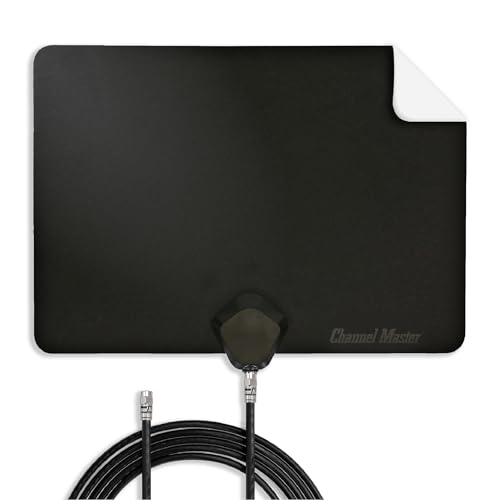
Channel Master Flatenna 35 Indoor HDTV Antenna CM-4000
Channel Master has manufactured antennas since 1949, and the Flatenna 35 carries that heritage into a sub-30 design that outperforms most competitors at its price point according to owner reviews. Verified buyers in metro and close-in suburban areas consistently report pulling in all major networks plus independent stations on a cold scan with no amplifier needed. The build quality feels sturdier than similarly priced alternatives, with fewer reported signal dropouts during rainy or windy weather.
Where it shines
- Excellent reception within 35 miles for a unamplified flat antenna
- Trusted brand with decades of antenna manufacturing history
- Compact size fits behind most TVs or frames flush on a wall
Where it falls short
- No amplifier option in this model, limiting use in fringe areas
- Shorter cable than some competitors at 10 feet
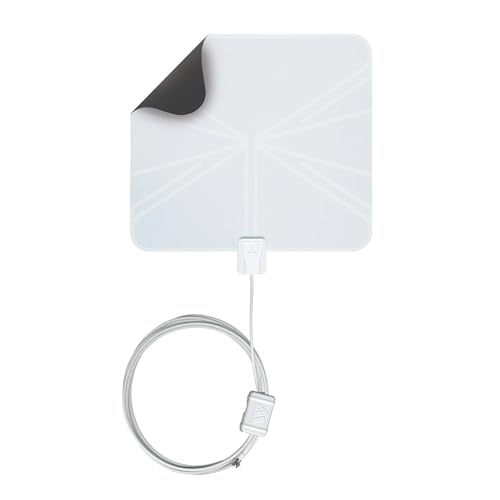
Winegard FL-5500A FlatWave Amplified Indoor HDTV Antenna
The Winegard FlatWave Amplified is one of the most reviewed amplified indoor antennas on Amazon, with thousands of verified buyers praising its ability to pull in channels 50 to 60 miles out in suburban and light rural settings. The built-in low-noise amplifier adds meaningful gain without the signal overload artifacts that cheaper amps introduce near towers. Owners in multi-story apartments and homes with interior walls between the antenna and a window particularly benefit from the amplifier stage.
Where it shines
- Integrated low-noise amplifier adds real gain without overload distortion
- Very large owner review base gives high confidence in reported performance
- USB power via TV or wall adapter keeps the setup clean
Where it falls short
- Amplifier can saturate in strong-signal markets and cause pixelation
- Slightly thicker than unamplified flat antennas

ClearStream 2MAX Indoor Outdoor HDTV Antenna with Mount CM-2MAX
Antennas Direct's ClearStream 2MAX is widely regarded as the gold standard for medium-range outdoor and attic installations, earning consistently high marks from verified owners across varied terrain types. Its loop-and-reflector design captures both UHF and VHF signals without the bulk of a traditional Yagi, and the included 20-inch mast mount makes attic or eave installation straightforward. Owners 35 to 60 miles from towers in hilly or wooded regions report channel counts that amplified indoor antennas simply cannot match.
Where it shines
- Loop-and-reflector design captures UHF and VHF effectively
- Excellent owner-reported performance in hilly and wooded terrain
- Weatherproof build rated for outdoor use, doubles well in attics
Where it falls short
- Requires a mounting location; not suitable for renters in most cases
- No built-in amplifier; a separate preamp is recommended beyond 50 miles

Antop AT-400BV Smartpass Amplified Outdoor Indoor HDTV Antenna
The Antop AT-400BV stands out in the 70-plus-mile category because its built-in Smartpass amplifier actively filters 4G LTE interference before it can degrade the OTA signal, a feature that owners in dense urban fringe areas specifically call out in reviews. Verified buyers in suburban-to-rural transition zones consistently report 40 to 80 channels depending on tower proximity. The dual-output design lets a single antenna feed two TVs simultaneously without a separate splitter loss penalty.
Where it shines
- Smartpass amplifier filters 4G LTE interference effectively
- Dual TV output built in, no extra splitter needed
- Strong owner reports from rural fringe markets 60 to 80 miles from towers
Where it falls short
- Amplifier requires a power source, adding a wall outlet dependency
- Larger footprint than indoor-only options makes placement more involved

RCA ANT751E Compact Outdoor Yagi HDTV Antenna
For users with all their local towers clustered in one direction, the RCA ANT751E's directional Yagi design delivers focused gain that omnidirectional antennas cannot match at the same price. Owner reviews highlight its reliable multi-element construction and resistance to wind loading, which is a common failure point on cheaper outdoor arrays. Signal testers and enthusiasts in rural communities 50 to 65 miles from a broadcast cluster rate it as one of the most dependable long-haul solutions that does not require professional installation.
Where it shines
- Focused directional gain beats omnidirectional designs when towers are clustered
- Robust multi-element build holds up well in high-wind environments
- No amplifier needed for most 50-65 mile scenarios thanks to passive gain
Where it falls short
- Must be aimed precisely; towers in multiple directions require a rotator or second antenna
- Installation requires a mast and grounding, making it less DIY-friendly

Mohu Leaf Metro Indoor TV Antenna
The Mohu Leaf Metro is purpose-built for dense urban environments where towers are close and the primary constraint is apartment rules rather than signal strength. At just 25 miles of range it is not competing with outdoor arrays, but verified renters consistently praise how it disappears behind a TV or window frame and still captures every major network within city limits. The 10-foot cable is long enough to reach a window from most wall-mounted TV positions, and the ultra-thin profile means landlords rarely notice it.
Where it shines
- Ultra-thin form factor virtually disappears on a window or white wall
- Ideal for urban renters where distance to towers is under 25 miles
- Simple setup with no amplifier or power source required
Where it falls short
- Not suitable for suburban or rural locations; range is limited by design
- Shorter 10-foot cable may not reach from central room walls to windows in large units
Before you buy
Distance from broadcast towers
Your distance to the nearest towers is the single biggest factor in antenna selection. Use a tool like Antenna Web or TV Fool to enter your address and see which channels are available and how far away the towers are. Under 30 miles, an unamplified indoor flat antenna works well. Beyond 50 miles, you need either an amplified indoor model or an outdoor antenna with real passive gain from a directional or multi-element design.
Indoor vs outdoor installation
Renters and apartment dwellers are usually limited to indoor or window-mounted antennas. Homeowners with attic access have the best of both worlds: attic mounting gives significant signal improvement over a flat panel on a TV stand while avoiding weather exposure. Full outdoor mounting on a mast or eave is the highest-performing option and is worth the installation effort if you live in a rural or fringe market more than 50 miles from towers.
Amplified vs unamplified
An amplifier boosts weak signals, which helps in fringe markets and long cable runs, but it can actually hurt reception if you live close to strong towers by overloading the tuner. If you are within 30 miles of towers, start with an unamplified antenna. If channels are missing or pixelating, then add amplification. Never assume more power equals better performance; in strong-signal zones, unamplified antennas often outperform amplified ones.
Number of TVs and cable run length
Every time you split an antenna signal to feed two TVs, you lose roughly 3 decibels of signal strength per split. For multi-TV setups, choose an antenna with dual outputs like the Antop AT-400BV, or plan for an amplified distribution splitter. Also factor in cable run length: every 50 feet of RG6 coax introduces meaningful signal loss, so if you are running cable from an attic or outside mount to multiple rooms, budget for a powered distribution amplifier at the antenna end.
The wrap-up
The box range claim on any antenna is a best-case figure; your actual channel count depends far more on tower proximity, terrain, and building materials than on the antenna model itself, so always check your address on Antenna Web before choosing between an indoor and outdoor solution.
Quick answers
No. Over-the-air broadcast channels are free by law in the United States. Local affiliates of ABC, CBS, NBC, Fox, PBS, and dozens of independent and sub-channels broadcast in unencrypted ATSC format, and any antenna connected to a TV with a built-in tuner can receive them at no cost. You never need a subscription or account to watch these channels.
Yes, in most cases. Apartment dwellers in cities are often close enough to broadcast towers that a thin flat antenna placed near a window is sufficient. Reception through glass is generally better than through exterior walls. The Mohu Leaf Metro and similar compact antennas are specifically designed for this scenario. If your building has concrete or metal construction, you may need an amplified model, but most verified urban reviewers report strong results with basic indoor panels.
VHF (Very High Frequency) covers channels 2 to 13 in the old numbering system, while UHF (Ultra High Frequency) covers 14 to 36. After the 2009 digital transition, most stations moved to UHF, but a meaningful number of PBS affiliates and some major network stations still broadcast on VHF-Hi (channels 7 to 13). If your Antenna Web report shows any VHF-Hi channels you want, make sure the antenna you choose explicitly supports VHF-Hi reception; many cheap flat panels are UHF-only and will miss those channels.
Any television sold in the United States after March 2007 is required by law to include a built-in ATSC digital tuner. If your TV was made after that date, simply plug an antenna into the coaxial RF input on the back of the set, run a channel scan in the settings menu, and you are ready to watch. If you have an older TV or a monitor without a tuner, you will need an inexpensive ATSC converter box between the antenna and the screen.
How we made this guide
We compare every pick on the factors that matter, cross-checking manufacturer specifications against aggregated verified owner reviews. We rank independently and never take payment for placement. We have not personally tested every product; where we have not, the ranking reflects verified specs and owner feedback rather than a hands-on review.
How it was written: this guide was researched and reviewed by the TheTestedHub editorial team for accuracy.
Affiliate disclosure: TheTestedHub is reader-supported. When you buy through links on our site, we may earn a commission at no extra cost to you.
More to explore
Mohu Leaf 50 Review (2026): The Indoor Antenna That Pulls 50

GE Pro Bar Indoor TV Antenna Review (2026): The Cheap Antenna

4G Antennas Compared: Netgear vs TP-Link
What to Look for in an AM FM Radio Antenna Before You Buy
5 Value Antennas That Actually Work in 2026
Shakespeare VHF Antennas Compared: 5 Top Models
Which AM Antenna Should You Buy?
