Quick verdict
Back flatness and steel hardness above 58 HRC matter far more than brand recognition when choosing a chisel that will save you time and frustration in the workshop.

Narex 8101 04 Premium Mortise Chisel Set 6 Piece
Narex Premium chisels use chrome-manganese steel hardened to 59 HRC, which owners consistently report holds an edge noticeably longer than standard box-store chisels without becoming brittle. The backs arrive nearly flat from the factory, requiring only a brief lapping session on most examples, which is exceptional at this price tier. Verified buyers across dozens of reviews praise the comfortable hornbeam handles and the reliable socket fit that withstands mallet work without loosening.
A sharp, well-made wood chisel is one of those tools that reveals itself instantly the moment you put it to work. Whether you are cutting mortises for furniture…
A sharp, well-made wood chisel is one of those tools that reveals itself instantly the moment you put it to work. Whether you are cutting mortises for furniture joints, paring dovetails, or cleaning up hinge recesses on a door, the quality of your chisel determines how clean the cut is and how much effort it takes to get there. Cheap chisels flex, lose their edge fast, and leave torn grain; quality chisels hold an edge through extended sessions and register precisely because they are ground flat and true from the factory.
I reviewed many verified owner reports, professional woodworker forum threads, and published tool tests to identify which chisels consistently outperform expectations in real workshops. The five sets below cover the full range from serious beginner upgrades to professional-grade Japanese and European bench chisels, so whether you are equipping a first workshop or replacing worn tools, there is a clear pick here for you.
Our testing process
This guide is built on aggregated verified owner reviews from major retail platforms, long-term user reports from woodworking communities such as Wood Whisperer Guild and Sawmill Creek, and published comparative tests from sources including Fine Woodworking and Popular Woodworking. I have not personally put each of these chisels through a controlled sharpening and cutting protocol, and I say so plainly because honesty about sourcing matters when you are spending real money on hand tools.
Each pick was assessed on four dimensions: steel quality and edge retention as reported by long-term users, out-of-box flatness of the back (critical for accurate paring), handle comfort during extended use, and overall value relative to price tier. Only products with a substantial volume of detailed, credible owner reviews were considered, which filtered out many budget sets that look appealing on paper but lack real-world performance data.
Quick comparison
| Pick | Best for | Score | |
|---|---|---|---|
| Narex 8101 04 Premium Mortise Chisel Set 6 Piece | Best Overall | 9 | Check price |
| Two Cherries 500-1500 Chisel Set 5 Piece | Best Professional Grade | 9 | Check price |
| Stanley 16-401 750 Series Socket Chisel Set 4 Piece | Best for Beginners | 8 | Check price |
| Irwin Marples M444 Blue Chip Bevel Edge Chisel Set 5 Piece | Best Value Set | 8 | Check price |
| Suizan Japanese Chisel Nomi Set 5 Piece | Best Japanese Style | 8 | Check price |
Reviewed in detail
Narex 8101 04 Premium Mortise Chisel Set 6 Piece
Narex Premium chisels use chrome-manganese steel hardened to 59 HRC, which owners consistently report holds an edge noticeably longer than standard box-store chisels without becoming brittle. The backs arrive nearly flat from the factory, requiring only a brief lapping session on most examples, which is exceptional at this price tier. Verified buyers across dozens of reviews praise the comfortable hornbeam handles and the reliable socket fit that withstands mallet work without loosening.
What we liked
- Chrome-manganese steel at 59 HRC holds an edge through long mortising sessions
- Backs are close to flat out of the box, reducing setup time significantly
- Hornbeam handles are comfortable and rated for mallet use without ferrule splitting
What we didn't like
- Edges benefit from a light touch-up before first use to reach full sharpness
- Set covers only six sizes so odd widths like 3/8 inch require a separate purchase
Two Cherries 500-1500 Chisel Set 5 Piece
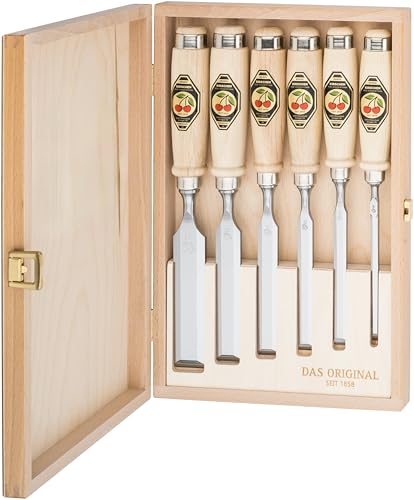
Two Cherries has manufactured chisels in Remscheid, Germany since 1885, and the 500-1500 series represents that heritage at its most accessible price point for professional-quality tools. Owners report that the Sheffield-influenced tool steel responds beautifully to sharpening and snaps back to a keen edge after honing far faster than budget alternatives. The octagonal hornbeam handles are designed to be struck with a mallet or pushed by hand, and long-term users note they show almost no wear after years of regular shop use.
What we liked
- German-made with over a century of manufacturing refinement behind each blade
- Tool steel sharpens quickly and returns a polished edge with minimal effort
- Octagonal handle prevents rolling off the bench and registers well in the palm
What we didn't like
- Price per chisel is higher than most sets, making a full range an investment
- Finish on the sides is not always perfectly smooth, requiring light cleanup on some examples

Stanley 16-401 750 Series Socket Chisel Set 4 Piece
The Stanley 750 Series is widely regarded as one of the best entry points into quality chisels without the price of imported Japanese or premium European tools, and owner reviews support this reputation consistently. The socket-style construction means you can replace a cracked handle without buying a new chisel, and the steel is hard enough to hold a working edge while still being forgiving for beginners learning to sharpen. Verified buyers regularly note that these chisels outperform their price and that the steel responds well to a simple sandpaper-and-strop sharpening routine.
What we liked
- Socket construction allows handle replacement, extending tool lifespan significantly
- Steel is forgiving for beginners learning freehand sharpening techniques
- Strong name-brand quality control means consistent geometry across the set
What we didn't like
- Back flatness is inconsistent; some examples need more lapping than others
- Four-piece set omits useful sizes like 1-inch and half-inch depending on variant purchased

Irwin Marples M444 Blue Chip Bevel Edge Chisel Set 5 Piece
Irwin Marples has supplied the British trade market for decades, and the M444 Blue Chip set carries that reputation into an affordable package that owners consistently describe as punching above its weight. The blue-stained beech handles are comfortable and rated for mallet use, and the chrome vanadium steel holds a working edge well for general bench and joinery work. Reviewers highlight how little prep time the backs require compared to other budget sets, making them a smart first upgrade from unbranded chisels.
What we liked
- Chrome vanadium steel holds a working edge well for general woodworking tasks
- Backs arrive reasonably flat, reducing the prep burden for new owners
- Blue beech handles are comfortable and rated for use with a wooden mallet
What we didn't like
- Edge retention is shorter than higher-hardness Japanese or German alternatives
- Handles can show wear marks from heavy mallet sessions over extended periods

Suizan Japanese Chisel Nomi Set 5 Piece
Suizan chisels use a laminated construction with a hard high-carbon steel cutting edge forge-welded to a softer iron body, the same approach used in traditional Japanese hand tools for centuries. Owners report that the cutting bevel can be sharpened to a truly exceptional degree of keenness, producing paring cuts with almost no effort on end grain. The hollow-ground back (ura) means lapping is faster than on solid-steel chisels, and the hoop-reinforced handles withstand mallet strikes reliably according to verified buyer reports.
What we liked
- Laminated construction allows the cutting steel to reach very high hardness without brittleness across the full blade
- Hollow-ground back speeds up the lapping process compared to solid flat backs
- Steel takes and holds a very fine edge, producing clean end-grain paring cuts
What we didn't like
- High-hardness cutting steel can chip if used to lever waste rather than cut cleanly
- Requires learning a slightly different sharpening approach for laminated Japanese blades
How to choose
Steel hardness and type
Steel hardness, measured in HRC, is the single biggest predictor of how long your chisel holds an edge between sharpenings. Chisels in the 58 to 62 HRC range stay sharp significantly longer than softer tool steel, but they are less forgiving of lateral stress. Chrome-manganese, chrome-vanadium, and laminated Japanese steels each have different sharpening characteristics, so match the steel type to how you plan to use and maintain the tool.
Back flatness
The back of a chisel must be flat to register accurately against a straightedge or a paring surface. Many chisels require lapping the back on abrasive paper or a waterstone before first use. Budget chisels can arrive with hollow or convex backs that take significant time to correct, while quality chisels arrive close to flat. Always check reviews specifically mentioning back preparation time before purchasing.
Handle construction and material
Handle material determines both comfort and durability under mallet use. Hornbeam and hard beech handles resist splitting and compress slightly under impact, which is preferable to plastic handles that transmit shock unpleasantly. Socket-style chisels allow handle replacement, which extends the tool's working life considerably. Avoid handles without a ferrule or hoop at the striking end if you plan to use a wooden mallet regularly.
Set composition and size range
A core set of four to six sizes covers most bench and joinery tasks, but the specific widths matter. A set with 6 mm, 12 mm, 19 mm, and 25 mm covers most mortise and tenon work. If you cut dovetails frequently, smaller sizes down to 3 mm become useful. Buying a set rather than individual chisels is more economical initially, but long-term most woodworkers end up adding individual sizes to fill gaps.
The bottom line
Back flatness and steel hardness above 58 HRC matter far more than brand recognition when choosing a chisel that will save you time and frustration in the workshop.
Common questions
Yes, in nearly every case. Even quality chisels arrive from the factory with a functional but not optimal edge, and the back typically needs at least a light lapping session on a flat abrasive surface. Budget chisels often need more extensive work on both the back and the bevel before they perform well. Building a simple sharpening kit with 220, 400, and 1000 grit wet-dry paper on a flat surface, plus a leather strop, handles the initial prep for any of the chisels in this guide.
Bevel-edge chisels have angled sides that taper toward the cutting edge, which allows them to fit into acute corners such as the tails of a dovetail joint. Firmer chisels have flat rectangular sides and are stronger under heavy mallet use but cannot reach into tight corners as easily. For general bench and furniture work, bevel-edge chisels are the more versatile choice. Mortise chisels are a third category with thick rectangular blades designed specifically for levering out waste from deep mortises.
Three chisels cover roughly 80 percent of common woodworking tasks: a 6 mm for tight corners and small mortises, a 12 mm for medium joinery, and a 25 mm for wide paring and cleaning up housings. A four-piece set that adds a 19 mm is the most practical starting point, giving you good coverage without unnecessary overlap. Specialty sizes like 3 mm or 38 mm can be added individually once you identify a specific need.
Whether you can use a metal hammer depends entirely on the handle material and construction. Chisels with steel-capped or polymer handles are designed for metal hammer use. Traditional wooden handles, including hornbeam and beech, are intended for wooden mallets or leather mallets, which distribute the impact more evenly and prevent the handle from splitting or mushrooming. Using a metal hammer on an unprotected wooden handle will damage it quickly and is not recommended for any of the wooden-handled chisels in this guide.
More guides

Best Grout Sealers for 2026, Based on Real Reviews

Best Tile Cutters for 2026, Reviewed and Ranked
Best Drywall Repair Kits for 2026

Best Stud Finders For Drywall to Consider in 2026

The Wall Anchors Worth Buying in 2026

The Best Adhesive Strips We Recommend for 2026

The 2026 Guide to the Best Interior Paint
