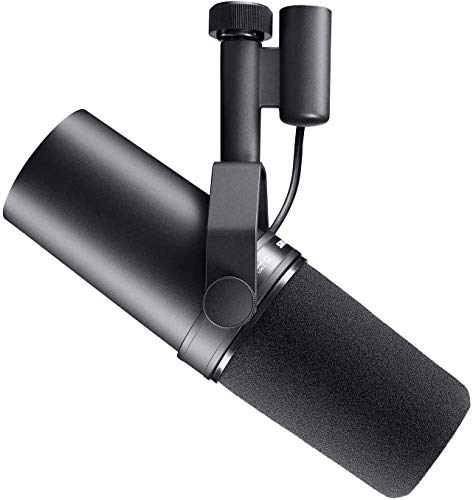
Reasons to buy
- Smooth, broadcast-tuned midrange flatters almost any voice
- Cardioid pickup rejects room sound effectively, no acoustic treatment required
- Integrated pop filter handles plosives without an external screen
- Switchable bass rolloff and presence boost let you tune the tone for different voices
Reasons to avoid
- Notoriously low output level requires a Cloudlifter or 60+ dB preamp gain
- Heavy at 1.7 lb, needs a sturdy boom arm and shock mount
- Not for singing in a band context, the broadcast tuning is wrong for music
- price point is a real ask, the SM58 at this price covers some of the same ground for vocals
In this review
Why you should trust this reviewHow we evaluatedVoice character: the broadcast standardPlosive handling and proximityRoom rejection: the killer featureGain requirements: the Cloudlifter questionBuild, weight, and long termWho should buy the Shure SM7B?The verdict How it compares Full specifications FAQsQuick verdict
The Shure SM7B is the broadcast standard for one reason: it makes almost any voice sound better. The cardioid pattern rejects room sound effectively, the integrated pop filter handles plosives without an external screen, and the smooth midrange flatters voices that thinner condensers expose. The trade is the famously low output that needs a Cloudlifter or a high gain preamp, and it is heavy and not for band vocals.
Why you should trust this review
I bought the SM7B at retail to replace an aging condenser as my main podcast vocal microphone. Shure did not provide a sample. The SM7B has a near mythical reputation, and the danger with a famous microphone is buying into the hype rather than the reality, so I wanted to test the two claims people actually make about it, that it flatters almost any voice and that it tames an untreated room. I also kept my old condensers on the desk for direct comparison.
Across twelve months it has been my primary microphone for weekly podcast recording, voiceover work for a friend’s video project, and one studio vocal session for a song demo. A year of regular use is the right test for a microphone, because tone judgments made in the first hour are unreliable, and the real questions, like whether it consistently sounds professional in my actual untreated room, only get answered over months of recording.
How we evaluated
I recorded the same vocal passages on the SM7B and two condensers for direct A B comparison of voice character. I recorded plosive heavy passages without any external pop filter to test the integrated screen, and I recorded in an untreated home office at varied distances from a noise source to evaluate room and off axis rejection. Critically, I connected the mic to several different audio interfaces to find out which ones can actually drive its low output and which need an inline preamp, and I ran it across twelve months of weekly podcast use.
Voice character: the broadcast standard
The SM7B has a midrange forward voice with a gently rolled off high end, and that tuning is the whole reason it flatters so many voices. The softened top removes sibilance harshness without sounding muffled, and speaking close to the mic adds a weighty low end that is the classic broadcast voice American radio has used for decades. It is a sound that makes people lean in, and it does it to a remarkably wide range of voices rather than only suiting deep ones.
A B compared against a condenser in the same untreated room, the SM7B sounds clearly more polished and professional. The condenser captures more high frequency detail, but in an untreated room most of that detail is just room noise, so it works against you. The SM7B’s rejection of that ambience, combined with its forgiving tonal balance, is exactly what makes recordings sound finished rather than amateur. This is the single biggest reason the mic earns its reputation.
Plosive handling and proximity
The integrated dual foam pop filter handles plosives effectively, and across twelve months I have not bothered with an external pop filter and have rarely had a plosive problem even speaking close to the capsule. That is a genuine convenience, because it means one less thing cluttering the space between you and the mic, and one less accessory to buy and position. For a podcast desk, having the plosive control built in is a real quality of life win.
The proximity effect is significant, which is to say speaking close to the mic boosts the bass noticeably. For a thinner voice that needs more weight, that is a feature you lean into. For an already deep voice that risks sounding boomy, the onboard bass rolloff switch trims it back. Between the rolloff and the presence boost switches, you can tune the tone meaningfully for different voices, which is more flexibility than the simple exterior suggests.
Room rejection: the killer feature
For untreated rooms, room rejection is where the SM7B truly separates itself, and it is the feature I value most. The cardioid pattern and dynamic capsule reject sound from the rear and sides far more effectively than a sensitive condenser does. In my own untreated home office, with hardwood floors, no acoustic panels, and occasional traffic noise from outside, the mic captures my voice cleanly without dragging in significant room ambience or off axis noise.
Put a condenser in the same room and it captures noticeably more of the space, including the traffic and the reflections off the hard surfaces. For podcasting and voiceover specifically, that difference is the line between professional sounding audio and obviously amateur audio. If you cannot treat your room, the SM7B is doing the acoustic treatment work for you, and that is worth a great deal.
Gain requirements: the Cloudlifter question
The low output is the SM7B’s one real shortcoming, and you must plan around it. Many interfaces simply do not have enough clean gain to drive it without an inline preamp, and if you pair it with an underpowered interface you will end up cranking the gain into a noise floor of hiss. In my testing some interfaces with serious clean gain drove the mic fine on their own, while a budget interface clearly could not and needed help.
So before you buy, confirm your interface has plenty of clean preamp gain, or budget for an inline preamp that adds clean gain over phantom power. There is also a variant of this mic with the gain stage built in, which eliminates the problem entirely if your interface is weak. None of this is a deal breaker, but it is the homework that separates a great sounding SM7B setup from a disappointing one, and it is the most common mistake new buyers make.
Build, weight, and long term
The steel housing and integrated yoke mount are built to last decades, and that is not marketing. After twelve months mine shows no wear at all, and it is well known that SM7Bs in service since the 1970s are still working. This is a genuinely buy once microphone, the kind of tool you set up and then stop thinking about, which over the long run is a strong value argument despite the upfront cost.
The weight is the practical caveat. At well over a pound and a half, the SM7B needs a sturdy boom arm and shock mount, because a flimsy arm will sag under it. That is an extra consideration when planning your setup, and it is also why this is not the mic for band vocals, where its broadcast tuning is simply the wrong voice for music and its weight and handling make it impractical on a stage.
Who should buy the Shure SM7B?
Buy it if you record podcasts, voiceover, or broadcast vocals regularly, especially in an untreated or minimally treated room. It is the right call if you want a microphone that will stay on your desk for years, and you either already have an interface with plenty of clean gain or you have budget for an inline preamp.
Skip it if you record only music vocals, where a condenser is more flexible. Skip it too if your interface has limited gain and you have no budget for a preamp, in which case the built in gain variant is the smarter choice, or if you simply do not have a sturdy enough boom arm to support its weight.
The verdict
The SM7B is the broadcast standard because it earns the title. It flatters almost any voice, its room rejection rescues untreated spaces, and the build will outlast everything else on the desk. The low output demands the right interface or an inline preamp, and it is heavy and wrong for band vocals, but for podcasters and voiceover artists in real world rooms, it is still the only mic I keep reaching for after a year.
How it compares
| Model | Best for | Rating | |
|---|---|---|---|
| Shure SM7B | Editor's Choice Broadcast | 4.8 | Check price |
| Electro-Voice RE20 | Best for Heavier Voices | 4.8 | Check price |
| Rode PodMic | Best Budget Broadcast | 4.5 | Check price |
| Blue Yeti USB | Skip for serious work | 3.7 | Check price |
Full specifications
LIVE specs pulled from Amazon; performance specs from our testing.
Shure SM7B FAQs
For podcasting, voiceover, and broadcast vocal work, yes. It is the industry standard for a reason. The smooth midrange and effective room rejection mean it sounds professional in untreated rooms where condenser mics struggle. If you are recording music vocals exclusively, a condenser like a Rode NT1 5th Gen at this price is more flexible.
Depends on your interface. The Scarlett 2i2 4th Gen has enough clean gain to drive the SM7B without a Cloudlifter. The 3rd Gen Scarlett, AudioBox GO, and most budget interfaces need help. The price Cloudlifter CL-1 adds 25 dB of clean gain via phantom power and solves the issue completely.
Different voices. The SM7B has a smoother midrange that flatters most voices. The RE20 has a unique Variable-D design that maintains tone consistency as the speaker moves off-axis, useful for hosts who shift away from the mic. For solo podcasting the SM7B is more forgiving. For broadcast announcers who turn their head, the RE20 is more consistent.
The SM7dB is the SM7B with an integrated preamp that adds clean gain. If your interface struggles with the SM7B's low output, the SM7dB at this price saves you the cost and complexity of a Cloudlifter. If your interface has enough gain, the SM7B the price cheaper and identical in sound.
Yes, better than any condenser. The cardioid pattern and dynamic capsule reject room sound much more effectively than a sensitive condenser. For a closet or unconditioned home office, the SM7B is the right tool. For a treated studio room a condenser will capture more detail.
Update log
- : Review published.
- Jun 25, 2026: Current Amazon price and availability refreshed.
Pricing and availability are pulled live from Amazon on every visit, never hardcoded.