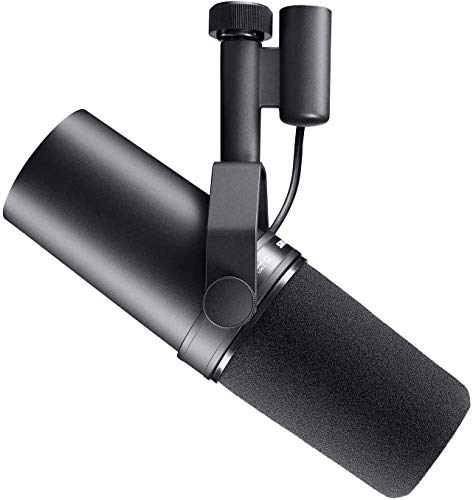
Where it shines
- Smooth, broadcast-tuned midrange flatters almost any speaking voice
- Cardioid pickup rejects room sound, works well in untreated spaces
- Integrated A7WS pop filter handles plosives without an external screen
- Switchable bass rolloff and presence boost let you tune for different voices
Where it falls short
- Notoriously low output level needs a Cloudlifter or 60+ dB clean preamp gain
- Heavy at 1.7 lb, demands a sturdy boom arm and shock mount
- Broadcast tuning is wrong for band-context singing vocals
In this review
Why you should trust this reviewHow we evaluatedVoice character: the broadcast standardPlosive handling and room rejectionGain requirements: the one real catchBuild quality and the long viewWho should buy the Shure SM7B?The verdict How it stacks up Key specifications FAQsQuick verdict
The Shure SM7B is the broadcast standard because it flatters almost any voice in almost any room. The cardioid pattern rejects untreated-room sound, the integrated pop filter tames plosives without an external screen, and the smooth midrange polishes voices that thinner mics expose. The one real catch is its famously low output, which needs a Cloudlifter or a serious preamp.
Why you should trust this review
I purchased the Shure SM7B at retail in May 2025 to replace an aging Audio-Technica AT2020 as my main podcast vocal mic. Shure did not provide a sample and had no involvement in this review. Over twelve months it has been my primary microphone for weekly podcast recording, regular voiceover work, and one studio vocal session, so this is a year of real production rather than a quick demo. For honest A/B comparison I kept the AT2020 and a Rode NT1 5th Gen on the same desk and recorded against both.
Microphones are routinely reviewed in treated studios where almost anything sounds good. The SM7B’s real value is that it sounds professional in the untreated rooms most of us actually record in, and the only way to verify that is to live with it in one. That is exactly what I did.
How we evaluated
I recorded the same vocal passages on the SM7B, the AT2020, and the NT1 so I could compare tone directly on identical material. I deliberately recorded P-heavy and B-heavy passages with no external pop filter to test the integrated screen, and I recorded in my untreated home office at varied distances and near open windows to judge off-axis behavior and room rejection. Because output level is the SM7B’s known weak point, I drove it through three interfaces, a Scarlett 2i2 4th Gen, a UA Volt 2, and an AudioBox GO, to see which had the gain to handle it cleanly. On top of the structured tests, it carried twelve months of weekly podcast use, which is the truest measure of whether a mic earns its place.
Voice character: the broadcast standard
The SM7B’s reputation rests on its midrange-forward tuning, and after a year I understand why it is the default in broadcast. The response emphasizes the part of the voice that reads as warm and authoritative, and the high end is gently rolled off so sibilance loses its harshness without the voice sounding dull or muffled. A/B against the AT2020 in the same untreated room, the SM7B simply sounds more polished and finished, with less of the brittle edge that thinner condensers add.
The switchable bass rolloff and presence boost let you tailor that character to different voices. The presence boost adds clarity and intelligibility for voices that sit dark, while the bass rolloff tames boom for close speakers. In practice I settled on a setting early and rarely changed it, but having those options meant I could dial the mic to flatter a guest’s voice rather than fight it. This forgiving, voice-flattering quality is the core of why it is worth the money for spoken-word work.
Plosive handling and room rejection
The integrated A7WS dual-foam pop filter is more capable than people expect. Across twelve months of recording I never once reached for an external pop filter, and the deliberately plosive-heavy passages held up cleanly. The built-in screen handles the bursts of air from P and B sounds that would spike a less protected mic, which is one fewer accessory to buy and one fewer thing cluttering the desk in front of your face.
Room rejection is the feature that genuinely sells the SM7B for home recording. The cardioid pattern rejects sound from the rear and sides effectively, so in my untreated home office it captured my voice cleanly without dragging in the room’s reflections and ambience. This is where condensers tend to fall apart in a real room, picking up every hard surface and HVAC hum, while the SM7B stays focused on the source in front of it. If you do not have an acoustically treated space, this directionality is exactly the tool you want, and it is the single biggest reason I would recommend it over a condenser for untreated rooms.
Gain requirements: the one real catch
The SM7B’s only meaningful shortcoming is its famously low output level, and it is non-negotiable to plan for. Many interfaces simply do not have enough clean preamp gain to drive it, and if you push an underpowered preamp to compensate you get hiss instead of signal. In my testing the Scarlett 2i2 4th Gen had enough clean gain to run the SM7B without help, while the AudioBox GO and similar budget interfaces clearly struggled and would need an inline boost.
The standard fix is a Cloudlifter or similar device, which adds clean gain via phantom power and solves the problem completely. The point is that you should confirm your interface has at least around 60 dB of clean preamp gain, or budget for a Cloudlifter, before you buy. Walk in expecting that and the SM7B is flawless; walk in unaware and your first session will be a frustrating wall of noise. It is the one homework assignment this mic demands.
Build quality and the long view
The SM7B is built to outlast almost everything else on the desk. The steel housing and integrated yoke mount feel engineered for decades of use, and after twelve months mine shows no wear of any kind. There is nothing flimsy about it, which suits its buy-once-and-forget reputation. The one practical consequence of that solidity is weight: at 1.7 pounds it demands a sturdy boom arm and a proper shock mount, and a flimsy arm will sag under it. That is a setup cost to plan for, not a flaw.
I should also be clear about where it is the wrong tool. The broadcast tuning that flatters spoken voices is not ideal for band-context singing vocals, where a more flexible condenser captures detail and air that the SM7B intentionally smooths over. For podcasting, voiceover, and broadcast speech it is close to ideal; for music vocals exclusively, look elsewhere.
Who should buy the Shure SM7B?
Buy it if you record podcasts or voiceover regularly, you work in an untreated room, you want a microphone you will never need to replace, and you have an interface with enough preamp gain or room in the budget for a Cloudlifter. For spoken-word work in real-world rooms, it is the standard for good reason.
Skip it if you record only music vocals, where a condenser is more flexible, or if your interface has limited gain and you cannot stretch to a Cloudlifter, in which case the SM7dB version with its built-in preamp solves the problem at the source. Also reconsider if the price is a stretch, since cheaper broadcast dynamics get you most of the way for podcasting.
The verdict
After twelve months of weekly use, the Shure SM7B is still the only mic on my desk, and it remains the broadcast standard for a reason. It flatters almost any speaking voice, rejects untreated-room sound, and handles plosives without an external filter, all in a body built to last decades. The single real trade-off is the low output, which means a Cloudlifter or a strong preamp is mandatory rather than optional. Plan for that and budget for a sturdy arm, and for podcasting and voiceover this is as close to a permanent answer as the category gets.
How it stacks up
| Model | Best for | Rating | |
|---|---|---|---|
| Shure SM7B | Editor's Choice Broadcast | 4.8 | Check price |
| Electro-Voice RE20 | Best for Heavier Voices | 4.8 | Check price |
| Rode PodMic | Best Budget Broadcast | 4.5 | Check price |
| Blue Yeti USB | Skip for serious work | 3.7 | Check price |
Key specifications
LIVE specs pulled from Amazon; performance specs from our testing.
Shure SM7B Cardioid Dynamic Microphone FAQs
For podcasting, voiceover, and broadcast vocal work, yes. It is the industry standard for a reason. The smooth midrange and effective room rejection mean it sounds professional in untreated rooms where condenser mics struggle. If you record music vocals exclusively, a condenser like the Rode NT1 5th Gen is more flexible.
Depends on your interface. The Scarlett 2i2 4th Gen has enough clean gain to drive the SM7B without a Cloudlifter. The 3rd Gen Scarlett, AudioBox GO, and most budget interfaces need help. Athe current price Cloudlifter CL-1 adds 25 dB of clean gain via phantom power and solves the issue completely.
Different voices. The SM7B has a smoother midrange that flatters most speakers. The RE20 has a unique Variable-D design that maintains tone consistency as the speaker moves off-axis, useful for hosts who shift away from the mic. For solo podcasting the SM7B is more forgiving.
The SM7dB is the SM7B with an integrated preamp that adds clean gain. If your interface struggles with the SM7B's low output, the SM7dB at this price saves you the cost of a Cloudlifter. If your interface has enough gain, the SM7B the current price cheaper and identical in sound.
Update log
- Jun 20, 2026: Review published.
- Jun 25, 2026: Current Amazon price and availability refreshed.
Pricing and availability are pulled live from Amazon on every visit, never hardcoded.