A cheap graphics card is one of the smartest upgrades you can make to an aging or budget PC. Whether you are reviving an old office desktop, building a first gaming rig, or just need a second monitor output, the right inexpensive GPU can transform how a machine feels without forcing a full system rebuild. The trick is matching the card to the job, because “cheap” covers everything from capable 1080p gaming cards down to basic display adapters.
When shopping, look first at what you actually need: gaming demands real VRAM and a modern GPU architecture, while simple desktop or media use can run on a tiny low-profile card. Check your power supply, your case clearance, and the output ports your monitor uses. Get those three things right and a budget card will serve you well for years.

ASUS Dual NVIDIA GeForce RTX 3050 6GB GDDR6 OC Edition Gaming Graphics Card - PCIe 4.0, HDMI 2.1, DisplayPort 1.4a, 2-Slot Design, Axial-tech Fan Design, Steel Bracket, 3 Year Warranty
The ASUS Dual GeForce RTX 3050 6GB OC Edition is the strongest all-around budget pick, pairing a modern NVIDIA GPU with 6GB of GDDR6 for genuine 1080p gaming. Its dual-fan cooler and compact design make it an easy, reliable upgrade for almost any desktop.
- NVIDIA Ampere Streaming Multiprocessors: The all-new Ampere SM brings 2X the FP32 throughput and improved power efficiency.
- 2nd Generation RT Cores: Experience 2X the throughput of 1st gen RT Cores, plus concurrent RT and shading for a whole new level of ray-tracing performance.
- 3rd Generation Tensor Cores: Get up to 2X the throughput with structural sparsity and advanced AI algorithms such as DLSS. These cores deliver a massive boost in game performance and all-new AI capabilities.
- Axial-tech fan design features a smaller fan hub that facilitates longer blades and a barrier ring that increases downward air pressure.

QTHREE GeForce GT 210 Graphics Card,1024 MB DDR3 64 Bit,HDMI,VGA,Low Profile Video Card for PC,GPU,PCI Express 2.0 x16,SFF,Low Power
The QTHREE GeForce GT 210 is an ultra-low-cost, low-profile card with 1GB of DDR3 and both HDMI and VGA outputs for legacy and modern monitors. It is built purely to provide basic display output and revive older systems, not to game.
- The Geforce 210 is with a 589MHz core clock,up to 1066Mbps effective,perfect for working,video and photo editing,allows good fluency,which can effectively meet your needs.
- PCI Express 2.0 interface,offers compatibility with a range of systems. Also includes VGA and HDMI outputs for expanded connectivity,supports up to 2 monitors.Good for adding a simple low profile gpu to a small form factor pc.
- The computer graphics cards is small in size and saves more space,easy to install,plug and play,you can build a compact PC system easily for slim/ITX chassis.
- This low profile video card is good value option for entry level, if you just want basic upgrade graphics and daily simple work for your computer, or not be AAA gamer.(include low profile bracket)

GeForce GT 610 2G DDR3 Low Profile Graphics Card, PCI Express 1.1 x16, HDMI/VGA, Entry Level GPU for PC, SFF and HTPC, Compatible with Win11
The GeForce GT 610 2G DDR3 low-profile card offers HDMI and VGA connectivity in a compact PCI Express form factor for slim cases. It is a dependable basic display adapter for desktop, browsing, and media tasks rather than gaming.
- Powered by NVIDIA GeForce GT 610, 40nm chipset process with 523MHz core frequency, integrated with 2048MB DDR3 memory and 64-bit bus width
- Compatible with windows 11 system, no need to download driver manually
- HDMI / VGA 2 ports output available. HDMI Max Resolution-2560x1600, VGA Max Resolution-2048x1536
- Support DirectX 11, OpenCL, CUDA, DirectCompute 5.0

Kelinx AISURIX RX 580 Graphics Card, 2048SP, Real 8GB, GDDR5, 256 Bit, Pc Gaming Video Card, 2XDP, HDMI, PCI Express 3.0 with Freeze Fan Stop for Desktop Computer Gaming Gpu
The Kelinx AISURIX RX 580 packs a real 8GB of GDDR5 on a 256-bit bus, giving budget gamers a large VRAM buffer for 1080p play. It delivers a lot of memory and gaming capability for the money among older-generation value cards.
- 【Arctic Islands architecture and Superior Gaminig Experience】RX 580 8G is a mainstream gaming GPU built on the 14 nm process and based on the Polaris 20 graphics processor, in its Polaris 20 XTX variant,the video card supports DirectX 12. This ensures that all modern games will run on this RX 580. The gpu has equipped with 2048SP and 8GB GDDR5 memory with a 1750 MHz (8 GB), features to deliver the fastest, smoothest, most power-efficient gaming experiences for computer users.
- 【Multiple Interfaces and High Defination】The AISURIX 580 graphic card can hold up to 2 monitor and support ouput included 2X DisplayPort +1X HDMI. RX 580 is connected to the rest of the system using a PCI-Express 3.0 x16 interface which has higher resolution,show more character action details and clearer image quality, supports up to 4K display, delivers more higher definition pc gaming effect and experience.
- High Frame Rate Experience - The superior performance of 580 graphics card ends up the unstable game play and broken frames with fluid, artifact-free performance at virtually any frame rate. Enhanced contrast and color provide an incredibly sharp,colorful and vivid visual experience.
- 【low noise and Durable】This rx 580 8g pc gaming video card has semi-automatic intelligent fans system, which can automatically sense the GPU temperature. When the GPU temperature is low or under low load, the fans will automatically stop running, providing a comfortable office experience with zero noise and extended service life of this 8g graphic cards.
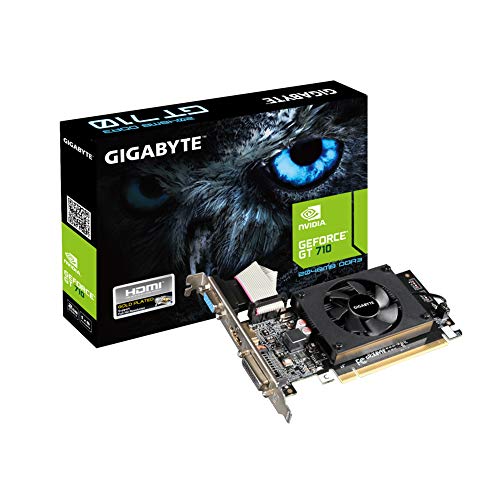
GIGABYTE 2GB RAM DDR3 SDRAM Video Graphics Cards GV-N710D3-2GL REV2.0 for Desktop
The GIGABYTE GV-N710D3-2GL REV2.0 with 2GB DDR3 is a polished, low-power display card from a trusted brand for desktop use. It is a clean, fanless-friendly choice for reliable everyday output rather than gaming performance.
- Core Clock: 954 MHz
- Low profile design
- Features Dual-link DVI-D/D-Sub/HDMI
- Form Factor: Low Profile.Avoid using unofficial software
Key buying factors
Decide upfront whether you want to play modern games or simply drive a monitor. Gaming requires a card with real GPU horsepower and adequate VRAM, while basic productivity, browsing, and media playback can run on a minimal card. Buying a gaming card for office work wastes money, and buying a display card for games leads to disappointment.
Video memory determines how comfortably a card handles textures and higher resolutions. Modern 1080p games increasingly want 6GB or more, while older titles and esports can manage on less. Display-only cards with 1GB or 2GB are fine for desktops but should never be expected to game.
Many cheap cards are specifically designed to draw power from the PCIe slot alone, meaning no extra connector is needed. This is a huge advantage for prebuilt and office PCs with weak power supplies. Always confirm whether a card needs a supplemental power cable before buying.
Low-profile cards fit slim, small-form-factor, and home-theater PCs that cannot accept full-height cards. Measure your available slot height and length before ordering. A card that does not physically fit is the most common avoidable mistake with budget GPUs.
Check whether you need HDMI, VGA, DisplayPort, or DVI, and confirm the card provides it. Older budget cards often include VGA for legacy monitors, while newer ones favor HDMI. Match the ports to your actual displays so you are not stuck buying adapters.
A newer architecture generally means better efficiency, features, and ongoing driver updates. Very old chips still work for basic tasks but receive limited driver attention going forward. For gaming, prioritize the most recent generation your budget allows.
Types explained
These cards pair a modern GPU with enough VRAM to play current games at 1080p with sensible settings. They are the entry point into genuine PC gaming and often run on the PCIe slot or a single power connector.
Best for: First-time gamers and anyone wanting playable modern 1080p performance on a budget.Compact, half-height cards built to fit slim and small-form-factor PCs. They focus on adding or upgrading display outputs rather than gaming muscle.
Best for: Slim office PCs, HTPCs, and multi-monitor setups that cannot fit a full-size card.Minimal GPUs designed to provide reliable video output and smooth desktop and media playback. They use little power and slot into almost any system.
Best for: Reviving older desktops or replacing a dead onboard graphics output.Previous-generation gaming GPUs with larger VRAM buffers that still handle many games at 1080p. They offer a lot of raw memory for the money but lack the newest features.
Best for: Bargain hunters who prioritize VRAM and older or less demanding game libraries.Care & usage tips
After physically installing the card, download the latest driver directly from the GPU vendor and do a clean install. If you are switching brands or generations, use a driver removal utility first to avoid conflicts and stuttering. Reboot once the installation completes.
Budget cards can run warm, especially in cramped or dusty cases. Ensure at least one intake and one exhaust fan are working and keep the card free of dust buildup. Good airflow extends the life of the fans and keeps performance stable under load.
Every few months, power down, unplug, and gently blow out the heatsink and fans with compressed air. Check that the card is still firmly seated in its slot and that any power connector is secure. This simple routine prevents most thermal and stability problems.
On a budget, VRAM capacity and slot power draw often matter more than raw GPU benchmark numbers. A card that runs entirely from the PCIe slot lets you upgrade a weak prebuilt PC without also replacing the power supply, and adequate VRAM keeps modern games from stuttering even when the core is modest. Many shoppers overspend on a faster chip only to bottleneck it on memory or a power supply that cannot feed it.
Before buying, open your case and confirm both the physical clearance and whether you have a spare PCIe power connector, because a card that needs power your supply cannot deliver is the fastest way to waste an upgrade.
Frequently asked questions
Can a cheap graphics card really play modern games?+
Yes, a budget gaming card like an RTX 3050 6GB can play most current titles at 1080p with adjusted settings. You will not max out demanding games, but the experience is smooth and genuinely enjoyable for the money.
What is the difference between a gaming card and a display card?+
A gaming card has a powerful GPU and ample VRAM to render games, while a display card simply provides video output for desktop use and media. Cards like the GT 610 or GT 710 are display cards and are not meant for gaming.
Do cheap graphics cards need a separate power connector?+
Many do not. Low-power and entry cards often draw everything they need from the PCIe slot, which makes them ideal for prebuilt PCs with limited power supplies. Always check the card's listed requirements first.
Will a low-profile card fit my computer?+
Low-profile cards are designed for slim and small-form-factor cases and usually include a half-height bracket. Measure your available slot height and length before buying to be sure, since full-height cards will not fit a slim chassis.
How much VRAM do I need on a budget?+
For modern 1080p gaming, aim for 6GB or more when possible. For basic desktop, office, and media use, 1GB to 2GB is perfectly adequate and keeps the card inexpensive and low-power.