Choosing a graphics card means matching silicon to purpose, and the gap between options is wider than ever in 2026. A flagship-class card with GDDR7 memory and PCIe 5.0 will chew through modern 1440p titles and creative workloads, while a low-profile display card exists for an entirely different reason: quiet, cool, multi-monitor output in a small or office-bound machine. Buying the wrong one wastes money or leaves performance on the table.
The key is to start with what you actually do, then work backward to the hardware. Pay attention to memory size and type, the PCIe interface, physical length and slot height, and the power connectors your supply offers. Gamers and creators should prioritize raw throughput and VRAM, whereas anyone building a small-form-factor or HTPC rig should weigh footprint, fanless or single-fan cooling, and the right port mix above all else.

ASUS SFF-Ready Prime NVIDIA GeForce RTX 5070 Graphics Card (PCIe 5.0, 12GB GDDR7, HDMI/DP 2.1, 2.5-Slot, Axial-tech Fans, Dual BIOS), 3 Year Warranty
The ASUS SFF-Ready Prime RTX 5070 pairs 12GB of fast GDDR7 memory with a PCIe 5.0 interface, making it the strongest performer here for modern 1440p gaming and creative work. Its small-form-factor-ready design means that power fits in compact builds as well as full towers.
- Powered by the NVIDIA Blackwell architecture and DLSS 4
- SFF-Ready enthusiast GeForce card compatible with small-form-factor builds
- Axial-tech fans feature a smaller fan hub that facilitates longer blades and a barrier ring that increases downward air pressure
- Phase-change GPU thermal pad helps ensure optimal heat transfer, lowering GPU temperatures for enhanced performance and reliability

ASUS Dual NVIDIA GeForce RTX 3050 6GB GDDR6 OC Edition Gaming Graphics Card - PCIe 4.0, HDMI 2.1, DisplayPort 1.4a, 2-Slot Design, Axial-tech Fan Design, Steel Bracket, 3 Year Warranty
The ASUS Dual RTX 3050 6GB OC Edition delivers capable 1080p gaming and efficient operation without the bulk of a flagship card. With 6GB of GDDR6 and a dual-fan cooler, it is a sensible upgrade from integrated graphics for everyday and casual gamers.
- NVIDIA Ampere Streaming Multiprocessors: The all-new Ampere SM brings 2X the FP32 throughput and improved power efficiency.
- 2nd Generation RT Cores: Experience 2X the throughput of 1st gen RT Cores, plus concurrent RT and shading for a whole new level of ray-tracing performance.
- 3rd Generation Tensor Cores: Get up to 2X the throughput with structural sparsity and advanced AI algorithms such as DLSS. These cores deliver a massive boost in game performance and all-new AI capabilities.
- Axial-tech fan design features a smaller fan hub that facilitates longer blades and a barrier ring that increases downward air pressure.

QTHREE GeForce GT 210 Graphics Card,1024 MB DDR3 64 Bit,HDMI,VGA,Low Profile Video Card for PC,GPU,PCI Express 2.0 x16,SFF,Low Power
The QTHREE GeForce GT 210 with 1024MB of DDR3 and a low-profile design exists to provide dependable basic video output and dual-display support. Its HDMI and VGA ports and minimal power needs make it a quiet fix for older or office systems lacking onboard graphics.
- The Geforce 210 is with a 589MHz core clock,up to 1066Mbps effective,perfect for working,video and photo editing,allows good fluency,which can effectively meet your needs.
- PCI Express 2.0 interface,offers compatibility with a range of systems. Also includes VGA and HDMI outputs for expanded connectivity,supports up to 2 monitors.Good for adding a simple low profile gpu to a small form factor pc.
- The computer graphics cards is small in size and saves more space,easy to install,plug and play,you can build a compact PC system easily for slim/ITX chassis.
- This low profile video card is good value option for entry level, if you just want basic upgrade graphics and daily simple work for your computer, or not be AAA gamer.(include low profile bracket)

GeForce GT 610 2G DDR3 Low Profile Graphics Card, PCI Express 1.1 x16, HDMI/VGA, Entry Level GPU for PC, SFF and HTPC, Compatible with Win11
The GeForce GT 610 2GB DDR3 low-profile card offers a PCIe x16 connection with HDMI and VGA output for slim cases and light productivity use. It is a straightforward display and media card for builds that simply need working, low-power graphics.
- Powered by NVIDIA GeForce GT 610, 40nm chipset process with 523MHz core frequency, integrated with 2048MB DDR3 memory and 64-bit bus width
- Compatible with windows 11 system, no need to download driver manually
- HDMI / VGA 2 ports output available. HDMI Max Resolution-2560x1600, VGA Max Resolution-2048x1536
- Support DirectX 11, OpenCL, CUDA, DirectCompute 5.0
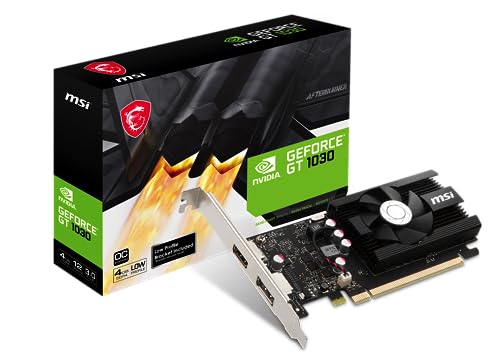
msi Gaming GeForce GT 1030 4GB DDR4 64-bit HDCP Support DirectX 12 DP/HDMI Single Fan OC Graphics Card (GT 1030 4GD4 LP OC)
The MSI Gaming GT 1030 4GB DDR4 stands out among the entry cards with DirectX 12 support and both DisplayPort and HDMI outputs in a single-fan, compact form. It is the most capable of the low-profile options for light gaming, media playback, and modern displays.
- Chipset: NVIDIA GeForce GT 1030
- Video Memory: 4GB DDR4
- Boost Clock: 1430 MHz
- Memory Interface: 64-bit
Key buying factors
Match the card to the job before anything else. Demanding 1440p gaming and content creation call for a modern GPU like the RTX 5070, while web browsing, video playback, or simply driving extra monitors can run perfectly on an entry-level card. Overbuying for a light workload is wasted budget.
Memory capacity determines how high you can push textures and resolution before stuttering. The RTX 5070's 12GB of GDDR7 is generations ahead of the DDR3 or DDR4 found on budget cards. For modern games aim for at least 8GB, but display-only tasks are fine with 1GB to 4GB.
Newer cards use PCIe 5.0 for maximum bandwidth, while older entry models run on PCIe 1.1 or 3.0. Cards are backward compatible with older slots, but pairing a fast card with a slow slot can bottleneck it. Confirm your motherboard slot before buying high-end.
Length and height decide whether a card even fits your case. The ASUS Prime RTX 5070 is SFF-ready for small builds, while the GT 210, GT 610, and GT 1030 ship in low-profile form for slim or office chassis. Always measure clearance first.
High-performance GPUs need dedicated PCIe power cables and a capable supply, whereas low-profile cards often draw all they need from the slot itself. Verify your power supply has the right connectors and headroom. Single-fan and passive cards keep heat and noise low in tight builds.
Check that the card has the connectors your monitors use. The budget cards here offer HDMI and VGA for legacy or office displays, while higher-end cards add DisplayPort for high refresh rates. Count your screens and match the outputs accordingly.
Types explained
Current-generation cards built for high frame rates at 1080p and 1440p with fast GDDR7 memory and PCIe 5.0. They handle ray tracing, upscaling, and creative apps with ease. The RTX 5070 represents this class.
Best for: Gamers and creators who want strong modern performance.Compact, modest-power cards like the RTX 3050 6GB that run esports titles and older games at 1080p without a dedicated power cable in many builds. They balance capability and efficiency. A sensible step up from integrated graphics.
Best for: Casual 1080p gamers and efficient compact builds.Slim cards such as the GT 1030 and GT 610 that fit small or office cases and drive monitors with HDMI and VGA output. They add light acceleration without heavy power draw. Ideal for productivity and media boxes.
Best for: HTPCs, office PCs, and multi-monitor setups.The most minimal tier, like the GT 210, designed simply to provide working video output and dual-display support. Performance is limited, but they revive systems lacking onboard graphics. Quiet and undemanding on power.
Best for: Reviving older PCs or adding basic display output.Care & usage tips
Press the card firmly into the PCIe slot until the retention clip clicks, then attach any required PCIe power cables completely. A partially seated card or missing power connector causes no display or crashes under load. Secure the bracket screw before powering on.
Download the latest driver directly from NVIDIA for your specific model after a fresh install. For older cards like the GT 210 or GT 610, use the legacy driver branch that still supports them. Clean installs prevent conflicts and stutter.
Dust buildup on fans and heatsinks raises temperatures and throttles performance over time. Blow out the card and case airflow paths every few months with compressed air. For single-fan and low-profile cards, ensure case ventilation is not blocked.
The biggest mistake buyers make is judging a card by its GPU name alone while ignoring the memory bus and type. A "GT 1030 DDR4 64-bit" performs noticeably differently from a GDDR5 version of the same name, and a narrow 64-bit bus limits even capable chips. Always read the full memory spec, not just the model number.
Before buying, measure your case's maximum card length and slot height with a ruler, then compare against the card's listed dimensions, because a low-profile bracket and short PCB are what make budget cards fit slim builds that a full-size GPU never could.
Frequently asked questions
Which graphics card is best for modern gaming?+
Among these, the ASUS Prime RTX 5070 with 12GB of GDDR7 and PCIe 5.0 is clearly the strongest choice for current games at 1080p and 1440p. The RTX 3050 6GB is a reasonable entry option for lighter 1080p gaming, while the GT-series cards are not designed for modern titles.
Do I need a dedicated graphics card if I just use multiple monitors?+
If your CPU lacks integrated graphics or you need more outputs, a low-profile card like the GT 1030, GT 610, or GT 210 provides reliable multi-monitor support with HDMI and VGA. These draw little power and fit small cases, making them ideal for office and display-focused builds.
Will a low-profile card fit my computer?+
Low-profile cards such as the GT 210, GT 610, and GT 1030 are made for slim and small-form-factor cases and usually include a short bracket. Measure your case's clearance and confirm the included bracket matches your chassis before installing.
What does the PCIe generation mean for performance?+
PCIe generation sets the bandwidth between the card and motherboard, with PCIe 5.0 on the RTX 5070 offering the most headroom and older cards using PCIe 1.1 or 3.0. Cards remain backward compatible, but pairing a powerful card with a much older slot can limit it slightly.
Is more VRAM always better?+
More VRAM helps with higher resolutions, large textures, and creative work, which is why the RTX 5070's 12GB matters for gaming. For display-only or basic tasks, however, the 1GB to 4GB on budget cards is plenty, and you would gain nothing from paying for more capacity than your workload uses.