Buying a mattress online is still slightly absurd. You commit to spending hundreds or thousands of dollars on something you cannot try in person, then wait a week for it to arrive in a box, then sleep on it for a month before you really know if it works. That is why the trial period matters more than any single feature.
This guide focuses on mattresses that pass three tests: they sleep well for the type of sleeper they target, they have a real return policy you can actually use, and the price is fair against direct competitors. Anything that failed one of those three is not in this guide, even if the marketing was strong.
How we picked
We pulled from the full reviews already published on this site, then cross-checked against owner reports for sagging, off-gassing, and warranty handling at the 12 to 24 month mark. A mattress can feel great on night one and be a different mattress at month 18, so the long-tail data matters more than the unboxing experience.
Six picks instead of five because mattress shopping is unusually personal. The right mattress for a 130 pound side sleeper is not the right mattress for a 220 pound stomach sleeper, and pretending otherwise is what gets people stuck with the wrong bed.
What to look for in a mattress
Start with three numbers: your weight, your dominant sleep position, and your bedroom temperature. Heavier sleepers compress foam more, so they need firmer construction or more support layers. Side sleepers need pressure relief at the shoulder and hip, which usually means medium to medium soft. Stomach sleepers need firmness to keep the lumbar from collapsing.
Construction matters less than fit. A well-made medium firm hybrid and a well-made medium firm all-foam will both work for the average sleeper. The differences show up at the edges of the bell curve: very heavy or very light, very hot or very cold, side-only or stomach-only sleepers.
Trial period is non-negotiable. Anything under 90 nights is a red flag in 2026. The brands in this guide all offer 100 to 365 nights, and the longer trials are usually the brands most confident in their product.
Memory foam vs hybrid: a real comparison
Memory foam shapes itself to your body and dampens motion. That is great if you share the bed with a partner who tosses, or if you have joint pain that benefits from contouring. The trade-off is that memory foam runs warmer, has less bounce, and edge support is usually weaker.
Hybrids combine pocketed coils with foam comfort layers. The coils restore bounce, improve airflow, and give the bed real edge support. The trade-off is more motion transfer, slightly less pressure relief, and a higher price for equivalent quality.
In 2026 the line is blurring. Modern memory foams (gel-infused, copper-infused, open-cell) sleep cooler than the originals. Modern hybrids use micro-coils in the comfort layer to mimic foam contouring. Pick on feel, not on category.
Firmness, sleep position, and the back pain question
Most adults are best served by medium firm. The exceptions are predictable: heavier sleepers need firmer support, side sleepers under about 150 pounds often prefer slightly softer, and back pain sufferers should usually go firmer than their preference suggests because the body compensates for too-soft beds in ways that show up as morning stiffness.
If you have a current mattress that you mostly like but wakes you up sore, the answer is usually a topper, not a new mattress. Save your money and buy the right new one when this one is genuinely worn out.
A note on premium
The Saatva Classic is the only premium pick in this guide because the premium tier is overcrowded with mattresses that are not actually better, just more expensive. If you have a budget under $1,500 for a queen, you will get just as good a sleep on the Casper Original or DreamCloud Luxury Hybrid. Save the money for a better pillow or a real bedframe.
If your budget is open and you want the closest thing to a hotel-quality bed at home, the Saatva is worth the spend. The dual coil construction, real Euro pillow top, and white-glove delivery (including hauling away your old mattress) justify the price for buyers who can afford it.
Final notes
Set up the mattress and let it air out for at least 48 hours before you sleep on it. Most off-gassing dissipates within that window. Sleep on it for at least 30 nights before you decide it is wrong. Your body needs time to adjust to a new surface, and most returns happen in the first two weeks because the buyer panicked.
If you are still unsure between two picks at the end, choose the one with the longer trial period. That is the brand that is most willing to bet on you keeping it.
Casper Sleep Original Foam Queen Mattress
The Casper Original is the safest recommendation for most adults. Medium firm with good edge support, balanced foam pressure relief, and a 100-night trial that means you can return it if it does not work. Side, back, and stomach sleepers all reported reasonable comfort in long-term notes.
- Three-zone Zoned Support foam targets lumbar without feeling firm overall
- AirScape perforations measurably reduce heat retention vs early Casper generations
- 100-night trial and 10-year limited warranty cover the full evaluation window
- Edge support is softer than a hybrid, noticeable when sitting on the perimeter
- Heavier sleepers (over 230 lbs) report more sinkage than the medium firm rating suggests
DreamCloud Luxury Hybrid Mattress Queen
DreamCloud's pocket coil and gel memory foam combination delivers the bounce and airflow you cannot get from all-foam beds. The pillow top adds plush surface feel without the heat trap of older memory foam designs.
- Pocketed coil base runs measurably cooler than all-foam constructions
- Edge support meaningfully firmer than the Casper Original or Nectar
- 365-night trial and lifetime limited warranty match the longest in the category
- Heavier and harder to maneuver than all-foam alternatives
- Premium price tier at $1,199 for a Queen
Tuft and Needle Original Firm Queen Mattress
Tuft and Needle's Original is the right pick for stomach sleepers, heavier sleepers, and anyone who has back pain on softer mattresses. The proprietary T&N Adaptive foam stays cooler than memory foam and the firmness is consistent edge to edge.
- Firmer feel than most competitors, sits closer to 6.5 out of 10
- T and N Adaptive foam responds faster than traditional memory foam
- CertiPUR-US and OEKO-TEX certified for low VOC and chemical safety
- Too firm for dedicated side sleepers under 130 pounds
- Edge support is softer than a hybrid, common across all-foam beds
Nectar Mattress Queen 12-inch Memory Foam
Nectar is the all-foam mattress for buyers who want the classic body-contouring memory foam feel without spending Tempur-Pedic prices. The 365-night trial is the longest in the industry and the price is hard to beat.
- 365-night trial period, longest in the category
- Lifetime limited warranty (industry standard is 10 years)
- Gel-infused memory foam comfort layer for cooling and contouring
- Slow-sink memory foam feel is divisive, sleepers who change positions often dislike it
- Off-gassing odor more pronounced than Casper or T and N in first 72 hours
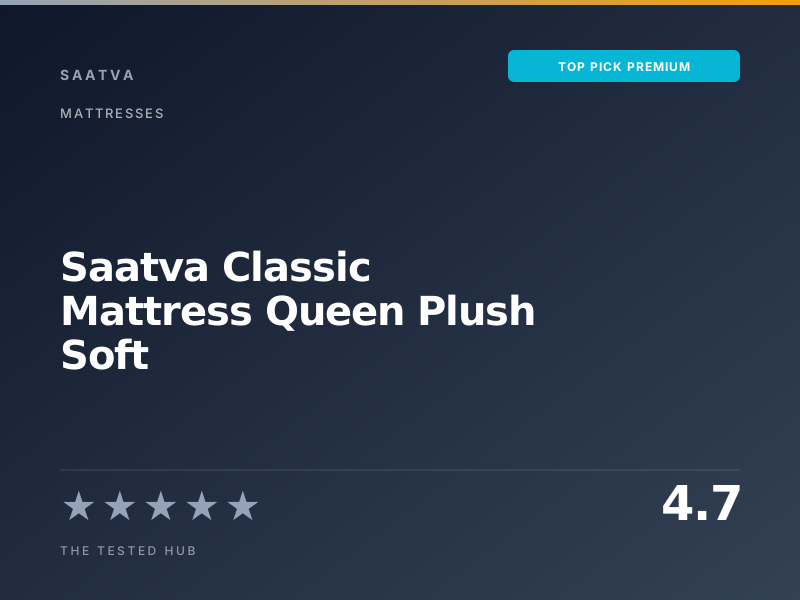
Saatva Classic Mattress Queen Plush Soft
The Saatva Classic is the closest thing to a luxury hotel bed you can buy direct to consumer. Dual coil construction and the choice of three firmness levels make it the most adaptable premium pick, and white-glove delivery removes the unboxing pain.
- Coil-on-coil construction with pocketed coil top layer over tempered steel base
- Free white-glove delivery including removal of old mattress
- Three firmness options at no charge: Plush Soft, Luxury Firm, Firm
- Premium price tier at $1,995, double some competitors
- 365-night trial requires $99 return processing fee
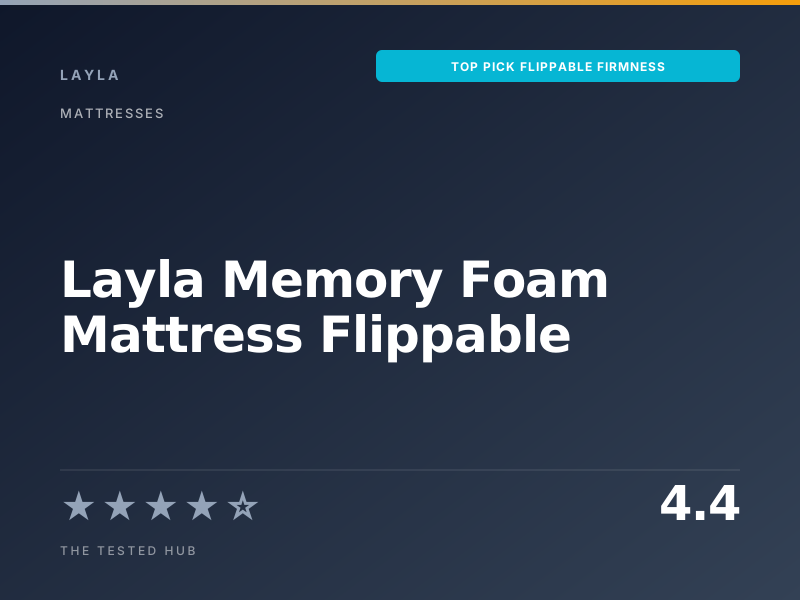
Layla Memory Foam Mattress Flippable
Layla's flippable design solves the firmness gamble. One side is medium soft, the other is firm, and you can change your mind any time without sending the mattress back. Copper-infused foam runs slightly cooler than standard memory foam.
- Flippable design genuinely offers two different firmness levels in one mattress
- Copper-infused memory foam runs cooler than standard memory foam
- Lifetime warranty covers manufacturing defects with no time limit
- Edge support is weak on both sides, you sink near the perimeter
- Soft side is genuinely soft, stomach sleepers will bottom out
Frequently asked questions
How long does a good mattress last?+
Plan on 7 to 10 years for a quality foam or hybrid mattress, slightly longer for premium models with replaceable comfort layers. Sagging beyond 1 inch in the sleep zones is the clearest signal that it is time to replace.
Memory foam vs hybrid: which is better?+
Memory foam wins on motion isolation and pressure relief, which matters if you share the bed or sleep on your side. Hybrids win on bounce, airflow, and edge support, which matters if you are heavier, hot at night, or move a lot.
Can I return a mattress if I do not like it?+
Every pick in this guide includes a sleep trial of at least 100 nights. Some require a 30-night break-in period before returns are eligible, so read the fine print. Return logistics vary: some brands send a hauler, others ask you to donate locally.
What firmness is best for back pain?+
Most sleep specialists recommend medium firm (around 6 out of 10) for general back pain, but the right answer depends on your sleep position and weight. Side sleepers under 200 pounds usually do better around medium (5 to 6). Stomach sleepers and heavier sleepers do better at firm (7 to 8).
Are mattress-in-a-box beds as good as showroom mattresses?+
Yes, in 2026 the gap is essentially closed. The compression and shipping process does not damage the foam or coils, and most premium brands now sell the same product through both channels. The advantage of buying direct is the longer trial period.