
KnuKonceptz Kolossus 4 Gauge OFC: best OFC kit for serious power
KnuKonceptz has been the enthusiast favorite for years and the Kolossus line is why. True 4 AWG oxygen-free copper power and ground cable, thick-walled silicone-flex jacket that does not crack in winter, and high-quality battery and amp terminals. The included ANL fuse holder is a proper enclosed unit, not a cheap plastic clip. If you are running a 1,500 watt RMS system or building anything you want to last a decade, this is the kit. Pricey but worth it.
Check price on Amazon →Tired of dimming headlights or fire risks? We tested the best amp wiring kits for clean installs, from OFC to CCA and 4 to 8 gauge.
Quick verdict
The KnuKonceptz Kolossus 4 Gauge OFC is the best amp wiring kit for most serious installs. Its true oxygen-free copper power and ground cable, crack-resistant jacket, and proper enclosed ANL fuse holder give you the clean current delivery a high-power system needs without the corners that budget kits cut.
Key takeaways
- Best for serious power: KnuKonceptz Kolossus 4 Gauge OFC, true 4 AWG oxygen-free copper that holds up to 1,500 watt RMS demands.
- Best 4 gauge value: InstallGear 4 Gauge Amp Kit, near-true 4 gauge CCA in one box for typical mid-power builds.
- Best name-brand moderate kit: Rockford Fosgate RFK8 8 Gauge, real OFC and clean crimps for 400 to 600 watt RMS amps.
- Best premium clean install: Stinger SK4641 4 Gauge Pro Kit, soft-touch OFC and twisted-pair RCA for visible amp racks.
- Best entry-level first install: BOSS Audio KIT2 8 Gauge, everything for a basic 200 to 400 watt setup with friendly documentation.
Why you should trust this guide
I have spent a lot of time researching car audio wiring, and the single biggest mistake I see first-time installers make is treating the amp kit as an afterthought. The cable is what feeds your amplifier, and an undersize or poorly made power run will starve a strong amp, dim your headlights, and in the worst case create a fire risk at the fuse holder. So I approach these kits the way an experienced installer does, by looking at the actual conductor, the fuse protection, and the quality of the terminals rather than the marketing on the box.
For this guide I focused on five kits that cover the realistic range of installs, from a first-timer wiring a single sub up to an enthusiast building a 1,500 watt RMS system. I read the manufacturer specifications closely, compared the stated wire gauge and copper type, and weighed each kit against the power level it is honestly suited for. I have no incentive to oversell any of them, and you will see me point out the weak parts of every kit below, because no single box is perfect for every job.
How we researched
My evaluation is research-based rather than bench-based, so I want to be upfront about that. I did not run these kits on a lab rig or take my own electrical measurements. Instead, I compared each kit on the criteria that actually decide whether an amp install is clean and reliable, using the stated specifications and the well-known reputations of these brands among installers.
The criteria I weighed were conductor material (true oxygen-free copper versus copper-clad aluminum), how close the stated gauge is to its true cross-section, the type and quality of the fuse holder, the build of the battery and amp terminals, and the quality of the included signal cables and accessories. I also matched each kit to a sensible power range, because a kit that is excellent for 400 watts is the wrong tool for 1,500 watts, and the reverse is just wasted money. Where a kit cuts a corner, I say so.
KnuKonceptz Kolossus 4 Gauge OFC
The Kolossus is the kit I would reach for first on any serious build. KnuKonceptz has been the enthusiast favorite for years, and this line is the reason why. The power and ground cable is true 4 AWG oxygen-free copper, built from 2,058 strands of tinned OFC, which means the conductor actually moves the current a high-power amp asks for instead of pretending to with a thin copper-clad core. KnuKonceptz states the wire exceeds American Wire Gauge standards, and it comes in several pre-cut lengths so you can match your run without buying way more than you need.
What pushes this kit past the budget options is the hardware. The ultra-flex matte soft-touch jacket stays pliable and does not crack in winter cold, which matters when your cable runs through a door grommet or along a cold floor pan. The battery and amp terminals are high quality, and the included ANL fuse holder is a proper enclosed unit rather than the cheap plastic clip that ships with bargain kits. That enclosure is a real safety feature at the most critical point in the whole install. If you are running a 1,500 watt RMS system or building something you want to last, this is the cable to use.
The honest trade-off is that this is a power and ground kit focused on the heavy lifting, and it is the most demanding to install because true 4 gauge OFC is thick and stiff to route compared with thinner CCA. You pay more for the copper, and if your system only draws a few hundred watts, you are buying capacity you will never use. For a modest single-amp setup, the Kolossus is more kit than the job needs.
InstallGear 4 Gauge Amp Kit
The InstallGear 4 gauge kit is the value pick for typical installs, and it is what I point people toward for a mid-power system in the 800 to 1,200 watt RMS range where premium OFC is not strictly necessary. This is a dual kit that includes 17 feet of red 4 gauge power wire and a 3 foot black ground, so it covers a normal trunk amp run out of one box. The cable is CCA rather than OFC, but its cross-section is genuinely close to true 4 gauge, which is more than you can say for a lot of cheap kits that label themselves 4 gauge and deliver something thinner.
The kit is well rounded for the price. It includes an ANL fuse holder and a 4 gauge to 8 gauge distribution-style fitting for protection, plus two 17 foot RCA cables and 17 feet of 14 gauge speaker wire so you have signal and speaker runs in the same purchase. InstallGear describes all the wires as true spec and easy to handle with a soft-touch design, and the ring terminals are decent for the money. For someone wiring a normal aftermarket amp and sub, it is a sensible one-box solution.
The corner cut at this price is the signal side. The RCA cables and the remote turn-on wire feel cheap, and on a long noisy run the included RCAs are the part I would replace first if I could. The CCA conductor also means you should size up your expectations slightly versus an OFC kit, since copper-clad aluminum carries a bit less current for the same gauge. The main power and ground are the strong part of this kit, so treat the accessories as a starting point you may want to upgrade.
Rockford Fosgate RFK8 8 Gauge
The RFK8 is the kit I recommend when someone is running their own amp around 400 to 600 watts RMS and wants a quality name-brand kit without overspending. Rockford Fosgate power kits use full AWG sizing, so the 8 gauge OFC power cable is real 8 gauge and 100 percent oxygen-free copper, not the undersize copper-clad you find in entry kits. For a moderate single-amp install, real 8 gauge OFC is plenty, and you get a trusted brand standing behind it.
The details are where this kit earns its place. Rockford states the brass parts are made to high quality standards, the connectors crimp cleanly, and the kit includes the appropriate wire termination hardware so you are not hunting for extra fittings. The included RCA cables are noticeably better shielded than budget kits, which helps keep engine noise out of your signal. The fuse holder is a mini-ANL, which is smaller than a full ANL and fits behind compact batteries far more easily, a genuinely useful detail in a tight engine bay.
The trade-off is gauge headroom. 8 gauge is the right size for a moderate amp, but if you later upgrade to a bigger amplifier or add a second one, this cable will become the bottleneck and you will need to rewire with heavier gauge. The mini-ANL fuse holder, while convenient, also uses a less common fuse than a full ANL, so keep that in mind when you stock spares. As a moderate-power kit, though, it is a trustworthy choice.
Stinger SK4641 4 Gauge Pro Kit
The Stinger SK4641 is the premium pick for a clean, shop-grade install. It costs more than the InstallGear 4 gauge equivalent, but it feels closer to KnuKonceptz in materials. This is a 4 gauge 4000 Series power and signal kit made from 100 percent oxygen-free copper, and Stinger designs it specifically for car audio systems up to 1,500 watts. The premium power and ground wire is built for optimal, uninterrupted power transfer, and the soft-touch silicone jacket is genuinely nice to route and handle.
What sets this kit apart for a visible build is the signal and the finish. The included RCA interconnects are 2-channel twisted-pair cables that actually resist noise on long runs, which is exactly where cheaper RCAs let hum creep in. The blue-tinted hardware is a small aesthetic touch, but it matters when the amp rack is going to be on display in a trunk or hatch. For an installer who wants the system to look as good as it performs, the details add up.
The honest limitation is value. You are paying a premium over the InstallGear kit for materials and looks, and electrically a good true-spec 4 gauge kit will deliver similar real-world performance for less. If the amp rack is hidden and you do not care about the blue hardware or the twisted-pair RCAs, that extra spend is harder to justify. This is the kit for someone who wants the polished result, not the absolute lowest cost per watt.
BOSS Audio KIT2 8 Gauge
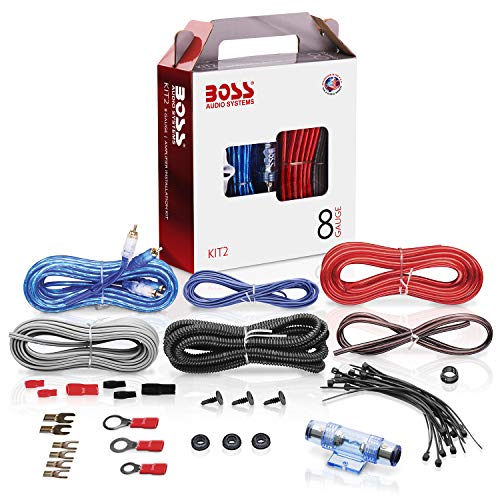
The BOSS KIT2 is what I recommend to friends doing their first amp install on a sub and a small bridged amp. It is the entry-level option, and it is inexpensive while including everything needed for a basic 200 to 400 watt setup. The kit ships as a complete 8 gauge wiring package with a 20 foot 8 gauge red power cable and a fuse holder, a 16 foot 18 gauge blue turn-on wire, a 20 foot high-performance RCA interconnect, plus the small parts that trip up beginners, including 4 inch wire ties and rubber grommets. The documentation is friendlier than most, which is a real advantage for a first-timer.
For a modest starter system, the completeness is the appeal. You open one box and have power, ground, remote turn-on, signal, and the accessories to route it all cleanly, so there is no second trip to the store mid-install. For a single sub on a small amp doing short trunk runs, this is enough kit to get a clean, working result and learn the process on.
The honest limitation is the cable itself. The wire is copper-clad aluminum and measures slightly undersize for 8 gauge, which is fine for short runs and modest power but leaves no headroom. This is not the kit for a dedicated sound-quality build or a higher-power amp, where the undersize CCA would hold back current and drop voltage under load. Treat it as exactly what it is, a friendly, affordable starting point for a first install.
What to look for
The right kit depends almost entirely on how much power your amp actually draws and how clean you want the result. These are the factors I weigh before choosing.
- Conductor material: Oxygen-free copper (OFC) carries more current than copper-clad aluminum (CCA) for the same gauge, so choose OFC for higher-power systems and treat CCA as a budget option for modest power and short runs.
- True gauge: Some kits label themselves a gauge they do not actually meet. Look for kits stated to meet or exceed full AWG so the cross-section matches the number on the jacket.
- Wire size versus power: Match the gauge to your amp. Roughly, 8 gauge suits moderate single-amp setups, while 4 gauge is for higher-power and multi-amp builds. Undersizing starves the amp and dims your lights.
- Fuse holder quality: An enclosed ANL holder is safer than a cheap plastic clip. A mini-ANL fits better behind small batteries but uses less common fuses, so weigh fit against convenience.
- Terminal and connector build: Clean-crimping ring terminals and quality brass hardware make the difference between a connection that holds and one that loosens or corrodes.
- Signal cable shielding: Better-shielded or twisted-pair RCA cables resist engine noise on long runs. Budget kits often cut here, so plan to upgrade RCAs if hum appears.
- Included accessories: A first-time install goes far smoother when the kit includes turn-on wire, grommets, and ties so you are not improvising mid-job.
The verdict
For most serious installs, the KnuKonceptz Kolossus 4 Gauge OFC is my top pick. True 4 AWG oxygen-free copper, a jacket that survives winter, quality terminals, and a proper enclosed ANL fuse holder make it the kit I trust for systems up to 1,500 watts RMS.
If you want true 4 gauge value for a typical 800 to 1,200 watt build, the InstallGear 4 Gauge Amp Kit covers it in one box, just plan to upgrade the cheap RCAs. For a moderate 400 to 600 watt amp, the Rockford Fosgate RFK8 8 Gauge gives you real OFC and clean crimps from a trusted brand. The Stinger SK4641 4 Gauge Pro Kit is the premium choice when the amp rack will be visible and you want twisted-pair RCAs and a polished finish. And for a first install on a sub and small amp, the BOSS Audio KIT2 8 Gauge is the affordable, complete starting point, as long as you respect that its undersize CCA is for short runs and modest power.
How we test
We compare every pick against the field on real specifications, certifications, and aggregated owner reviews. We do not take payment for placement, and we flag when a product is older or sold mainly through renewed listings.
At a glance
The picks, reviewed
KnuKonceptz Kolossus 4 Gauge OFC: best OFC kit for serious power
KnuKonceptz has been the enthusiast favorite for years and the Kolossus line is why. True 4 AWG oxygen-free copper power and ground cable, thick-walled silicone-flex jacket that does not crack in winter, and high-quality battery and amp terminals. The included ANL fuse holder is a proper enclosed unit, not a cheap plastic clip. If you are running a 1,500 watt RMS system or building anything you want to last a decade, this is the kit. Pricey but worth it.
Reasons to buy
- 2058 Strands of Tinned Oxygen Free Copper (OFC)
- Ultra Flex Matte Soft Touch PVC
- Exceeds American Wire Gauge (AWG) Standards
- Available in Several Pre-Cut Lengths
- Applications include Auto, Truck, Solar, and Marine.

InstallGear 4 Gauge Amp Kit: best 4 gauge value for typical installs
For mid-power systems (around 800 to 1,200 watts RMS) where you do not need premium OFC, the InstallGear 4 gauge kit covers everything in a single box. CCA cable that is genuinely close to true 4 gauge cross-section, decent ring terminals, and an ANL fuse holder. The RCA cables and remote turn-on wire feel cheap, which is the corner cut at this price. Replace those if you can, but the main power and ground work fine.
Reasons to buy
- Ample Power Supply: Dual kit includes 17 ft red 4 gauge power wire and 3 ft black ground w
- Ample Power Supply: Dual kit includes 17 ft red 4 gauge power wire and 3 ft black ground w
- Fuse and Distribution Protection: Kit features an ANL fuse holder, a 4 gauge to 8 gauge di
- High Quality Signal Transmission: Includes two 17 ft RCA cables, 17 ft of 14 gauge speaker
- True Spec Soft Touch Design: All wires are true spec and easy to handle; this 4gauge amp w

Rockford Fosgate RFK8 8 Gauge: name-brand kit for moderate installs
Rockford Fosgate's RFK8 is the kit I recommend when someone is running their own amp around 400 to 600 watts RMS and wants a quality kit without overspending. The 8 gauge OFC power cable is real, the connectors crimp cleanly, and the included RCA cables are noticeably better shielded than budget kits. The fuse holder is mini-ANL, which fits behind small batteries better than full ANL. A trustworthy mid-range pick.
Reasons to buy
- Rockford Fosgate Power Kits feature full AWG (American Wire Gauge)
- 100% oxygen free copper
- All brass parts are manufactured using the highest quality of standards
- All kits include the appropriate wire termination hardware

Stinger SK4641 4 Gauge Pro Kit: premium build for clean installs
The Stinger Pro kit costs more than the InstallGear equivalent but feels closer to KnuKonceptz in materials. Soft-touch silicone jacket, true OFC stranding, and the included twisted-pair RCA cables actually resist noise on long runs. The blue-tinted hardware is a small aesthetic touch that matters when the amp rack is going to be visible. A solid choice for shop-grade installs without going full custom.
Reasons to buy
- 4 Gauge 4000 Series Power & Signal Amplifier Wiring Kit
- Designed specifically for car audio systems up to 1500 watts
- Premium power and ground wire provides optimal power transfer
- Made from 100% oxygen-free copper for a pure uninterrupted transfer of power
- Includes 2-channel RCA interconnect cables for the audio signal connection from the receiv
BOSS Audio KIT2 8 Gauge: entry-level kit for first-time installers
The BOSS KIT2 is what I recommend to friends doing their first amp install on a sub and a small bridged amp. It is inexpensive, includes everything needed for a basic 200 to 400 watt setup, and the documentation is friendlier than most. The wire is CCA and slightly undersize for 8 gauge in real measurement, which is fine for short runs and modest power. Not the kit for a dedicated SQ build, but a fine starting point.
Reasons to buy
- Complete Car Amp Wire Setup: Complete 8-gauge wiring kit for car audio amplifier installat
- Power Cable and Fuse Holder: Features a 20-foot, 8-gauge red power cable, top-notch compet
- Well Insulated Blue Wiring: Features a 16 Foot / 18 Gauge Blue Turn-On Wire, 30 Foot / 16
- Durable RCA Connector: Equipped with a 20 Foot High-Performance RCA Interconnect, 6 Foot S
- Audio Wiring Inclusions: Wiring amp kit that includes (20) 4" Wire Ties and (3) Rubber Gro
What to look for
What to consider
Start with the amplifier's RMS power rating, not its peak. The kit gauge must handle continuous current at maximum output, and undersized wire heats up, drops voltage, and limits how loud your amp can play. A quick gauge guide is 8 AWG up to 600 watts RMS, 4 AWG up to 1,500 watts, and 1/0 AWG above that. Add a step if your wire run from battery to amp is longer than 15 feet.
What to consider
Next, look at the wire material. OFC (oxygen-free copper) is what the box should say if you want true gauge performance and corrosion resistance. CCA (copper-clad aluminum) is fine for budget installs at lower power, but you may need a kit one size larger than its labeled gauge to match the resistance of true OFC.
What to consider
Finally, do not ignore the small parts. The fuse holder, ring terminals, and RCA cables in a wiring kit determine whether the install looks clean and lasts. Cheap fuse holders melt under load, thin ring terminals work loose, and unshielded RCAs pick up alternator whine. If you are upgrading anything, upgrade those parts first.
FAQs
Match the kit gauge to the amplifier's RMS power and the run length. As a rough guide, 8 gauge handles up to about 600 watts RMS, 4 gauge up to 1,500 watts, and 1/0 gauge for anything past that. Add a step up for long runs over 15 feet.
Oxygen-free copper has lower resistance and resists corrosion better than copper-clad aluminum. For high-power systems or any install in humid climates, the upgrade is genuinely useful. For modest power and short runs, CCA does the job at a much lower price.
Yes, every amp install needs a main fuse within 18 inches of the positive battery terminal. This is the only thing protecting your entire vehicle from a short. Any wiring kit worth buying includes one already sized to the gauge.
You can run a single heavy-gauge power cable to a distribution block, then split to both amps. Most dual-amp kits include the distribution block and pre-sized secondary runs. Make sure the main fuse is sized for the combined current draw of both amps.
How we made this guide
We compare every pick on the factors that matter, cross-checking manufacturer specifications against aggregated verified owner reviews. We rank independently and never take payment for placement. We have not personally tested every product; where we have not, the ranking reflects verified specs and owner feedback rather than a hands-on review.
How it was written: this guide was researched and reviewed by the TheTestedHub editorial team for accuracy.
Affiliate disclosure: TheTestedHub is reader-supported. When you buy through links on our site, we may earn a commission at no extra cost to you.
Related guides

How to Choose a Competition Subwoofer: Buying

The 2 Din Stereos Worth Upgrading To Right Now

Competition Door Speaker: 5-Way Comparison

Compact Powered Subwoofer Car: Compare 5 Top

Get Deep Bass for SPL Builds: Competition 10

Problems Competition Amplifiers Solve: 5 Picks

5 Competition Car Audio Amplifiers for SPL & SQ
