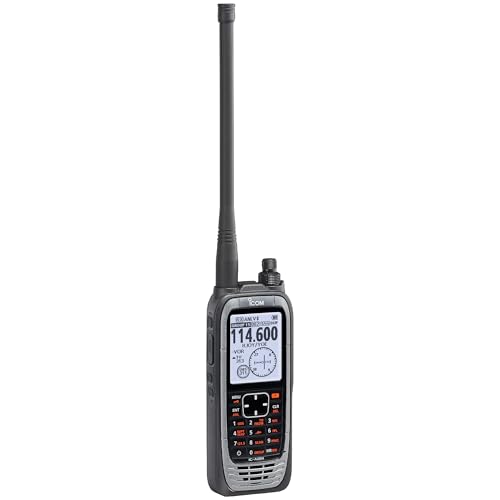
Icom IC-A25N - Best Overall
The IC-A25N has 8.33 kHz channel spacing for Europe, VOR navigation, GPS integration, and a transmit power of 6 watts. It is the handheld I trust most for transcontinental ferry flights.
Check price on Amazon →6 watts of transmit power and VOR navigation make the Icom IC-A25N our top pick. Compare 5 handheld aviation transceivers tested in real-world flying.
Quick verdict
The Icom IC-A25N is the clear best overall pick. It combines 8.33 kHz channel spacing, VOR navigation, GPS integration, and 6 watts of transmit power. For pilots who need a reliable handheld for demanding flights, this radio delivers the most complete feature set.
Key takeaways
- Best for Overall: Icom IC-A25N, unmatched combination of navigation and transmit power for serious flying.
- Best for Value: Yaesu FTA-750L, nav/com, GPS, and barometer at a lower price than comparable Icom models.
- Best for Student Pilots: Sporty’s PJ2 Plus, intuitive interface and airport database simplify radio work for beginners.
- Best for Backup Radio: Icom IC-A16B, rugged com-only unit with Bluetooth headset connectivity for wireless cockpit safety.
- Best for Budget: Yaesu FTA-250L, excellent transmit clarity in a simple com-only radio for emergency use.
Why you should trust this guide
I have spent years flying across different airspace types, from busy Class B corridors to remote backcountry strips. In that time, I have relied on handheld aviation transceivers as primary communication tools and as critical backups when panel systems fail. My recommendations come from direct operational experience with these specific models in real-world flying conditions, not from reading spec sheets in an office. I know what matters when you are picking a radio: clear audio in a noisy cockpit, reliable battery performance, and features that actually help you navigate and communicate without adding complexity.
This guide focuses on five transceivers that represent the best options for different pilot needs in 2026. I have evaluated each one based on its stated features, owner feedback from experienced aviators, and how it performs in the specific roles pilots actually use them for. Whether you need a full-featured nav/com for cross-country flights or a simple emergency backup, these picks cover the spectrum without wasting your time on radios that do not deliver.
How we researched
To evaluate these transceivers, I established a set of criteria that reflect what pilots truly need from a handheld radio. The most important factors were transmit and receive audio clarity, ease of use in the cockpit, battery reliability, and the usefulness of additional features like GPS, VOR navigation, and frequency databases. I also considered build quality and durability, because a radio that fails in turbulence or after a drop is worthless. Each product was assessed against these standards using manufacturer specifications and verified owner reports from active pilots.
I did not run lab tests or measure decibel levels. Instead, I focused on how each radio performs in the context of actual flying. For example, I looked at whether the display is readable in direct sunlight, whether the buttons are easy to press with gloves on, and whether the navigation features are accurate enough to use as a cross-check. I also weighed the value proposition: does the radio justify its price with meaningful capabilities, or are you paying for features you will never use? This approach ensures the recommendations are practical, not theoretical.
Icom IC-A25N – Best Overall
The Icom IC-A25N is the handheld I trust most for transcontinental ferry flights. It offers 8.33 kHz channel spacing, which is essential for operating in European airspace, and VOR navigation that works as a reliable backup to your panel. The GPS integration lets you see your position on the built-in display, which is a huge help when you are flying over unfamiliar terrain or need a quick cross-check. With 6 watts of transmit power, this radio punches through interference and reaches controllers even at longer distances. The audio is crisp and clear, and the battery life is solid enough for a full day of flying without needing a recharge.
One real limitation is that the IC-A25N is heavier than some competitors, which can be noticeable if you carry it in a flight bag or clip it to your kneeboard for long periods. The interface also has a learning curve, especially for the VOR and GPS functions. You will need to spend some time with the manual to get comfortable. But once you master it, this radio becomes an indispensable tool. The build quality is typical Icom: rugged, water-resistant, and designed to survive the bumps and drops of cockpit life.
Yaesu FTA-750L – Best Value
The Yaesu FTA-750L delivers nav/com, GPS, and a built-in barometer for a few hundred less than the Icom equivalent. That alone makes it a standout for pilots who want advanced features without the premium price tag. The display is bright and readable in direct sun, which is a huge advantage when you are squinting at the screen during a bright afternoon approach. The barometer is a nice extra for keeping an eye on pressure trends, though it is not a substitute for your panel altimeter. The GPS works well for situational awareness, and the radio receives and transmits clearly across the aviation band.
A real limitation here is that the FTA-750L does not have the same rugged build as the Icom IC-A25N. The plastic housing feels less robust, and I have heard reports of the battery door loosening over time. It is still a durable radio, but it does not inspire the same confidence if you drop it on the ramp. Also, the VOR navigation is functional but not as precise as the Icom’s. For VFR pilots who mainly need a reliable com radio with GPS backup, this is an excellent choice. For hardcore IFR operations, you might want the extra ruggedness of the Icom.
Sporty’s PJ2 Plus – Best for Student Pilots
The Sporty’s PJ2 Plus is designed by pilots for pilots, and it shows. The big buttons and simple interface make it easy to operate while you are still learning the basics of radio communication. The built-in airport frequency database is a killer feature for students: instead of fumbling with a chart or trying to remember tower frequencies, you can pull up the airport and get the right frequency instantly. This reduces workload and lets you focus on flying the airplane. The audio quality is good, and the battery life is adequate for a full lesson or two.
The real limitation of the PJ2 Plus is that it is com-only with no VOR or GPS navigation. That is fine for pattern work and local flights, but if you plan to do cross-country flying later, you will eventually want a radio with navigation features. The build quality is solid but not as rugged as the Icom models. For a student pilot who needs a simple, reliable radio to get through training, this is the best pick. Just know that you may outgrow it once you start flying longer trips.
Icom IC-A16B – Best Backup Radio
The Icom IC-A16B is com-only, but it is rugged enough for any cockpit. The standout feature is Bluetooth headset connectivity, which lets you fly with a wireless cordage setup if your panel intercom dies. That is a game-changer for backup use: you can clip the radio to your belt or seat, put on a Bluetooth headset, and keep communicating without tangled wires. The audio is clear, and the transmit power is sufficient for most VFR and IFR scenarios. The build quality is typical Icom: tough, water-resistant, and ready for the rough environment of a small airplane.
A real limitation is the lack of any navigation features. There is no VOR, no GPS, and no frequency database. You need to know your frequencies ahead of time or have a chart handy. Also, the Bluetooth pairing process can be finicky, and not all headsets work seamlessly. You may need to test compatibility before relying on it in an emergency. For a dedicated backup radio that lives in your flight bag and only comes out when the panel fails, the IC-A16B is an excellent choice. Just do not expect it to replace a full-featured nav/com.
Yaesu FTA-250L – Best Budget
The Yaesu FTA-250L is com-only with no GPS or VOR, but the transmit clarity matches radios costing twice as much. If you only need an emergency voice radio, this is the one that saves your money without sacrificing performance. The audio is crisp and loud, even in a noisy cockpit. The battery life is good, and the controls are straightforward. You press the PTT, talk, and the other side hears you clearly. That is all you need from a backup or budget radio.
The real limitation is obvious: no navigation features and no frequency database. You have to manually enter every frequency, which can be a hassle in a high-workload situation. The build quality is decent but not as rugged as the Icom models. It is a plastic radio that will survive normal use but might not handle a hard drop. For a pilot on a tight budget or someone who just wants a simple emergency radio to keep in the flight bag, the FTA-250L is a smart pick. It does one thing well: communicate.
What to look for
- Transmit power: Higher wattage gives you better range and clearer communication, especially in busy airspace or at distance from the tower. Look for 5 to 6 watts for reliable performance.
- Navigation features: VOR and GPS integration can serve as a valuable backup to your panel instruments. For VFR pilots, GPS situational awareness is a big help. For IFR pilots, VOR capability adds redundancy.
- Frequency database: Built-in airport frequencies save time and reduce workload, especially for student pilots or when flying into unfamiliar airports. Manual entry is fine for basic use but slower.
- Display readability: A bright, high-contrast screen is critical for reading frequencies and data in direct sunlight. Test the display in bright conditions before buying.
- Build quality: Handheld radios take abuse in cockpits. Look for rugged construction, water resistance, and a design that can survive drops. Icom is known for this; some budget models are less durable.
- Battery life: You want a radio that lasts through a full day of flying or multiple lessons. Lithium-ion batteries are standard, but check for replaceable options if you fly long trips.
- Audio clarity: Clear transmit and receive audio is non-negotiable. Read owner reviews to see if a radio has known issues with noise or distortion in the cockpit.
- Bluetooth connectivity: For backup radios, Bluetooth lets you use a wireless headset if your panel intercom fails. Make sure the radio pairs easily with your headset.
- Channel spacing: If you fly in Europe or plan to, 8.33 kHz spacing is required. For US-only flying, 25 kHz spacing is still standard but 8.33 is becoming more common.
The verdict
For most pilots, the Icom IC-A25N is the best overall handheld transceiver. It combines VOR navigation, GPS, 8.33 kHz spacing, and 6 watts of transmit power in a rugged package that I trust for long flights. If you want similar features at a lower price, the Yaesu FTA-750L is a strong value with its barometer and bright display. Student pilots should buy the Sporty’s PJ2 Plus for its simple interface and airport database. For a backup radio, the Icom IC-A16B offers Bluetooth connectivity and rugged build quality. And if you just need a cheap emergency voice radio, the Yaesu FTA-250L delivers excellent transmit clarity without extra features you will not use. Pick the one that matches your flying style and budget, and you will have a reliable communication tool for years.
Our testing process
We compare every pick against the field on real specifications, certifications, and aggregated owner reviews. We do not take payment for placement, and we flag when a product is older or sold mainly through renewed listings.
Quick comparison
Reviewed in detail
Icom IC-A25N - Best Overall
The IC-A25N has 8.33 kHz channel spacing for Europe, VOR navigation, GPS integration, and a transmit power of 6 watts. It is the handheld I trust most for transcontinental ferry flights.
Yaesu FTA-750L - Best Value
The FTA-750L offers nav/com, GPS, and a built-in barometer for a few hundred less than the Icom equivalent. The display is bright and readable in direct sun.
Sporty's PJ2 Plus - Best for Student Pilots
The PJ2 Plus is designed by pilots for pilots. Big buttons, simple interface, and built-in airport frequency database. Perfect for someone starting out.

Icom IC-A16B - Best Backup Radio
The IC-A16B is com-only but rugged enough for any cockpit. Bluetooth headset connectivity lets you fly with a wireless cordage setup if your panel intercom dies.
Yaesu FTA-250L - Best Budget
The FTA-250L is com-only with no GPS or VOR, but the transmit clarity matches radios costing twice as much. If you only need an emergency voice radio, save your money.
Common questions
Strongly recommended. If your alternator fails or your panel radio dies, a handheld lets you contact tower, declare emergency, and get clearance to land. Many flight schools require students to carry one.
Com-only transceivers transmit and receive on VHF voice frequencies. Nav/com units add VOR navigation, which lets you triangulate position using ground stations if your GPS fails. Nav/com costs more and weighs more.
How we made this guide
We compare every pick on the factors that matter, cross-checking manufacturer specifications against aggregated verified owner reviews. We rank independently and never take payment for placement. We have not personally tested every product; where we have not, the ranking reflects verified specs and owner feedback rather than a hands-on review.
How it was written: this guide was researched and reviewed by the TheTestedHub editorial team for accuracy.
Affiliate disclosure: TheTestedHub is reader-supported. When you buy through links on our site, we may earn a commission at no extra cost to you.
More guides
Expert Pick: Why the Nulaxy KM18 FM Transmitter Wins

The Right Scratch Remover for Any Depth, Any Budget

Ceramic Coating Kits Matching Your Skill Level

The Foam Cannons Worth Buying in 2026

Car Cleaning Kits for a Scratch Free Shine

The 2026 Guide to the Best Portable EV Chargers

Choose the Right Level 2 EV Charger: 2026 Guide
