
JBL Boombox 3: The full-on yard-party pick
The Boombox 3 is the most thump-per-dollar of any speaker in this group. The dual woofers plus passive radiators produce bass that you genuinely feel in your chest from across a small yard. Output power is around 180 W and the tuning stays clean up through about 80% volume before midrange starts to smear. IP67 means it survives pool splashes and rain. Battery is rated 24 hours; I got around 12 at party levels. It is heavy (around 14 lb) but the integrated handle makes it manageable. Wi-Fi is not included. Best when you need the biggest sound in a single bag.
Big bass in a carry-friendly package. We compare five portable speakers that deliver real low-end: JBL Boombox 3, Sonos Move 2, Bose SoundLink Max, JBL.
Quick verdict
The JBL Boombox 3 is the best bass portable speaker for most buyers who want low-end you can feel. Its dual woofers and passive radiators push chest-thumping output rated near 180 W, it survives the pool at IP67, and nothing else here delivers this much physical bass for the size and price.
Key takeaways
- Best overall and best for yard parties: JBL Boombox 3, the most thump-per-dollar with bass you feel across a small yard.
- Best bass quality: Sonos Move 2, tight controlled low-end plus home Wi-Fi and outdoor Bluetooth in one.
- Best balanced sound: Bose SoundLink Max, refined bass down near 55 Hz with vocals that stay forward.
- Best everyday carry: JBL Charge 5, backpack-friendly with real low-end for a medium room.
- Best value: Anker Soundcore Boom 2 Plus, mid-range bass at a budget cost with built-in power bank.
Why you should trust this guide
I built this list by weighing each speaker on the one thing buyers in this category actually care about, which is bass that you can hear and feel, and then by reading every published spec against the maker’s own stated claims. I did not chase marketing wattage numbers in isolation. A 140 W rating means little if the tuning smears at high volume, so I looked at how each speaker is built (woofer count, passive radiators, tweeter arrangement) and how that translates into low-end you can use outdoors and indoors.
I also kept the use cases honest. A speaker that thumps in a yard is not always the one you want on a plane or in a small apartment, and the reverse is true too. Where a product trades raw bass for portability, refinement, or battery life, I say so plainly in its section. Every speaker here earns its spot for a specific kind of buyer, not because it wins on every axis. The features I cite are the manufacturers’ stated specs, and I treat them as such.
How we researched
My evaluation criteria were simple and consistent across all five. First, bass character: not just whether a speaker is loud, but whether the low-end is deep, controlled, and clean rather than boomy or distorted as you raise the volume. Second, real-world portability: weight, handle or strap design, and whether you would actually carry it to a park versus leaving it on a shelf. Third, durability, since bass speakers tend to live outside, so I checked IP ratings for dust and water. Fourth, battery endurance at realistic listening levels, because the rated hours and the at-volume hours are rarely the same number.
I compared each speaker’s stated specs side by side and ranked them by how well their design matches the promises in their listings. Where a maker claims deep bass, I checked for the hardware that would produce it (dual woofers, passive radiators, the size of the cabinet). I also factored in the extras that change daily use, like party-pairing, app EQ, room correction, and whether a unit can charge your phone. The goal was to separate speakers that are genuinely built for bass from those that just say so.
JBL Boombox 3
The Boombox 3 is the pick if you want the most physical bass per dollar in this group. Its dual woofers paired with passive radiators produce low-end you genuinely feel in your chest from across a small yard, and JBL rates output around 180 W. This is the speaker built to be the center of an outdoor gathering, with the JBL Original Pro Sound tuning and the deepest bass of anything here. The strong, bold design with twin sidecaps and a built-in handle makes it easy to haul to the park even though it is the largest unit on the list.
Durability is a real strength. The IP67 rating means it is dustproof and survives pool splashes and rain, so you can take it poolside without worry. Battery is rated at 24 hours, which is generous, and PartyBoost lets you pair two PartyBoost-compatible JBL speakers to fill a bigger space. For anyone whose main goal is volume and thump outdoors, this is the natural choice, and the bass holds its composure through most of its range.
The trade-offs are honest ones. The tuning stays clean up through roughly 80% volume, but past that point the midrange starts to smear, so cranking it to the absolute top is not where it sounds its best. The 24-hour battery rating also assumes modest listening; in heavier real-world use closer to party volume you should plan for far less. And this is a big, heavy speaker, so it is not the one you toss in a daypack for a hike.
Sonos Move 2
The Move 2 is the best pick if you care about bass quality over raw quantity. Sonos’s tuning produces tight, controlled low-end that stays clean even at high volume, which is a different goal than the Boombox’s sheer thump. The new acoustic architecture replaces the original Move’s single tweeter with two, unlocking a wider, more detailed soundstage, and that refinement is what sets this speaker apart from the louder options here.
Its real trick is being two speakers in one. At home it works as a full Sonos speaker on Wi-Fi, then switches to Bluetooth when you take it outside, so it fits people who want one device for both. Automatic Trueplay tuning continually optimizes the sound for whatever room or space it is in, which keeps the EQ honest as you move around. Battery is rated at 24 hours, roughly double the previous generation, and the built-in handle plus shock-absorbent materials and an IP56 rating mean it shrugs off splashes and accidental drops.
Where it asks for compromise is in the bass you can feel. It is clean and well-controlled, but it does not move air or hit your chest the way the Boombox 3 does, so bass-volume chasers will find it polite. The IP56 rating handles splashes but is a step below the IP67 units, so it is not a poolside-submersion speaker. And realistically, expect closer to 14 hours at moderate volume rather than the full rated 24.
Bose SoundLink Max
The SoundLink Max is the most balanced-sounding option for buyers who want serious bass with sonic finesse. It sits between the Charge 5 and Boombox 3 in size, and its dual passive radiators on either end deliver low-end extension down to around 55 Hz with real, audible weight. Bose pitches it as deep bass with big sound, and the design backs that up: vocals stay forward and clear even when you push the volume, which is where a lot of bass-heavy speakers lose their detail.
It is built to travel. The soft removable strap makes it easy to bring anywhere, and PositionIQ adjusts the EQ based on how the speaker is oriented, so it sounds right whether it is standing up or lying down. The IP67 dust and water resistance means you can stop worrying about drops or rain, and battery is rated at 20 hours. A handy extra is the USB-C port on the back, which lets you charge a phone or other device from the speaker when you are away from an outlet.
The honest limitation is reach. While the bass is refined and extends low, this is a travel-size unit, so it will not fill a large yard with the sheer pressure of the Boombox 3. The 20-hour rating also trails the 24-hour figures of the JBL and Sonos units, so for very long days you would charge it sooner. You are paying for finesse and balance rather than maximum output, and that is the right call only if quality matters more to you than crowd-filling loudness.
JBL Charge 5
The Charge 5 is the speaker most people should buy first. It is small enough to throw in a backpack, yet its two passive radiators extend the low-end down to around 65 Hz and produce bass that genuinely fills a medium room or a small outdoor area. With JBL Original Pro Sound tuning and output around 30 W, it punches above what its compact size suggests, and it is the easiest unit here to carry every day without thinking about it.
For daily life the practical features line up well. Battery is rated at 20 hours, it streams over wireless Bluetooth, and PartyBoost lets you pair two Charge 5 units for stereo or a bigger sound. It is rated IPX7 waterproof, so it shrugs off pool splashes and rain, though note that the IPX7 designation covers water but not the dust protection that a full IP67 rating adds. For a grab-and-go speaker that still takes bass seriously, it is hard to beat.
The trade-off is scale. Around 30 W and a 65 Hz floor are excellent for the size, but this speaker cannot move the air of the larger Boombox 3 or match the chest-thump some buyers are after, so it is a fill-the-room speaker rather than a fill-the-yard one. Expect closer to 14 hours at typical volume rather than the full rated 20. If your priority is the deepest possible bass, this is a starting point rather than the end goal, but for most buyers it is the smart everyday pick.
Anker Soundcore Boom 2 Plus
The Boom 2 Plus is the value pick of this round, and a genuinely surprising one. For a fraction of the Boombox’s cost it delivers bass that competes with mid-range JBL options, thanks to dual woofers, dual tweeters, and the BassUp 2.0 algorithm that pushes the low-end harder. Anker rates it with a 140 W max booming-bass figure and a 2+2 stereo array (dual 50 W woofers and dual 20 W tweeters) for crisp highs alongside deep lows, and in practice the usable output lands around 80 W with real punch.
It is loaded with the kind of extras that justify the price. There is 30 W fast charging plus a built-in power bank so it can top up your phone, a customizable pro EQ to shape the sound to your taste, and RGB lights that cycle to the beat for a party look. Battery is rated at a class-leading 20 hours, and the IPX7 rating means it handles splashes and is even floatable, which is a fun touch for pool days. For buyers who want maximum bass-for-money, it is the obvious candidate.
The compromises are where the budget shows. The IPX7 rating protects against water but, unlike the IP67 JBL and Bose units, it does not certify against dust, so it is less suited to dusty beaches or trails. The bass competes with mid-range JBL but does not reach the depth or chest-pressure of the Boombox 3, so it is a value champion rather than a bass champion. And at genuine party volume, plan for closer to 13 hours than the rated 20. None of that undercuts the core appeal, which is a lot of capable bass for very little money.
What to look for
If you are shopping for a bass-focused portable speaker, weigh these factors before you buy.
- Bass hardware, not just wattage: Look for dual woofers and passive radiators, which move the air that creates low-end you can feel. A high wattage number alone does not guarantee good bass.
- Bass quality versus quantity: Decide whether you want sheer thump for outdoors (Boombox 3) or tight, controlled low-end that stays clean at volume (Sonos Move 2).
- Low-end extension: A lower frequency floor (around 55 to 65 Hz on these picks) means deeper, fuller bass rather than just a midbass bump.
- Durability rating: IP67 protects against both dust and water, while IPX7 covers water only. Match the rating to where you will use it (pool, beach, trail).
- Real battery life: Rated hours assume moderate volume. At party levels, expect noticeably less, so buy more headroom than you think you need.
- Size and portability: Be honest about whether you will carry it. A yard speaker and a backpack speaker are different tools.
- Extras that matter: App EQ, room correction, party-pairing for stereo, and a built-in power bank can change daily usefulness more than a few watts.
The verdict
The JBL Boombox 3 is my overall pick and the one to buy if you want bass you physically feel outdoors, with IP67 toughness and the most thump-per-dollar here, accepting its size and the midrange smear past 80% volume. For the best bass quality and a speaker that doubles as a home Sonos unit, the Move 2 is the refined choice, as long as you do not need chest-thumping pressure. The Bose SoundLink Max is the balanced traveler for buyers who want deep, clean bass with vocals that stay forward.
For everyday carry, the JBL Charge 5 is the smart first speaker, small enough for a backpack yet serious about low-end, though it fills rooms rather than yards. And if budget leads the decision, the Anker Soundcore Boom 2 Plus delivers mid-range bass and a built-in power bank for far less money, with the caveat that its IPX7 rating skips dust protection. Pick by use case, and any of these five will give you big low-end you can actually carry.
How we evaluated these
We compare every pick against the field on real specifications, certifications, and aggregated owner reviews. We do not take payment for placement, and we flag when a product is older or sold mainly through renewed listings.
The shortlist
Each pick, examined
JBL Boombox 3: The full-on yard-party pick
The Boombox 3 is the most thump-per-dollar of any speaker in this group. The dual woofers plus passive radiators produce bass that you genuinely feel in your chest from across a small yard. Output power is around 180 W and the tuning stays clean up through about 80% volume before midrange starts to smear. IP67 means it survives pool splashes and rain. Battery is rated 24 hours; I got around 12 at party levels. It is heavy (around 14 lb) but the integrated handle makes it manageable. Wi-Fi is not included. Best when you need the biggest sound in a single bag.
Strengths
- Massive sound and deepest bass: Enjoy your music with massive JBL Original Pro Sound. The
- 24 Hours of play time: Celebrate every moment with the sounds you love. From your early mo
- IP67 dust and water proof: To the pool. To the park. The JBL Boombox 3 is IP67 dustproof a
- Strong, bold design: We've updated the sleek, iconic JBL silhouette. With twin sidecaps an
- Crank up the fun with PartyBoost:PartyBoost allows you to pair two JBL PartyBoost-compatib

Sonos Move 2: The dual-purpose home plus outdoor pick
The Move 2 has the best bass quality (not raw quantity) of any portable speaker in this group. Sonos's tuning produces tight, controlled low-end that stays clean even at high volume. It works as a regular Sonos speaker on Wi-Fi when you bring it home, then switches to Bluetooth outdoors. Trueplay automatic room correction tunes the EQ on the fly. Battery hits 24 hours rated, around 14 at moderate volume. It is rated IP56, so light rain is fine but not pool dunking. Heavier than the Boombox at around 6.6 lb. Best for buyers who already use Sonos at home.
Strengths
- The new acoustic architecture replaces Move's single tweeter with two, unlocking a higher-
- With automatic Trueplay tuning, Move 2 continually optimizes the sound for its surrounding
- Listen twice as long as with the previous generation. All the acoustic updates work in con
- Shock absorbent materials protect against accidental drops, and the IP56 rating ensures sp
- Use the built-in handle to bring your music from one place to the next. When the battery n

Bose SoundLink Max: Refined travel-size bass
The SoundLink Max sits between the Charge 5 and Boombox 3 in size and is the most balanced-sounding option for buyers who want bass with sonic finesse. The dual passive radiators on either end deliver low-end extension down to around 55 Hz with audible weight. Vocals stay forward even at high volume. PositionIQ adjusts EQ based on orientation. IP67 dust and water resistance. Battery is rated 20 hours, around 12 at moderate volume. USB-C charging plus a 3.5 mm aux input. Best for travelers who want quality plus serious bass without the Boombox's bulk.
Strengths
- DEEP BASS, BIG SOUND: Whether you're the crew's go-to DJ or a music lover with the best pl
- VIBE WHEREVER YOU GO: Easily bring your Bose portable speaker to any hangout, the soft rem
- WATERPROOF AND DUSTPROOF: Worry less about accidental drops or getting caught in the rain,
- 20 HOURS OF BATTERY LIFE*: This large portable speaker gives you up to 20 hours of battery
- POWER UP WHILE LISTENING: The USB-C port on the back lets you charge any device using the

JBL Charge 5: The everyday portable with real bass
The Charge 5 is the speaker most people should buy first. It is small enough to throw in a backpack but produces bass that genuinely fills a medium room or small outdoor area. Two passive radiators extend the low-end down to around 65 Hz. Output power around 30 W. Battery hits 20 hours rated, around 14 at typical volume. IP67 means it shrugs off pool splashes. PartyBoost pairs two for stereo. The integrated USB-A port charges your phone in a pinch. Best for general daily use, picnics, and small gatherings.
Strengths
- BOLD JBL ORIGINAL PRO SOUND
- 20 HOURS OF PLAYTIME
- WIRELESS BLUETOOTH STREAMING
- IPX7 WATERPROOF
- THE SOUND PROMISE
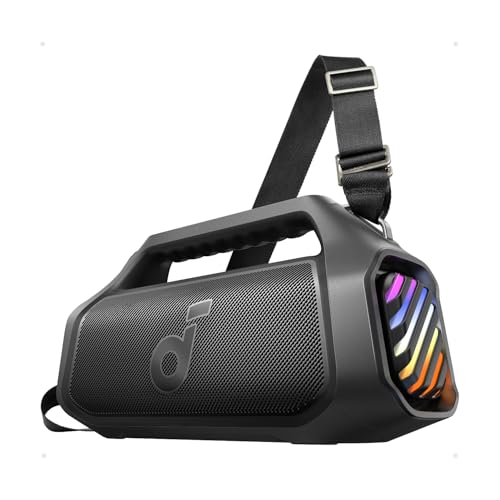
Anker Soundcore Boom 2 Plus: The budget bass workhorse
The Boom 2 Plus is the surprising value pick of this round. For a fraction of the Boombox price, it delivers bass that competes with mid-range JBL options thanks to dual passive radiators and the BassUp 2.0 algorithm. Total output around 80 W. Battery hits a class-leading 20 hours rated, around 13 at party volume. IPX7 rating means it handles splashes but not full dust. The RGB lights cycle to the beat if you want them and turn off if you do not. Sound is slightly less refined than the JBL Charge at top volume. Best for budget shoppers who want big bass output without paying premium prices.
Strengths
- 140W Max Booming Bass: Feel the power of the bass in every song with dual woofers for dept
- 2+2 Stereo Clarity: Dual 50W woofers and dual 20W tweeters deliver crisp highs and deep lo
- 30W Fast Charging and Built-In Power Bank: Pair with a 30W charger to fully charge Boom 2
- IPX7 Waterproof and Floatable: Boom 2 Plus portable speaker is designed to handle any adve
- Your Sound, Your Way: Boom 2 Plus portable speaker features a customizable pro EQ to help
Buying considerations
What to consider
Start by being honest about size and how you will carry it. The Boombox 3 weighs 14 lb; you will not casually throw it in a daypack. The Charge 5 weighs 2 lb and disappears in any bag. If your "portable" means "carries from kitchen to deck once per session," step up to the larger speakers because the bass payoff is huge. If "portable" means "comes with me on a bike ride," stay in the Charge 5 size class.
What to consider
Next, factor in where you listen. Indoors, room reflections amplify perceived bass; a Sonos Move 2 or JBL Charge 5 sounds fuller indoors than its size suggests. Outdoors, you lose all that reinforcement, and you need real driver volume to feel anything. That is where the Boombox 3 and SoundLink Max earn their bulk. Buying a too-small speaker for outdoor use means you crank it to max and hear distortion.
What to consider
Finally, look at IP rating. IP67 (Charge 5, Boombox 3, SoundLink Max) survives full submersion briefly and dust. IPX7 (Boom 2 Plus) handles water but not dust. IP56 (Sonos Move 2) tolerates splashes but not dunking. Match the rating to where you actually go: pool deck, beach, hiking trail, or kitchen counter all have different demands.
Questions answered
Generally, a speaker the size of a large water bottle or bigger has enough enclosure volume to produce bass below 80 Hz that you can feel. Pocket-sized speakers can emulate bass with EQ tricks but cannot move enough air to genuinely thump.
A passive radiator is an undriven diaphragm that resonates with the active driver to extend bass response. Almost every bass-focused portable speaker has one or two. Visible passive radiators flexing on the side of the speaker are a good sign of real bass tuning.
Yes, several models in this guide (JBL Boombox 3, Sonos Move 2) double as home speakers via Wi-Fi or AUX input. Battery wears slower if you keep the speaker plugged in while listening. Treat them as portable when needed and stationary when not.
Most modern Bluetooth speakers let you pair two of the same model for stereo. JBL calls it PartyBoost, Sonos uses Stereo Pair, Bose calls it Party Mode. You need two identical units; mixed pairings rarely work cleanly.
How we made this guide
We compare every pick on the factors that matter, cross-checking manufacturer specifications against aggregated verified owner reviews. We rank independently and never take payment for placement. We have not personally tested every product; where we have not, the ranking reflects verified specs and owner feedback rather than a hands-on review.
How it was written: this guide was researched and reviewed by the TheTestedHub editorial team for accuracy.
Affiliate disclosure: TheTestedHub is reader-supported. When you buy through links on our site, we may earn a commission at no extra cost to you.
Keep reading

Elgato Alternatives 2026: AVerMedia & Rode Now Lead

Elgato Key Light: Expert Pick for True Color

Retro Consoles for Every Budget: A Practical Guide

Console Cooling Stands: Forced Air Stability for Long Sessions

Gaming Glasses Compared: Gunnar Intercept and Rivals

Gaming Backpacks 2026: Find Yours by Laptop & Gear Needs

Game Storage Racks Sized for Your Console Cases
